Last updated: September 2026. A working grower’s walk through the five main routes to market for UK fresh produce in 2026: wholesale markets, supermarket contracts, foodservice and restaurant supply, direct sales (farm shop, roadside stall, farmers’ market), and subscription models (box schemes and CSA). The commission, margin and cost structure of each, the volume thresholds that decide which routes are realistic for a given holding, the cash-flow and risk profile of each channel, and the working blended-supply framework I would write down for any small or medium grower sitting at the kitchen table tonight deciding where the crop goes this season. General information, not regulated business advice. See the route-to-market decision checklist at the end.
The phone rang on a Tuesday evening in early July, three seasons back. Our packhouse buyer, the one who takes the summer iceberg programme, told me the retailer had cut the following week’s order by a third. No reason beyond “forecast adjustment.” That left roughly four tonnes of iceberg, already planted, already growing, already committed in labour and inputs, with nowhere to go on the contract side. By Thursday morning I had rung the salesman at New Covent Garden, spoken to two restaurant wholesalers who supply the London hotel trade, put the word out through the local direct-sales network, and stuck the Class 2 heads on the roadside stall. By the following Wednesday every head had moved, across four different channels, at four different prices, and the holding’s total return on that block was within touching distance of what the full contract would have paid.
That week was not unusual. It was a Tuesday. It is the working reality of UK fresh produce in 2026: the crop does not have one route to market. It has several, and the grower who understands how they differ, what each one costs, and which combination fits the holding is the grower who gets paid when the contract buyer rings on a Tuesday evening with bad news.
This guide is the one I wish someone had handed me twenty years ago. It puts the five main UK fresh-produce routes to market side by side, with the real numbers on margin, commission, capital cost and risk, and ends with a decision framework for choosing the mix. The individual channel guides on this site go deeper into each route. This one ties them together.
A way through this story
The five routes, mapped out
The UK fresh-produce supply chain in 2026 moves product from the field to the consumer through five distinct channels. Each channel has a different buyer, a different price-discovery mechanism, a different cost structure and a different risk profile for the grower.
1. Wholesale markets. The grower consigns produce to a wholesale market business (run by a salesman), which sells it on the market floor to restaurants, greengrocers, caterers and retail buyers. The price is discovered each morning in real time. Commission runs at 10 to 20 per cent of the achieved sale price plus handling charges. Payment terms are typically 14 to 28 days. The system operates across a national network of city markets: New Covent Garden in London, Birmingham, Western International in Southall, Manchester New Smithfield, Glasgow Blochairn, Bristol St Philip’s, and a handful of smaller regionals.[1]
2. Supermarket contracts. The grower supplies a contracted weekly tonnage to a packhouse or marketing group, which grades, packs and delivers into the retailer’s distribution network. Price is set by formula (fixed, index-linked or cost-plus), not by spot rate. Payment terms run 14 to 60 days. The contract requires Red Tractor or equivalent assurance, pesticide-residue compliance, detailed traceability and regular third-party audit. The retailer’s spec line determines what is accepted; rejected produce falls back to the grower.[2]
3. Foodservice and restaurant supply. The grower supplies a foodservice wholesaler or a restaurant group directly. This channel overlaps with the wholesale market system (many foodservice wholesalers buy on the market floor) but also includes direct grower-to-chef relationships, catering contract supply, and the hotel and institutional trade. Pricing sits between wholesale-market spot and supermarket-contract rates. Spec is generally looser than supermarket, and the buyer values consistency and reliability above cosmetic perfection.[3]
4. Direct sales. The grower sells directly to the end consumer through a farm shop, roadside stall, honesty box, vending unit, farmers’ market or online-and-collect model. The grower captures retail margin. Volume is low. Capital and labour costs vary from near-zero (a trestle table at the gate) to six figures (a full farm shop with butchery and cafe). There is no intermediary commission, but the grower carries the marketing, presentation, food-hygiene compliance and customer-service overhead.[4]
5. Box schemes and CSA. The grower runs a subscription direct-sales model: customers pay a weekly or seasonal fee for a box of seasonal produce, delivered or collected. The grower captures retail margin plus a convenience premium. Volume is modest. The operational overhead (packing, logistics, customer management, churn replacement) is the highest per-unit of any channel. Community-Supported Agriculture (CSA) shares the seasonal cropping risk with the subscriber base.[5]
The sixth channel that matters but sits outside this guide is processing and prepared food: supply to a processor, canner, frozen-food manufacturer or prepared-salad business. The economics are different enough (commodity pricing, long contracts, industrial volumes) that it warrants its own treatment.
What each route actually pays: the honest comparison
The numbers below are drawn from our own books, the guides on this site, published Defra data, and what growers I trust have told me across the trade. They are indicative, not precise, because every holding, every crop and every season is different. The point is the shape of the comparison, not the last decimal place.
I will use iceberg lettuce as the through-line because it is what we grow, but the relative positioning holds across most UK salad and field vegetable categories.
Wholesale market. Defra’s fortnightly average of the prices wholesalers charged for home-grown crisp iceberg at the Birmingham, Bristol, Manchester and London markets ran at 71 to 79p a head through June and July 2026, then climbed to between 98p and £1.31 from August into September as the dry summer cut supply. A year earlier, in summer 2025, the same series sat at 54 to 63p. Those are averages; any single morning on the floor can land well above or below them depending on what else has arrived. The salesman’s commission and handling charges take 10 to 20 per cent of the achieved price, so the June and July 2026 averages net the grower roughly 57 to 71p a head. The volatility is the feature, not the bug: the wholesale market is the route that pays best on the right morning and worst on the wrong one, and in a short season it can pay far more than any contract.[1][6]
Supermarket contract. The same iceberg on a summer supermarket programme, supplied through a packhouse, fetches a contracted gate price in the range of 30 to 40p per head after the packhouse margin and charges are stripped out. The price is stable across the season. The spec rejection rate on a well-run programme is 3 to 8 per cent of delivered volume; on a rough week it can hit 15 per cent, and the rejected heads come back to the grower at zero value. The audit, assurance and compliance overhead adds 1 to 3p per head to the grower’s cost base across the season. Net to the grower after all deductions: roughly 27 to 38p per head, with very low volatility.[7]
Foodservice supply. The same iceberg sold to a London restaurant wholesaler (either through the market or direct) fetches 40 to 55p per head at the top end, but the credit risk is higher and the volume commitment is less predictable. The restaurant trade orders for tomorrow, not for next month. A reliable foodservice wholesaler relationship is worth cultivating, but it rarely absorbs enough volume to be the primary route for a serious holding.[3]
Direct sale (roadside stall). The same iceberg at the farm gate sells for 80p to £1 per head. At the June and July 2026 wholesale averages, that is up to about three-quarters more per head than the same lettuce nets through the market; in the short weeks of August and September the market average ran above the stall price. But the stall sells hundreds of heads in a season, not tens of thousands. Wastage at the stall runs 10 to 25 per cent. The labour cost of running the stall clips the headline margin. The net return per head sold is outstanding; the net return per acre of crop grown for the stall alone is not, because the volume is too small to absorb a meaningful share of production.[4]
Box scheme. The same iceberg, packed into a weekly subscription box with six or seven other items and priced at £20 to £28 per box, contributes a wholesale-equivalent value of roughly 50 to 70p per head within the box. After packing labour, delivery cost, platform fees and customer-acquisition cost are deducted, the net contribution per head is comparable to the wholesale market on a good day. The difference is the operational complexity: a 50-box-per-week scheme is 15 to 25 hours of packing and logistics labour per week.[5]
The honest summary: supermarket contracts pay the least per unit but absorb the most volume with the least volatility. Wholesale markets pay more on the right morning but carry price risk. Direct sales pay the most per unit but absorb almost no volume. Box schemes and foodservice sit in the middle on both axes. Summer 2026 showed the trade-off sharply: the contract price held steady while the wholesale average for iceberg climbed from the low 70s to £1.31 a head. No single route is “best.” The question is which combination fits the holding.
Volume thresholds: what is realistic for your holding
The routes to market are not equally available to every grower. Each channel has a volume threshold below which it is not worth the overhead, and a volume ceiling above which it cannot absorb what the holding produces.
Wholesale markets. The minimum viable consignment to a major market is roughly half a pallet (200 to 300 units for most salad and veg categories). Below that, the haulage cost per unit makes the route uneconomic. The maximum is effectively unlimited for a single grower: New Covent Garden alone moves hundreds of thousands of units of salad per week. A grower sending 10 to 50 pallets per week to a major market is a mid-scale supplier; the large grower-shippers send hundreds. The entry cost is a salesman relationship, a logistics arrangement, and produce that meets the market’s grade expectation.[1]
Supermarket contracts. The minimum contracted volume is set by the packhouse and typically requires a committed weekly tonnage across a defined season window. For iceberg lettuce, that means a minimum planting programme of roughly 5 to 10 hectares for a small contract. A serious supermarket programme runs 30 hectares and upwards. Below the minimum, the packhouse will not offer a contract because the intake logistics do not justify the overhead. The capital investment in assurance, audit and compliance is a fixed cost that only makes sense above a certain acreage.[2]
Foodservice. Volume sits between wholesale and direct. A restaurant wholesaler wants reliable weekly supply of the lines the kitchen uses, in the grades the chef accepts. For a salad grower, that might mean 5 to 20 cases per delivery, two or three times a week, to a small number of wholesale customers. The volume is meaningful but not enough to absorb the output of a large holding on its own.
Direct sales. Volume is the constraint. A busy roadside stall in a good location on a busy B road sells a few thousand units across a 16-week summer season. A full farm shop sells more, but the lion’s share of its stock comes off-farm. A farmers’ market stall, trading one day a week, moves a few hundred units per market day. The point of direct sales is margin per unit, not volume.[4]
Box schemes. A 50-subscriber scheme moves roughly the output of half an acre of diverse vegetables per week. A 500-subscriber scheme (a serious regional operation) might absorb the output of 3 to 5 acres. Neither comes close to absorbing the output of a 30-hectare salad holding. Box schemes work as a complement, not a replacement, for the volume routes.[5]
The practical implication: a working UK fresh-produce holding under 10 hectares can realistically supply wholesale markets and direct sales, and may run a box scheme or supply a foodservice wholesaler. A holding over 30 hectares is almost certainly on a supermarket programme as the base load, with wholesale, foodservice and direct sales handling the surplus and the off-spec.
Cash flow and payment terms
Cash flow kills more farm businesses than bad prices. The payment terms of each route matter as much as the headline price.
Wholesale markets. Payment terms of 14 to 28 days from the date of sale. Some salesmen still pay weekly; most established relationships run on a fortnightly or monthly cycle. Sale-or-return consignments carry the risk that the remittance advice comes back at a lower price than the grower expected, or at zero on unsold produce. A firm-price arrangement (agreed up-front, grower paid regardless of what the salesman achieves) is the better position but requires a strong relationship.[6]
Supermarket contracts. Payment terms of 14 to 60 days from the end of the delivery week, depending on the packhouse. GSCOP regulates the retailer-packhouse payment terms but does not directly cover the packhouse-grower terms. In practice, most packhouse-grower contracts settle at 28 to 30 days end-of-month. Deductions for quality rejections, packaging charges and haulage contributions are netted off the remittance. A grower on a 30-day-end-of-month contract who delivers in week one of the month is effectively waiting 7 to 8 weeks for payment.[2]
Foodservice. Payment terms of 14 to 30 days on invoice, but credit risk is higher than on the supermarket or wholesale route. Restaurant businesses fail at a higher rate than retailers, and an unpaid invoice to a restaurant that has gone into administration is money lost. Credit-check the buyer, keep invoices small, and watch the payment pattern.
Direct sales. Payment is immediate: cash, card or bank transfer at the point of sale. This is the single biggest cash-flow advantage of direct sales. The money is in the till the same day the produce leaves the farm. For a holding with tight working capital, that immediacy can be more valuable than the higher margin.[4]
Box schemes. Payment is in advance (weekly subscription) or at the start of the season (CSA share). Cash flow is front-loaded, which is the structural advantage of the model: the grower has the money before the box is packed. The risk sits on the customer-churn side: if subscribers cancel faster than new ones join, the cash flow goes negative on customer-acquisition cost.[5]
The cost stack you do not see on the price ticket
Every route to market carries costs that sit behind the headline price. The grower who compares routes only on the face-value price per unit is comparing the wrong numbers.
Wholesale market costs. Commission (10 to 20 per cent), pallet and packaging to market specification, haulage to the market (60 to 250 miles for most growers), unloading labour if the grower’s driver handles it, and the implicit cost of the salesman relationship (time on the phone, visits to the market, the Christmas bottle of whisky). No assurance or audit overhead beyond basic food-safety registration.[1]
Supermarket contract costs. Packhouse margin and charges (variable, typically embedded in the gate price), Red Tractor or equivalent assurance (Red Tractor Fresh Produce membership costs £72 to £689.50 a year from April 2026, banded by holding size, plus the audit fee charged by the certification body), GLOBALG.A.P. if required (its own certification and audit fees), pesticide-residue testing (passed through or absorbed), traceability systems, field-record-keeping software, and the time cost of the audit itself. The compliance overhead on a small holding can run to £3,000 to £5,000 per year in direct costs, plus 20 to 40 hours of the grower’s own time on paperwork and audit preparation.[8]
Foodservice costs. Haulage or delivery to the wholesaler, credit-risk exposure, and the relationship-management time of a smaller number of higher-value accounts.
Direct-sale costs. Stall or shop fit-out (£500 to £500,000 depending on scale), food-business registration, public-liability insurance (£300 to £800 per year for a stall, more for a shop), signage, EPoS or card reader, and the labour to run the point of sale. The labour cost is the one most growers undercount. A 16-week summer stall takes 80-plus hours of the grower’s time; at £15 to £20 an hour, that is over £1,200 of implicit cost before the first head of lettuce is sold.[4]
Box-scheme costs. Packing shed (fit-out or conversion: £5,000 to £30,000), subscription-management platform (Shopify, Squarespace, bespoke: £30 to £200 per month plus transaction fees of 2 to 6 per cent), delivery vehicle (van lease or ownership: £3,000 to £8,000 per year), packing labour (20 to 30 minutes per box), delivery labour, and customer-acquisition marketing (social media, leaflet drops, local press). The customer-acquisition cost, amortised across the average subscriber tenure, is the hidden killer: £15 to £40 per new subscriber is a common range, and at a 12-month average tenure that is £1 to £4 per box before a single vegetable is packed.[5]
Risk: what goes wrong on each route
Wholesale market risk. Price collapse on an over-supplied morning. A consignment that arrives to find the floor already flooded with the same category from three other growers and an import container that landed overnight. The price drops to clear the floor, and the grower takes the hit. The second risk is the salesman relationship: a dishonest salesman reporting a lower price than was achieved, and pocketing the margin. It happens. The defence is to know the market well enough to spot it, and to have more than one salesman relationship so you can cross-check prices.
Supermarket contract risk. Forecast cut (the retailer reduces the order, the grower has crop in the ground with nowhere to go). Spec rejection (the produce fails quality checks at the packhouse, the grower takes the full loss). Payment-term stretch (the packhouse extends payment terms unilaterally, the grower’s working capital is squeezed). De-listing (the packhouse loses the retailer contract, the grower loses the outlet). The Groceries Code Adjudicator’s annual survey shows these risks declining year on year, with code-issue incidence down to 30 per cent of suppliers in 2025 and average compliance up to 93 per cent, but the risks remain real for individual growers.[9]
Foodservice risk. Customer insolvency. A restaurant closes, the last two invoices go unpaid. The credit risk per customer is higher than on any other route.
Direct-sale risk. Weather (a wet August weekend kills footfall), theft (honesty-box shrinkage, stall theft), food-safety incident (a customer complaint triggers an Environmental Health visit), and the opportunity cost of the grower’s time (every hour on the stall is an hour not spent on the field or the business).
Box-scheme risk. Subscriber churn outpacing new-subscriber acquisition. The scheme shrinks, the fixed costs (van, platform, packing shed) remain, and the per-box economics go negative. The second risk is crop-plan failure: a box scheme demands diverse weekly produce across a long season, and a single crop failure (a bad blight week on the potatoes, a caterpillar hit on the brassicas) leaves a gap in the box that has to be filled from bought-in produce at wholesale prices, compressing the margin.
The blended-supply framework: how to decide the mix
No working UK fresh-produce holding in 2026 should rely on a single route to market. The blended-supply framework I would write on the back of an envelope for any small or medium grower deciding the mix looks like this.
Step one: identify the base-load route. This is the channel that absorbs the largest share of the holding’s production on a predictable basis. For a holding over 15 to 20 hectares, this is almost always a supermarket contract or a wholesale-market relationship. For a holding under 10 hectares, it may be a wholesale-market relationship, a foodservice wholesaler, or (for a very small, diverse holding) a box scheme. The base load should absorb 50 to 70 per cent of the holding’s marketable production in a normal season.
Step two: identify the surplus route. This is the channel that absorbs the crop the base-load buyer does not take. It handles the over-production, the off-spec, the forecast cuts, the seasonal peaks. For most growers, this is the wholesale market. The wholesale market is the buyer of last resort for UK fresh produce, and the grower who does not have a working wholesale-market relationship is the grower who composts the surplus.
Step three: identify the premium route. This is the channel that pays the highest margin per unit on a small volume. Direct sales (stall, farm shop, farmers’ market) and box schemes sit here. The premium route should absorb 5 to 20 per cent of the holding’s production and should be fed with the best-looking produce: the Class 1 cosmetic grade that the consumer pays extra for.
Step four: stress-test the mix. Ask three questions. First: if the base-load buyer cuts the order by a third next Tuesday, where does the crop go? (If the answer is “nowhere,” the holding is too dependent on one route.) Second: if the premium route doubles in demand next summer, can the holding supply it without compromising the base-load contract? (If the answer is “no,” keep the premium route at its current size: growing it would start eating into the base load.) Third: if haulage costs rise by 20 per cent, which route becomes uneconomic first? (The answer tells you which route is the most fragile.)
Step five: review annually. The mix should shift as the holding’s acreage, crop plan, customer relationships and local market conditions change. A route that was marginal three years ago may have become the best-paying channel after a competitor exited or a new salesman arrived at the market. A route that was dominant five years ago may be squeezing margins to the point where switching the base load makes commercial sense.
The Defra supply-chain review: what is coming
Defra’s review of contractual relationships in the UK fresh produce industry is the most significant regulatory development for the fresh-produce route-to-market question in a decade. The public consultation ran in early 2024. Defra shared its first draft proposals for minimum contract regulations in March 2025 and a second version later that year, with feedback closing on 26 September 2025.[10][11] The direction of travel is towards minimum contract regulations for fresh produce, similar to the legally binding rules already in force for dairy and pig supply chains.
The draft proposals aim to give growers greater certainty through clearer terms and conditions in contractual agreements and improved access to market data. The NFU and British Growers Association have both engaged in the consultation process, and the industry consensus is that some form of regulation is coming. Defra has said a final version will be published before any legal or parliamentary steps are taken; I have not found regulations laid before Parliament as of September 2026, so the final scope and start date remain open.[11]
For a working grower deciding the route-to-market mix in 2026, the practical implication is this: the supermarket contract route is likely to become more transparent and more regulated over the next two to three years. That may improve the grower’s position within the contract. It will not change the fundamental economics of the route, which are driven by the retailer’s buying power, the packhouse’s margin and the consumer’s willingness to pay.
The wholesale market route, by contrast, sits largely outside the regulatory perimeter. The market operates on commercial relationships, not regulated contracts. That is both its strength (flexibility, speed, no compliance overhead) and its weakness (no regulatory protection when the price collapses or the salesman under-reports).
The question nobody asks: what does the consumer actually pay?
The gap between what the grower receives and what the consumer pays is the single most politically charged number in UK food. Iceberg shows the shape of it.
On 29 September 2026 a whole iceberg was 89p at Tesco, Asda and Morrisons, 90p at Waitrose and £1 at Iceland.[12] On a contract paying 30 to 40p at the packhouse gate, the grower’s share of an 89p head is roughly a third to 45 per cent. The packhouse takes 10 to 15p for grading, washing, packing and distribution, leaving the retailer roughly 35 to 50p for shelf space, store costs, waste and margin. Notice that the September shelf price sat below Defra’s average wholesale market price for the same lettuce. That is what a fixed contract price looks like in a short year.
On the same head of iceberg sold at a roadside stall for 80p to £1, the grower receives 80p to £1, much the same as the supermarket shelf price, with nobody taking a cut. The grower’s share is 100 per cent of the sale price. The volume is a fraction of the supermarket route. The total revenue to the holding from the stall is a fraction of the total revenue from the contract.
The grower who understands this arithmetic does not conclude that direct sales are “better” or supermarket contracts are “worse.” The grower concludes that they are different tools for different jobs, and the skill is in using both.
Where to go deeper: the channel guides
This guide is the overview. The individual channel guides on this site go into the operating detail of each route:
Wholesale markets: UK Wholesale Markets 2026: New Covent Garden and Birmingham covers the national system, the salesman relationship, the cash and credit conventions, and the daily rhythm. Individual market guides cover New Spitalfields (Leyton), Manchester New Smithfield, Western International (Southall), Glasgow Blochairn, and Bristol St Philip’s.
Supermarket contracts: Supermarket Contracts vs Wholesale Pricing 2026 covers the contract structure, the GSCOP and Adjudicator framework, the net-price comparison, and the blended-supply framework from the contract perspective.
Direct sales: UK Direct Sales and Farm Shop Economics 2026 covers roadside stalls, honesty boxes, vending, farm shops, and the planning and food-safety overlay.
PYO: Pick-Your-Own Economics 2026 covers the crops that pay, the per-acre revenue numbers, the insurance and traffic management, and the working PYO plan.
Box schemes: Box Schemes and CSA 2026 covers subscription economics, customer acquisition, packing logistics, and the CSA risk-sharing model.
Long-term salad contracts: Sainsbury’s salad growers deal: why 10-year UK contracts matter looks at what contract length does for a grower’s position on the supermarket route.
Route-to-market decision checklist
A working checklist for any grower reviewing their route-to-market mix this season.
- List every channel you currently supply, with the volume, price and net margin per unit for the last full season. Put the numbers side by side. If one route is consistently the lowest net margin and the highest hassle, ask whether it is worth keeping.
- Identify your base-load route. Is it absorbing 50 to 70 per cent of your marketable production? If it is absorbing more than 80 per cent, you are over-concentrated and exposed to a single-buyer risk.
- Check your surplus route. If your base-load buyer cuts the order by a third next week, where does the crop go? If the answer is “I don’t have a salesman” or “I’d have to find someone,” ring a wholesale market business this week and start the relationship before you need it.
- Review the premium route. Is your direct-sale or box-scheme operation absorbing the best produce and returning the highest margin per unit? If it is absorbing the worst produce (the rejects and the gluts), it is not a premium route. It is a salvage operation, and the margin will reflect that.
- Calculate the hidden costs. Add up the assurance and audit fees, the compliance time, the haulage, the wastage and the labour for each route. Subtract them from the headline price. The net number, not the face-value price, is what the route actually pays.
- Stress-test for cash flow. Which route pays fastest? Which route pays slowest? If the slowest-paying route is also the largest by volume, the holding’s working capital is under pressure every month.
- Talk to three growers who supply a channel you do not. The best market intelligence in UK farming is still the conversation at the county show bar, the machinery ring meeting and the NFU branch dinner. The information is free and it is current.
- Review the mix every January. Write the numbers down. Compare them to last year. The route that was marginal last season may be the best option this season, and the route that was dominant may be squeezing harder than it was.
Sources
[1] Fresh Produce Consortium, UK wholesale market system overview, freshproduce.org.uk; Defra, Wholesale fruit and vegetable prices (weekly average), crisp iceberg series to 28 September 2026
[2] Groceries Code Adjudicator, Groceries Supply Code of Practice, gov.uk; Red Tractor Assurance, Standards, redtractor.org.uk
[3] UKHospitality, Foodservice sector overview 2025, ukhospitality.org.uk; USDA FAS, United Kingdom Food Service: Hotel Restaurant Institutional Annual 2025
[4] Defra, Farm Business Survey: farm diversification income, gov.uk; Food Standards Agency, Food hygiene for your business, food.gov.uk
[5] Soil Association, Organic Market Report 2025, soilassociation.org; Community Supported Agriculture Network UK, CSA directory, communitysupportedagriculture.org.uk
[6] BritFarmers, UK Wholesale Markets 2026: New Covent Garden and Birmingham
[7] BritFarmers, Supermarket Contracts vs Wholesale Pricing 2026
[8] Red Tractor Assurance, Fee structure from 1 April 2026; GLOBALG.A.P., Certification costs, globalgap.org
[9] Groceries Code Adjudicator, Annual survey results 2025, reported in Treatment of grocery suppliers improves for second year running, Food Manufacture, June 2025
[10] Defra, Contractual relationships in the UK fresh produce industry: consultation
[11] NFU, Horticulture supply chain review; Fresh Produce Consortium, Proposals for Fair Dealings Regulations in the Fresh Produce Sector: feedback required; British Growers Association, britishgrowers.org
[12] Supermarket shelf prices for a whole iceberg lettuce, checked on 29 September 2026. For the longer run, ONS, Average price: lettuce, iceberg, each (series ends January 2025, at 92p)
About the author
Tim Harfield runs a salad and field vegetable holding in Suffolk and has supplied every route to market covered in this guide across twenty-one seasons of commercial growing. The wholesale market, the supermarket contract, the roadside stall and the box scheme have all had their turn on this holding, and the mix has changed more than once.
The headline: no single route to market is the right answer. The right answer is the combination that fits your holding, your crop plan, your cash flow and your appetite for risk, reviewed every season and stress-tested before you need it.
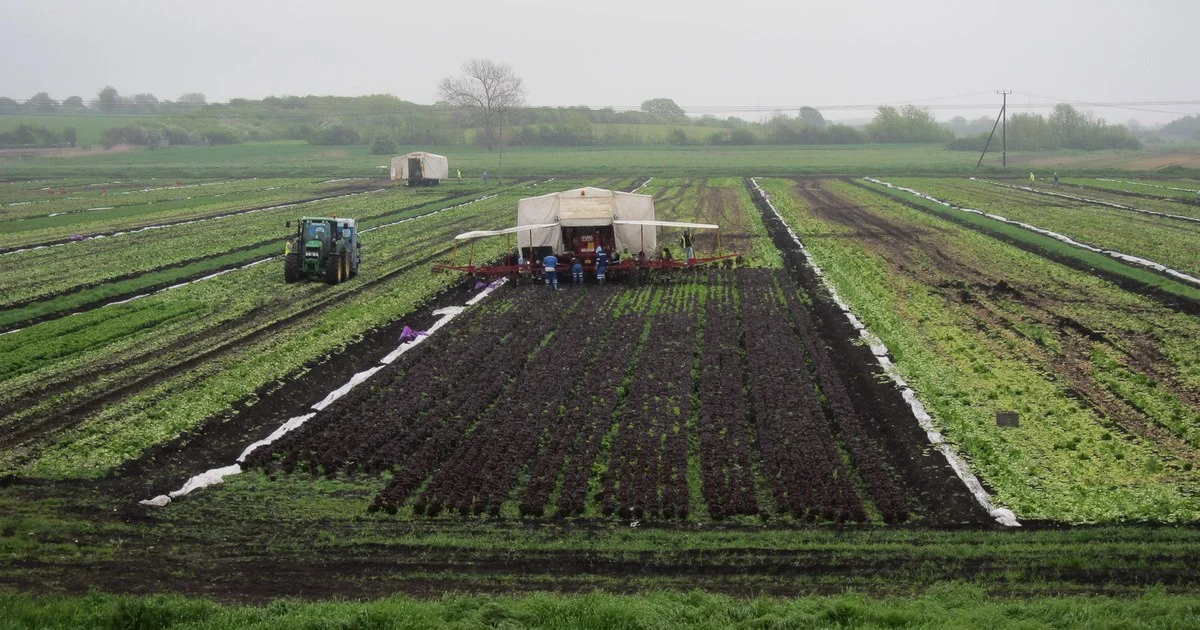
Cover photo: Harvesting lettuces near Stuntney, Cambridgeshire, photographed in May 2012. Photo: Hugh Venables (CC BY-SA 2.0, cropped), via Wikimedia Commons.
You’ve reached the end of this story.