Ask ten growers whether aphids were bad this year and most will say yes. Ask them what that meant on their farm and you will get ten different answers. A beet grower will talk about virus yellows and a fourth spray. A cereal grower drilling now is thinking about barley yellow dwarf. An iceberg grower will tell you that a handful of aphids in the heart of a lettuce can cost a whole consignment.
That is the point of this piece. Britain does not have one aphid problem. It has several, and they work in different ways: some aphids matter because they carry viruses, some because they feed, and some simply because they end up in the bag. The right response in iceberg lettuce can be the opposite of the right response in wheat or potatoes. With warmer winters, resistant aphid populations and fewer reliable insecticides, spraying more often is not a strategy that holds up.
A way through this story
What 2026 actually looked like
The season started early. The 2025–26 winter was mild, and AHDB’s spring aphid forecasts expected aphids to fly up to two weeks earlier than normal in southern England and around the usual time further north. In beet, Rothamsted Research’s virus yellows forecast put the risk at 59.15% of the national crop becoming infected if nothing was done: 62% in the East and 49% in the North. Rothamsted linked the higher risk to January and February being 1.3°C warmer than in 2025, and forecast flights from 22 April (NFU summary of the forecast).
The aphids beat the forecast. The first peach-potato aphid (Myzus persicae) was caught in the Broom’s Barn suction trap on 16 April. By BBRO’s guidance of 24 April, migration was “high and widespread”, fields across the growing area were breaching the spray threshold at an early growth stage, and a dry spell was making things worse by speeding up migration while slowing plant growth. BBRO expected most fields to need all three approved aphicides. HSE later granted an emergency authorisation for a fourth application of acetamiprid, valid from 28 May to 1 August, and only after the other three products had been used.
Pulse growers had the same warm, dry spring. That matters because colonies of pea aphid and black bean aphid build quickly in warm weather, and PGRO is clear that virus transmitted before flowering does the most damage.
Now attention has moved to autumn cereals. AHDB tests samples of bird cherry-oat aphids from a handful of suction traps for barley yellow dwarf virus (BYDV) and cereal yellow dwarf virus (CYDV). By the bulletin published on 25 September, 128 of the 306 bird cherry-oat aphids tested this autumn had been positive, which is 41%. The week to 20 September came in at 38%, ranging from 14% at Broom’s Barn to 50% at Starcross and Gogarbank. For comparison, AHDB says the average never went above 30% across 2021–24, and autumn 2025 was itself the highest of the last seven years at around 35%.
What the 41% does and does not mean
It does not mean 41% of the aphids in your field, or in Britain, carry virus. It is a small sample from a few suction traps, and the trap results differ a lot from one another. What it tells you is that the aphids flying this autumn are carrying more virus than in recent years. Your own risk still depends on when you drilled, how warm it stays, whether aphids are actually in the crop, and what was growing in that field before.
Early infection is what costs yield in cereals. A plant infected in the first few leaves has the whole season to be stunted, while one infected late in the autumn usually loses less. That is why AHDB’s BYDV management tool models when the second generation of aphids, the one most linked to virus spread in the crop, is likely to appear, based on accumulated temperatures since emergence. Aphids stop flying below about 11°C and are much less active below 3°C. A September-drilled crop emerging into a warm October with aphids flying is a very different case from a late-October crop emerging into cold weather. Spraying both on the same day because the sprayer is out is the habit to break.
Why lettuce breaks the usual threshold logic
Most aphid thresholds come from arable farming. They ask how many aphids it takes before you lose more yield, or more crop to virus, than the treatment costs. That way of thinking works reasonably well for cereals, beet and peas.
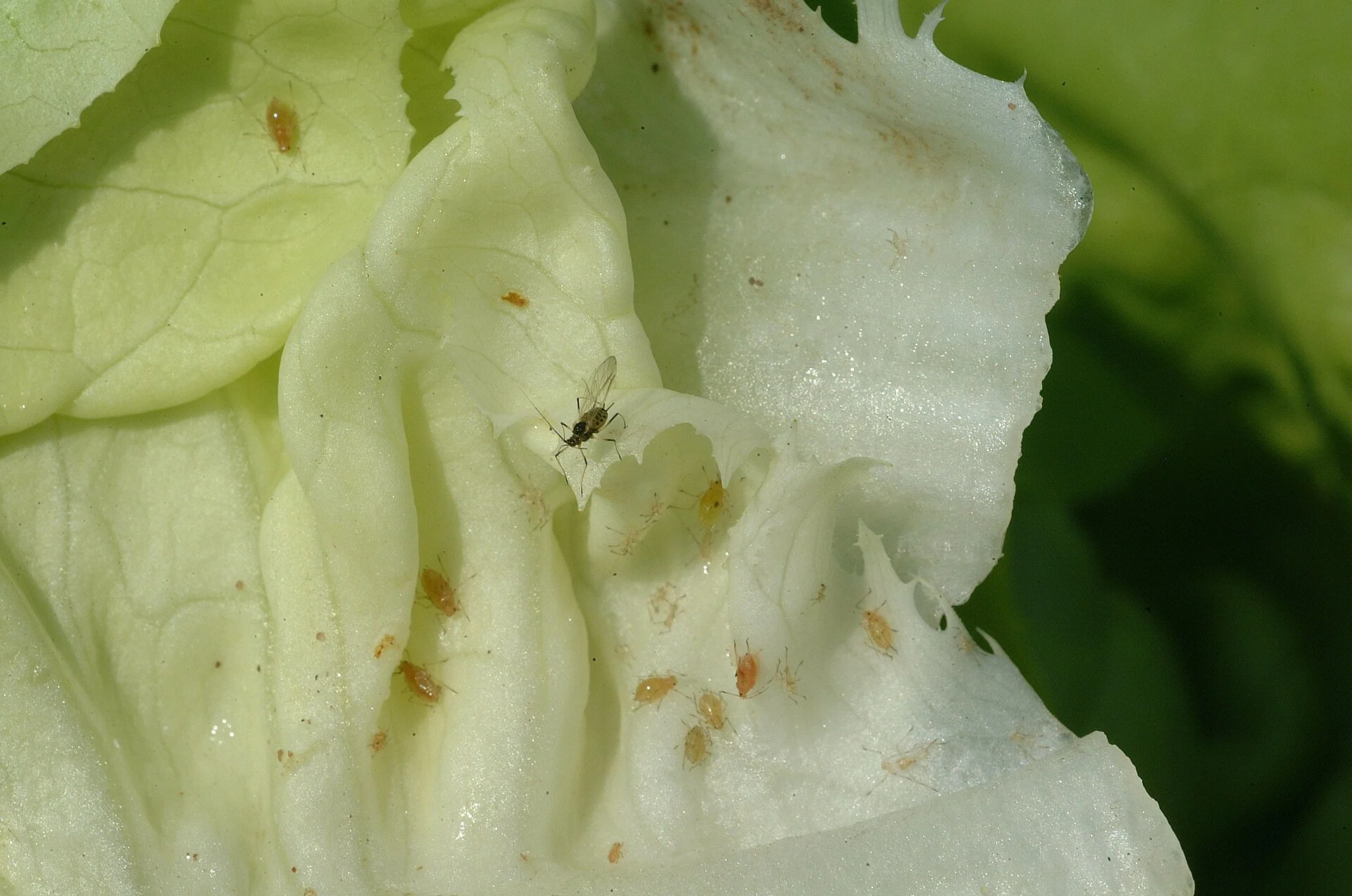
It doesn’t work for lettuce. The currant-lettuce aphid, Nasonovia ribisnigri, is the main reason. Arizona’s extension service describes how adults put their young near the growing point, and the colony keeps feeding and breeding on the youngest leaves deep in the plant. In iceberg and cos, it is found “almost exclusively in developing heads and heart, often well protected under several layers of leaves” (University of Arizona, 2025). Once the head closes, a contact spray has very little chance of reaching it.
And this aphid does not need to cost any yield to cost money. In a cereal crop, a few aphids are a yield or virus question. In iceberg, baby leaf or a bag of salad, a few aphids, a dead aphid or a cast skin in the product can be enough for a rejection. Lettuce has a contamination threshold, and for many retail specifications it is close to zero. Spinach and baby-leaf crops are stricter still, because nearly the whole plant ends up in the bag and there are no wrapper leaves to strip off.
Other aphids matter on lettuce too:
- Peach-potato aphid (Myzus persicae) colonises lettuce and carries viruses, and it is the UK aphid with the most serious insecticide resistance problem (more below).
- Potato aphid (Macrosiphum euphorbiae) is the third foliage aphid that Warwick Crop Centre tracks for lettuce growers.
- Lettuce root aphid (Pemphigus bursarius) lives below ground and is often mistaken for drought. It gets its own section further down.
- Willow-carrot aphid and black bean aphid are mainly problems in other crops, but both turn up in mixed vegetable rotations and on weeds around salad fields.
Warwick Crop Centre publishes day-degree forecasts for lettuce aphids. For Nasonovia, the forecast counts day-degrees above 4.4°C from 1 February; on average 507 have built up by the time the first aphid is found, and the prediction is usually accurate to within two or three weeks. The weak point is that winged Nasonovia are rarely caught in the national suction-trap network, so trap data says little about this species. The forecast tells you when to start looking. It does not replace pulling plants apart in the field and checking the heart leaves.
What other countries learned the hard way
California and Arizona
The western US has lived with Nasonovia since around the turn of the century. John Palumbo, who has studied it for 25 years in Arizona’s desert lettuce, gives its lifecycle as roughly eight to ten days, which is why populations can build so fast once temperatures average above about 60°F (16°C). The economic loss comes from contamination, not feeding damage: “often rendering whole fields unmarketable”. In spring 2022, he estimated that about 20% of Arizona’s organic lettuce went unharvested because of lettuce aphid contamination (Palumbo, 2025).
The US response shows how much the threshold changes. For most aphid species in leafy vegetables, Arizona’s guidance is to act when about 10% of plants carry colonies. For lettuce aphid, the advice is to treat as soon as colonising nymphs are found in the terminal growth. Arizona’s work also found that even the newer translaminar aphicides work against lettuce aphid only on small plants where the growing point is still exposed, and “are not capable of controlling heavy lettuce aphid infestations within heads”.
Natural enemies count for something. UC IPM names hoverfly (syrphid) larvae and green lacewing larvae as the useful predators of lettuce aphid, and says ladybirds and parasitoids do not play a significant role. Many organic growers in California interplant lettuce with quick-flowering annuals such as sweet alyssum, coriander, Persian clover and baby’s breath to feed adult hoverflies. Even so, the 20% of organic lettuce lost in Arizona in 2022 shows that insectary strips alone do not protect a crop in a bad year.
A note on US products
The US product names in this section are there to show the pattern, not as recommendations. Approvals in the US and Australia differ from Great Britain’s. Check any product against the current HSE label and talk to a BASIS-qualified adviser before using it.
Australia
Currant-lettuce aphid reached Tasmania in 2004, probably blown across from New Zealand, and was confirmed in every Australian state by 2006. The levy-funded IPM work that followed is one of the best records of what biological control can and cannot do in lettuce (Horticulture Australia project VG05044).
At Devonport in northern Tasmania in 2004–05, nine successive plantings of iceberg (55,000 heads in total) were grown on IPM principles: sequential, adjacent plantings so predators could move from the old crop into the new one, checking before spraying, and selective products wherever possible. The first seven plantings were sold. Control failed in the last two, possibly because large areas of lettuce treated with systemic drenches were planted next door, which killed predators and disrupted their movement. In southern Tasmania, the team grew oats next to the iceberg to host cereal aphids as a nursery for predators, and left harvested loose-leaf residues in place as a source of beneficial insects.
In Victoria, three large commercial iceberg and cos growers harvested and sold Nasonovia-susceptible lettuce without rejections from the time the aphid arrived in May 2005, using IPM with no broad-spectrum insecticides. The main predators were the brown lacewing (Micromus tasmaniae) and hoverflies. Their numbers rose as aphid numbers rose and fell away before harvest.
The same report has a counter-example. On a farm near Camden, outside Sydney, two winter blocks of 20,000 lettuces had fewer than four predators per 100 plants for most of the crop’s life, and about 300 aphids per lettuce at harvest. The grower moved to resistant varieties and treated transplants afterwards. In the Tasmanian trials, fungal disease killed many aphids late in one planting, but the aphids “dead and alive, remained numerous”, and a dead aphid in a lettuce heart is still a rejection.
New Zealand
Nasonovia appeared in New Zealand in 2002, and the lettuce industry started a three-year IPM programme that year. The key finding was that the young larva of the brown lacewing is small enough to work its way deep into the plant and eat aphids where sprays cannot reach. In the third year, brown lacewings controlled lettuce aphid in three spring trials in commercial crops in South Auckland. The programme set an action threshold based on the number of aphids and predators in the crop, and found that in some seasons no insecticide was needed at all. Its advice to growers was blunt: “put your boots on and scout the crop” (Rural Delivery, NZ).
Plant & Food Research’s current guidance for New Zealand lettuce growers sums up the habitat side as SNAP: selective insecticides and biodiverse plantings that provide shelter, nectar, alternative food and pollen (Plant & Food Research factsheet). The idea behind it is simple. Beneficial insects need somewhere to live before the aphids take off. Predators that arrive after the head has closed around an aphid colony are too late for that crop.
The Netherlands and the resistance story
Europe, where Nasonovia is native, took a different route: genetics. Breeders bred the Nr resistance gene into lettuce, and for years resistant varieties worked very well against the aphid population now called Nr:0. Then, in the northern European summer of 2007, aphids were found feeding and breeding on resistant varieties (reported in VG05044). That resistance-breaking biotype is known as Nr:1, and it undid much of the protection growers had come to rely on.
New lettuce genetics now claim resistance to both types. According to the breeders: Rijk Zwaan launched the iceberg varieties Happinas RZ and Friendlinas RZ in September 2025 under its “Nasonovia Defense” label, with high resistance to Nr:0 and Nr:1 (Fruitnet, reporting the launch). In April 2026, Enza Zaden announced Lenovia (E01E.13418), an iceberg it lists as highly resistant to Nr:0 and Nr:1 and to Bremia races Bl:29–41EU, and said the resistance meets the International Seed Federation standard for high resistance (Enza Zaden). These are the breeders’ own claims. It will take UK trials and a few commercial seasons to show how they hold up here.
The question to ask your seed rep
Don’t just ask whether a variety is Nasonovia resistant. Ask which Nasonovia biotypes the resistance covers (Nr:0, Nr:1 or both), whether it is rated as high or intermediate resistance, and what the breeder will do if a new biotype appears. A variety that only covers Nr:0 may be giving you a lot less protection than the word “resistant” suggests.
Root aphids: the problem that looks like drought
Lettuce root aphid is easy to misdiagnose because you can’t see it from the cab. It spends the winter as eggs on Lombardy and black poplar. In spring the young aphids form galls on poplar leaf stalks, and winged aphids leave the trees over four to five weeks in late June and early July to colonise lettuce roots (AHDB). Colonies then build underground.
The first sign is usually patches of plants that yellow and wilt. Because the aphids damage roots and cut water uptake, AHDB notes that symptoms are worse in dry seasons. So a dry summer, a field near a line of poplars and a patch that won’t perk up after watering is a combination to check properly. Lift some plants, shake off the soil and look for white, waxy colonies on the roots before deciding the irrigation is the problem. Irrigation can help a damaged crop cope, but it won’t remove the aphids, and you need to know what you are dealing with before the next planting in that field. The old varieties Avoncrisp and Avondefiance had near-complete resistance, but AHDB says that resistance was never bred into modern varieties.
Crop by crop: different aphids, different risks
Here is the whole farm in one table. The “main commercial risk” column matters most, because it decides what a threshold means for that crop.
| Crop | Key aphids | Main commercial risk | What the threshold looks like | Where to look |
|---|---|---|---|---|
| Wheat, barley | Bird cherry-oat, grain aphid | BYDV/CYDV | Risk-based: emergence date, temperature, virus levels in aphids. No simple count. | AHDB BYDV tool, virus testing |
| Sugar beet | Peach-potato aphid (green) | Virus yellows | 5 green wingless aphids per 20 plants up to 12 true leaves; 1 per plant at 12–16 leaves | BBRO AphidWatch |
| Potatoes | Peach-potato and many non-colonising species | PVY, PVA (non-persistent); PLRV (persistent) | Seed crops: very low tolerance; insecticides help with PLRV more than PVY | AHDB potatoes |
| Oilseed rape | Peach-potato aphid | Turnip yellows virus | No satisfactory threshold; AHDB says to assume aphids carry virus | AHDB TuYV guidance |
| Peas | Pea aphid | Feeding damage, PEMV and other viruses | Combining 20% of plants infested; vining 15% | PGRO |
| Field beans | Black bean aphid, pea aphid | Feeding damage, BLRV and other viruses | 10% of plants colonised; 5% or early flowering where virus is the concern | PGRO |
| Vegetable brassicas | Mealy cabbage aphid, peach-potato aphid | Contamination, virus (TuMV, CaMV) | No established threshold for vegetable brassicas | AHDB |
| Carrots | Willow-carrot aphid | Carrot motley dwarf complex | Timing of migration matters more than counts | Warwick forecast |
| Lettuce, iceberg | Currant-lettuce, peach-potato, potato aphid; root aphid | Contamination inside the heart | Close to zero tolerance in the product; act on the first colonising nymphs | Warwick forecast plus crop walking |
| Spinach, baby leaf | Peach-potato and others | Contamination | Effectively zero; the whole plant is the product | Crop walking |
Cereals
Bird cherry-oat aphid is the main virus vector, and grain aphid becomes a problem mostly in very early sown crops or where the green bridge has not been dealt with (AHDB). The levers are drilling date, green-bridge control, the BYDV tool and, more and more, varieties. Pyrethroids are still the main spray, but AHDB says moderate pyrethroid resistance is already widespread in UK grain aphid populations. Every unnecessary spray adds to that selection pressure.
Sugar beet
Young beet is the most vulnerable, and BBRO’s thresholds relax after 12 true leaves. Its 2026 programme order was acetamiprid at T1, flupyradifurone at T2 and flonicamid at T3. Each active ingredient can be used only once, and flonicamid (a different IRAC group) is there partly to deal with aphids resistant to the group 4 products. BBRO also points out that foliar sprays are unlikely to stop the first infections brought in by winged migrants. Their job is to stop wingless offspring spreading the virus from plant to plant. On pyrethroids, BBRO is unambiguous: Myzus persicae is widely resistant to them, so they don’t control the target aphid but do kill the predators. If a pyrethroid is needed for another pest, BBRO advises waiting until after 12 true leaves.
Potatoes
Potatoes show most clearly that killing aphids and stopping virus are different things. AHDB separates the two kinds of virus. Potato leafroll virus is persistent: an aphid needs hours of feeding to pick it up and pass it on, but then stays infective for life. Because of that delay, insecticides can break the cycle. PVY and PVA are non-persistent: the virus sits on the tip of the aphid’s mouthparts and passes on within minutes, if not seconds, of a test probe. Many of the aphids that spread PVY don’t colonise potatoes at all. They land, probe and fly on. An insecticide that takes hours or days to kill doesn’t stop that. Seed growers rely on clean seed stocks, removing rogue plants, killing haulm early and, where approved, mineral oils that interfere with transmission.
Oilseed rape
Turnip yellows virus can cut yields by up to 30%, and in some samples up to 72% of winged peach-potato aphids carry it. AHDB says there are no satisfactory spray thresholds: if aphids are there, assume they carry virus (AHDB). The vector is resistant to several insecticide groups. Resistant varieties have done more than chemistry here. TuYV resistance now appears in about a quarter of Recommended List varieties, and later-drilled crops carry less risk.
Peas and beans
Pulses fall between feeding damage and virus. PGRO’s thresholds are counts of infested plants, but the timing advice is mostly about virus: control colonies as soon as they appear if that happens before flowering, and for combining peas the yield benefit from treatment ends at the fourth pod-bearing node (PGRO). Once that window has passed, a spray may add nothing to yield but still kill the ladybirds, hoverfly larvae and parasitoids feeding on the colonies.
Brassicas
Mealy cabbage aphid contaminates produce with aphids, wax, cast skins and honeydew, and also spreads turnip mosaic and cauliflower mosaic viruses. AHDB lists no threshold for vegetable brassicas and no known insecticide resistance in this species. It also makes the point this article keeps returning to: natural enemies such as the parasitoid Diaeretiella rapae are valuable, but they may not prevent virus spread, because that can happen even at low aphid densities (AHDB).
Carrots
Willow-carrot aphid spends the winter on willow and moves into carrots and other umbellifers over five to six weeks, usually peaking in early June. It spreads the viruses behind carrot motley dwarf. Warwick’s day-degree forecast, built from Rothamsted suction-trap catches, predicts when the first migrants arrive (Warwick). For a virus crop, knowing when the migration starts is worth more than counting aphids after it has happened.
Why spraying harder is running out of road
Insecticide resistance in UK aphids is well documented. AHDB-funded monitoring found the MACE and kdr resistance mechanisms in more than half of the peach-potato aphid samples collected in 2004–07, and “super-kdr” gives high resistance to several pyrethroids (AHDB potatoes). Grain aphids with moderate pyrethroid resistance are widespread. In the 1999–2004 period, Rothamsted researchers found UK currant-lettuce aphid strains with widespread, varied resistance to pirimicarb and lower resistance to pyrethroids (Rothamsted).
Selection pressure is simple enough. Every spray kills the aphids that are susceptible and leaves the resistant ones to breed. A spray applied when the aphids were never going to cause a loss adds resistance pressure and gains you nothing. And broad-spectrum products don’t only hit aphids. They also kill the hoverfly larvae, lacewings, ladybirds, parasitoid wasps, ground beetles and spiders that would otherwise keep the next wave of aphids in check. Interestingly, research on grain aphid found that aphids carrying kdr resistance were more vulnerable to the parasitoid Aphidius ervi (Jackson et al., 2020), which is one more reason to keep parasitoids alive.
None of this argues against insecticides. Beet growers in 2026 needed all three products and the emergency fourth. A seed potato crop in a high-PVY year, or an iceberg crop with colonising Nasonovia in the growing point, may need treatment fast. The point is narrower than that. Spray when it changes the economic outcome, not because an aphid has been seen or because the sprayer is already in the field. When you do spray, rotate IRAC mode-of-action groups and check the current HSE pesticide register, because approvals for aphicides have been changing quickly.
Natural enemies: how much they can and can’t do
The predator list is long: hoverfly larvae, lacewing larvae, ladybirds and their larvae, parasitoid wasps, predatory bugs, ground beetles, spiders and fungal diseases of aphids. Some do a lot. AHDB says a single hoverfly larva can eat up to 1,200 aphids (AHDB), and the Australian and New Zealand lettuce work shows predators bringing aphid numbers down before harvest in commercial crops.
There are three limits to keep in mind.
- Predators respond; they don’t prevent. They build up after aphids arrive. That is fine for feeding damage. For virus, where one infective aphid probing for a few seconds can infect a plant, it is too late. In cereals, potatoes, beet and oilseed rape, natural enemies help with aphid numbers and secondary spread but won’t stop the first infections.
- Dead aphids still count in salad crops. A parasitised mummy or a fungus-killed aphid in a lettuce heart is still a contaminant.
- They need food before the pest arrives. AHDB notes that hoverflies stay in a field only if there are enough aphids to feed on, and adults need open flowers for pollen and nectar.
That last point changes how to think about flower strips. A wildflower margin sown for a scheme payment and left to its own devices is not the same as a strip placed and timed to protect a crop. If aphid control is one of the aims, the questions are practical ones. Is the habitat close enough to the crop, or within it? Is something flowering in April and May when the first predators need feeding, not just in July? Is there shelter over winter, such as tussocky grass margins and hedge bases, for ground beetles and overwintering predators? Is there cover between crops so predators don’t have to start from nothing each time? The Tasmanian growers’ oat strips and successive plantings were exactly this kind of crop-protection infrastructure. Some of these options can be funded: see our guides to SFI for vegetable growers and cover and catch crops.
Green bridges: timing matters
Volunteer cereals, grass weeds, last year’s crop residues, unharvested vegetable beds and alternative hosts can carry both aphids and viruses from one crop into the next. In cereals, AHDB advises waiting five weeks between destroying weeds and volunteers (especially annual meadow-grass and volunteer cereals) and sowing, so the aphids on that green material die out first (AHDB).
The timing is the important part. If you spray off or cultivate an aphid-infested green bridge right next to a crop that is just emerging, the aphids don’t die. They move, and the young crop next door is the nearest food. The five-week gap is there to break that link. The same logic applies in vegetables. Old lettuce or brassica crops left standing next to new plantings can feed the next crop with aphids, as well as with predators, as the Tasmanian work showed. Whether an old crop is acting as a predator nursery or an aphid source depends on what is living in it, and the only way to know is to look.
Genetics are becoming the main defence
As chemistry gets harder to rely on, resistant and tolerant varieties are taking on more of the work:
- Cereals. BYDV resistance and tolerance are now on the AHDB Recommended Lists, including RGT Wolverine (winter wheat, resistance) and KWS Feeris (winter barley, tolerance) (AHDB). For early drilling in high-risk fields, these change the calculation.
- Oilseed rape. TuYV resistance has been on the Recommended List since Amalie in 2016 and now features in about a quarter of recommended varieties (AHDB).
- Lettuce. after Nr:1 broke the original Nr resistance, breeders now claim varieties with high resistance to both Nr:0 and Nr:1 (Enza Zaden; Rijk Zwaan via Fruitnet).
The lettuce story is the warning. A resistance gene used on its own across a whole industry puts strong selection pressure on the pest, and in 2007 the aphid adapted. Resistant varieties need looking after in the same way as insecticides do. Keep scouting resistant crops, don’t treat resistance as a reason to stop looking, and report colonies on varieties that should be resistant to your adviser or seed supplier quickly.
A whole-farm aphid strategy
This framework works for any crop on the farm. It isn’t complicated, but it does mean asking the questions in order, before anyone fills the sprayer.
- Identify the species. A green aphid on beet, a grain aphid on wheat and a Nasonovia in a lettuce heart call for different responses. Use the AHDB, BBRO and Warwick ID guides, or send a sample.
- Name the actual risk. Is it feeding, virus or contamination? That decides what the threshold means.
- Check crop vulnerability at its current growth stage. Beet under 12 leaves, cereals in the first leaves, peas before flowering and lettuce before the head closes are the stages that matter most.
- Check regional information. Use AHDB aphid monitoring and virus testing, BBRO AphidWatch, and Warwick and AHDB forecasts.
- Walk the field. Traps miss some species, Nasonovia in particular. Pull plants apart.
- Count the predators as well as the aphids. Note hoverfly larvae, mummies, ladybird larvae and lacewings. A colony with predators in it is different from one without.
- Map the green bridges. Note volunteers, old crops, weedy margins, poplars near lettuce and willows near carrots.
- Use resistant genetics where they make commercial sense, and know exactly what the resistance covers.
- Use drilling date and crop scheduling. Later drilling for cereals and oilseed rape, and planting sequences in vegetables that let predators move from crop to crop.
- Use selective chemistry when intervention is justified. Check the current HSE label and get BASIS advice.
- Rotate modes of action. Avoid back-to-back use of the same IRAC group.
- Stop when the vulnerable period is over. Beet past 16 leaves, cereals once it is cold and aphids have stopped flying. Spraying after that adds selection pressure for nothing.
- Review the season. Note where aphids came from, what worked, and what to change in next year’s drilling dates, variety choice or habitat.
The question to change
For decades the default question about an aphid has been: what kills it? That question made sense when cheap broad-spectrum products killed nearly everything and aphids hadn’t adapted. It makes much less sense now.
The better question is: what combination of genetics, crop timing, field hygiene, ecology, monitoring and chemistry stops this aphid from becoming an economic problem?
Two things follow from it. First, controlling aphids and controlling virus are not always the same thing: a spray can kill every aphid in a potato crop and still not stop PVY. Second, the right threshold can be hundreds of aphids in one crop and effectively one in another. A national headline saying “aphid pressure is high” doesn’t tell anyone what to do. Which crop, which species and which growth stage do.
Iceberg growers learned this first because contamination left them no room for error. Beet growers are learning it with three products and a strict order to use them in. Cereal growers will be weighing it this autumn as the virus results come in. Each crop has something to teach the others, and all of them depend on someone walking the field and looking.
Sources are linked throughout. Pesticide approvals change: always check the current HSE label and take advice from a BASIS-qualified adviser before applying any product. Overseas product references show international practice and are not UK recommendations.
Header photo: currant-lettuce aphids in a lettuce heart, by Josef Schlaghecken, CC BY-SA 4.0, via Wikimedia Commons.
You’ve reached the end of this story.