Most growers who want to supply a big buyer start by thinking about price. Before any price is agreed, though, there is an approval gate. Many growers who could supply a supermarket packer, a crisp factory or a foodservice wholesaler never get through it. The paperwork isn’t impossible. The problem is that nobody sets out the requirements in advance, and each type of buyer adds its own layer.
This guide covers the three big routes for British and Irish fresh produce: supermarkets, processors (the factories that freeze, crisp, chip, cut or bag), and foodservice (the wholesalers supplying hotels, pubs, schools and hospitals). The foundation is the same for all three. What sits on top differs a great deal.
A way through this story
The common base: farm assurance and supplier approval
Nearly every large buyer runs its own site, or its packer’s site, to the BRCGS Global Standard for Food Safety or another standard benchmarked by the Global Food Safety Initiative (GFSI). That matters to growers because of one clause. BRCGS Food Safety Issue 9 (clause 3.5.1.2) requires a certified site to approve every raw material supplier through a documented procedure, based on one of three things:
- valid certification to a BRCGS standard or another GFSI-benchmarked standard;
- an audit of the supplier by the buyer, covering product safety, traceability, HACCP and related plans;
- for suppliers the buyer has assessed as low risk, a questionnaire backed by a successful traceability test.
Option 1 is cheapest for everyone, so buyers prefer it. That is why “BRC or equivalent” appears in so many supplier requirements. Few farms hold BRCGS Food Safety itself, because it is written for packing and processing sites. At farm level the usual equivalents are:
- Red Tractor Fresh Produce. This is the standard UK scheme. It is benchmarked to GLOBALG.A.P., so members can take a GLOBALG.A.P. certificate “without the need for extra assessments”, in Red Tractor’s words, and can reach GLOBALG.A.P. add-on modules that some customers require.
- GLOBALG.A.P. Integrated Farm Assurance. The international farm-level standard. Its fruit and vegetables version is GFSI-recognised and covers more than 600 crop species.
- Bord Bia’s Sustainable Horticulture Assurance Scheme (SHAS) for growers in the Republic of Ireland. It is audited independently at least every 18 months and operates to ISO 17065.
If you pack, wash, trim or bag on farm, expect a buyer to look at the packhouse as well as the field. That is where BRCGS proper applies.
Farm assurance gets you considered. Each channel then adds its own requirements.
Supermarkets: assurance plus environmental and ethical layers
Supplying Tesco, Sainsbury’s, Asda, Morrisons, Waitrose, M&S, Co-op or the discounters normally means supplying a packer or marketing group that holds the retailer’s account. Few growers sell to a supermarket’s central buying team directly. That affects your protection as well as your paperwork.
LEAF Marque is becoming the entry ticket. Several retailers now require it on top of Red Tractor or GLOBALG.A.P.:
- Tesco completed LEAF Marque certification across its UK fruit and vegetable growers in February 2023, around 500 growers, and set 2025 as the target for its global grower base.
- Waitrose says all its UK fresh fruit and vegetable growers are LEAF Marque certified.
- M&S says it requires its UK fresh produce growers to be LEAF Marque certified.
- Co-op announced in December 2025 that all its UK-grown fresh produce must be LEAF Marque certified by January 2027.
LEAF Marque audits integrated farm management: soil, water, biodiversity, energy and crop protection planning. Allow a full growing season to get ready for a first audit.
An ethical audit is expected. Major supermarkets expect produce suppliers to be members of Sedex and to hold a SMETA ethical audit, or an accepted alternative such as GLOBALG.A.P.’s GRASP module. This has been a sore point. SMETA 7.0, due from 10 September 2024, brought in an “employer pays” principle, meaning growers carry seasonal workers’ recruitment and travel costs. In a British Growers Association survey, 46% of growers said they would leave Sedex or move to another ethical audit rather than use SMETA 7.0. Check with your packer which audit, and which version, your retailer accepts before you book one.
Residue testing is routine. Every UK supermarket runs its own pesticide residue testing programme. Pesticide Action Network UK’s 2024 ranking found that the point at which retailers start investigating varies: some act once a residue passes a third of the legal maximum residue level (MRL), others at 80% or 100%. In practice, “legal” and “acceptable to my retailer” are not always the same number. Ask for the retailer’s residue policy and keep your spray records audit-ready.
Specifications are the tightest in the market. Supermarket specs cover class, size, colour, Brix or pressure for fruit, defect tolerances, pack format and shelf life. Produce that passes the legal marketing standard can still fail a retailer spec.
Know whether the Groceries Code protects you. The Groceries Supply Code of Practice covers the 14 designated retailers (those with UK grocery turnover above £1 billion: Aldi, Amazon, Asda, B&M, Co-op, Iceland, Lidl, M&S, Morrisons, Ocado, Sainsbury’s, Tesco, TJ Morris and Waitrose). It only protects their direct suppliers. If you supply through a packer, your terms with that packer are a commercial contract that the Groceries Code Adjudicator does not police, so read it carefully.
Processors and factories: the specification follows the process
A factory buys a raw material, not a display product. Appearance matters less, but whether the crop works on the line matters more, and the specification measures exactly that. The factory’s own BRCGS certification still brings the supplier approval clause above, so farm assurance remains the base.
Potatoes for crisps and chips. Fertiliser company Yara’s guidance to growers says processing contracts once set 18% dry matter as the minimum, but “industry standards now seek potatoes with a 20-25% DM”. Processors judge fry colour against standard colour charts. Contracts usually set an acceptable range for reducing sugars, because too much sugar browns the crisp or chip. Yara adds that “a standard contract will specify a maximum of 5% out grade potatoes by weight”, and that processors usually penalise losses from blemishes, bruising, pest damage, greening and growth cracks. Storage management counts as much as growing, because reducing sugars can rise in store.
Vining peas for freezing. Here timing is the specification. In the weeks before harvest, fields are sampled daily and tested in a tenderometer, which measures the force needed to crush a sample and shows when the peas are at the right maturity. Birds Eye says its peas go from picked to frozen in about 150 minutes, harvested by a grower co-operative, The Green Pea Company. Growers in that system hand the decision on when to harvest to the factory’s schedule, in exchange for a secure outlet.
What processing suits. Processing contracts are usually agreed before planting, on tonnage or area, with bonuses and deductions tied to measured quality. Price is less exposed to the day-to-day market than with wholesale. The trade-off is that what you are paid depends on test results you don’t control, so check how and where samples are taken before you sign.
Foodservice: daily intake checks and seasonal scrutiny
Foodservice wholesalers supply kitchens, and kitchens portion by count and weight. Henderson Foodservice, which delivers across Northern Ireland and the Republic from four regional depots, gives an unusually plain public account of how fresh produce suppliers are checked:
- “All our suppliers go through a rigorous Supplier Approval Process to ensure compliance with specifications and BRC or equivalent.”
- “We hold specifications for all our produce range, which are used for checks and benchmarking.”
- “Extra checks across seasonality produce as well as any changes in growing regions and sourcing.”
- “Sampling and benchmarking for produce – size / dimensions / brix / label detail etc.”
- “Sample inspection on all products and suppliers each day.”
Two points stand out for growers. First, benchmarking: your samples are compared with other suppliers of the same line, so consistency across the season counts for more than one outstanding load. Second, seasonal switches get extra checks. Henderson doesn’t explain why, but the reasoning is easy to follow: risk rises when supply changes hands, as when imports hand over to the home crop and back again. For a local grower, that means your first loads of the season and your last ones get the closest look. Don’t cut early on size or Brix to catch the opening price, and warn the buyer before your season ends.
The specification: the document every dispute comes back to
Whichever channel you supply, the specification is what your produce is judged against. It typically covers:
- Variety or type, sometimes with acceptable alternatives
- Class, where one applies (Extra, Class I, Class II)
- Size or count: diameter bands, unit weight or heads per case
- Quality tolerances: percentage limits for bruising, blemish, soil, bolting or misshapes
- Maturity or eating quality, often a minimum Brix, or pressure for top fruit, or dry matter and fry colour for processing potatoes
- Packaging: case type, net weight, count and palletisation
- Labelling and traceability: what goes on the case and how a batch links back to a field
- Temperature and shelf life on arrival
Some of this comes from law, not the buyer. Great Britain has specific marketing standards for ten products: apples, citrus, kiwifruit, lettuces and endives, peaches and nectarines, pears, strawberries, sweet peppers, table grapes and tomatoes. For these, class, sizing and minimum quality are defined in law, and some minimum maturity levels are written as Brix values: 6.2° Brix for kiwifruit at packing, 10.5° Brix for apples in the smaller size bands, and 8° Brix for peaches and nectarines. Other fresh produce falls under the general marketing standard, which requires it to be sound, clean, of marketable quality and labelled with its country of origin.
A buyer’s specification sits on top of that legal minimum and is almost always tighter. Ask for it before you quote, and price against it. A size band you can’t reliably meet in a wet August is a rejection waiting to happen. It is better to negotiate a wider band now than to argue about a returned pallet later.
At intake: what gets measured
Checks differ in detail, but the same handful of measurements come up across all three channels.
- Size and dimensions: diameter rings, callipers or check-weighing. Grading consistency across a case matters as much as the average.
- Brix: degrees Brix measure dissolved solids in the juice, mostly sugars, and are read with a refractometer from a few drops. It is the quickest objective check that fruit was picked ripe enough to eat well. If you grow Brix-sensitive crops, buy a refractometer and test before dispatch. A handheld digital unit costs far less than a rejected load, and your own readings give you evidence if a result is disputed.
- Label detail: the case label must show the packer or dispatcher’s name and address, the produce and variety where required, country of origin, and class and size where a standard applies. A missing origin or wrong class on a correctly graded crop is still a failed check, and it is the easiest failure to avoid.
- Temperature and condition on arrival, plus shelf-life testing for supermarket lines.
Labelling across the Irish Sea: three rulebooks
For growers trading across these islands, labelling depends on where the produce goes.
- Great Britain uses the assimilated (formerly EU) marketing standards described above, enforced in England and Wales by the Horticultural Marketing Inspectorate.
- Northern Ireland and the Republic of Ireland have applied the EU’s revised framework, Delegated Regulation (EU) 2023/2429, since 1 January 2025. It replaced Regulation 543/2011 in the EU and applies in Northern Ireland under the Windsor Framework. The two rulebooks began from the same text but have since diverged, so a GB specification should not be assumed to meet the EU version.
- Produce moving from Great Britain to Northern Ireland under the Northern Ireland Retail Movement Scheme has needed “Not for EU” labelling for fresh fruit and vegetables since 1 July 2025. According to the Fresh Produce Consortium’s guidance, pre-packed produce needs individual labels. Produce sold loose, by weight or put together in a foodservice setting needs the label at case level, plus shelf labelling.
The UK and EU agreed in May 2025 to work towards a sanitary and phytosanitary (SPS) agreement, which may simplify some of this. Until one is in force, confirm the current position with your buyer before a first delivery across the Irish Sea.
Side by side
| Supermarket (usually via a packer) | Processor / factory | Foodservice wholesaler | |
|---|---|---|---|
| Baseline assurance | Red Tractor or GLOBALG.A.P. (Bord Bia SHAS in Ireland) | Red Tractor or GLOBALG.A.P. | “BRC or equivalent”, in practice farm assurance |
| Extra layers | LEAF Marque (Tesco, Waitrose, M&S, Co-op from 2027), Sedex/SMETA or GRASP, residue policy | Crop-specific agronomy and storage protocols | Specification compliance, benchmarking against other suppliers |
| What is measured | Class, size, colour, Brix or pressure, defects, shelf life | Process traits: dry matter, fry colour, reducing sugars, tenderometer reading | Size and dimensions, Brix, label detail, daily samples |
| Price basis | Programme or seasonal price agreed through the packer | Pre-planting contract with quality bonuses and deductions | Negotiated with the wholesaler, often reviewed through the season |
| Main risk for the grower | Specification rejections and packer terms outside the Groceries Code | Test results you don’t control, and quality losses in store | Seasonal switch checks and inconsistency across loads |
What to have ready before you approach any big buyer
- A current assurance certificate (Red Tractor Fresh Produce, GLOBALG.A.P., Bord Bia SHAS, or BRCGS for a packhouse) and the certificate number. Add LEAF Marque if you are aiming at supermarkets.
- A traceability test you have run yourself. Pick a case at random, trace it back to the field and forward to the customer, and time it. Buyers ask for this, and a quick, clean answer is persuasive.
- Your ethical audit status, or at least Sedex membership and a plan, if supermarket supply is the aim.
- Spray and residue records ready for audit, plus any residue test results you hold.
- Your own draft specification for each crop, so the conversation starts from tolerances you can actually meet.
- Dispatch records of size, Brix, dry matter or whatever your buyer measures, as evidence in a dispute.
- A season calendar with honest start and finish dates and weekly volumes.
- Label artwork checked against the marketing standard for every market you will ship into.
None of this guarantees a listing, and none of it sets a price. But approval is where many capable growers fall out, and it is the part almost entirely in your control. For the commercial side, see our guides to routes to market for UK fresh produce and supermarket contracts compared with wholesale pricing. Salad and vegetable growers will find the production side in the UK salad and vegetable production guide.
FAQ
Do I need BRC certification to supply a supermarket or food factory?
Usually not BRCGS itself, unless you run a packhouse. BRCGS-certified buyers must approve suppliers through a BRCGS or other GFSI-benchmarked certificate, their own audit, or, for low-risk suppliers only, a questionnaire and traceability test. For growers, Red Tractor Fresh Produce (benchmarked to GLOBALG.A.P.) or GLOBALG.A.P. is the normal route.
Do supermarkets require LEAF Marque?
Several do. Tesco completed LEAF Marque certification of its UK fruit and vegetable growers in 2023. Waitrose says all its UK fruit and vegetable growers are certified, M&S says it requires it of its UK fresh produce growers, and Co-op requires it for all UK-grown fresh produce by January 2027.
What is Brix and why do buyers test it?
Degrees Brix measure dissolved solids, mainly sugars, in a crop’s juice, read with a refractometer. It is a quick, objective check on ripeness and eating quality. Some legal marketing standards set Brix minimums, such as 6.2° Brix for kiwifruit at packing, and buyers often set their own on top.
What do crisp and chip factories test potatoes for?
Mainly dry matter, fry colour and reducing sugars, plus defects. Yara’s grower guidance says industry standards now seek 20-25% dry matter, and that a standard contract allows a maximum of 5% out-grade by weight.
Does the Groceries Code protect growers who supply through a packer?
No. The Groceries Supply Code of Practice covers the relationship between the 14 designated retailers and their direct suppliers. Terms between a grower and a packer are an ordinary commercial contract.
Sources
- BRCGS, Global Standard Food Safety: Issue 9 clause 3.5.1.2 on supplier approval
- Red Tractor, Fresh Produce GLOBALG.A.P. benchmarking (February 2022)
- GFSI, GLOBALG.A.P. IFA v6 GFS recognition
- Bord Bia, Sustainable Horticulture Assurance Scheme
- Fresh Produce Journal, Tesco hits UK LEAF certification milestone (February 2023)
- Waitrose, Crops, fruit and veg sourcing; M&S, Agriculture and supporting our farmers
- The Grocer, Co-op says all UK-grown fresh produce must be Leaf Marque certified by 2027 (December 2025)
- Fresh Produce Journal, Many UK growers intend to walk away from SMETA (September 2024)
- PAN UK, Supermarket ranking: residues in food (2024)
- GOV.UK, Statutory review of the Groceries Code Adjudicator
- Yara UK, Potato market requirements
- FoodNavigator, Birds Eye’s pea harvest: picked to frozen in 150 minutes (July 2023)
- Henderson Foodservice, Fresh Produce (accessed 29 September 2026)
- legislation.gov.uk, Regulation (EU) No 543/2011, Annex I marketing standards; Defra, Marketing standards
- EUR-Lex, Commission Delegated Regulation (EU) 2023/2429
- Fresh Produce Consortium, Windsor Framework Phase 3 labelling from 1 July 2025
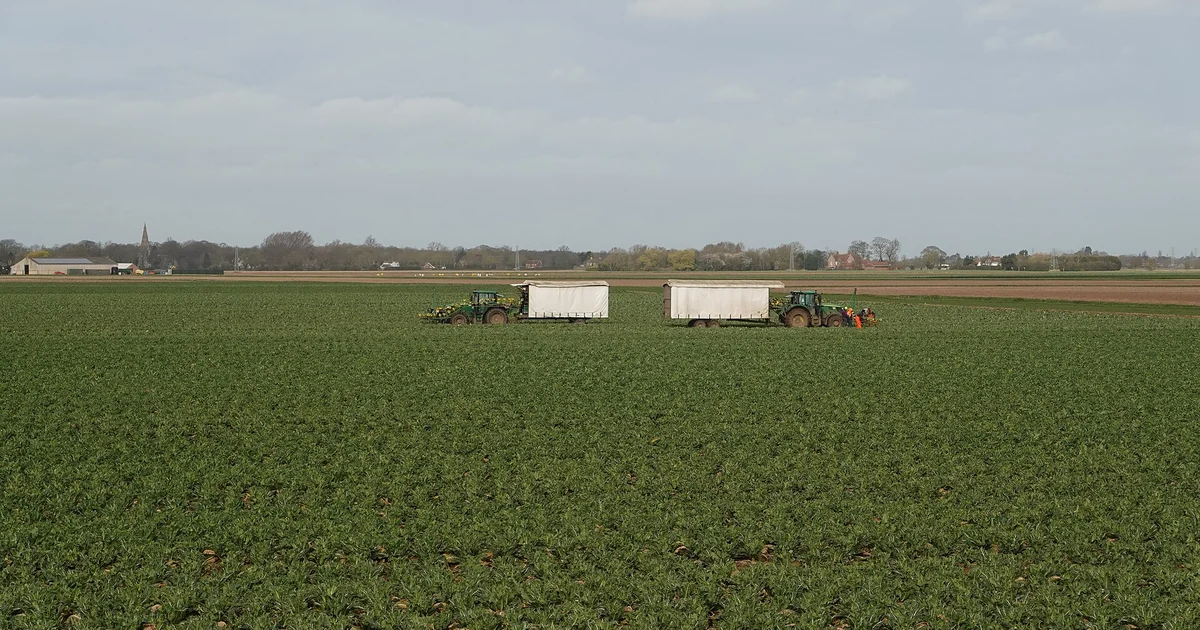
Cover photo: vegetable harvesting, March 2026, by Hugh Venables via Geograph, CC BY-SA 2.0, cropped.
You’ve reached the end of this story.