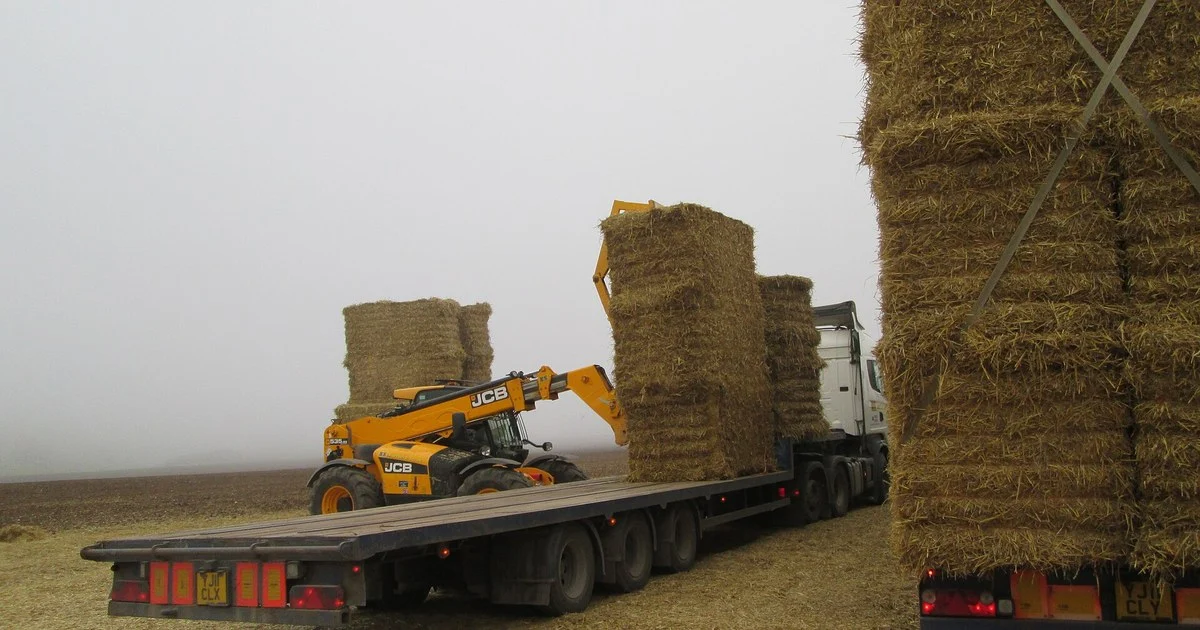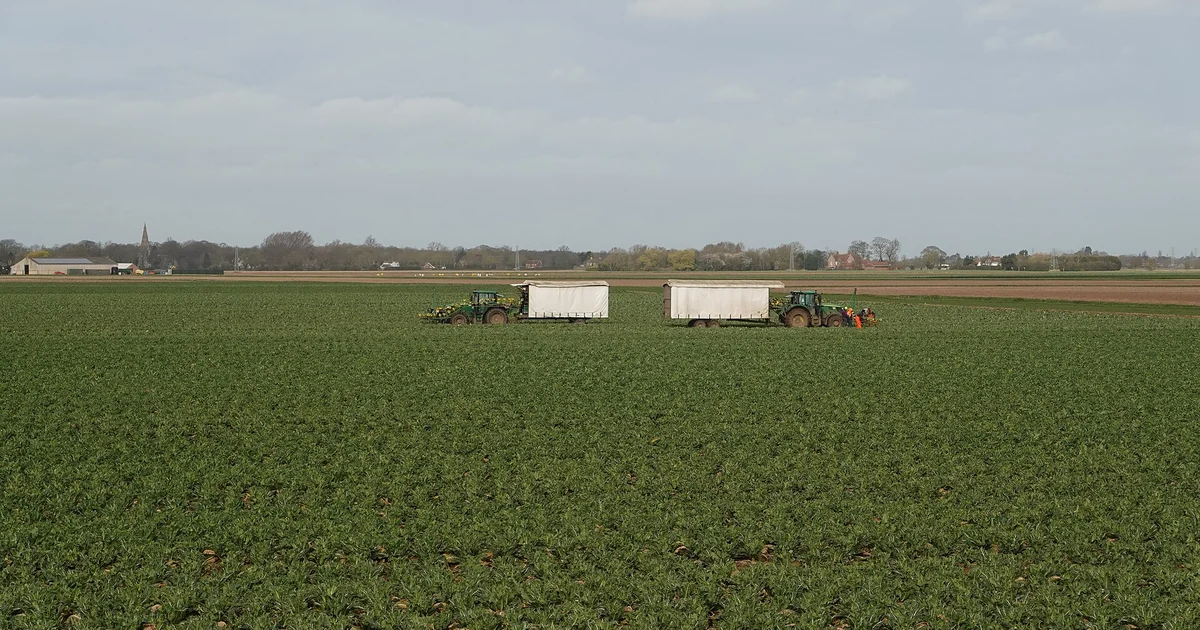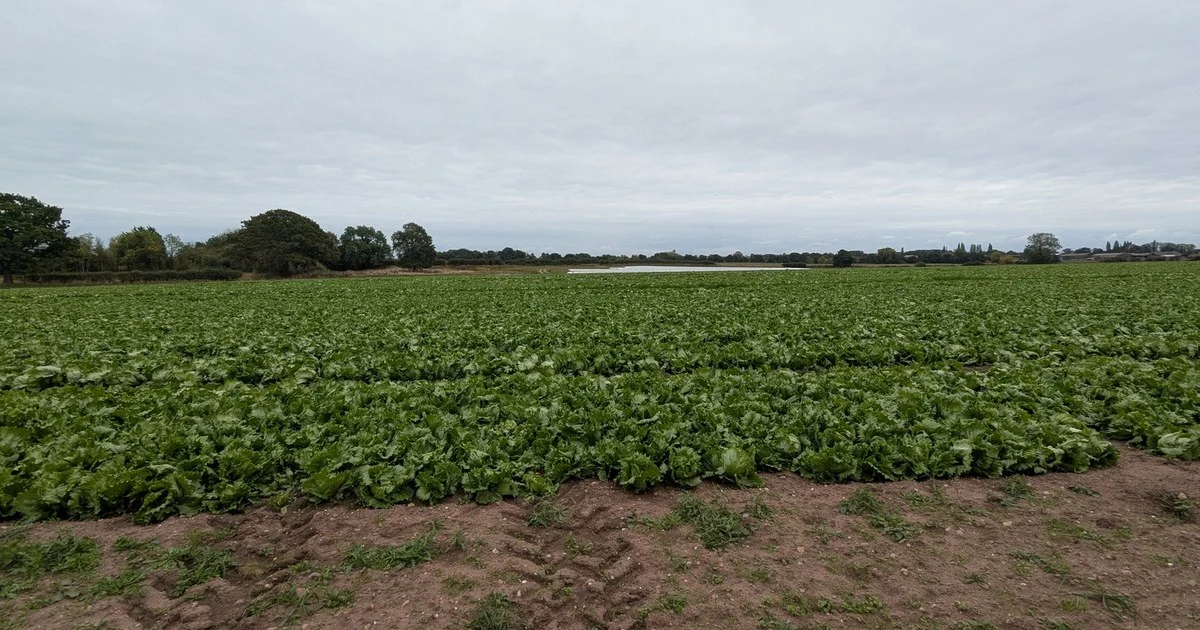
Cover photo: Sandy Gerrard (CC BY-SA 2.0, cropped) · Source
UK Salad And Vegetable Production — Last updated: April 2026. This guide is written from inside the field-veg sector for the field-veg sector. It covers the economics, agronomy, labour, cold chain and supermarket dynamics that decide whether a salad and vegetable holding clears its costs in 2026, and what the recent move to layer some arable into the rotation has taught us. It is general information, not tailored agronomy or business advice. See the action checklist at the end for what to do this season.
The most honest sentence about salad and vegetable growing in this country is that almost nobody outside the sector understands the work. I had a contractor in last August moving grain off a winter wheat field we’d put in for the first time, and he stood by the trailer looking across the road at the iceberg gang we’d had cutting since six that morning. “How much do you get for that?” he asked. I told him. He laughed and said he’d stick to combining.
He wasn’t wrong to laugh. Twenty-one summers in salad and veg, the last two with a slice of arable in the rotation, and I can tell you the iceberg field pays better per acre than the wheat ever will. I can also tell you that on a tight August week, with the gang tired, the spec line getting fussy and a vacuum cooler down for two hours on a Tuesday afternoon, the wheat field looks like the most peaceful place on the farm.
This is the bit of UK farming that the press doesn’t cover and the trade bodies barely fund. AHDB walked away from horticulture in April 2022 after growers voted to scrap the levy.[1] There hasn’t been a national levy-funded research programme for field veg since. The big buyers are consolidating, the labour scheme is shrinking, and Defra’s headline numbers say domestic production keeps inching down while imports keep inching up.[2] Yet salad and veg still puts a lot of food on a lot of British plates, and more of it than people realise comes off farms like ours.
This guide is the conversation I’ve had with our agronomist, our packhouse manager, our seasonal labour provider and most of the neighbours over the last few seasons, written down. If you grow veg, some of it will be familiar. If you don’t, it’s an attempt to explain what the inside of this sector actually looks like.
A way through this story
Where the UK salad and veg sector sits in 2026 — UK Salad And Vegetable Production
The bones of the sector look like this. In 2024 the value of UK vegetable production rose 2.1% to just over £2 billion, with total output up 2.3% to 2.4 million tonnes. The planted area, however, fell 3.5% to 97,000 hectares. Domestic production accounted for 53% of total fresh vegetable supply, down a percentage point on 2023.[2] Protected vegetables (that’s the glasshouse line — tomatoes, cucumbers, peppers, protected lettuce) came in at 235,000 tonnes, the eighth year in a row that protected production has fallen since the 2015 peak.[3]
Read that the right way round. Output is up because yields are up. Area is down because growers are dropping acreage, often the marginal blocks where the irrigation doesn’t quite stretch or the agronomy doesn’t quite work. The fall in self-sufficiency isn’t a story of British growers being beaten on price; it’s a story of fewer of us doing the work, on better blocks, for tighter contracts.
The buyer side has consolidated harder than most outside the sector realise. The Greencore acquisition of Bakkavor closed on 16 January 2026 after the Competition and Markets Authority cleared it in December 2025, creating a convenience-food group running close to £4 billion in annual revenue.[4] The CMA’s specific finding on own-label bagged salad was that the merger raised no competition concerns, which tells you how the market already looked. On the produce side, growers like G’s Fresh out of Cambridgeshire run thousands of staff across the UK and Europe, supplying iceberg, celery, beetroot and onion into Tesco, Sainsbury’s and Asda direct from grower-owned packhouses.[5] If you’re a smaller field-veg holding, you’re either in a marketing group that aggregates volume to those buyers, or you’re selling on the open wholesale market, or you’ve gone direct to box schemes and farm shops. The middle ground, the independent grower selling a couple of artic loads a week to a regional packer, has thinned out year by year.
Where I land on this: the consolidation is a fact of the trade now, not a trend to fight. The serious question for any grower under 200 hectares is whether you’re inside one of the marketing groups or outside it, and whether you have the post-harvest kit to clear the buyer’s spec without paying someone else to do it for you.
The economics: it’s £/kg, not yield/acre
The first thing that catches a combinable-crops grower coming into veg is the unit. We don’t price in tonnes/hectare. We price in pence per kilo, on the spec line, against a contract that has a Class 1 percentage, a rejection percentage and a packhouse cost line that comes off the gate price before you see any of it.
Take an iceberg crop. A working block on contract might run 35,000 to 45,000 marketable heads per hectare, depending on plant population, variety and how kind the August weather has been. The contract gate price varies, but a fair benchmark across a season is somewhere in the 30 to 40p per head zone for Class 1, with a hand-harvest cost that takes 6 to 9p of that off the top before you even get to the field overhead. Multiply through and the gross is meaningful, but every pence of spec failure, every percent of rejection at intake, and every box of unders or overs in the box-fill bites straight into the only line that matters. It’s not the yield map that decides whether the field paid; it’s the rejection rate at the packhouse and the box-fill standard the supermarket QC signs off.
The other line a combinable-crops grower won’t see is the packhouse cost. A modern wash, vacuum-cool and pack operation isn’t cheap. Heuch and similar vacuum coolers, hydro-coolers, the wash line, the bag line, palletisers, cold-store electricity, the QC team, the line foreman and the seasonal pack staff add up to a per-kilo cost that has to be priced into every contract. On the bagged salad line, the packhouse cost can be a bigger number than the field cost. That’s why the buyer relationship is built around the packhouse, not the farm.
The split between contract growing and the open market is the other variable that catches people out. A contract gives you a fixed price (or a fixed plus market-linked floor and ceiling) on a programmed weekly tonnage, in exchange for which you take 100% of the spec risk and the rejection risk. The open market gives you whatever the wholesale market will pay that morning at New Covent Garden or Western International, which on a glut week in August is essentially zero, and on a short week in February is whatever a Spanish import shortfall pushes it to. Most working salad holdings run a mix. The contract pays the bills; the open market either tops it up or pulls it down depending on the year.
If I’m honest, the single most expensive mistake I’ve made in the last decade was over-committing contract volume in a year when our drilling window slipped a fortnight. The buyer wanted the heads. We didn’t have them. The penalty clause was real. Now we underprogramme by about 10% and sell the surplus on the open market in a normal year. In a short year we don’t pay penalties. In a long year we do a bit less well. The asymmetry favours the underprogrammed grower.
Variety selection: the breeding programmes do most of the work
The most underrated piece of agronomy in this sector is varietal choice, and the work is mostly done in continental Europe. Iceberg, romaine, butterhead and the various baby-leaf segments come out of breeding programmes run by Syngenta, Rijk Zwaan, Enza Zaden, Bejo, Vitalis and a handful of others. The British end of the breeding work is real but smaller. Elsoms in Lincolnshire is the substantive UK seed house in this space. The rest of the catalogue arrives off boats from the Netherlands.
The driving variable is disease tolerance, and the disease that drives the iceberg catalogue more than any other is downy mildew. Bremia lactucae mutates fast. The International Bremia Evaluation Board recognised race 41 in July 2024, with races 38, 39 and 40 also emerging in the last couple of seasons.[6] Syngenta’s iceberg lines such as Crispita II and the Merinos wholehead now carry HR (high resistance) ratings against the most recent races; the breeders update the catalogue most years and, in honesty, you read the resistance code on the seed bag the way an arable grower reads the protein on a wheat sample.
Aphid pressure is the other driver. The currant-lettuce aphid (Nasonovia ribisnigri) was largely controlled for a decade by the Nr-resistance gene; some populations have now broken it, particularly in protected baby-leaf, and that has pushed the trade towards stacked-resistance varieties and harder reliance on biologicals. The UC-Davis IPM literature on lettuce mildew remains the best summary I know of how the pathogen, the variety and the spray programme interact, and any working agronomist in this sector reads it.[7]
What I’d actually do on variety selection: pick the resistance package first, the field type and slot date second, and the head shape and bag-line characteristics third. A variety that yields half a head per square metre more but gives away the mildew programme will lose you the field one wet August in five. The reverse rarely happens.
Crop protection: IPM under tight residue specs
The active-substance cupboard for field veg has thinned every year of my working life. Chlorothalonil went; many of the older organophosphates went; the neonicotinoids have been off-licence for outdoor use since 2018, with the sugar-beet emergency authorisations granted up to 2024 reminding everyone that even those exceptions are politically contested.[8] The Health and Safety Executive’s pesticides register is the canonical place to check what’s still approved, and any working grower has it bookmarked.[9]
The supermarket residue specs are the second pinch. Every major UK retailer runs a residue testing programme that rejects loads above a fraction of the statutory MRL, often 50% of MRL, and a handful of buyers operate near-zero policies on specific actives. A spray decision in mid-July is a decision about whether the load will pass intake QC three weeks later. The spray diary isn’t a record-keeping exercise; it’s the document that defends a £20,000 lorry of iceberg when a residue lab raises an eyebrow.
The IPM build is now the working spec, not the optional add-on. Trichogramma releases against caterpillars in protected baby-leaf, Aphidius and Aphidoletes against aphids, sticky-trap monitoring, weather-driven mildew forecasting, full pre-drilling weed kills with the few residual herbicides we still have, and a tighter discipline on rotation length than most outsiders realise. Iceberg back on iceberg ground inside three years is asking for sclerotinia. We push for five.
My take: the loss of actives is permanent and the spec lines are tightening, not loosening. Treat the agronomist as the most important hire on the farm and pay accordingly. A second-rate spray decision in July costs more than a year of agronomy fees.
Drilling, transplanting, harvest: the labour shape of the year
The thing combinable-crops people don’t see is the labour shape. Veg isn’t a four-week harvest with a quiet winter. It’s a continuous drumbeat from March drilling and module transplant through to November harvest, with staff numbers swinging between 10 and 70 on a holding our size depending on the week.
Iceberg is module-raised, not drilled. Tray-grown plants come out of the propagator on a programmed delivery, hit a transplanter behind a tractor at 30,000 to 50,000 plants per hour per row, and go through a drip irrigation set-up the same day. The drilling window for any one block is 24 to 48 hours; miss it and you’ve shifted the cut date out of the contract slot, which costs you penalties or a rejection. Romaine and butterhead are similar. Baby-leaf is direct-drilled at high seed rates and mown rather than picked. Brassicas (cauliflower, cabbage, calabrese) are module-transplanted on the same kit. Carrots and parsnips are precision-drilled, weeded, harvested mechanically and then graded in the packhouse.
The harvest window for a head crop like iceberg is similarly tight. A field reaches commercial cut from one end and walks across in 5 to 10 days, with the gang cutting at the right head weight, dropping into hand-trim, then onto a conveyor on a trailing rig, into bins, onto a tractor and back to the cooler within two hours of cut where you can manage it. Get behind on that, and the head heats in the bin, the inner leaves wilt, and the QC line at the packhouse marks you down on box quality.
The labour intensity of this is the bit nobody outside the sector quite believes. Defra’s June Survey and the Farm Business Survey horticulture data show field veg labour costs running at multiples of combinable crops on a per-hectare basis.[10] On our holding, in round numbers, salad labour runs at five to seven times the equivalent line on the wheat field next to it. That’s not bad management. That’s the crop.
Water: the licence, the reservoir and the climate change reality
Salad and veg is an irrigated business. You can grow wheat in this country on rainfall in most years. You cannot grow iceberg, baby-leaf, brassicas or salad onions on rainfall in any year. A working holding either has surface-water abstraction, groundwater abstraction, a winter-fill reservoir, or some combination of the three.
The Environment Agency licensing regime under the Water Resources Act 1991 treats anyone abstracting more than 20m³/day as a licensed abstractor, and trickle and drip irrigation, which used to sit in an exemption, has been brought into licensing for any system over the de minimis level.[11] New licences are time-limited and reviewed against the local Catchment Abstraction Management Strategy. Two practical realities flow from that. First, an existing licence is now a real asset that goes with the land, and any holding with a long-standing summer abstraction licence is worth more than a comparable holding without one. Second, anybody growing veg without a winter-fill reservoir is one CAMS review away from a problem.
The 2025 National Framework for Water Resources sets out the EA’s working assumption that abstraction headroom is going to tighten across most of southern and eastern England for the rest of this decade.[12] On the ground, that means more growers building reservoirs, more growers paying for them out of capital we’d rather have spent on planting kit, and more growers eyeing the moisture meter through July with one finger over the irrigator switch.
Looking back, I’d say the single best capital decision we made was building the second winter-fill reservoir in 2018. The build cost was material at the time. The cost of NOT having that storage in the dry summers of 2022 and 2024 would have been a multiple of it.
Hand-harvest economics: the picker line
The sector still hand-harvests most of its leafy salad and a fair slice of its head brassicas. There’s been talk of mechanical iceberg cutting since I came into the trade. There are working machines now, and they will become standard on flat blocks of one variety on uniform spacing. They are not yet faster, cheaper or kinder to the head than a good gang.
The picker labour comes overwhelmingly through the Seasonal Worker Scheme. Post-Brexit, free movement ended, and field veg lost the bulk of its EU labour pool. The current scheme runs through Defra-endorsed and GLAA-licensed scheme operators on a quota set annually. The 2024 quota was 47,000 visas (45,000 horticulture plus 2,000 poultry, with a 10,000 contingency). The 2025 quota was 45,000. The 2026 quota is 42,900, with 41,000 of those for horticulture.[13] The quota is shrinking. The wage floor is climbing.
The Migration Advisory Committee’s July 2024 review recommended a guaranteed two months’ pay for incoming workers and a tighter regulatory floor on accommodation and recruitment fees.[14] The Government has accepted parts of that. The minimum hourly rate for Seasonal Workers stands at £12.21 from April 2025, rising to £12.71 from 1 April 2026, in line with the National Living Wage.[15] From 11 November 2025, time on the route is capped at six months in any rolling ten-month period.[16]
In plain English: the labour is harder to get, more expensive, and tied up in more compliance than at any point since I came into the trade. A 100-hectare salad holding can be carrying a labour bill north of £1.5 million in a working year, before pension, NI, accommodation and operator fees. The economics only stack if the spec line clears at intake and the box-fill is right.
What I’d actually do on labour: build the relationship with one or two scheme operators, pay the accommodation properly, and write into your costing model that wage rates will rise in line with NLW for the rest of the decade. Anything that depends on a £10/hr wage is a model that’s already broken.
Cold chain and post-harvest: the four-hour window and the wash line
The thing that separates a working salad business from a struggling one isn’t the field. It’s the cold chain. Lettuce is 95% water and respires hard. Field heat at 24°C, untreated, will halve a head’s shelf life inside 24 hours.[17] The peer-reviewed post-harvest literature is unambiguous on the point: a four-hour delay between cut and pre-cooling produces measurable water loss and shelf-life penalties on arrival at the depot.[18]
The standard tool is vacuum cooling. A vacuum cooler pulls the chamber pressure down, evaporates a fraction of the head’s water, and drops the head temperature from 20°C-plus to around 1°C in 15 to 25 minutes. Hydro-cooling does similar work for a different range of crops. Either way, the bin needs to be in the cooler within an hour or two of cut, and the head needs to be at 0.5°C to 2°C through the rest of the chain to the consumer fridge.
The wash line is the second piece. Bagged salad runs through chlorinated water (typically sodium hypochlorite at 50 to 100 ppm free chlorine, monitored continuously, with pH and ORP control), then a triple rinse, a centrifuge spin to dry, and into modified-atmosphere packaging on the bag line. The microbiology spec on bagged salad is tight: total viable counts, E. coli, Listeria and Salmonella are all monitored on every shift. A failure on a bag line shuts production until the line is cleared, and a recall costs more than most growers’ annual profit.
The supermarket DC delivery window is the third. Bagged salad with a five- to seven-day shelf life has to clear a depot that wants it on shelf the next morning. That means a cut-to-DC time often inside 18 hours. Miss the window, and the buyer walks the load.
If I’m honest, the cold chain is where the real engineering of this sector lives, and it’s also where most of the capital cost sits. A new vacuum cooler is six figures. A bag line with controlled atmosphere kit is seven figures. A grower without that kit either runs through a packing partner who takes a cut, or runs whole-head into a marketing group that does the bagging elsewhere.
Supermarket spec: Class 1, the cosmetic line and the food-waste problem
The Class 1 specification is the heart of the buyer relationship and the bit consumers don’t see. A Class 1 iceberg has a head weight in a defined range (typically 350-650g for retail), a leaf colour and a head shape inside the spec, no visible pest damage, no rib break, no tipburn, and a packed-box weight that hits the supermarket DC tolerance.
The European-marketing standards for fresh produce, which UK retailers map their specifications onto, are framed in EU Regulation 543/2011 and its successors, retained in UK law post-Brexit.[19] The supermarket spec sheets sit on top of that, and they are tighter. A retailer’s iceberg specification can run to several pages on weight, colour, head density, packaging, label position and pallet build. A field that grows a perfectly good crop can still fail intake for a head shape the buyer’s QC team doesn’t like that morning.
WRAP has put a number on this. The fresh produce supply chain in the UK loses around 170,000 tonnes of food to surplus and waste every year, and the front edge of that loss is on the farm.[20] On our own holding, depending on the season and the buyer, anywhere from 10% to 25% of a field’s marketable yield doesn’t make Class 1, sometimes for reasons as small as a wind-mark on the outer leaf. Some of it goes into Class 2 lines (the “wonky” ranges, which pay around 60-70% of the Class 1 price); some goes into processing; some goes to anaerobic digestion or stock feed; a portion is left in the field.
This is the place where the cosmetic standards reality bites hardest. The “wonky veg” press story has been around for a decade. The truth on the ground is that the wonky-veg ranges have grown but they have not grown fast enough to clear the volume that the spec sheets reject. The food waste isn’t because growers grow too much. It’s because the spec line cuts too narrow.
Where I land on this: the spec is the spec, and you grow to it or you don’t grow. But the sector deserves more honesty from the buyers about how much usable food the spec rejects, and the consumer deserves more honesty from the press about why the wonky aisle isn’t bigger.
The veg-on-arable rotation: what we’ve learned in two years
We added arable into the rotation two seasons ago. The driver was straightforward. Land that’s been in continuous salad and veg for fifteen years carries a soil legacy you don’t want — high phosphate indices, compaction from constant trafficking, sclerotinia and lettuce-root-aphid pressure that won’t shift on a four-year rotation. A break crop of winter wheat or spring barley, properly grown, lifts soil structure, drops disease pressure and gives you a cash margin you didn’t have on the same block in salad.
It hasn’t all been straightforward. Arable kit is different kit. The drill is different, the sprayer is different, the combine is somebody else’s. We contract the wheat out for drilling and combining, kept ploughing and primary cultivations in-house, and built a working relationship with a neighbour who brings the combine over for a fortnight each August. The arable margin doesn’t beat the veg margin per acre, but on the blocks where it makes sense (the heavier ground, the wetter end, the field with the awkward access), it pays better than running marginal veg.
The agronomy has been the bigger learning curve than the kit. Wheat doesn’t think like iceberg. Spray timings are different, fertiliser timings are different, the disease set is different. Our salad agronomist knows wheat, but he’s not the wheat agronomist I’d want for a 50-hectare programme, and I’ve leant on a combinable-crops specialist as well. Two agronomists is two invoices, but it’s also two sets of eyes.
What I’d say to anyone thinking about this move: don’t do it on the strength of one bad veg year. Do it because the rotation needs it, the soil needs it, and you have a block of ground where the maths actually works. The break crop pays you back over the next three years of veg, not this year of wheat.
The future: automation, vertical farming, consolidation
The hype cycle on indoor and vertical farming has come and gone, and it’s worth being honest about it. UK and European vertical farming has had a brutal two years. Jones Food Company entered administration on 3 April 2025, taking down the Scunthorpe and Lydney facilities that had been held up as the European benchmark. Vertical Future is reported to be seeking a buyer after material losses. At least 15 European vertical farms have failed since 2022, including Infarm and Agricool. Industry analysis points to electricity at around 60% of operating costs and only about 27% of operations reaching profitability.[21]
That doesn’t mean controlled-environment agriculture is finished. Glasshouse-grown protected lettuce, herbs and tomatoes are real businesses with real economics, and the high-end CEA model for short-shelf-life herbs has a future. But the idea that vertical farming was about to displace field-grown salad in this country was always optimistic, and it hasn’t aged well.
Field automation is the more interesting story. Working harvest robots for iceberg and broccoli are nearer than they were five years ago and further off than the press releases suggest. Weeding robots (Robocrop, Naïo, FarmDroid and a handful of others) have a real role on baby-leaf and brassica blocks, especially with the active-substance cupboard so thin. The labour-saving case for them is going to strengthen every year that the SWS quota tightens and the wage floor rises. I’d say a working-scale salad business in 2030 will look meaningfully different from one in 2020. It still won’t be a vertical farm.
Consolidation is the other inevitability. The Greencore-Bakkavor close in January 2026 was the most visible move. The supermarkets themselves are consolidated. The growers are consolidating. The marketing groups are consolidating. The independent grower selling direct to a regional packer is now a smaller part of the trade than at any point in my working life, and there’s no policy lever in sight that’s going to reverse that.
Tim’s view: what’s good, what’s broken, what working growers should know
What’s good: the British growing base is technically strong, the agronomy is world-class, the breeding catalogue is improving every year, the cold-chain engineering is excellent, and the consumer demand is solid. We grow some of the best leafy salad and field veg in Europe, and we do it on tight margins under tight specs.
What’s broken: the levy-funded research base disappeared with AHDB Horticulture’s exit and hasn’t been replaced. The labour scheme is shrinking annually with no credible plan for what replaces it. The supermarket spec sheets reject more usable food than the public would tolerate if it had transparency on the numbers. The capital cost of post-harvest kit means new entrants are essentially priced out of bagged salad. And the climate trajectory means abstraction headroom is going to be the binding constraint for the rest of the decade.
What working growers should know: the contract relationship is the asset, the packhouse is the engine, the agronomist is the most important hire, and the labour line is going up every year. Build the reservoir. Read the seed catalogue. Keep the spray diary clean. Underprogramme by 10%. And do the conversation with the next generation about whether they actually want to take it on, because this work is harder than the people who haven’t done it think.
A first-week checklist for a working salad and veg holding
If you take nothing else from this guide, do six things this fortnight.
Walk the planting plan with your agronomist and the buyer’s spec sheet beside you. Match every block to a contract or open-market home. Mark the weeks where the labour curve will run hot.
Read the resistance code on every variety in the planting plan. If anything you’re drilling carries a Bremia rating older than two seasons, ring the seed house and ask for an upgrade.
Pull last year’s residue test results. Find any active that’s been on the borderline of buyer spec twice and replace it in this year’s programme.
Check the abstraction licence. If you don’t have a winter-fill reservoir and you grow more than 20 hectares of irrigated leafy salad, get a costed feasibility study off your land agent before this autumn.
Sit with the scheme operator and walk the labour numbers. Build the wage line at £12.71 for the 2026 season and at £13.50-plus for 2027, and price the labour hours into every block honestly.
Do the conversation about the next generation. Is anybody coming through? Is the kit they’ll inherit kit they want to run? If not, what does the exit look like, and on whose terms?
Where this is heading
The Government’s Blueprint to grow the UK fruit and vegetable sector was published in 2023 and is the working policy document for now.[22] The NFU Horticulture and Potatoes Board continues to push for a longer-horizon labour scheme, a real research replacement for the lost AHDB Horticulture function, and supermarket-supply-chain reform under the Groceries Supply Code of Practice. The British Growers Association continues to do the working-level coordination across most of the field-veg sub-sectors and is the closest thing the trade has to a national voice.[23]
The political picture is less helpful than it should be. Field veg sits across the seam between the Defra brief, the Home Office brief (labour) and the Department for Business and Trade brief (supermarket regulation), and no minister owns the file. That isn’t going to change quickly. The work, in the meantime, carries on. Growers grow. Packhouses pack. Supermarkets sell. And the bit of British agriculture that puts a daily salad on a million tables keeps doing the work largely out of public view.
If you’re reading this and you’re outside the sector: come and see a salad cut at five in the morning before you decide what you think of British produce. If you’re inside the sector: book the holiday in February, walk the blocks twice a week, and keep your eye on the spec line. That’s the work.
Sources
[1] AHDB, Horticulture and Potatoes: ballot results, ahdb.org.uk; The Grocer, Growers vote to abolish AHDB’s compulsory horticulture levy, 19 March 2021: https://www.thegrocer.co.uk/sourcing/growers-vote-to-abolish-ahdbs-compulsory-horticulture-levy/653257.article; Defra, Government responds to the consultation to reform the AHDB, gov.uk: https://www.gov.uk/government/news/government-responds-to-the-consultation-to-reform-the-ahdb
[2] Defra, Horticulture statistics 2024, gov.uk: https://www.gov.uk/government/statistics/latest-horticulture-statistics/horticulture-statistics-2024
[3] Defra, Horticulture statistics 2024, gov.uk; Defra, Agriculture in the United Kingdom 2024, gov.uk: https://assets.publishing.service.gov.uk/media/6881de3ff47abf78ca1d35b0/agriculture-in-the-uk-2024.pdf
[4] Competition and Markets Authority, Greencore Group plc / Bakkavor Group plc merger inquiry, gov.uk; Greencore press releases, 2 April 2025 and 16 January 2026.
[5] G’s Fresh, About G’s Fresh, gs-fresh.com.
[6] International Bremia Evaluation Board (IBEB-EU), Race nomenclature update 2024; Syngenta Vegetable Seeds, Resistance to new Bremia races, syngentavegetables.com: https://www.syngentavegetables.com/en-gb/news/syngenta-updates/syngenta-extends-downy-mildew-resistance-cover-all-three-new-official-races
[7] University of California Statewide IPM Program, Downy Mildew, Lettuce: Pest Management Guidelines, ipm.ucanr.edu.
[8] Health and Safety Executive, Bees and Neonicotinoid Insecticides, hse.gov.uk: https://www.hse.gov.uk/pesticides/reducing-environmental-impact/background-information-on-use-of-neonicotinoid-pesticides.htm
[9] Health and Safety Executive, Active substances approved for use in pesticides, hse.gov.uk: https://www.hse.gov.uk/pesticides/active-substances/register.htm
[10] Defra, Farm Business Survey: Horticulture in England 2023/24, farmbusinesssurvey.co.uk: https://farmbusinesssurvey.co.uk/wp-content/uploads/2025/10/Horticultural-Production-in-England-2023-24.pdf
[11] Water Resources Act 1991, ss.24-27, legislation.gov.uk; Environment Agency, Apply for a water abstraction or impounding licence, gov.uk: https://www.gov.uk/guidance/water-management-apply-for-a-water-abstraction-or-impoundment-licence
[12] Environment Agency, National Framework for Water Resources 2025, gov.uk: https://www.gov.uk/government/publications/national-framework-for-water-resources-2025-water-for-growth-nature-and-a-resilient-future/10-water-resources-planning-and-abstraction-licensing-national-framework-for-water-resources-2025
[13] Defra/Home Office, Government provides certainty to horticulture and poultry businesses, gov.uk: https://www.gov.uk/government/news/government-provides-certainty-to-horticulture-and-poultry-businesses; Defra, Seasonal Worker visa allocations 2026, gov.uk.
[14] Migration Advisory Committee, Review of the Seasonal Worker visa, July 2024, gov.uk: https://www.gov.uk/government/publications/seasonal-worker-visa-review/review-of-the-seasonal-worker-visa-accessible
[15] Home Office/Defra, Seasonal Worker visa guidance, gov.uk: https://www.gov.uk/seasonal-worker-visa; Low Pay Commission, National Living Wage rates from 1 April 2026, gov.uk.
[16] Home Office, Seasonal Worker visa: time-cap rule changes from 11 November 2025, gov.uk.
[17] Kader, A. A. et al., Postharvest Technology of Horticultural Crops, University of California ANR Publication 3311.
[18] Brosnan, T. and Sun, D-W., Precooling techniques and applications for horticultural products: a review, International Journal of Refrigeration 2001; Hui, Y. H. et al., Handbook of Vegetables and Vegetable Processing.
[19] Commission Implementing Regulation (EU) No 543/2011 (laying down detailed rules for the application of Council Regulation (EC) No 1234/2007 in respect of the fruit and vegetables and processed fruit and vegetables sectors), retained EU law post-Brexit.
[20] WRAP, Quantification of food surplus and waste in the UK grocery supply chain, wrap.ngo: https://www.wrap.ngo/taking-action/food-drink/food-types/fresh-produce
[21] FreshPlaza, Jones Food Company enters administration, 3 April 2025; AgTechNavigator, Vertical farmer Jones Food Company enters administration, agtechnavigator.com.
[22] Defra, A blueprint to grow the UK fruit and vegetable sector, gov.uk: https://www.gov.uk/government/publications/a-blueprint-to-grow-the-uk-fruit-and-vegetable-sector/a-blueprint-to-grow-the-uk-fruit-and-vegetable-sector
[23] British Growers Association, britishgrowers.org; NFU Horticulture and Potatoes Board, nfuonline.com.
About the author
Tim Harfield runs a salad and vegetable holding in Suffolk and has done for 21 years. The bulk of the work has been leafy salad and field veg into the supermarket programme, with a packhouse on site and the usual cold-chain headaches. The last two seasons we’ve added a slice of arable into the rotation, partly for soil health on the older blocks and partly because the maths on a long break crop finally added up. The arable end is new ground; the veg end is the work we’ve done for two decades.
The headline: salad and veg is a more technical, more capital-hungry and more labour-dependent corner of UK farming than most people outside it understand. If you grow it, the contract relationship and the cold chain are the two assets that decide whether you clear your costs. If you eat it, every Class 1 head you pick up has somebody’s six-in-the-morning hand-cut behind it. BritFarmers is independent, takes no commission, and is written by working growers for working growers.
See also
You’ve reached the end of this story.