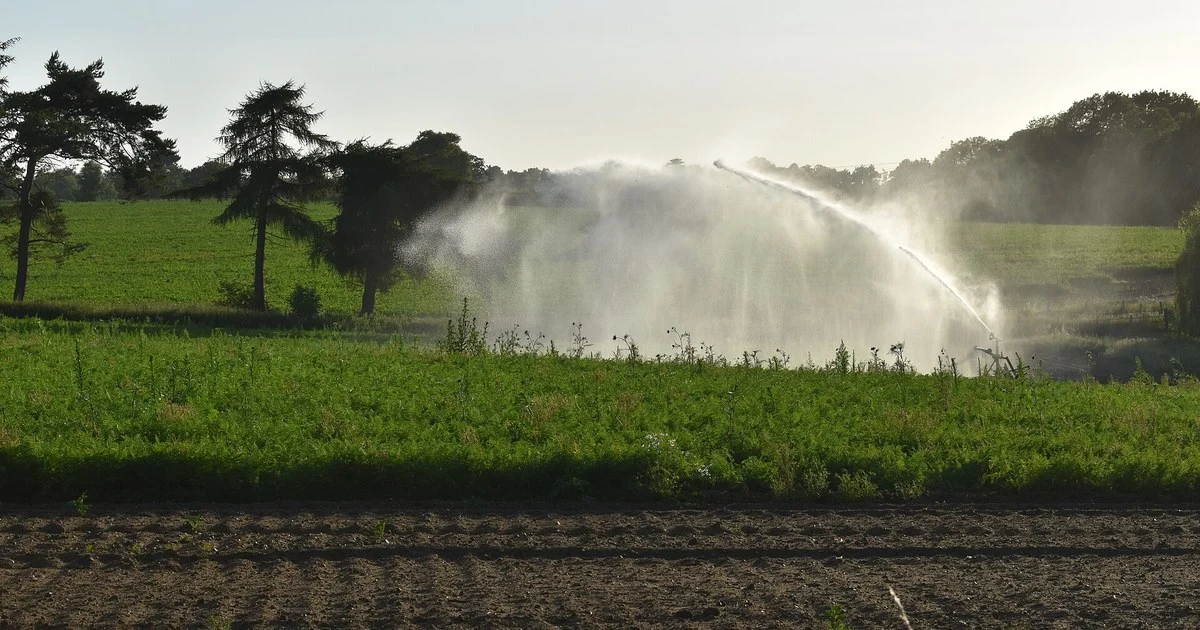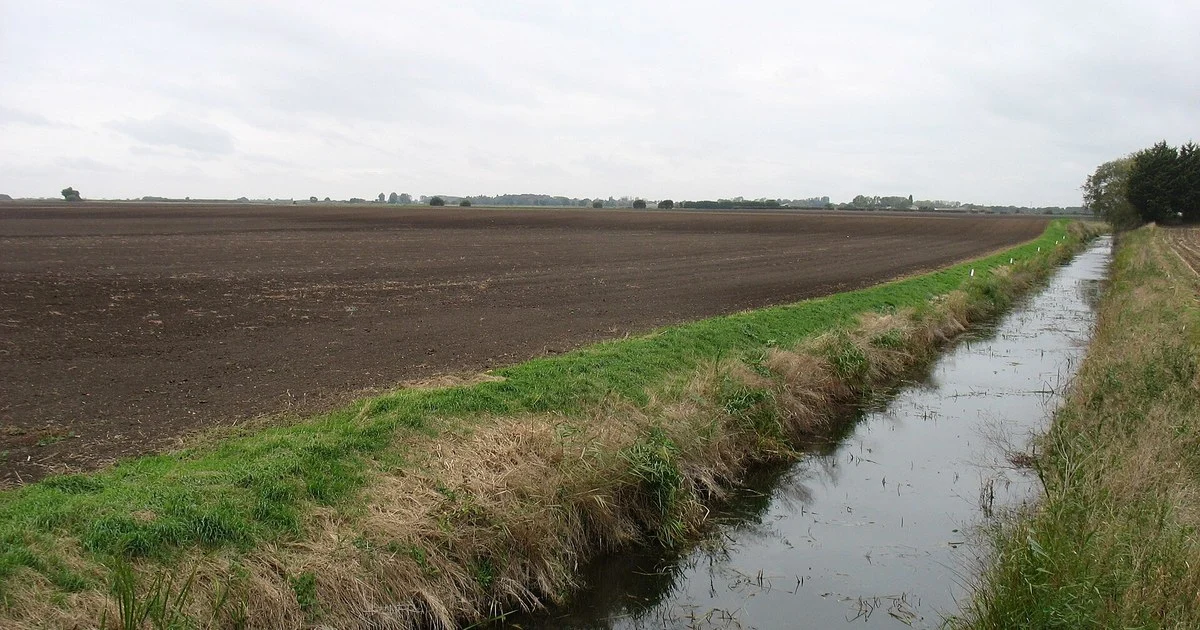
Cover photo: David Purchase (CC BY-SA 2.0, cropped) · Source
Last updated: June 2026. A working farmer’s walk through field drainage in 2026: why the post-war drainage grants set the working baseline, how plastic underdrains actually behave 30 to 60 years on, the signs of failing systems most growers miss until it’s too late, the SFI and Capital Grants money currently available, mole-ploughing as the cheapest intervention and the contractor-grade jobs that are not, the planning permissions and Defra rules that catch people, and the working drainage plan I’d start tomorrow if I were taking on a wet field for the first time. General information, not engineering advice. See the drainage-audit checklist at the end for the six steps to take before the next wet October.
The conversation about drainage on this holding started in late October two years ago, when the bottom 14 hectares of what was about to become our first wheat field stood under three inches of water for four days after a 38 mm rainfall event. The previous occupier had farmed the same block for grass and contract sheep grazing for fifteen years, and the field had behaved acceptably as a wet pasture. The same block as a winter wheat field was a different proposition entirely. Twenty-three years on this holding, twenty-one of those in salad and field vegetables where you choose the well-drained fields and leave the wet ones to grass, and the addition of arable on heavier land was the moment drainage stopped being somebody else’s problem.
This is what I learnt after a winter of evening reading and three site visits from drainage contractors, and what I would actually do if I were taking on a known wet field with the intention of growing arable on it. It is written for a working farmer running a small or medium UK holding, sat at the kitchen table with a topographic map and a wet patch they want to understand.
A way through this story
The drainage system you inherited
Most British arable land was drained in the 60 years between 1939 and 1990, funded by a sequence of state grant schemes that put roughly around 6.4 million hectares of UK farmland under organised drainage at public expense.[1] The Field Drainage Grant Scheme, the Agricultural Improvement Scheme and the various Defra antecedents paid 30 to 70 per cent of the cost of installing tile, clay-pipe and then plastic drainage from the 1940s onwards. The peak year for installed drainage peaked in the mid-1970s, when grant-funded works covered more than 100,000 hectares of UK farmland in a single year.[2]
What that means in practice is that under almost every arable field in lowland Britain there is a drainage system, installed somewhere between 30 and 80 years ago, that you didn’t put in, you have no plan for, and that is at or near the end of its design life.
The materials vary by era. Pre-1965 systems are mostly clay pipe (short rigid sections, 50 to 75 mm bore, butt-jointed). 1965 to 1975 systems are often the transitional perforated concrete pipe. From the mid-1970s onwards the standard became corrugated plastic perforated drain pipe (50 to 100 mm bore for laterals, 100 to 150 mm for collectors), the system used on essentially every drainage installation since.[3]
The design life of plastic underdrains under typical UK farming conditions was estimated at 50 to 80 years in the original installation specifications, with the failure modes being silt accumulation, root ingress, pipe collapse from compaction and outfall failure where the drain emerges into a ditch.[4] The first generations of plastic drainage are now hitting the upper end of their design life. The second generation is in mid-life. The clay-pipe systems are mostly beyond it, though clay pipe in undisturbed conditions can last 100 years or more.
The implication for a working holding: the drainage you inherited is doing some of the work it used to. How much depends on field-by-field condition that has rarely been mapped or monitored. The first task of a drainage plan is to find out what’s actually under each field.
The map you didn’t know existed
The British Field Drainage Drawings, held now by the Ministry of Agriculture, Fisheries and Food’s successor at Defra and at the relevant county and National Archives, contain the design plans for most field drainage installed under the grant schemes between 1940 and 1990.[5] The plans are not always easy to find and they are not always complete, but for grant-funded work the as-built drawings were a requirement of the scheme.
The first place to look is the Local Land Charges register at the relevant district or unitary council. The second is the National Archives at Kew, which holds the Ministry’s regional drainage files. The third, and the one that yields most often, is the previous occupier or owner. A box of yellowed drawings in an old farm office desk is the working source for most drainage plans I have seen in the field.
If no plans exist, the working alternative is a drainage survey. A drainage contractor will walk the field with a long-armed metal detector or a ground-penetrating radar set and locate the drainage lines, the depths and the outfalls. The cost for a 10-hectare survey runs £400 to £1,200 depending on the kit and the field condition. The output is a sketch plan and a list of suspect locations. It is the working baseline for any subsequent investment in drainage repair.
The fields that have never been drained at all, the wet hollow at the back of the holding or the boggy corner by the river, are the rare ones. Almost every arable field in lowland Britain has some form of drainage from some era. The question is how well it works.
Signs of failing drainage every working farmer should know
The visible signs of failing field drainage are clear once you know what you’re looking for, and most fields show them long before the failure becomes a crisis.
Standing water in patterns. Standing water in a band across a field, particularly in the same place after every wet event, is a collector or lateral drain failure. Standing water in a single corner is usually an outfall failure or a blocked collector. Standing water in a broad area is the drainage system collectively under-performing.
Linear strips of poorer growth. In an arable crop, linear strips of stunted or yellowing growth that run parallel and at consistent spacing are usually an underdrain pattern, with the drains under the better-growing rows and the lateral runs across the poorer rows. The pattern often emerges in May or June as the crop demands more water and the saturated zones lag behind.
Rush invasion in pasture. Soft rush (Juncus effusus) and hard rush (Juncus inflexus) are the diagnostic species of failing field drainage in lowland pasture. A field with patches of rush colonisation has surface or near-surface saturation. A field with widespread rush has lost most of its drainage.
Wet weather track damage that doesn’t recover. Tractor tracks across a wet field that hold water for weeks and do not recover indicate a drainage problem either at the surface (compaction) or in the subsoil (drain failure).
Outfall problems. Walk the field boundary ditches in October. The drainage outfalls (the perforated pipes emerging through the ditch bank) should be flowing during wet weather and dry between events. A silted-up, collapsed or grown-over outfall means the drainage line behind it is dumping water back into the field instead of discharging into the ditch.
Soil sampling at depth. A spade pit dug to 60 to 80 cm in late winter tells you what is going on below the surface. A gleyed (grey-blue, anaerobic) layer at 30 to 50 cm depth that is the same in March as it was in June indicates a drainage problem. Healthy soil at the same depth shows oxygenated structure (red, brown, ferritic) all year round.
The single best diagnostic walk is one taken in late January or February of a wet year, with a notebook, marking the standing water patterns. The pattern is the diagnosis. The repair plan follows from the diagnosis, not from a generic textbook approach.
Mole-ploughing: the cheapest field intervention
Mole-ploughing is the cheapest intervention on a working drainage problem and the most often overlooked. A mole-plough pulls a torpedo-shaped foot (the “mole” itself) at 40 to 60 cm depth through clay or heavy clay-loam soil, leaving a permanent channel a few centimetres in diameter. The channel acts as a temporary drain that connects surface water to the existing collector system below, and lasts 5 to 12 years in good clay before the channel collapses and needs re-pulling.[6]
The kit needed is a mole plough on the back of a 130 hp+ tractor in good draft conditions. The cost is roughly £80 to £140 per hectare contracted, or £50 to £90 per hectare if you have the kit and the operator. The job is done in late summer or early autumn when the clay is just-moist enough to hold the channel open but not so dry it fractures or so wet it smears.[7]
Mole-ploughing works on clay and heavy clay-loam soils. It does not work on sandy soils, gravelly soils or anything where the channel collapses immediately. It is the right intervention on roughly half of British arable land and has no effect at all on the other half.
The pattern matters. Mole-ploughing perpendicular to the existing collector drain (so the moles cross the existing system and feed water into it) is the working layout. The mole spacing is typically 2 to 4 metres apart, depending on rainfall and slope. The mole depth is 40 to 60 cm depending on soil and existing drainage depth.
A well-pulled mole system on suitable soil, into a working collector system, can recover 80 to 90 per cent of the drainage capacity of a tired field for one-tenth the cost of a full re-drainage job. It is the first thing I would do on any field with a drainage issue and existing collectors that I believed were still functioning.
When you need a full re-drainage job
The full re-drainage job is the expensive end of field drainage and the only honest answer when the original system has substantially failed. The cost in 2026, contracted, runs £1,800 to £3,800 per hectare for a typical lowland clay-loam field with a standard drainage pattern, before any allowance for difficult ground, deep collectors or unusual conditions.[8] On the heaviest land or in the deepest installations, the cost can run £5,000+ per hectare. The job involves laying perforated plastic pipe at typical depths of 80 to 120 cm in a herringbone or grid pattern, connecting laterals (50 mm pipe at 8 to 20 metre spacing) to a collector (100 to 150 mm pipe at field-edge or central location), and bringing the collector to a designed outfall at a field boundary ditch.
The capital outlay is significant. On the 14-hectare block I described at the start of this guide, a full re-drainage estimate from a local contractor came in at £42,000. The same block can be mole-ploughed for under £2,000. The decision between the two depends on whether the existing collectors are working. In our case the contractor’s investigation showed the collectors were 1970s plastic, were silted but largely intact, and could be flushed and re-jetted to recover most of their function. We pulled moles in late August, the wheat went in clean in October, and the field has held up properly through two winters since. The full re-drainage option was deferred and may now never be needed.
The decision tree is roughly:
- Outfalls clear and flowing in wet weather: collectors probably working. Mole-plough is the right next step.
- Outfalls silted or collapsed but locatable: clear them, jet the collectors, then mole-plough. Mid-range cost.
- Outfalls absent or unfindable, system age over 50 years, mole-ploughing makes no difference: full re-drainage is required.
The Defra and AHDB working guidance is to investigate the cheap interventions first, document the outcome, and only commit to full re-drainage when the evidence supports it.[9]
The SFI and Capital Grants money available
Drainage-related work has been intermittently eligible under the Defra Capital Grants schemes since 2015, with eligibility expanding and contracting with each scheme reset.[10] The Capital Grants 2024-2026 round (with new windows opening across 2026 under the next scheme generation) includes items for:
- New and replacement field drainage (capital cost contribution, typically 40 to 60 per cent of contractor cost, with capped per-hectare rates)
- Drainage outfall repairs and headwall replacements
- Reedbed and constructed wetland treatment systems (for managing field drainage discharge under Nitrate Vulnerable Zone rules)
- Buffer strips alongside watercourses (for managing drainage discharge water quality)
The detail of which items are funded and at what rate moves with each Capital Grants window. The Rural Payments Agency Capital Grants pages and the Catchment Sensitive Farming officer’s regional grants information are the working source.[10] The catch is the Capital Grants window is usually open for a limited period each year and is heavily oversubscribed for water-quality items.
SFI 2026 includes a number of buffer and water-management actions that can interact with drainage:
- BFS1 (12m to 24m watercourse buffer strip on cultivated land): £707/ha/year
- BFS6 (6m to 12m habitat strip next to watercourses): £742/ha/year
- CIGL3 (4m to 12m grass buffer strip on improved grassland): £235/ha/year
- WBD2 (Manage ditches): check the current GOV.UK action page before budgeting, because ditch actions and boundary rules have changed between SFI versions
The SFI actions pay annual per-hectare or per-metre rates rather than capital costs, and stack with Capital Grants for the upfront infrastructure. Modelling both into a drainage project gets the cost of a contractor-grade job down to a number a working farm can actually finance.[11]
The combination of Capital Grants for the physical infrastructure and SFI for the ongoing management is the working financial model for a full drainage project in 2026. The annual SFI payments on a properly modelled scheme can fund 40 to 60 per cent of the financing cost of the Capital Grants-eligible work. Our SFI 2026 Actions Explained guide covers the SFI actions in more detail.
Internal drainage boards and the role they play
Internal drainage boards (IDBs) are statutory bodies in low-lying parts of England that manage the main drainage systems on a regional basis. Most of the East of England (the Fens, the Norfolk and Suffolk coastal marshes, the Somerset Levels, parts of Yorkshire and Lincolnshire and a number of smaller areas) sits in an IDB.[12] The IDB maintains the main carriers, the main pumps and the major outfalls into watercourses or the sea. The IDB also levies a drainage rate on land within the IDB area, billed annually.
For a farmer in an IDB area, the field drainage on your holding is the network that connects into the IDB’s main system at the field-boundary ditch. If the IDB’s main carrier is silted, choked or under-pumped, your field drainage cannot discharge regardless of how good it is on the field side. Conversely, an underperforming IDB main carrier is the first thing to investigate before spending capital on field drainage that has nowhere to discharge to.
The Association of Drainage Authorities (ADA) publishes the IDB membership and contact list.[13] Engaging early with the local IDB engineer when planning major field drainage works is the working norm. The IDB has the regional knowledge, the consent regime for new outfalls into main carriers, and often a complementary investment plan.
Planning permissions and Defra rules that catch people
Field drainage work itself does not normally require planning permission. It is “agricultural permitted development” under the Town and Country Planning (General Permitted Development) (England) Order 2015.[14] The exceptions catch people regularly.
Discharging into a designated watercourse may require an Environmental Permit from the Environment Agency or Natural Resources Wales, particularly where the discharge could contain agricultural pollutants (slurry runoff, fertiliser runoff or pesticide residues).[15] The threshold for needing a permit is set by the type and volume of discharge.
Working within or alongside a designated watercourse (an “ordinary watercourse” or a “main river”) requires Land Drainage Consent from the relevant authority (the Environment Agency for main rivers, the local authority for ordinary watercourses, or the IDB where one exists).[16] This includes new outfalls, headwall replacements, ditch deepening or widening, and any work that affects flow.
Working in a Nitrate Vulnerable Zone (NVZ) brings the NVZ regulations into play, which constrain nutrient applications and require specific record-keeping but do not directly affect drainage installation.[17]
Working in a Site of Special Scientific Interest (SSSI), in a designated peat soil area, or on land subject to the Habitats Directive may require Natural England consent and can constrain or prohibit drainage works altogether. The Defra peat-soil restoration agenda since 2021 has hardened the position on draining peat soils; in the Fens and on the Somerset Levels, deep drainage of carbon-rich peat is now actively discouraged on policy grounds and may be prohibited on grant-eligible land.[18]
The pragmatic answer is to call the Environment Agency, the IDB engineer (if applicable), the local authority drainage officer and Natural England (if there is any designated land in the catchment) at the planning stage of any drainage project. Late-stage discovery of a consent requirement can stop a job and force expensive redesign.
Working drainage on heavier crops and pack-house yards
The drainage conversation is not only about the field. The pack-house yard, the slurry pad, the muck-heap area and the silage clamp are all SSAFO-regulated areas (Silage, Slurry and Agricultural Fuel Oil Regulations) and need drainage that meets specific standards.[19] Our UK Slurry, Silage and SSAFO 2026 guide covers the SSAFO side in detail.
Drainage on a pack-house yard for wash-water and washdown runoff is regulated under the Environmental Permitting Regulations and may require an environmental permit or a discharge consent depending on volume and content.[15] Combined sewer connections, soakaways or constructed reed-bed treatment systems are the three options. The right answer depends on the volume, the site context and the local environmental sensitivities.
For salad and vegetable holdings (and parts of horticulture more broadly), the wash-water discharge volumes can be substantial during peak season. Constructed wetland and reed-bed treatment of pack-house wash-water has been a working solution for some holdings, supported by Capital Grants and SFI as relevant.
Climate change and the rainfall direction of travel
The Met Office UK climate projections (UKCP18 and the subsequent updates) are consistent in their projection of wetter winters and a higher frequency of intense rainfall events over the next 30 years.[20] The South and East of England, where most arable land sits, sees the most pronounced shift in winter rainfall and the most pronounced increase in intense rainfall events.
The implication for drainage is that the systems sized to 1970s climate conditions are now under-sized for current conditions. A typical 1975 drainage installation was designed for a 1-in-2-year rainfall event of around 12 to 15 mm/hour. The same field in 2026 sees a 1-in-2-year event of 15 to 20 mm/hour. The drainage system, even when functioning, is no longer the size it should be.
This is not a reason to abandon repairs of existing systems; the repaired system still does substantial useful work. It is a reason to think about resilience rather than restoration when sizing a full re-drainage installation. Closer lateral spacing, larger collector diameter and oversized outfalls add modest cost at installation and substantial resilience to future rainfall.
The Environment Agency‘s catchment-scale work and the Defra-funded flood resilience programmes have begun to consider land drainage as part of catchment flood management.[21] Whether catchment-scale drainage funding becomes accessible to working farms over the next five years depends on policy direction.
A worked drainage example
A worked example, taking our 14-hectare wet bottom field as the case:
Year 1 (the inheritance year): Standing water October to March. Walked the field with the agronomist in January, marked the standing water patterns. Walked the ditches in February, found two silted outfalls and one collapsed outfall.
Year 1 summer: Booked a drainage contractor for a survey. Located the existing collectors (1973 plastic, two parallel lines 28 metres apart). Cleared the silted outfalls (£200 contractor time). Jetted the collectors (£800). Re-built the collapsed outfall with a new headwall (£1,200).
Year 1 late summer: Mole-ploughed the field at 3 metre spacing perpendicular to the collectors (£1,650 contractor cost). Drilled the field with winter wheat in mid-October on a dry seedbed.
Year 2 (the first arable year): Field held up through 110 mm of December rainfall. Standing water only in one small corner (under investigation; likely an unrelated localised issue). Wheat yield 8.1 t/ha, ahead of the holding average.
Year 3 (the current year): Field continuing to perform. Moles re-pulled in late August (£1,400 contractor cost) as a maintenance intervention. A BFS1 watercourse buffer strip along the cultivated ditch margin would currently pay £707 a hectare per year on the eligible strip area, if the land and width meet the GOV.UK action rules.
Total drainage capital outlay over the first three years: £5,250. Recovered yield: roughly 1 to 1.5 tonnes per hectare per year on the 14-hectare block, worth £2,400 to £3,900 in additional gross output per year at current wheat prices. Payback period: under two years on the capital. The mole-ploughing repeat is a maintenance cost we now budget for at three to five-year intervals.
The point of the example is that the cheap interventions, applied in the right order to a properly diagnosed problem, recovered most of the field’s productive capacity for a fraction of the cost of a full re-drainage job.
A six-step drainage-audit checklist
Six things to do before the next wet October on any field that has shown drainage issues.
Walk the field in late January or February of a wet year. Take a notebook. Mark every standing-water area and every visible drainage pattern on a sketch plan. The pattern is the diagnosis.
Walk the field boundary ditches in November. Locate every outfall. Note which are flowing, which are silted, which have collapsed, which cannot be found. Photograph every one.
Get the drainage plans if they exist. Old farm office desk, the previous occupier, the National Archives, the IDB engineer (if applicable). The drawings tell you what was put in and where.
Book a drainage contractor for a survey if the plans are missing. £400 to £1,200 for a 10-hectare survey. The output is the working baseline for any subsequent investment.
Investigate the cheap interventions first: outfall repairs, collector flushing, mole-ploughing. Document the outcome. Only commit to full re-drainage when the cheap interventions have been demonstrated insufficient.
Model the Capital Grants and SFI overlay into any drainage project. The combined funding can fund 40 to 60 per cent of the cost of a contractor-grade job in the right circumstances.
Where this is heading
Three forces will shape field drainage on working UK farms over the next five years.
The first is climate. Winter rainfall and intense rainfall frequency are rising. The drainage systems installed in 1965 to 1985 are now under-sized for current rainfall and substantially under-sized for the rainfall expected by 2050. Resilience rather than restoration is the working frame for any new installation.
The second is policy on peat. The Defra position on draining peat soils has hardened since 2021 and is likely to harden further. On peat-soil land, the working assumption should be that deep drainage is no longer policy-supported and that paludiculture (wet farming, the cultivation of crops that tolerate or require saturated conditions) is the direction of travel for the most peat-rich land.[22]
The third is the integration of catchment-scale water management into farm-level decision-making. The Catchment Sensitive Farming programme, the Catchment Partnerships under the Water Framework Directive transposition, and the next iteration of agri-environment funding will increasingly treat field drainage as a catchment-scale issue rather than a farm-scale one. Engagement with the catchment partnership and the regional Environment Agency officer is increasingly the working norm.
The thing that will not change is that on a working arable holding in lowland Britain, drainage is the foundation of everything else. The best agronomy in the world cannot rescue a field that holds water for six weeks every winter.
Further reading
The Defra drainage policy archive and the Environment Agency‘s Land Drainage Consent guidance are the canonical reference for drainage works in England.[5] AHDB and ADAS publish the working agronomic and engineering guidance for field drainage.[9] The Association of Drainage Authorities (ADA) is the trade body for internal drainage boards.[13] Natural England provides the working guidance on drainage in designated landscape and habitat areas.[18] For BritFarmers readers, this guide sits alongside our SFI 2026 Actions Explained guide, our UK Soil Health 2026 guide, our UK Water Resources and Abstraction 2026 guide and our UK Slurry, Silage and SSAFO 2026 guide.
Sources
[1] Defra and predecessor ministries, Field Drainage Grant Scheme and subsequent agricultural drainage funding history; House of Commons Library briefings on agricultural drainage history.
[2] Ministry of Agriculture, Fisheries and Food, Annual statistics on field drainage works, 1939-1990, archived at the National Archives, Kew.
[3] British Standards Institution, BS 4962 Plastics pipes and fittings for use as subsoil field drains, and successor BS EN 1852.
[4] ADAS and HR Wallingford, Field drainage design and performance: engineering manuals, originally published for MAFF.
[5] Defra and the National Archives (Kew), Land Drainage archive holdings: https://www.nationalarchives.gov.uk/.
[6] AHDB, Mole drainage: principles and practice, ahdb.org.uk.
[7] ADAS, Mole ploughing: working guidance, adas.co.uk.
[8] National Association of Agricultural Contractors (NAAC), Annual contracting rates survey: drainage and earthmoving rates, naac.co.uk.
[9] AHDB and ADAS, Field drainage investigation and decision support, ahdb.org.uk.
[10] Rural Payments Agency and Defra, Capital Grants 2024-2026: eligible items and rates, gov.uk: https://www.gov.uk/find-funding-for-land-or-farms.
[11] Defra and Rural Payments Agency, Sustainable Farming Incentive (SFI) handbook: water management actions, gov.uk: https://www.gov.uk/government/collections/sustainable-farming-incentive-guidance-for-applicants-and-agreement-holders.
[12] Environment Agency and Defra, Internal drainage districts in England, gov.uk.
[13] Association of Drainage Authorities (ADA), About IDBs and member directory, ada.org.uk.
[14] Town and Country Planning (General Permitted Development) (England) Order 2015, Part 6, legislation.gov.uk: https://www.legislation.gov.uk/uksi/2015/596/contents.
[15] Environment Agency, Environmental Permitting Regulations: agricultural discharges, gov.uk.
[16] Environment Agency and Defra, Land Drainage Consent guidance, gov.uk: https://www.gov.uk/guidance/land-drainage-applying-for-consent-to-do-work-on-a-watercourse.
[17] Defra, Nitrate Vulnerable Zones: rules and obligations, gov.uk.
[18] Defra and Natural England, Peat and lowland peat soils policy, gov.uk.
[19] Defra, Storing silage, slurry and agricultural fuel oil (SSAFO) regulations, gov.uk.
[20] Met Office, UK Climate Projections (UKCP18), metoffice.gov.uk.
[21] Environment Agency, Catchment Sensitive Farming and Water Framework Directive implementation, gov.uk.
[22] Defra and Natural England, Paludiculture and wet farming research, gov.uk; UKCEH and partner research on lowland peat farming.
About the author
I run a salad and field vegetable holding in Suffolk, twenty-three years on the same ground, the last two with a slice of wheat and oilseed rape rotated in alongside the iceberg, baby-leaf and brassicas. The drainage conversation started when the arable went in on a field that had been adequate as a wet pasture and was no longer adequate as a winter wheat field. The notes above are the working framework I went back to first principles on, with help from a drainage contractor and an evening of reading the ADAS engineering manuals that nobody talks about until they need to.
The headline: investigate cheap before expensive. Walk the field in February, walk the ditches in November, mole-plough before re-draining, and engage with the IDB and Environment Agency before any major capital outlay. The cost of getting drainage right is the floor on which every other arable decision sits.
Disclaimer: This guide is general information about UK field drainage practice in 2026. It is not engineering or regulatory advice and is not a substitute for tailored guidance from a chartered drainage engineer, the Environment Agency, your local Internal Drainage Board (if applicable) or Natural England. Land Drainage Consent, Environmental Permits, Capital Grants and SFI rates change; always confirm the current position before relying on it.
You’ve reached the end of this story.