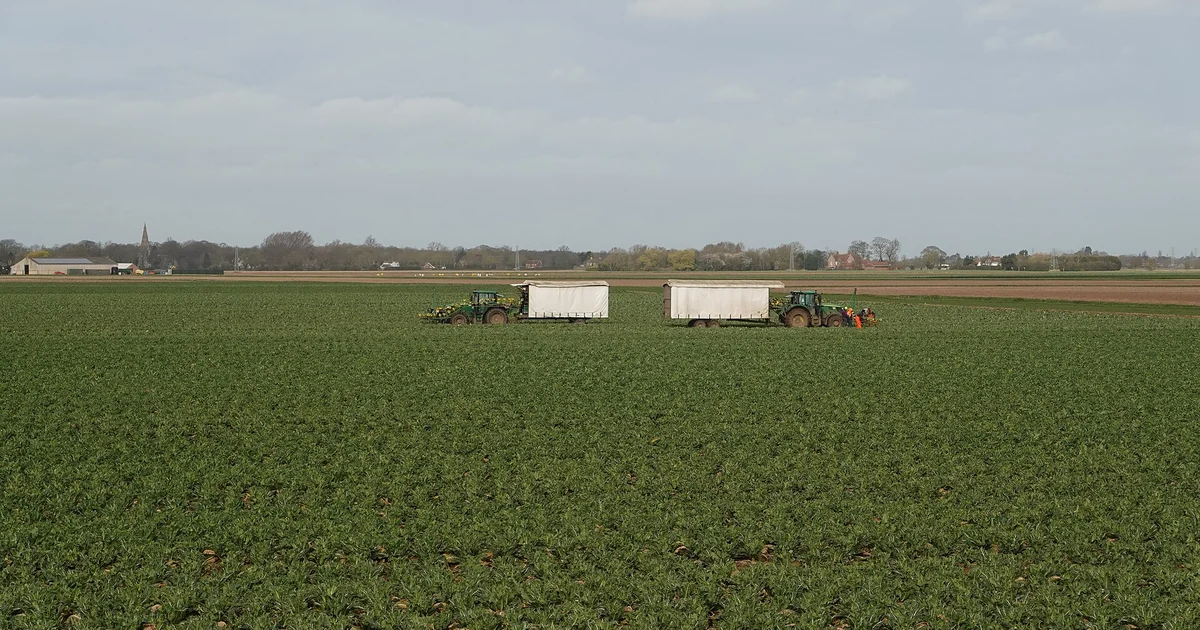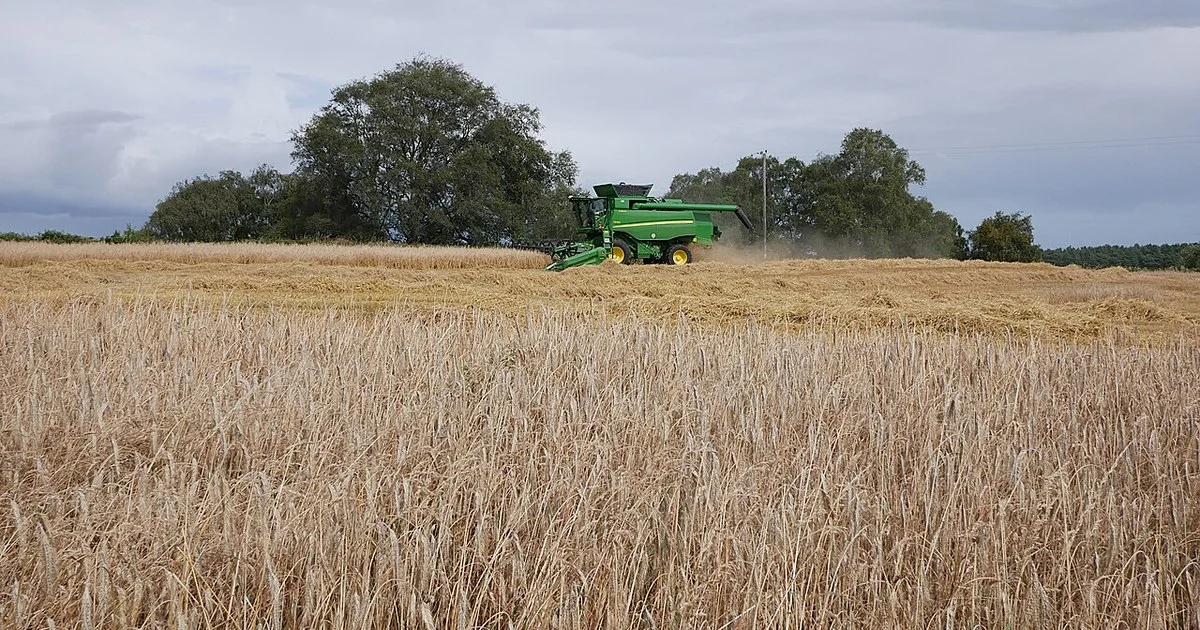
Cover photo: Combining near Cothill. Photo: Craig Wallace, geograph.org.uk (cropped), CC BY-SA 2.0 · Source
Tim’s take:
Every July the same conversation starts in grain offices and machinery yards: when do you reckon you’ll be going? The honest answer has never changed, which is when the crop is ready, but this year the question has an edge to it. A dry April and May pulled the season forward on the light land while leaving stronger ground on its own clock, so the usual calendar needs reading with more care than usual.
The guide below sets out the running order, crop by crop and region by region, and the number in it worth holding onto is from last season: by 9 July 2025 the Eastern region had 38% of its winter barley cut while the north and west had not started a field. That gap, not the national percentage, is what an early season actually looks like. Add 30% more oilseed rape in the ground this year and the July workload is heavier than most farms have carried for a while.
AHDB’s harvest reports confirmed the early rush: winter barley was 95% cut by 27 July, with winter wheat at 54% and oilseed rape at 73%. If grain is still coming in on your farm, the drying and selling decisions are live now, not ahead of you. For the selling side, the week’s ex-farm and futures quotes are on our UK wheat prices page.
If you want the short answer: winter barley opens harvest 2026, and in southern and eastern England the first fields normally go in the first half of July.
A way through this story
Introduction
If you want the short answer: winter barley opens harvest 2026, and in southern and eastern England the first fields normally go in the first half of July. Oilseed rape follows from mid-July, winter wheat carries the bulk of the work through August, and spring barley and oats run into September. In a normal year the combines are parked up again by late September, with the far north sometimes pushing into October.
That is the calendar in outline. The useful detail is in how far each region sits from that line, and in what this season’s weather has already done to it. After a dry April and May across much of England, parts of harvest 2026 are likely to come early on the lighter land. This page sets out the typical window for each crop, the regional running order, and where to watch the real numbers as they land.
For how the season is turning out, now forecast to be the smallest harvest since detailed records began in 1984, our harvest 2026 progress report tracks each AHDB report as it lands.
When is harvest in the UK?
Harvest in the UK runs from late June to early October. Winter barley is cut first, from late June into July, followed by oilseed rape from mid-July. Winter wheat, the biggest crop, comes off mainly in August, then spring barley and oats run into September and beans finish the season in October.
That running order barely changes from one year to the next. What moves is the start date, and 2026 has run early: AHDB’s week-three report (data to 27 July) had winter barley 95% cut and winter wheat already past halfway.
The harvest 2026 calendar at a glance
Every farm and every season moves these windows, but this is the shape of a UK harvest. Jump straight to a crop: winter barley · oilseed rape · wheat · spring barley · oats · beans and pulses.
When is winter barley harvested in the UK?
Winter barley is cut from early July to late July, the first crop of the season, starting in the south and east. In 2026 the first fields in Suffolk and Norfolk went in the last week of June after the dry spring — the running score is in our UK harvest 2026 progress report.
When is oilseed rape harvested?
Winter oilseed rape comes off from mid-July to mid-August, following the barley and often overlapping it. With the 2026 area up 30%, this window carries more work than in any recent year, and the first fields were cut in Cambridgeshire in the final days of June.
When is wheat harvested in the UK?
Winter wheat is harvested from late July or early August in southern England through to early September in the north, peaking through August — the main event of the season. In 2026 the earliest drought-forced fields in the south came off from mid-July, but the crops that set the national verdict come off in August. The other end of the wheat calendar, when to drill and at what seed rate, is in our winter wheat drilling guide.
When is spring barley harvested?
Spring barley runs from mid-August to late September: later drilled, later ripe, and important for malting quality. Scottish spring barley, the backbone of the malting trade, is the last big block of the season.
When are oats harvested in the UK?
Oats are cut from mid-August through September, between the wheat and the last spring barley, with milling quality deciding much of their value.
When are beans and pulses harvested?
Beans and other pulses close the season in September, sometimes stretching later in the north. The orchard side of the season runs to its own clock, with the earliest dessert apples picked from late August; our UK apple picking guide covers orchards, season dates and prices.
The five-year pattern in AHDB’s harvest data backs this up: by the second week of July, around 6% of GB winter barley is typically cut, and essentially none of the wheat. By late September the job is done in all but the latest seasons.
What actually sets the date
No calendar cuts a field. Two things do: crop maturity and moisture.
A cereal crop is ready when the grain has finished filling and dried down in the field. You can cut earlier than ideal, but every point of moisture above contract specification is money spent on drying or lost in claims, so most farms wait for the crop to meet them partway. That is why a fortnight of hot, dry weather concertinas harvest into a rush, and a wet August stretches it out for weeks.
The second constraint is the weather window itself. Grain that is fit on Monday can be unfit by Wednesday if rain arrives, and quality in milling wheat and malting barley starts to slip if ripe crops stand wet. When forecasters give three clear days, harvest runs around the clock. Anyone who has spent a late-August night in a grain trailer queue knows the calendar was never really in charge. If the forecast itself is the weak link, our guide to why weather forecasts are always wrong for your farm explains how to read one properly.
Winter barley leads the way
Winter barley is always the opening act, and it is the crop to watch for reading how early or late a season is running.
Last year gives a useful yardstick. AHDB’s first harvest report of 2025 was its earliest for at least 19 years: by 9 July 2025, 10% of the GB winter barley area was already cut, against a five-year average of about 6% at that point. The regional split told the real story, though. The Eastern region had 38% of its winter barley harvested and the South East 19%, while farms further north and west had not started.
That is the normal shape of an early season: it is not that the whole country starts early, it is that the south and east sprint ahead while everyone else waits for their crops to come fit.
What an early year against a late year looks like
The difference between an early season and a late one is worth seeing in numbers, because it changes what the same calendar date means.
In 2025, the earliest-starting season in AHDB’s records for at least 19 years, a tenth of the national winter barley crop was in the shed before 10 July, and the whole cereals harvest was effectively wrapped up by the last full week of September. In a typical year, that second week of July shows about 6% of winter barley cut and nothing else touched. In a genuinely late year, the kind that follows a cold, wet spring, winter barley may not start in earnest until the third week of July, wheat drags on Septembers end, and northern spring barley is still standing in October.
The practical point: a date on its own tells you little. Ten per cent cut in the second week of July is quick; the same figure in the first week of August is a season running badly behind, with all the drying costs and quality risk that implies. That is why the reported percentages, read against the five-year average, matter more than any calendar.
Either way the sequence holds. Barley, then rape, then wheat, then the spring crops. Weather compresses or stretches the gaps; it has never yet changed the order.
Malting barley and milling wheat: when timing is quality
For feed crops, harvest date is mostly a logistics question. For quality crops, it is money.
Malting barley is the sharpest case. Maltsters buy germination and grain nitrogen, and both are hostage to the weather in the fortnight the crop stands ripe. A catchy harvest, with ripe barley taking repeated wettings, raises the risk of pre-germination in the ear, and a load that fails the maltster’s tests does not get a second interview: it goes for feed at feed money. That is why, when a weather window opens in August, malting barley often jumps the queue ahead of feed wheat that could technically be cut the same day.
Milling wheat runs on the same logic. The premium depends on protein and on Hagberg falling number, and Hagberg starts to slide when a ripe crop stands through warm, wet spells. A milling grower watching a broken forecast in mid-August is not being impatient; they are watching their premium.
So when you read that a region is cutting hard, look at what it is cutting. A rush into quality crops ahead of rain is a different signal from steady progress through feed barley in the sunshine, even if the headline percentage looks the same.
Planning around the start date
If you farm, the dates question is really a readiness question, and the dry spring has shortened the run-up in the south and east this year.
The jobs that bite when the start comes early are the boring ones. Grain stores swept, treated and dry before the first load, because intake is the worst moment to find last year’s grain in a corner. Dryers serviced and fuel in the tank, since an early start on stressed crops often means uneven ripening and mixed moistures in the same field. Contractor slots confirmed, because in a compressed season everyone wants the same ten days. And a selling plan written down before the pressure starts: harvest is the point of maximum grain supply and minimum thinking time, which is exactly when unpriced tonnes get sold badly.
On that last point, the market side of harvest, from reading ex-farm quotes to deciding whether to sell off the combine or carry into the winter, is a subject on its own: see our working guide to UK farm prices in 2026 before the trailers start rolling.
Region by region: the running order
Harvest moves across the UK in a fairly reliable order, driven by heat accumulated through the season:
South East and Eastern England go first. Light land in Essex, Suffolk, Norfolk and Kent is routinely cutting winter barley in the first days of July in a forward year.
The South West and Midlands follow, usually a week or so behind the east on comparable crops.
Northern England comes next, typically two weeks or more behind the south east.
Scotland, Wales and Northern Ireland close the season out. Scottish spring barley, the backbone of the malting trade, is largely an August and September harvest, and in a late year runs into October.
The same gradient repeats within each crop. The wheat that opens August in Essex has cousins in Aberdeenshire that will not see a combine until September.
What the dry spring does to 2026’s timing
This is where harvest 2026 stops being a typical year.
England had a prolonged dry spell through April and May, and AHDB’s crop condition report with data to 22 June 2026 shows the cost: 58% of GB winter wheat rated good or excellent, down from 64% a month earlier. Winter barley sat at 64% good or excellent and winter oilseed rape at 80%, while spring crops on dry seedbeds fared worse, with spring barley at 55%. AHDB’s regional picture is blunt about who carried the damage: England took the worst of the moisture stress, while Scotland, Wales and Northern Ireland had a kinder season.
For timing, drought stress cuts both ways. Stressed crops on light land ripen early, sometimes weeks early, because the plant shuts down rather than finishes properly. Those fields will bring the first cutting dates forward in the east and south. Better-bodied crops on moisture-retentive land, and most crops in the north and west, are running closer to normal.
So expect a stretched harvest: an early, patchy start on burnt-up land in eastern England, then a long tail as the fuller crops come fit in their own time. AHDB analyst Helen Plant noted in late June that most winter crops were still in better shape than at the same point in 2025, which argues against writing the season off. The area numbers add one more wrinkle: with the oilseed rape area up 30% to 316,000 hectares, there is a lot more OSR to cut in that mid-July to mid-August window than the UK has handled for years.
Where the real numbers land
Across the season, AHDB publishes GB harvest progress reports, four editions in 2026, covering wheat, winter and spring barley, oats and winter oilseed rape, with the percentage of each crop harvested nationally and by region, plus early yield and quality indications. It is the single best public source for how harvest 2026 is actually going, and the first 2026 edition was published on 31 July.
We track each report as it lands in our harvest 2026 progress report, and follow what the crops are actually yielding, crop by crop against last year’s averages, in our harvest 2026 yields guide. For what the trade is paying, see our guide to UK farm prices in 2026.
Bottom line
Winter barley from early July in the south and east, oilseed rape from mid-July, wheat through August, spring crops into September. Harvest 2026 will follow that order the way every UK harvest does. The season’s signature is the dry English spring: an early and uneven start on stressed land, more oilseed rape in the July workload than any recent year, and the north and west running to their own, later clock. The winter barley figures have already told us which kind of year this is: 95% cut by 27 July, a fast and largely straightforward run in most regions, and wheat yields so far a disappointing 6.8 t/ha.
Frequently Asked Questions
When does harvest 2026 start in the UK?
Winter barley opens the season, with the first fields in southern and eastern England typically cut in the first half of July. After a dry spring, some stressed crops on light land in eastern England are likely to be cut early. AHDB’s first harvest report of 2026, published on 31 July, confirmed the earliest start since its records began in 2006.
Which crop is harvested first in the UK?
Winter barley is harvested first, usually from early July, followed by winter oilseed rape from mid-July. Winter wheat, the largest crop by area, is mainly an August harvest.
When is the wheat harvest in 2026?
Winter wheat harvest typically runs from late July or early August in southern England through to early September in the north, peaking through August. Timing on any given farm depends on crop maturity, grain moisture and the weather window.
How long does the UK harvest last?
From the first winter barley in early July to the last spring barley, oats and beans in late September, a UK harvest spans roughly twelve weeks. In a late year, harvest in northern England and Scotland can run into October.
When is barley harvested in the UK?
Winter barley is harvested from early July to late July, starting in southern and eastern England; spring barley follows from mid-August to late September. In 2026 the first winter barley was cut in the last week of June after the dry spring.
When is winter wheat harvested in the UK?
Winter wheat is harvested from late July or early August in southern England through to early September in the north, peaking through August — it is mainly an August harvest and the biggest single job of the season. AHDB’s harvest progress reports show how it is running in each region.
When are oats harvested in the UK?
Oats are harvested from mid-August through September, between the winter wheat and the last spring barley. In a late year, northern oat harvests can run into early October.
Will harvest 2026 be early?
Partly. The dry April and May stressed crops on lighter land in England, and drought-stressed crops ripen early, so an early, patchy start in the south and east is likely. Crops in Scotland, Wales, Northern Ireland and on stronger land had better moisture and are running closer to a normal calendar.
BritFarmers Weekly
One email a week: what’s moved on schemes, prices, disease control and policy, with links to primary sources. Free. No sponsors. Unsubscribe anytime. Subscribe.
Source: AHDB
You’ve reached the end of this story.