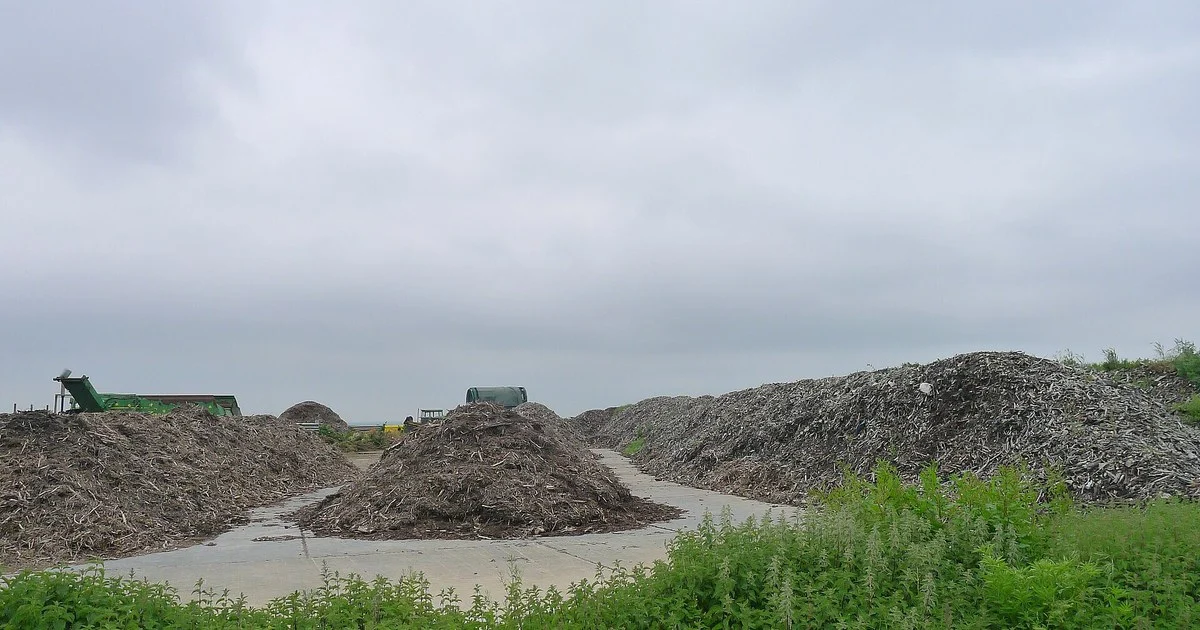
Cover photo: Tim Heaton (CC BY-SA 2.0, cropped) · Source
Last updated: June 2026. A working farmer’s walk through on-farm composting at commercial scale in 2026: why every working salad and arable holding produces enough organic waste to feed a meaningful compost operation, the windrow vs static-pile vs in-vessel process options, the temperature and turning regime that produces a working product, the Environment Agency permitting threshold that separates a farm-waste exemption from a regulated composting facility, the PAS 100 quality standard and what it allows you to do with the finished compost, the soil and rotation benefits of returning the compost to the land, and the working plan I’d write down if I were starting a composting operation on a corner of this holding tomorrow. General information, not regulated environmental advice. See the composting-readiness checklist at the end.
The first windrow I built on this holding was in spring 2014, in a corner of the bottom field, about thirty metres long and two metres high. The material was a year’s accumulation of brassica leaf and stem trim from the pack-shed, some failed iceberg from a bolted crop, the straw bedding from the chickens we kept at the time, and a load of leaves the parish had swept out of the village in November and didn’t know what else to do with. The mix worked almost by accident. The windrow ran up to 62 degrees Celsius within five days, held it for nearly three weeks, and produced about forty cubic metres of decent dark compost by the following spring. Twenty-three years on this holding, twenty-one of those running salad and field vegetables, and that first windrow taught me more about the working physics of compost than anything I read in the same year.
This is what I have learnt about on-farm composting at working scale over the decade since, and what I would actually do today if I were setting up a composting operation on a corner of a working holding for the first time. It is written for a working farmer, a farm manager or a horticultural grower who has waste material to handle and wants to turn it into a working soil input rather than a tip charge.
A way through this story
Why every working holding should be composting
Every working UK farm produces organic waste at scale. The waste streams typically include:
- Crop residues and trash (leaf, stem, root crown, off-cuts from grading)
- Failed or off-spec crop (the iceberg field that bolted, the cauliflower that went too far, the potato that exceeded size grade)
- Straw and bedding (where livestock or poultry are present)
- Manure and slurry (separately regulated under SSAFO; covered in our UK Slurry, Silage and SSAFO 2026 guide)
- Cardboard and packaging (from the pack-shed)
- Pruning, hedge trim and grass cuttings
- Spoilt forage and feed
- Greenhouse and polytunnel plant material at end of season
The Defra Agricultural Statistics record that UK farming produces tens of millions of tonnes of agricultural and food-processing organic residues each year, and that a substantial proportion of this is either composted on-farm, spread direct to land, or sent to commercial composting and anaerobic digestion facilities.[1]
The alternatives to composting on a working horticultural holding are:
- Direct spreading of fresh waste to land (limited by NVZ rules, hygiene concerns, and the practical reality that fresh waste smells, attracts pests and is hard to incorporate)
- Sending to a commercial composting or anaerobic digestion facility (gate fees in 2026 typically £20 to £55 per tonne plus haulage cost)
- Sending to landfill (gate fee plus landfill tax of £126.15 per tonne in 2026, with rare exceptions for non-recyclable agricultural waste)[2]
Composting on-farm converts a waste stream that costs money to dispose of into a soil-amendment input that has working value. The economics, on most working holdings, are strongly positive.
The basic compost process: what’s actually happening
Composting is the biological breakdown of organic matter by aerobic micro-organisms (bacteria, actinomycetes, fungi) into a stable, humus-rich product. The process requires four conditions:
Carbon-to-nitrogen ratio (C:N). The micro-organisms doing the work need about 25 to 35 parts carbon to 1 part nitrogen, by weight, to thrive.[3] Wood chip, straw, dead leaves and cardboard are high-carbon (C:N typically 50 to 600). Grass cuttings, fresh manure, vegetable waste and slurry are high-nitrogen (C:N typically 10 to 30). Mixing the two in the right proportion is the first piece of process design.
Moisture. The pile needs to be around 50 to 60 per cent moisture by weight, the consistency of a wrung-out sponge.[4] Too dry and the process stalls; too wet and anaerobic conditions develop and the process turns to silage or putrefaction.
Oxygen. Aerobic micro-organisms need oxygen. The pile structure must allow air to penetrate. Compaction kills the process. Turning the pile re-introduces oxygen.
Temperature. The metabolic heat from the micro-organisms drives the pile up to 55 to 70 degrees Celsius within a few days of construction. The high temperature kills pathogens and weed seeds, which is the working hygiene basis for using the compost on food crops.[5]
The process runs in three phases:
Mesophilic phase (day 0 to day 5). Micro-organisms colonise the fresh material; temperature rises to 40 degrees Celsius.
Thermophilic phase (day 5 to day 28). Heat-loving micro-organisms take over; temperature rises to 55 to 70 degrees Celsius. This is the phase that kills pathogens, weed seeds and most pests. The pile loses mass as carbon is respired as CO2 and water is driven off as vapour.
Curing phase (day 28 to day 120+). Temperature falls back to ambient. The compost stabilises. Earthworms and macro-fauna colonise. The finished product is dark, friable, smells of woodland soil, and has no recognisable structure of the original material.
A well-managed windrow process, on a working holding, produces a finished compost from a fresh feed in 90 to 180 days. Less well-managed processes can take 12 to 24 months. The difference is mostly turning frequency and temperature management.
Windrow, static pile, in-vessel: the process options
The three main process options at working farm scale:
Open windrow. Long, narrow piles (typically 1.5 to 3 metres high, 3 to 5 metres wide, 20 to 100 metres long) turned periodically with a tractor, loader or specialist windrow turner. The simplest and lowest-capital-cost option. Suitable for most agricultural waste streams. The working scale most UK on-farm composting operations use.
Static pile (aerated). A pile built with internal aeration (pipes, perforated floor) or a forced-air system below the pile, eliminating the need for mechanical turning. Capital-cost moderate; running-cost moderate. Used where land area is constrained or odour control is critical (near residential areas).
In-vessel. Enclosed composting in tanks, drums or insulated buildings. High capital cost. Used where regulatory requirements are most stringent (composting of meat or animal by-products under Animal By-Product Regulations) and where space is highly constrained.[6]
For most working agricultural composting operations, the open windrow is the working answer. The capital outlay is modest (a hardstanding pad, a windrow turner or a loader with a bucket, and a containment system for runoff). The process is straightforward to manage. The output is appropriate for return to the holding’s own fields.
The static pile system has a niche use on holdings with odour-sensitive neighbours or land-area constraints. The in-vessel system is reserved for regulated waste streams that the open windrow cannot legally handle.
Windrow management: the working practice
A working windrow management programme runs as follows.
Feedstock preparation. Materials are collected and combined to achieve the target C:N ratio. A working mix on a salad and brassica holding might be: 40 per cent brassica leaf and stem trim (high N), 30 per cent straw (high C), 20 per cent cardboard packaging (high C), 10 per cent failed crop (high N). The mix is layered or end-blended depending on the equipment available.
Pile construction. The windrow is built on a hardstanding pad, 2 metres high, 4 metres wide at the base, and the appropriate length for the volume. The cross-section is roughly trapezoidal. Air can penetrate from the sides; rain runs off the top.
Initial temperature monitoring. A long-stem compost thermometer (1 metre or longer, typically £80 to £150 for working kit) is inserted at three points along the windrow. Temperature is logged daily for the first 28 days.
Turning. The windrow is turned when the temperature exceeds 65 degrees Celsius (to vent excess heat and re-introduce oxygen) or when the temperature falls below 55 degrees Celsius (to re-start the thermophilic phase). Typical turning frequency: 2 to 4 turns in the first 30 days, then weekly or fortnightly through the active phase, then monthly through the curing phase. Some operations turn more frequently for faster product; others turn less for lower energy cost.
Moisture management. Moisture is checked weekly. If the pile is dry, water is added (a 10-tonne windrow typically takes 1 to 3 cubic metres of water per turn in a dry summer). If the pile is too wet, drier material is added or the pile is opened up and dried.
Temperature record. A temperature log is kept for the duration of the process. The record is the working evidence that the pile reached and held the pathogen-killing temperature required by the PAS 100 standard (or the equivalent farm-waste exemption).
Maturity assessment. After 90 to 180 days, the compost is assessed for maturity: dark colour, friable texture, woodland-soil smell, no recognisable feedstock structure, ambient temperature, presence of macro-fauna. A maturity test (CO2 evolution, ammonium-to-nitrate ratio) can be done by a soil lab if formal certification is required.
Screening. The mature compost is screened (typically through a 10 to 25 mm mesh) to remove the contraries (stones, plastic, woody material) and produce a uniform product. Larger material is returned to the next windrow as a bulking agent.
Storage. The finished compost is stored undercover or on a covered pad to prevent leaching and recolonisation. It can be held for 12 months or longer without significant loss of quality.
The Environment Agency permitting threshold
The single most important regulatory question for any working composting operation is whether it qualifies for an exemption from environmental permitting or whether it requires a full Environmental Permit.[7]
Agricultural waste exemption. Under the Environmental Permitting Regulations (England and Wales) 2016, a holding composting only agricultural waste arising from its own operations, for use on its own land, at a scale of up to 80 tonnes held at any one time, falls under the “T23 Aerobic composting and associated prior treatment” exemption. The exemption requires registration (free) and compliance with the exemption’s conditions but does not require a formal permit.[8]
T23 exemption conditions (working summary): the activity is on a hardstanding; runoff is contained; the compost is for use on the land where it was made or another agricultural holding under common control; operations cause no pollution or nuisance; records are kept of feedstock and output.
Above the 80-tonne at-any-one-time limit (60 tonnes for third-party or off-site waste), or accepting third-party waste, or selling the finished compost commercially: the operation requires either a Standard Rules Environmental Permit (for some categories of small composting) or a Bespoke Permit (for larger or more complex operations). The Standard Rules permit costs around £1,500 to £4,000 to obtain plus annual subsistence fees; the Bespoke permit costs substantially more and requires a site-specific permit application.[7]
The third-party waste threshold matters. A holding that accepts brassica trim from a neighbour, or green-waste cardboard from a parish recycling scheme, or fruit pulp from a juice factory, crosses out of the agricultural-only category and into the regulated waste regime even if less than 80 tonnes is held at any one time. The exemption presumes the waste is from your own holding. Accepting waste from elsewhere typically requires a permit.
Animal by-product regulations. Composting of any animal-derived waste (manure is the main one; meat, dairy and fish trim are tighter) is regulated under the Animal By-Products (Enforcement) (England) Regulations 2013 and the equivalent devolved regulations.[9] Manure composted on the holding where it was produced is normally lower-risk. Manure or any animal product composted with other material or for use off-farm requires APHA registration and may require permit-level controls.
The practical answer for a small-to-medium working holding: register the T23 exemption with the Environment Agency, stay within the 1,000 tonne annual limit, compost only your own holding’s agricultural waste, use the compost only on the holding’s own fields or on another holding under common control. The regulatory overhead is manageable and the working operation is viable.
For a larger holding, or one wanting to compost neighbour’s waste or sell the finished product, a Standard Rules permit and PAS 100 certification (covered below) is the working pathway.
PAS 100: the quality standard and what it allows
PAS 100 is the British Standards Institution’s Publicly Available Specification for composted materials, jointly developed with WRAP and the trade body REA.[10] A compost product certified to PAS 100 has met defined process and quality standards: temperature record, sanitisation regime, contaminant limits, maturity criteria.
What PAS 100 allows:
- Sale and supply of the compost as a defined product (not as waste under waste regulations)
- Use of the compost outside the holding where it was made
- Recognised quality status for buyer relationships
- Eligibility for inclusion in WRAP’s Quality Compost market and trade
What PAS 100 does not allow:
- Mixing in untreated waste post-process (the entire batch must have met the PAS 100 process)
- Untracked changes in feedstock that fall outside the certified process
- Use claims beyond what the standard supports
For a working holding using its own compost on its own land, PAS 100 certification is not required. The compost is, in regulatory terms, an internal soil amendment. For a holding selling finished compost commercially, PAS 100 is the working standard and the buyer expectation.
The cost of PAS 100 certification for a small-to-medium operation runs £4,000 to £12,000 per year (initial assessment, annual audit, ongoing process control). The price the certified product can command commercially is typically £15 to £35 per tonne at the gate (uncertified compost may sell for £5 to £15 per tonne or be given away).
The economic case for PAS 100 certification depends on volume. For a 100-tonne annual output, the certification cost is a working barrier. For a 1,000-tonne annual output, the cost is a working investment.
Soil and rotation benefits of compost
The reason to compost on a working holding is, ultimately, that compost is one of the most valuable soil inputs available. The soil-amendment benefits are well-established in the agronomic literature.[11]
Organic matter. Compost is 30 to 50 per cent organic matter on a dry-weight basis. Returning compost to working soils builds organic matter content over time, which improves water-holding capacity, structure, biological activity, nutrient cycling and erosion resistance. The Defra Soil Health Action Plan and the AHDB Great Soils programme both flag organic matter as the single most important soil quality indicator.[12]
Nitrogen. Mature compost typically supplies 1 to 2 per cent total nitrogen on a dry-weight basis. The nitrogen is in a slow-release organic form, mineralising over 2 to 5 years rather than being immediately available. The slow release is a feature, not a defect: it reduces leaching loss and provides a working background nutrient supply.
Phosphate and potash. Compost typically supplies 0.5 to 1.5 per cent phosphate and 0.8 to 2.0 per cent potash. Both are largely plant-available.
Trace elements. Compost contains a working balance of trace nutrients (calcium, magnesium, sulphur, manganese, zinc, copper, boron) that synthetic fertilisers do not provide.
Biological inoculum. Mature compost contains a working population of beneficial soil micro-organisms. Applied to soils with depleted biology, compost can re-establish the soil-biological community more effectively than any synthetic alternative.
Suppression of soil-borne disease. Some compost amendments have demonstrable suppression effects on soil-borne pathogens (Pythium, Rhizoctonia, Fusarium). The effect is variable and not predictable but is real on the right soil with the right compost.[13]
The application rate on a working horticultural holding is typically 15 to 35 tonnes per hectare per rotation cycle (every 3 to 6 years), applied to the most demanding crop in the rotation (typically the brassicas or the first wheat). On a 200-hectare mixed holding, that’s 3,000 to 7,000 tonnes of compost demand per rotation cycle, or 500 to 1,200 tonnes per year averaged.
A working compost operation on a 200-hectare holding can produce 200 to 800 tonnes of finished compost per year from the holding’s own waste streams, depending on the cropping mix. That covers a meaningful but not complete share of the soil-amendment demand. The balance is made up from bought-in compost, manure from neighbouring livestock farms, or green-waste compost from the local authority.
Compost benefits compound. The first application has modest visible effect; the third or fourth application on the same field, three rotations later, shows a transformation in soil structure, organic matter and crop response. Working compost programmes are 10 to 20-year commitments.
A worked example: a 200-hectare compost operation
A worked example for a notional 200-hectare salad and brassica holding in 2026:
Feedstock (annual):
- Pack-shed brassica trim: 350 tonnes
- Off-spec and failed crop: 180 tonnes
- Pruning, hedge trim and field-edge cuttings: 80 tonnes
- Cardboard packaging from pack-shed: 60 tonnes
- Straw (purchased in for bulking): 90 tonnes
- Total annual feedstock: 760 tonnes
Capital costs (year 0):
- Hardstanding pad with runoff containment (3,000 m² concrete-block construction): £85,000
- Bunded compost area with leachate pond: £15,000
- Windrow turner (tractor-mounted PTO model): £35,000
- Loader bucket and forks (existing kit, no incremental cost)
- Long-stem thermometer set and data logger: £400
- Screen (vibrating screen, used kit): £8,000
- Total year-0 capital outlay: roughly £143,400
Annual operating costs (year 1 onwards):
- Operator labour (3 days a week, average): roughly £18,000
- Tractor fuel and consumables (turning, loading, screening): £4,000
- Bought-in straw bulking material: £5,400
- Water and electricity: £1,200
- Insurance and audit allocation: £2,000
- Environmental Agency exemption registration (one-off): nil for T23 (free)
- Total annual operating cost: roughly £30,600
Finished compost output:
- Approximately 40 to 50 per cent of fresh feedstock mass survives the process (the rest is lost as CO2 and water vapour)
- 760 tonnes feedstock × 45 per cent = 342 tonnes finished compost per year
Value of finished compost:
- Applied to holding’s own fields as soil amendment
- Direct value (substituting for purchased manure or compost at £15 per tonne delivered): 342 × £15 = £5,130
- Indirect value (improved soil health, reduced fertiliser requirement, improved crop quality): considerably more, perhaps £25 to £45 per tonne of applied compost over the full 5-year benefit horizon. Working figure: 342 × £35 = £12,000 per year of agronomic value
- Avoided waste disposal cost (the 760 tonnes feedstock would otherwise cost £30 to £55 per tonne to send to a commercial composting facility): 760 × £40 = £30,400 per year
Net annual benefit:
- Avoided disposal cost: £30,400
- Agronomic value of compost: £12,000
- Less operating cost: £30,600
- Net annual benefit: roughly £11,800
Capital payback:
- £143,400 capital outlay ÷ £11,800 net annual benefit = roughly 12 years
The economic case looks marginal in the worked example, dominated by the capital outlay on the hardstanding pad and runoff containment. The reality is that the avoided disposal cost is the dominant variable; if the holding’s waste-disposal cost is closer to £55 per tonne (which is typical in 2026), the net annual benefit doubles and the payback halves.
The wider point is that on-farm composting is a long-term investment in the holding’s soil, not a high-margin commercial activity. The economic case rests on the combination of waste disposal cost avoidance and long-term soil health improvement. Both are real; neither is dramatic in any one year.
Risks and what catches people
The patterns of failure in on-farm composting at scale:
Poor process management. A windrow that doesn’t reach 55 degrees Celsius is not sanitising. The output is a soil amendment with potentially viable weed seeds and pathogens. Hot composting is the working norm; cold composting (no temperature rise) is a different process with different output and different risk.
Inadequate runoff containment. A compost pad on bare soil, or on hardstanding with no leachate collection, can produce compost leachate that is rich in nitrogen and biological oxygen demand. Discharge to a watercourse can trigger an Environment Agency enforcement.
Animal by-product mix-ins. Composting any animal-derived material (poultry litter included) crosses regulatory thresholds and may require APHA registration or permit-level controls. Many smaller operations underestimate this.
Odour complaints. A poorly-managed windrow can smell strongly (anaerobic pockets, putrefaction). Neighbour complaints can trigger Environmental Health enforcement and may result in restrictions on operating hours or relocation.
Pest attraction. Rats, flies, gulls. Properly hot-composted material is less attractive than fresh waste, but the early stage of the pile can attract pests. Distance from buildings and a working pest-control regime are working norms.
Plastic and contaminant accumulation. Cardboard with plastic film, packaging contaminated with stickers and tape, plastic in the feedstock from the pack-shed. The screening step removes most but a steady accumulation of micro-plastics is a working environmental concern, particularly for soils that will be used for food production.
Records not kept. The Environmental Agency exemption registration and any future permit require records of feedstock, process temperature, output destination. Records are usually the first thing the regulator asks for in any incident.
Composting alongside slurry storage and SSAFO
A working composting operation often sits alongside the slurry storage, the muck heap and the silage clamp on the working holding. Each is separately regulated under SSAFO (Storage of Silage, Slurry and Agricultural Fuel Oil Regulations 2010), covered in detail in our UK Slurry, Silage and SSAFO 2026 guide.
The interaction between the compost operation and SSAFO compliance:
- Composting is not directly SSAFO-regulated unless the feedstock includes slurry or silage effluent
- Manure stored before composting falls under SSAFO if held for over 30 days
- Compost leachate falls under environmental discharge regulations
- The siting requirements for SSAFO storage (distance from watercourses, distance from neighbours, drainage) are similar to those for a compost pad
A holding designing a working compost facility alongside SSAFO storage should treat them as a single integrated farm-yard design problem. The hardstanding, the bunding, the runoff and leachate management, the access for vehicles and the visual screening from neighbours are all common requirements.
Where this is heading
Three forces will shape on-farm composting at scale over the next five years.
The first is the landfill cost trajectory. Landfill tax has risen steadily since 2008 and is projected to continue rising in real terms.[2] Every increase in disposal cost strengthens the economic case for on-farm composting.
The second is the soil-carbon market. The various private soil carbon markets that have emerged over the last five years (Indigo Agriculture, AgreenaCarbon, Soil Capital, the UK government’s developing Land Use Framework) pay for soil carbon sequestration over multi-year baselines. Composting builds soil carbon over time. Whether the soil carbon credit market matures into a substantial revenue line for working compost operations is an open question; the direction of travel is positive but the per-tonne credit price has been volatile.[14]
The third is the regulatory frame. The Environment Agency‘s environmental permitting regime has been undergoing a series of reviews and reforms since 2020. The direction of travel is towards more, not less, regulation of organic waste handling. Working operations should assume the compliance burden will rise rather than fall.
The thing that will not change is that compost is the cheapest single soil-amendment input on a working horticultural and arable holding, and the holding produces, every year, the feedstock that could feed a working compost operation. Whether or not to capture that value is one of the cleanest cost-benefit decisions on a working farm.
A six-step composting-readiness checklist
Six things to do before starting an on-farm compost operation at scale.
Audit the feedstock. Tonnes per year of each material, C:N estimate, seasonality, contaminant load. The feedstock determines the process design.
Plan the site. Hardstanding pad with runoff containment, distance from watercourses, distance from neighbours, vehicle access, visual screening. The site decisions are the dominant capital cost.
Register the Environment Agency T23 exemption (or apply for a Standard Rules permit if above the 1,000 tonne threshold or accepting third-party waste). The registration is free and mandatory; non-registration is an enforcement issue.
Buy the working kit. Windrow turner (or capacity to turn with an existing loader), long-stem thermometer, log book, screen. The capital outlay is modest compared with the pad.
Run a 3-month trial windrow before committing to a full operation. The trial picks up the working issues (the mix isn’t heating, the moisture is wrong, the screen is the wrong mesh) before the full-scale investment.
Plan the compost-to-field programme. Application rates, rotation timing, soil-test baseline. The compost is for the soil; design the agronomy alongside the production.
Further reading
WRAP, the REA Organics Recycling Group and the British Standards Institution publish the working technical guidance on compost process and PAS 100 standards.[10] The Environment Agency‘s environmental permitting and farm exemption pages are the working regulatory reference.[7] The Defra Soil Health Action Plan and the AHDB Great Soils programme cover the agronomic case for compost.[12] For BritFarmers readers, this guide sits alongside our UK Slurry, Silage and SSAFO 2026 guide, our UK Soil Health 2026 guide, our UK Carbon Farming and Net Zero 2026 guide and our UK Cover Crops and Catch Crops 2026 guide.
Sources
[1] Defra, Agricultural Statistics: organic waste and recycling, gov.uk: https://www.gov.uk/government/collections/agriculture-statistics.
[2] HMRC, Landfill tax rates, gov.uk: https://www.gov.uk/government/publications/rates-and-allowances-landfill-tax.
[3] WRAP and REA Organics Recycling Group, Composting process design and the C:N ratio, wrap.org.uk; British Standards Institution, PAS 100 Composted Materials Specification, bsigroup.com.
[4] WRAP, Practical guidance on composting moisture and process control, wrap.org.uk.
[5] WRAP and the British Standards Institution, PAS 100: time-temperature requirements for sanitisation, bsigroup.com.
[6] Defra and Animal and Plant Health Agency (APHA), Animal By-Product Regulations: composting requirements, gov.uk.
[7] Environment Agency, Environmental Permitting Regulations 2016: composting activities, gov.uk: https://www.gov.uk/guidance/check-if-you-need-an-environmental-permit.
[8] Environment Agency, T23 aerobic composting exemption, gov.uk.
[9] Animal By-Products (Enforcement) (England) Regulations 2013, legislation.gov.uk; Defra and APHA, Composting animal by-products: rules and registration, gov.uk.
[10] British Standards Institution, PAS 100:2018 Specification for composted materials, bsigroup.com.
[11] AHDB, Compost in arable rotations: agronomic case, ahdb.org.uk; NIAB, Compost and soil organic matter research, niab.com.
[12] Defra, Soil Health Action Plan, gov.uk; AHDB, Great Soils programme, ahdb.org.uk.
[13] Rothamsted Research and AHDB, Disease suppression in compost-amended soils, rothamsted.ac.uk and ahdb.org.uk.
[14] Soil Association and the Sustainable Soils Alliance, Soil carbon market overview, soilassociation.org and sustainablesoilsalliance.org; Indigo Agriculture, Agreena, Soil Capital (vendor literature).
[15] WRAP, On-farm composting infrastructure guidance, wrap.org.uk.
[16] NFU, Farm composting and waste management, nfuonline.com.
[17] REA Organics Recycling Group, Industry guidance and best practice, r-e-a.net.
[18] DEFRA and EA joint guidance, Storage of Silage, Slurry and Agricultural Fuel Oil Regulations (SSAFO), gov.uk.
[19] Town and Country Planning Act 1990 and the Town and Country Planning (General Permitted Development) (England) Order 2015 (permitted-development rights for agricultural buildings).
[20] British Compost Industries Association and the Composting Association industry materials.
About the author
I run a salad and field vegetable holding in Suffolk, twenty-three years on the same ground, the last two with a slice of wheat and oilseed rape rotated in alongside the iceberg, baby-leaf and brassicas. I built my first commercial windrow in spring 2014 from a year’s accumulation of pack-shed trim and a load of village leaves that nobody else wanted. Twelve years of windrows later, the working compost operation here produces enough soil amendment to cover the brassica and salad rotation, with the bonus that the waste-disposal cost on the pack-shed and the field trim is essentially zero. The notes above are the working framework I would write down for a younger grower setting up a compost facility for the first time.
The headline: compost is the cheapest single soil-amendment input available to a working horticultural or arable holding, and the holding produces the feedstock every year that could feed it. The economic case rests on waste disposal cost avoidance plus long-term soil health investment. Neither is dramatic in any one year. Both compound over a decade.
Disclaimer: This guide is general information about UK on-farm composting at scale in 2026. It is not regulated environmental, planning or engineering advice and is not a substitute for tailored guidance from the Environment Agency, your local authority Environmental Health department, your soil consultant or your agronomist. Environmental Permitting Regulations, animal by-product rules, PAS 100 specifications and waste-handling thresholds change; always confirm the current position before relying on it.
You’ve reached the end of this story.