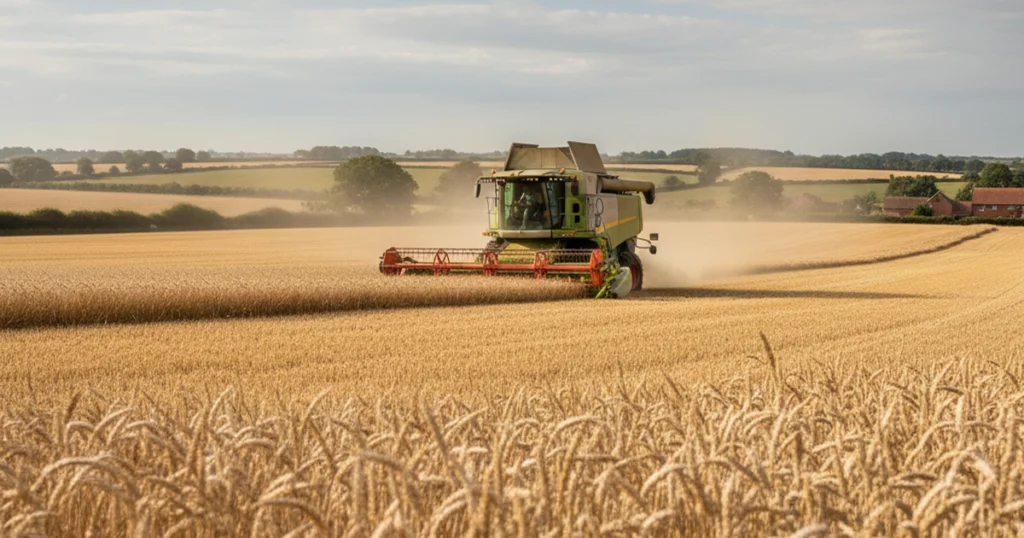
As of 12 July 2026, harvest has started. The first winter barley was cut in Suffolk and Norfolk in the last week of June, among the earliest starts on record, with oilseed rape following from late June and the earliest southern wheat expected from mid-July. Winter barley typically opens the UK harvest in early July, wheat peaks through August, and spring crops run into September. The week-by-week cutting figures are in our harvest 2026 progress report and the early yields in our harvest 2026 yields guide.
Last updated: 12 July 2026. The rest of this page is the pre-season picture as of early June: what got planted, what condition it is in, and the short window of weather that will decide whether the year’s early promise holds. The area figures come from AHDB’s Early Bird Survey and the condition scores from the AHDB Crop Development Report. This is my second season with combinable crops in the rotation, so I am watching these numbers with my own ground in mind rather than from behind a desk.
The planted area: wheat steady, barley down hard, OSR back
The AHDB Early Bird Survey, built from returns covering around 600,000 hectares across nearly 70 agronomy firms, put the harvest 2026 areas roughly here:
- Wheat: 1,675 Kha, up 1% on 2025 but still short of 2023.
- Barley: 972 Kha in total, down 10% on the year and the smallest UK barley area since 2011. Winter barley eased 2% to 356 Kha; spring barley fell 15% to 610 Kha.
- Oilseed rape: 316 Kha, a 30% rise and a real recovery from 2025’s forty-two-year low, according to AHDB’s analyst insight.
- Oats: down 14% to a projected 170 Kha.
The barley figure is the one that matters most for the trade. A 15-year low in planted area changes the supply maths for both malting and feed before a single combine moves. The OSR recovery tells its own story: better price expectations and a strong 2025 yield persuaded growers back into a crop many had walked away from after years of flea beetle losses.
Crop condition: a good start that May has been eating
The condition story through spring has been a slow slide. At the end of March, 82% of GB winter wheat was rated good or excellent. By the end of April that was 75%. The late-May Crop Development Report had it at 64%. Winter barley followed the same path, down to 62% good or excellent from 70% a month earlier.
The cause is no mystery to anyone who has stood in a field this spring. April and May ran dry, and AHDB’s analysts flagged the dry start to May as the point where conditions began to bite. The bursts of heat above 30°C added stress on top, with leaf rolling visible in wheat where moisture ran short, and any benefit from passing rain proving short-lived on lighter land.
Two things stop this being a gloomy picture. First, winter oilseed rape has held up well: 78% good or excellent in late May, against 52% at the same point last year. Second, even after the slide, wheat and barley are still in better shape than they were at this stage in either 2024 or 2025. The base the season is working from is sound. The question is whether the weather lets it stay that way.
The window that decides it
Grain fill is where harvest 2026 gets settled, and the next two to three weeks are the critical stretch. The crops need rain, and for winter cereals the window to repair lost potential is not large. Timely, steady rainfall through June could stabilise yield potential; another dry, hot run would lock the damage in.
On our ground the job now is mostly watching: soil moisture, ear counts, and how quickly the lighter fields turn. There is not much an arable farm can do for a winter crop in June except hope the forecast cooperates, which is an uncomfortable position the trade shares with every grower in the country.
AHDB’s final condition report on the 2026 crops is due on 26 June. That report, and the rain gauges between now and then, will say more about final yields than any forecast written today.
What it could mean for markets
It is too early for yield claims, and this article will not invent any. What the area numbers already support is this: a small barley crop tightens the malting and feed supply picture regardless of yield, and a 30% bigger OSR area rebuilds a domestic crush supply that had nearly vanished. Wheat remains the crop where global prices, not UK areas, set the tone. For the wider price context, our UK agricultural markets and prices guide covers how those markets are quoted and what moves them.
What to watch between now and the combine
- Rainfall through June — the single biggest variable left in the season.
- The AHDB final condition report, 26 June — the last full condition reading before cutting starts.
- Spring barley — a 15% smaller area on top of a dry spring; how it finishes matters for malting premiums. Our spring barley drilling guide covers how the crop went in.
- Harvest progress reports — AHDB publishes weekly GB harvest progress once combines roll, usually from mid-July; we track what each week’s cutting is showing in our harvest 2026 progress report.
- Rotation plans for autumn — area swings this size ripple into next year’s cropping decisions; our UK arable farming guide covers the rotation side.
- When your region starts — our harvest 2026 dates guide sets out the crop-by-crop running order, region by region, and what the dry spring does to it.
Bottom line
Harvest 2026 starts from a better position than the last two years: more wheat than 2025, OSR genuinely back, and crop condition that, even after a dry spring, still beats 2024 and 2025 at the same point. Against that sits the smallest barley area since 2011 and a condition trend moving the wrong way since March. June rainfall decides which of those stories ends up defining the year. Nobody honest can call it yet.
FAQ
When does harvest 2026 start in the UK?
Harvest 2026 has already started: the first winter barley was cut in eastern England in the last week of June 2026, unusually early after the dry spring, with oilseed rape following and the earliest southern wheat expected from mid-July. Winter barley normally opens the season in early-to-mid July; AHDB’s weekly harvest progress reports track the national picture through the season.
What is the biggest change from harvest 2025?
The oilseed rape area, up 30% to 316 Kha after a forty-two-year low in 2025. The barley area moving the other way, down 10% to a 15-year low, is the change the grain trade is watching most closely.
Are 2026 crops in better condition than last year?
Yes, as of late May. Winter wheat at 64% good or excellent and winter OSR at 78% both compare favourably with the same point in 2025, though wheat condition has slipped steadily since March and needs June rain to hold.