Cover photo: Martin Dawes (CC BY-SA 2.0, cropped) · Source
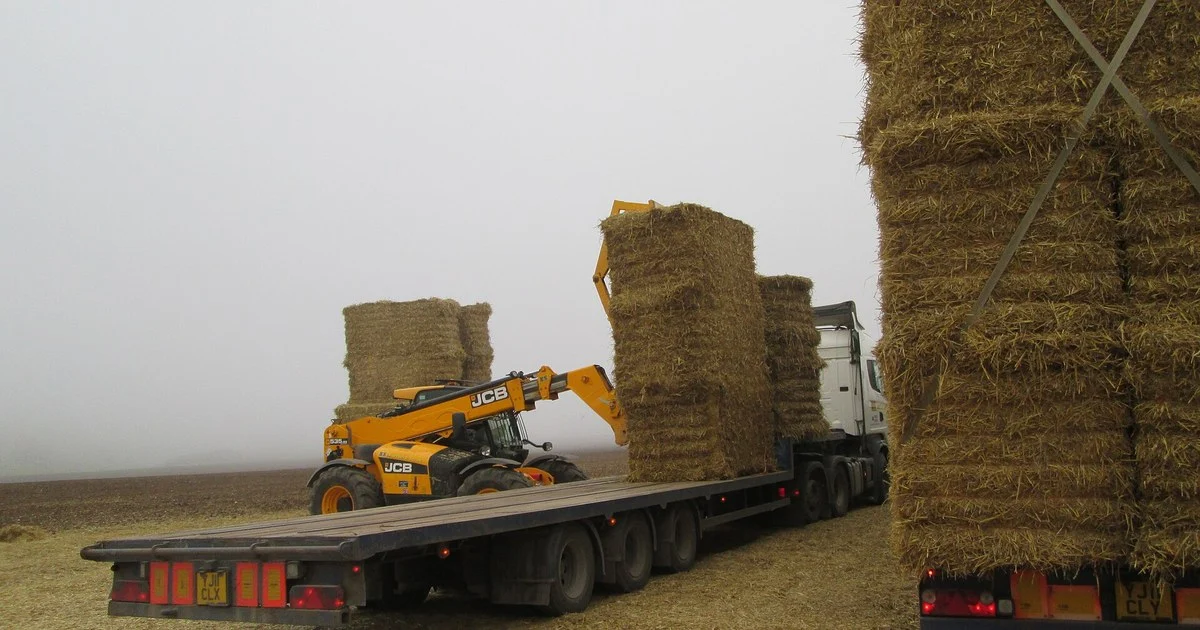
Big square bales of wheat straw were averaging £74 a tonne ex-farm in the first week of October, £7 less than a year earlier. In a season when the grain harvest was poor, straw and hay are both cheaper than a year ago, and Defra’s harvest figures help explain the straw side of that.
England grew 3.2 million tonnes of wheat straw in 2026, up 24% on last year and the most since 2022. Barley straw rose too. The grain crop was smaller, but the straw that came off with it was not, and a bigger wheat straw crop sits alongside a lower merchant price.
A way through this story
Straw prices this week
The benchmark most of the trade uses is the weekly British Hay and Straw Merchants’ Association series published by AHDB. These are average merchant buying prices, ex-farm, for big bales across Great Britain.
| Product (GB, ex-farm) | Week of 4 Oct 2026 | Week of 5 Oct 2025 | Change on the year |
|---|---|---|---|
| Big square baled wheat straw | £74/t | £81/t | -£7 |
| Big square baled barley straw | £89/t | £92/t | -£3 |
| Big bale hay | £106/t | £118/t | -£12 |
Three things to know before you use those numbers. They are what merchants pay at the farm gate, so a delivered price to your yard will be higher once haulage and the merchant’s margin are added. They are national averages of regional prices, and the regions do not report every week. And AHDB is explicit that the series is a historical record, not a basis for contract prices; the price you pay is whatever you and the seller agree.
Barley straw usually sells at a premium to wheat straw, typically around £8 to £10 a tonne on the AHDB series in recent years, so today’s £15 gap is wider than usual. Livestock farms value barley straw as a feed as well as for bedding, which may be part of why its price has fallen less.
Why straw is cheaper after a poor harvest
It looks like a contradiction. Defra’s provisional estimates for England, published on 8 October, put the combined cereal and oilseed rape crop at around 16 million tonnes, the smallest combined English harvest in ECIU’s series, which runs back to 1984. Barley and oats both had their smallest crops since 2012.
Wheat bucked the trend among the cereals, as did oilseed rape, and wheat is where most of the straw comes from. English wheat production edged up 0.8% to 10.8 million tonnes, and Defra estimates wheat straw rose much faster than the grain. The full straw picture for England looks like this:
| Straw type (England) | 2026 production | Change on 2025 |
|---|---|---|
| Wheat straw | 3.2m tonnes | +24% |
| Barley straw | 1.3m tonnes | +5.4% |
| Oat straw | 187,000 tonnes | -5.1% |
| Oilseed rape straw | 125,000 tonnes | +98% |
Where that straw goes matters as much as how much there is. Defra’s survey found 42% of 2026 straw was sold or exchanged for feed and bedding and a further 32% used at home for the same jobs. Only around 10% was sold for biomass and 15% sold for other uses. In other words, about three-quarters of English straw is used for feed or bedding, so most of the extra wheat straw is likely to end up in that market.
Two caveats. Defra’s figures are for England only; Scotland, Wales and Northern Ireland come in the final UK estimates on 10 December. And production is not the same as what reaches the market: straw chopped and incorporated never shows up in a merchant’s yard.
What it means if you are buying bedding
For a farm buying straw in, the arithmetic is simple. At £7 a tonne less than last year, a unit that buys 100 tonnes of wheat straw for the winter saves about £700 on the ex-farm price alone, before haulage. On barley straw the saving is £3 a tonne.
A few practical points follow from the way straw is priced:
- Compare in pounds per tonne, not per bale. Big square bales vary in weight with the baler, the crop and how dry it was. A cheap bale can be an expensive tonne. Ask for the weight, or a weighbridge ticket on the first load.
- Get the delivered price in writing. The AHDB figures are ex-farm. Haulage can be a large part of the delivered cost, and more so the further the straw has to travel.
- Check where it will be stored. Straw bought cheap in October and left uncovered loses value fast. If you lack covered storage, buying in smaller loads through the winter may cost less in the end.
- Watch the price through the winter. The price can still move as housing gets under way and stocks are used up. The AHDB series updates weekly, so check it before you commit to a large order.
Hay follows the same pattern, at £106 a tonne for big bales, £12 down on the year. Our guide to hay, silage and haylage covers how to compare forage options on value rather than price alone.
What it means if you are selling straw
For arable farms the same figures cut the other way. More straw on the market means a weaker price for anyone baling to sell, and on a poor grain year that is unwelcome. The usual decision between baling and selling, swapping straw for muck with a livestock neighbour, or chopping and incorporating for soil organic matter is worth running again at £74 a tonne rather than last year’s £81.
We looked at one alternative buyer in detail in should you sell your straw to the building trade?, and found no UK straw-panel factory buying at scale and no published construction price. For now, bedding and feed remain the main market.
Where the figures come from
Prices are from the AHDB hay and straw prices page, which republishes British Hay and Straw Merchants’ Association data weekly; all prices since 9 August 2026 are new-season prices. Production and straw use figures are from Defra’s provisional cereal and oilseed production estimates for England 2026, based on returns from 1,500 farms. The wider harvest picture, crop by crop, is in our UK harvest 2026 yields page.
Frequently asked questions
How much is straw per tonne in 2026?
In the week of 4 October 2026, big square baled wheat straw averaged £74 a tonne and barley straw £89 a tonne, ex-farm, according to the AHDB and BHSMA weekly series. Delivered prices are higher once haulage is added.
Is straw cheaper this year than last?
Yes. Wheat straw is £7 a tonne below the same week of 2025 and barley straw £3 lower. Big bale hay is £12 down. The fall comes alongside a bigger crop: English wheat straw production rose 24% to 3.2 million tonnes in 2026.
How much straw did England produce in 2026?
Defra’s provisional estimates put English wheat straw at 3.2 million tonnes, barley straw at 1.3 million, oat straw at 187,000 tonnes and oilseed rape straw at 125,000 tonnes. Final UK figures are due on 10 December 2026.
Straw and hay are cheaper than a year ago, which is welcome in a hard year. Price it by the tonne, get it under cover, and check the weekly figures before the big order.
You’ve reached the end of this story.