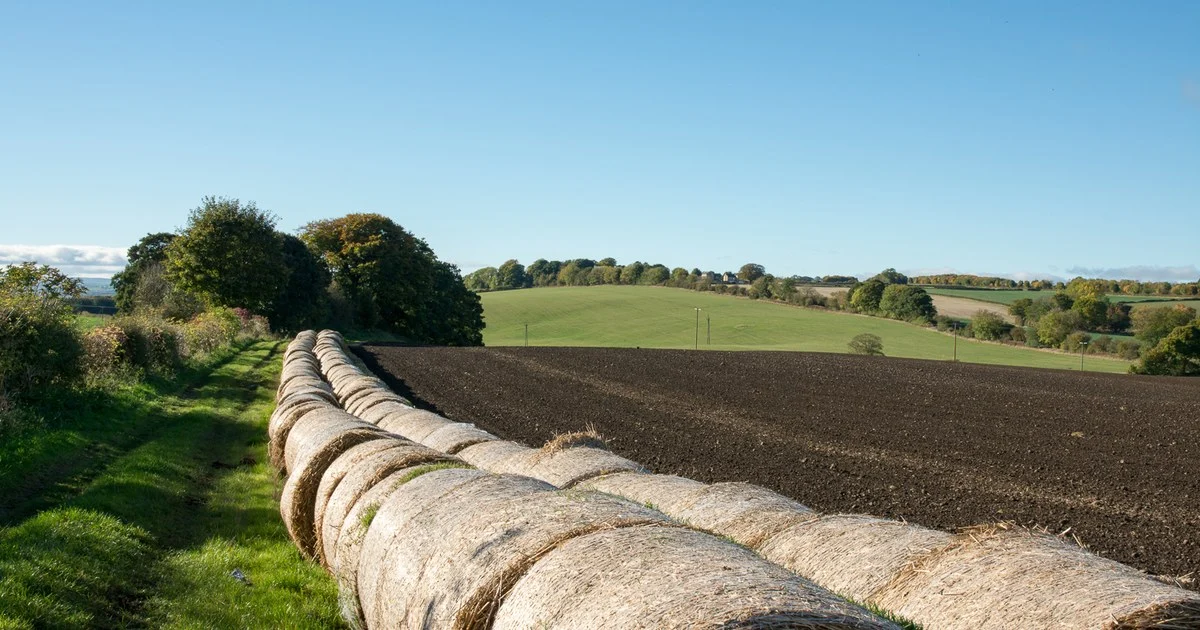
Cover photo: Trevor Littlewood (CC BY-SA 2.0, cropped) · Source
Hay, haylage and silage explained: dry matter, how each is made, hay bale and round bale weights, stacking, fire risk and silage storage rules.
A way through this story
Hay, haylage and silage at a glance
All three are conserved grass. The difference is how much water is left in the crop and how it keeps.
- Hay: dried in the field, baled and kept dry. Ontario’s provincial forage guidance says small square bales should be below 15% moisture (85% dry matter) at baling, and round bales about 13%.
- Haylage: wilted harder than silage, then wrapped so it ferments. North Carolina State University extension puts haylage at 40% to 60% dry matter.
- Silage: wilted briefly, then sealed airtight in a clamp or wrapped bales. The same guide classes high-moisture silage at 30% dry matter or less and medium-moisture silage at 30% to 40%.
Hay keeps because it is dry. Haylage and silage keep because they ferment: bacteria turn grass sugars into acid and the crop stays stable while air is kept out.
How hay is made
Standing grass holds roughly 65% to 85% moisture, so hay needs a run of dry weather to mow, ted and row up until it is dry enough to bale. Small square bales kept under cover go on drying to about 89% dry matter, the Ontario guidance says.
Baling too wet is the main risk: the hay goes mouldy and dusty, loses feed value and can heat enough to catch fire. Preservatives applied at the baler let wetter hay be stored, but treated hay should not be stacked against dry hay, which pulls moisture across and moulds.
How to make silage and haylage
Silage is a fermentation job, and every step is about getting air out fast and keeping it out.
- Cut at the stage that matches the quality you need. Younger, leafier grass gives more energy and protein but less bulk.
- Mow at a sensible height. Cutting too low picks up soil and spoils fermentation.
- Wilt quickly and evenly, then row up.
- Chop and consolidate. Shorter chop packs tighter, whether rolled in a clamp or baled.
- Seal fast. Sheet and weight the clamp, or wrap bales as soon as possible.
Once sealed, fermentation runs for a week or more as the pH falls from about 6.0 to between 3.8 and 5.0, according to the North Carolina State guide. Bales made too dry ferment poorly, and Aberystwyth University’s baled silage handbook warns that fermentation becomes unpredictable above about 60% dry matter.
For big bale silage the levy board’s guidance is to wrap as soon as possible with six layers of good quality film. The Agriculture and Horticulture Development Board reports that six layers rather than four gave a better film seal, cut visible mould from 0.5% to 0.1% and reduced dry matter losses from 10.4% to 8.2%. Wrapping at the stack gives a better seal than wrapping in the field.
How much does a hay bale weigh?
There is no fixed weight: baler settings, crop, moisture and density all change it. Published figures give a guide:
- Small conventional bales: Teagasc lists a small square straw bale at about 12.5 kg. Hay bales of the same size are usually heavier.
- Round hay bales: Dairy Australia’s survey of hay bales found 1.2 m by 1.2 m round bales averaged 265 kg, but ranged from 195 kg to 390 kg. Bigger 1.5 m by 1.5 m bales averaged 475 kg.
- Dry matter in round bales: University of Missouri Extension works out that a 4 ft by 4 ft round bale holds about 450 to 600 lb of dry matter (roughly 205 to 270 kg) depending on density, and a 4 ft by 5 ft bale about 710 to 940 lb (roughly 320 to 425 kg).
- Large square bales: Teagasc gives about 400 kg for an 8 x 4 x 3 ft straw bale and 580 kg for an 8 x 4 x 4 ft bale. The HSE warns that big square bales can weigh up to 600 kg.
Two bales of the same size can differ by more than 300 lb (about 135 kg), Missouri found, so buying by the tonne with a dry matter figure is fairer than buying by the bale.
Round bale silage weight and bales per hectare
Wrapped silage bales are far heavier than hay bales of the same size because they hold much more water. In Teagasc trials published in 1999, round silage bales averaged 514 kg (unchopped grass) and 562 kg (chopped grass) before wrapping, with between about 167 kg and 262 kg of dry matter per bale. Irish advisers working out fodder budgets more recently have assumed 700 to 800 kg fresh weight per bale.
The same 1999 Teagasc work surveyed bale numbers and found an average of 27.4 bales per hectare at first cut, 20.3 at second cut and 17.0 at third cut. Yield, dry matter and baler settings drive the number, so use your own records where you can.
Stacking bales and fire risk
Hay can catch fire on its own. Northern Ireland Fire and Rescue Service advice says hay baled above 15% moisture will heat within 3 to 7 days, usually not dangerously, but at 22% or more there is a risk of spontaneous combustion, with fires most likely within six weeks of baling. A caramel or strong musty smell means the hay is heating. Check new stacks regularly and get fire service advice if one becomes very hot.
The HSE’s leaflet on safe working with bales sets out the main stacking rules:
- Build stacks on firm, dry, level, free-draining ground, away from ignition sources and overhead power lines.
- Do not build stacks or work within 10 m horizontally of overhead power lines without assessing the risk and talking to the network operator.
- Keep big square bale stacks no higher than one and a half times the width of the base, ten bales on hard standing or eight bales where there is none.
- Round bales are best stacked on their sides in a pyramid, with the bottom row chocked. Keep the stack to roughly three times the bale diameter.
- Wrapped bales are slippery. Stack them one high below 25% dry matter, two high between 25% and 35%, and three high between 35% and 45%.
- No smoking or hot work, such as welding, near stacks.
Silage effluent and storage rules
Silage effluent is highly polluting, and wet, low dry matter silage produces the most of it. In England, silage storage falls under the SSAFO rules. For bales, the government’s guidance says baled silage must be sealed in an impermeable membrane or bag, must be kept at least 10 metres from inland or coastal waters, and must not be unwrapped within 10 metres of them. Field silage has extra rules, including a 50 metre gap from protected water supplies and notifying the Environment Agency at least 14 days before using a new site.
Clamp base, effluent tank and capacity rules are covered in our guide to slurry, silage and SSAFO regulations, so we have not repeated them here.
Feeding value and forage analysis
Forage quality varies widely, so get it analysed before planning winter rations. The main figures are dry matter, D-value or digestibility, metabolisable energy (ME, in MJ per kg of dry matter) and crude protein, plus pH for silage, where a low pH shows a good fermentation.
Sample several bales or several points across the clamp face. Once a clamp is open, keep the face moving: the North Carolina State guide suggests taking off about 6 inches (15 cm) a day to limit heating and spoilage.
Frequently Asked Questions
What is the difference between haylage and silage?
Both are fermented, but haylage is wilted to a much higher dry matter, roughly 40% to 60%, while most silage is 40% dry matter or less. Haylage is drier and less acidic, and is popular for horses; silage is the usual winter forage for cattle and sheep.
How much does a round bale weigh?
It depends on size, crop, moisture and density. A survey of 1.2 m by 1.2 m round hay bales found an average of 265 kg, with a range of 195 to 390 kg. Wrapped silage bales are much heavier, often 500 kg or more, because they hold more water.
How much does a small bale of hay weigh?
Teagasc puts a small square straw bale at about 12.5 kg. Small hay bales are denser and usually heavier, but the weight depends on how the baler is set, so weigh a few if you are buying by the bale.
Why does hay catch fire?
Damp hay keeps respiring and moulds grow in it, which produces heat. Fire service guidance says hay baled at 22% moisture or more is a real fire risk, especially in the first six weeks. A caramel or musty smell is a warning sign.
How far from a watercourse can I store silage bales?
Under the SSAFO rules in England, baled silage must be kept at least 10 metres from inland or coastal waters and must not be unwrapped within 10 metres of them.
BritFarmers Weekly
One email a week: what’s moved on schemes, prices, disease control and policy, with links to primary sources. Free. No sponsors. Unsubscribe anytime. Subscribe.
Source: AHDB: Top 10 tips to optimise big bale silage quality
You’ve reached the end of this story.