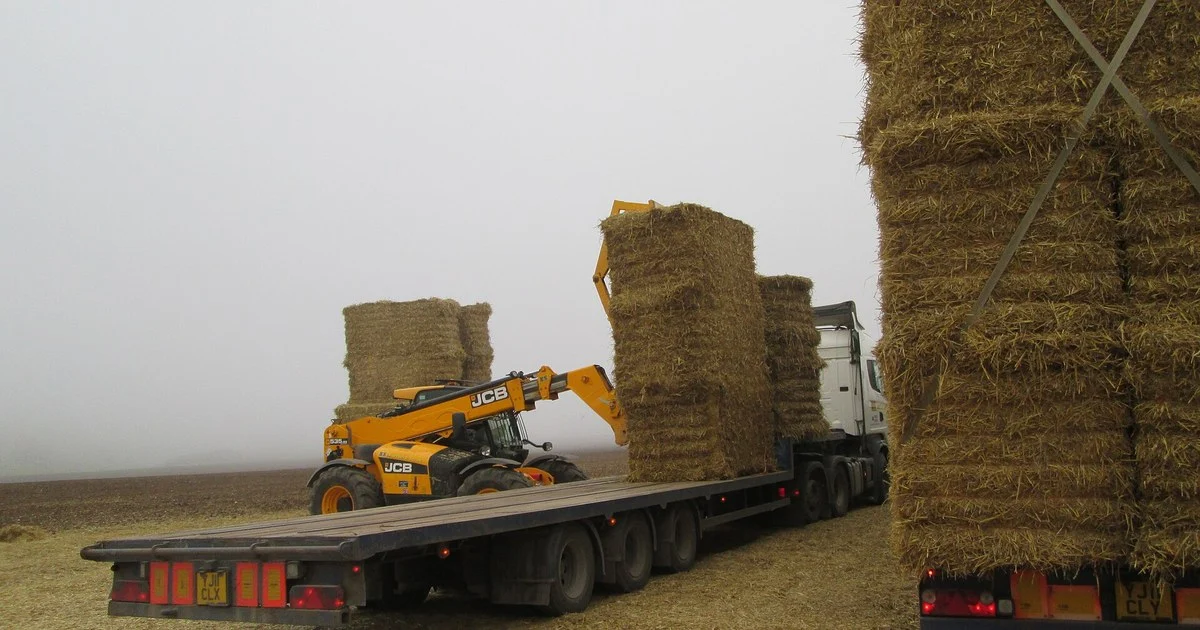
Cover photo: Martin Dawes (CC BY-SA 2.0) · Source
Tim’s take:
Every few months a different “straw gold rush” article crosses my desk, and I’ve learned to treat them the same way I treat a dubious greengrocer’s special: with interest, but with the chequebook firmly in my pocket. This week the numbers got checked properly, and they don’t flatter the dream.
The working farmer’s question is straightforward: is the construction trade actually paying more than the bedding market’s £74/t for baled wheat straw? After ringing round every credible UK buyer, the answer is a flat no. There is no operating straw-panel, strawboard or straw-insulation plant in the UK or Ireland, no published construction price, and certainly no spot market you can ring up on a wet August evening when you’ve got 600 acres of spring barley to clear. Bio-based building as a sector is real, but as a buyer of your straw bales it is, for now, vapour.
So what does a sensible farmer do with the 2026 straw heap? Price it honestly against bedding and the livestock end-user, factor in haulage, and ignore anyone selling you a ten-year offtake agreement signed with a company that has yet to pour a slab. If a builder rings offering a premium, ask which plant, which month, and which haulage rate is included; if the answers are vague, so is the price. Watch this space when the first commercial UK panel line actually switches on, not before.
Should you sell your straw to the building trade? I checked every UK buyer: no straw-panel factory, no published construction price, and bedding wheat straw pays £74/t.
Every few months someone puts the same idea in front of British farmers: the construction industry is desperate to decarbonise, your straw locks up carbon, therefore your straw is about to be worth a great deal more than the £74/t the bedding trade is paying for it.
A reader who does on-farm research into exactly this got in touch last week, which prompted me to go and check the numbers properly. Here is what I found, and it is not the article the bio-based building sector would write.
The short version. There is no straw-panel, strawboard or straw-insulation factory operating anywhere in the UK or Ireland. There is no published price that any construction buyer pays for cereal straw, and no documented premium over bedding. The one crop with a genuine construction market — hemp — runs through a single merchant decorticator in East Yorkshire, and the price that makes its budgets work is a modelling assumption, not a contract. If you are looking at this as a diversification, the realistic version in 2026 is building with your own residues on your own farm, not selling them.
Below is the evidence, with the counter-argument on soil at the end.
A way through this story
First, the benchmark: what your straw is already worth
Any construction offer has to beat the bedding market, and the bedding market is strong.
GB big square bales, ex-farm, week ending 4 October 2026, from the BHSMA series published by AHDB:
- Wheat straw — 4 Oct 2026: £74/t; Year earlier: £81/t
- Barley straw — 4 Oct 2026: £89/t; Year earlier: £92/t
Those are national averages and they hide the thing that actually matters. On the regional BHSMA tables for week ending 4 October 2026, barley straw is £80/t in East Yorkshire and £118/t in the South West. A £38/t spread on the same commodity, driven almost entirely by haulage and by where the livestock are.
The season before was tighter still. AHDB’s straw market outlook had wheat straw at £92/t and barley at £102/t on 8 February 2026, after a dry 2025 and a wet winter, with spring barley area forecast down 15% for this harvest. Farmers Weekly reported in May that hauliers had spent the winter bringing straw in from France.
Set against that, a construction buyer would have to outbid livestock farmers in a shortage, in a market where the same bale is worth nearly 50% more in Devon than in Driffield. Nobody is currently doing it.
Harvest itself has now put the first new-crop numbers on the table. AHDB’s first harvest report of 2026, published on 31 July, has early-season straw prices around £20/t below the March highs and broadly level with last July and August, and reads that as the seasonal flush of fresh supply rather than a signal about the winter. It is also blunt about quality: the early start meant some grain hit maturity before the straw was fully fit, so bales are running green in places and brittle and dusty in others, with swaths generally smaller in the East and larger in the West, though not universally.
The buyers: who is actually out there
I went through the sector company by company, including Companies House checks in July 2026.
- ModCell, the Bristol straw-panel business behind the 20 straw-bale homes at LILAC in Leeds, is gone. Modcell Ltd was dissolved on 24 August 2021. The successor company dropped the ModCell name in November 2018, is now registered as Agile Property UK Limited, and has filed dormant accounts for every year since 2019. The website is still up and still carries the dissolved company’s number.
- EcoCocon panels — 89% straw, 10% timber — are available here. Ecological Building Systems signed an exclusive UK and Ireland distribution deal in August 2025. The panels are manufactured in Slovakia and Lithuania. I could not confirm that any UK or Irish straw goes into them, either way.
- Straw Works, the training and consultancy outfit, was dissolved in October 2023, though Barbara Jones still works through the School of Natural Building.
- Stramit, the old strawboard name, is gone as a strawboard manufacturer. Stramit International (Strawboard) Ltd was dissolved in November 2020 and Stramit Industries Ltd in July 2022. A small company called Stramit Limited is still registered in London and still files accounts, but I found no evidence it manufactures strawboard.
The one genuinely expanding UK business in this space, Adaptavate in Bristol, raised £2.7m in a pre-Series A round in April 2025. Its Breathaboard uses “fibrous and cellulosic by-products from food and fibre crops” — but straw is not named in any of its published material, so don’t assume a route to market there without asking.
The finding that matters: across an exhaustive search I could not find a single published UK or Irish price paid by a construction buyer for cereal straw, a single grower contract, or any documented premium. That is not a gap in the research. It is the state of the market.
For scale, remember who you would be competing with. England’s biomass power stations burned 768,000 tonnes of straw in 2022/23 — Sleaford, Brigg, Snetterton and Ely between them, each on long-term contracts. Against that, with no factory operating, straw for building currently consumes nothing at all. The ROC-backed plants can pay and do; the building trade is a market that has yet to open.
If a buyer does turn up, what they’ll want
There is no British Standard for straw-bale construction. The de facto reference is the Straw Works Bale Standard:
- Moisture below 20%
- Density minimum 80 kg/m³ (EcoCocon compresses to 110–115 kg/m³ in-panel)
- Two-string bales 1,050 × 355 × 460mm, 16–25kg
- Straw length preferably 150mm or more — which rules out a lot of modern combine settings
- Virtually no seed heads, no vermin
- Stored 150mm off the ground, weatherproof but ventilated
That is a tighter spec than bedding, on a crop with no premium attached. Worth knowing before anyone tells you it’s easy money.
Hemp: a real market, a real bottleneck
Hemp is the one purpose-grown fibre crop with actual UK construction demand behind it, and the licensing has genuinely got easier.
A Home Office licence is £580 for a new application, £326 to renew, and from the 2026 season runs for six growing seasons rather than three. Since 2025 you can grow anywhere on the licensed farm rather than on pre-approved plots. On 20ha that licence works out at under £5/ha/year — the barrier is paperwork and DBS checks, not cost. The THC limit is still 0.2%. The government accepted an ACMD recommendation to move to 0.3% in February 2025, but as of October 2026 the regulation that sets the limit has still not been amended. There were 102 licences in force in Great Britain in November 2025.
The crop itself is genuinely low-input: no insecticide needed, around 120 kg N/ha optimal in the Scottish trials.
Now the economics, and read this bit twice.
The Scottish Enterprise/SAC supply chain study (February 2025) models hemp straw at £270/t farm-gate on 6 t/ha, giving a gross margin of £1,046/ha. That £270 is a modelling assumption, not a price anyone is demonstrably paying. The only real contract figure on record is £320/t delivered to Harrison Spinks in Leeds for January 2024 delivery.
But Harrison Spinks’ own growers told Farmers Weekly they budget on 2 t/ha “to get a fair average over several years.” Run the SAC’s own cost structure at that yield — £574/ha variable costs against 2t × £270 — and you get minus £34/ha. On these numbers hemp breaks even somewhere around 2.2 t/ha. The crop is entirely yield-dependent, and there is no hemp gross margin in John Nix, the SAC handbook or any AHDB series to check it against.
The bottleneck is physical. Britain has essentially one merchant decorticator: East Yorkshire Hemp at Brandesburton near Driffield, where Nick Voase built his own line after the previous processors went under, handling up to 500 acres a year. Harrison Spinks runs a second, captive line in Leeds. That is it. The Suffolk decorticators dissolved in 2011 and 2020. A £30m, 25 t/day Leicestershire plant announced in 2020 was never built.
This matters because raw straw doesn’t travel — fibre does. IndiNature’s insulation plant at Jedburgh in the Borders buys processed fibre and carts it roughly 200 miles up from East Yorkshire, because there is nowhere nearer. On SAC’s own haulage quotes, moving bales costs £11/t at 30 miles, £14/t at 60 and £19/t at 90. On a £270/t crop, 90 miles is 7% of your gross output before you’ve done anything else.
A decortication line costs £1–1.6m from Tatham in Yorkshire — grain store money, not impossible money. The problem is that nobody builds a line without contracted straw and nobody grows straw without a line within about 30 miles.
Where the demand pull is real: IndiNature holds a BBA Agrément certificate (23/7060) for UK-grown hemp insulation, achieved a Euroclass B fire classification in a tested build-up in April 2026, and — the strongest single fact in this whole area — secured an Ofgem Innovation Uplift giving hemp loft insulation a 25% savings uplift on the ECO4 Area Based Scheme, reaching EPC Band D homes that conventional loft materials can’t serve. That is a government retrofit scheme actively paying a premium for a British hemp product. The King visited the Jedburgh mill on 2 July 2026.
One caution before you plan a rotation around it: the accounts of Industrial Nature Ltd to 31 March 2025 show net liabilities of £993,539, and £6.19m of convertible loan notes now falling due within a year — £4.2m of which sat beyond one year in 2024. A change of control followed in December 2025: co-founder Scott Simpson ceased to be a person with significant control and left the board on 19 December, and two new directors were appointed. The directors signed those accounts on a going concern basis and reported no material uncertainty, so this is a company trading and expanding, not one in trouble — but it is a single buyer, and single buyers are how the last generation of UK hemp growers got caught.
Miscanthus: a good contract, for burning
Miscanthus has the thing hemp lacks — a real, contracted, index-linked market. Terravesta’s published base is £94.56/t, index-linked, off an establishment cost of about £2,150/ha with a 7–12 year payback and a 20-year stand. Brigg and Snetterton both name miscanthus in their fuel contracts and hold ROC accreditation to October 2035 and December 2036 respectively.
But that is combustion, not construction. The only UK miscanthus building product on open sale is the Tŷ-Bloc from Tŷ-Mawr Lime in Brecon, at £4.40 a block, with no published lambda value, density, strength or certification. Terravesta advertises a “Green Construction” market on its homepage; the page itself currently reads “work in progress, coming online shortly.”
If you want a fibre crop with a bankable contract, miscanthus is it. Just don’t plant it expecting a building market.
The version that might actually work: build with it yourself
This is where the research that reader is involved in comes in, and it is the most useful thing published on the subject.
Ag.Lab was an EPSRC-funded project run by Local Works Studio with the Centre for Rural Policy Research at Exeter, from September 2024 to December 2025, on a 1,000-acre East Sussex arable and horticulture farm growing 450+ acres of sweetcorn a year. The premise — “Harvest to House” — is that farms make insulation blocks from their own residues, using kit they already own, in the season when the food work is quiet.
The full report (February 2026) is unusually honest about what works and what doesn’t.
What works. The blocks are good. Made at standard UK concrete block size (440 × 215 × 100mm) from 1kg of shredded sweetcorn stem, 1.5L clay slip and 1.5L lime, they came out at 650 kg/m³ with a compressive strength of 2.2–3.8 N/mm² at 92 days — against hempcrete’s typical 0.3–1 N/mm². A 600°C blowtorch held on one for an hour and a half produced no ignition and no smoke, just 30mm of surface erosion. Drying the crop standing in the field for two to three weeks beat every other drying method they tried, and the report’s most promising untested idea is ensiling residues in existing silage clamps for three to five years’ storage.
What doesn’t. With the mechanical harvester, 90% of the plant is discarded but only about a third is recoverable — the wheels crush the rest. That’s 216 blocks per acre mechanically, against 648 hand-picked. One worker makes 12 blocks an hour; three semi-skilled workers manage 150 a day; with a mechanised press, three skilled workers might do 1,000. Fabricators told the team that commercial viability starts at 20,000–25,000 blocks a day. Transport of the bulky, wet material is prohibitively expensive beyond about five miles. The farm reckoned it needed another £30,000 of pallets, storage and clean-down kit to make it work. And they never got a U-value, because formal thermal testing costs £5,000–£25,000 and was beyond the budget.
There is also a regulatory problem nobody has written up: the Seasonal Worker visa covers harvesting and sorting, and does not explicitly permit fabrication work. The team asked the Home Office for clarification and didn’t get an answer.
The realistic use case the report lands on is on-farm: insulating seasonal worker accommodation, barns and bunkhouses with material you’d otherwise plough in. Not a product line. That is a smaller idea than the headlines suggest, but it is a real one, and the five-mile transport limit stops being a problem when you’re not going anywhere.
The counter-argument: should you be selling it at all?
Worth doing the sum honestly, because the “don’t sell your straw” orthodoxy overstates it on nutrients.
RB209 (March 2026) puts winter wheat and barley straw at 1.2 kg P₂O₅ and 9.5 kg K₂O per tonne; spring cereals at 1.5 and 12.5; oilseed rape at 2.2 and 13.0. Note what isn’t there: RB209 gives no nitrogen or sulphur value for straw, deliberately, because straw N is immobilised by soil microbes rather than made available to the following crop. Any £/t figure you’re shown that includes N is not RB209-based.
At AHDB’s 25 September 2026 fertiliser prices (TSP £641/t, MOP £367/t), my calculation puts that at roughly £7.50 per tonne of straw in P and K — call it £26–34/ha at 3.5–4.5 t/ha. Against £74–118/t in the yard, the nutrient replacement value is about 6–10% of the sale price. On nutrients alone, selling wins comfortably, which is what FAS Scotland found too.
The better arguments for chopping are the ones that don’t show up in that sum: AHDB’s straw incorporation review found incorporation can lift soil total nitrogen reserves by around 7% over eight years or more, and separately puts the cost of remediating compaction from straw removal at up to £55/ha. If you’re on light land with low organic matter and you’re carting bales off in a wet autumn, that changes the answer.
And note what England doesn’t pay you. SFI26 reopened on 30 June 2026 — Window 1 restricted to farms of 3–50ha, £60m of a £240m pot, £100,000/year cap. Window 1 closed on 28 August 2026, and Window 2, with £253m of a total for new agreements lifted to £310m, opened and closed on 22 September. Nothing in the scheme pays for straw incorporation or penalises removal. Across the Irish Sea, the Straw Incorporation Measure is paying €250/ha for cereals and €150/ha for oilseed rape to chop it in — 3,242 applications on 73,000ha this year, over budget and needing a €6.8m top-up. Ireland is simultaneously paying farmers to plough straw in, importing 55,000 tonnes of it, and arguing in the trade press for a domestic straw construction industry. Make of that what you will.
So what would actually have to change
Three things, and none of them are in your control:
1. Someone builds a processing plant. Until there’s a decorticator or a panel line within cart distance, the economics can’t work — bulky low-value material doesn’t travel.
2. Embodied carbon gets regulated. It still isn’t. The Future Homes Standard published on 24 March 2026 and in force from March 2027 covers operational carbon only; MHCLG’s July 2025 research note explicitly said publication “does not indicate any specific future action.” Part Z remains a voluntary industry proposal. The pressure is real but it’s commercial — RICS whole-life carbon assessment has been mandatory for its members since July 2024, the UK Net Zero Carbon Buildings Standard published v1 in March 2026 with verification opening this summer, and London already requires whole-life carbon assessments on major schemes.
3. Warranty and certification catch up. NHBC’s accepted systems list — 34 of them — contains no straw, hemp or bio-based system at all. No warranty, no mortgage, no volume housebuilder.
If you still want in
- Don’t plant hemp without a signed offtake and a decorticator inside 30 miles. Ring East Yorkshire Hemp (01964 542477) before you ring anyone else.
- Check the Defra Farming Innovation Programme. February 2026’s £21.5m round included a project on climate-resilient hemp varieties explicitly for “fibre and biomaterials.” The ADOPT fund is farmer-led with rolling rounds through November 2026.
- Propose a field lab. The Soil Association’s field lab network takes farmer-proposed trials and has run hemp work before. Nobody has yet run one on construction materials.
- If you’re curious about the on-farm version, Local Works Studio’s Ag.Lab report is free, and the Centre for Rural Policy Research at Exeter (Dr Caroline Nye, Prof Matt Lobley) co-authored it.
- And if a buyer approaches you, ask them three questions: what are you paying per tonne, where is it being processed, and who holds the warranty on the finished building. If they can’t answer all three, you’re being asked to fund their R&D.
Straw and fertiliser prices correct at 4 October 2026; SFI details as at 23 September 2026. Straw and fertiliser markets move weekly — check AHDB before making a decision on the strength of anything here.
Sources: AHDB hay and straw prices · AHDB straw market outlook · AHDB GB fertiliser prices · RB209 Section 4, March 2026 · AHDB straw incorporation review · BHSMA regional straw prices · Farmers Weekly on straw and forage prices · Defra: Agriculture in the UK 2025, Chapter 7 · Home Office industrial hemp licensing · Scottish Enterprise/SAC industrial hemp supply chain study · Farmers Weekly on Yorkshire hemp and miscanthus · East Yorkshire Hemp · IndiNature news · Ecological Building Systems / EcoCocon deal · Straw Works Bale Standard · Local Works Studio: Ag.Lab · Ag.Lab full report, February 2026 · Irish Straw Incorporation Measure 2026 · SFI26 scheme rules · NHBC accepted systems · MHCLG embodied carbon research
Frequently Asked Questions
Can you sell straw to the building trade in the UK?
Not currently. There is no straw-panel, strawboard or straw-insulation factory operating in the UK or Ireland, no published price any construction buyer pays for cereal straw, and no documented premium over the bedding market.
What is straw worth in 2026?
GB big square bales ex-farm were £74/t for wheat straw and £89/t for barley straw in the week ending 4 October 2026, on the AHDB BHSMA series. Regional spreads are wide — barley straw ran from £80/t in East Yorkshire to £118/t in the South West.
Does selling straw cost you more in nutrients than you gain?
On nutrients alone, no. RB209 values winter cereal straw at 1.2 kg P₂O₅ and 9.5 kg K₂O per tonne, which at late-September 2026 fertiliser prices is about £7.50 per tonne — roughly 6–10% of the sale price. RB209 assigns straw no nitrogen or sulphur value. The stronger arguments for chopping are soil organic matter and compaction, not nutrient replacement.
Is growing hemp for construction profitable?
It depends entirely on yield and on having a decorticator nearby. The SAC supply chain study models £270/t at 6 t/ha, but Harrison Spinks growers budget on 2 t/ha — which on the same cost structure gives about minus £34/ha. Break-even sits near 2.2 t/ha.
BritFarmers Weekly
One email a week: what’s moved on schemes, prices, disease control and policy, with links to primary sources. Free. No sponsors. Unsubscribe anytime. Subscribe.
You’ve reached the end of this story.