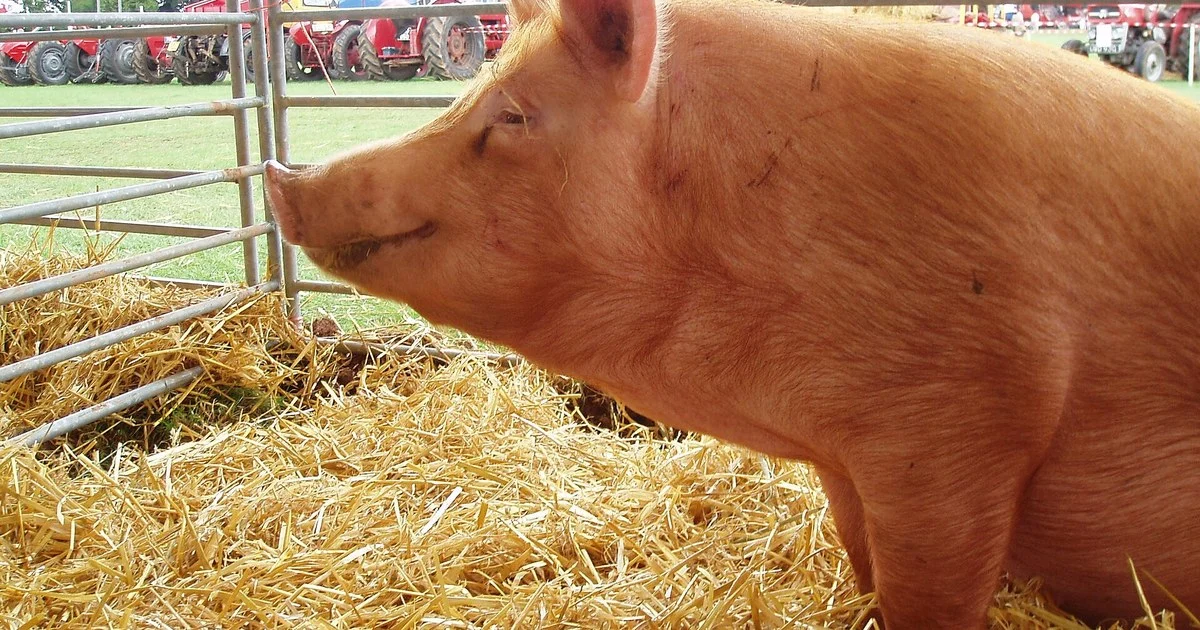
Cover photo: Amanda Slater from Coventry, England (CC BY-SA 2.0, cropped) · Source
Tamworth pigs explained: Midlands origin, ginger coat, RBST priority status, woodland rearing, pork and bacon, and the rules before you buy piglets.
A way through this story
Tamworth pigs at a glance
- Origin: the Midlands, around the town of Tamworth, from about 1800
- Colour: golden-red or ginger, with pink skin
- Status: Priority, the highest level of concern, on the RBST 2026-27 Watchlist
- Population: 225 breeding females recorded in 2024
- Breed club: the Tamworth Breeders’ Club, set up in 2004
- Mature weight: around 260 kg for sows and 320 kg for boars
- Use: dual-purpose, but historically known as a bacon pig
- Best suited to: outdoor, paddock and woodland systems
History of the breed
The Rare Breeds Survival Trust describes the Tamworth as Britain’s oldest pure pig breed and the closest in appearance to the Old English forest pig. It developed in the Midlands, near the town of Tamworth, around 1800. One theory links it to Irish pigs, known as Irish Grazers, brought to Drayton Manor at Drayton Bassett by Sir Robert Peel; another suggests red pigs imported from Barbados played a part. The breed was recognised in 1865 and a herd book started in 1885.
When 18th and 19th century breeders crossed native pigs with Asian imports to speed up growth, the Tamworth was largely left alone. The Tamworth Breeders’ Club says its blood stayed relatively pure as a result. After the Second World War, farmers were pushed towards faster-growing commercial breeds, consumers wanted leaner pork, and Tamworth numbers fell to a dangerously low level.
Appearance
The ginger coat makes a Tamworth easy to pick out. The breed standard calls for a golden-red coat that is abundant, straight and fine, as free from black hairs as possible, over pink skin free from black spots. Black hairs growing from black spots count against a pig.
The head has a long snout and a slightly dished face, with fairly large, pricked ears carried rigid and slightly forward, fringed with fine hair. The body is long and deep with a straight back and strong legs set well outside the body, and the pig stands up on its toes. Sows should have a straight underline with at least 12 sound, evenly spaced teats. Exhibitors are not allowed to use oil or other enhancements on show pigs.
Conservation status
All 11 native UK pig breeds are on the RBST Watchlist, and the Tamworth is in the Priority category on the 2026-27 list, alongside the Berkshire, British Landrace, British Lop, Large Black, Large White and Middle White. The trust recorded only 225 breeding females in 2024. The Tamworth Breeders’ Club puts the herd at between 200 and 300 registered breeding sows.
That makes registration matter. Selling registered pedigree breeding stock, and keeping boars from different bloodlines in use, does more for the breed than any number of unregistered pork pigs.
Outdoor and woodland rearing
Tamworths are hardy pigs with a thick, coarse coat, and the breed club says they are suited to living outdoors all year round. The long snout makes them strong rooters, which is why they are used for ground clearance and conservation grazing. The trust notes that rooting can aerate soil and clear scrub, but will damage pasture if it is not controlled.
Woodland is where the breed shines. The trust highlights its value in woods with heavy acorn fall, where the pigs clear acorns that are toxic to cattle, sheep and horses. This is the old practice of pannage, where pigs were turned out to forage in woodland during a set season.
Plan the ground carefully. Rotate paddocks before they turn to bare mud, protect tree roots and ground flora on sensitive woodland, use strong electric fencing set low for a rooting pig, and provide shade and a wallow in summer. Ginger skin is less prone to sunburn than white skin, but the pigs still need shelter in hot weather.
Pork, bacon and growth
By the 1870s the Tamworth had a reputation as a bacon pig, and it is still reared principally for bacon, although the meat suits both pork and bacon. The breed is slow to mature compared with commercial hybrids. The breed club says that slower growth builds intramuscular fat and marbling, and the fat cover makes the carcass good for curing.
The trust gives a typical slaughter weight of 80 kg producing a 50 to 60 kg deadweight carcass. Tamworth sows are known as good mothers, but litters are smaller than average; the trust’s figure for average litter size in 2009 was around 7.8 piglets. Most Tamworth pork is sold through butchers, farm shops and direct sales, where the breed name earns a premium; our guide to farm shop and direct sales covers the economics.
The Tamworth Two
The breed’s best-known pigs were Butch and Sundance, five-month-old Tamworth siblings who escaped from an abattoir in Malmesbury, Wiltshire, in January 1998. They squeezed through a fence and swam the River Avon, and spent about a week on the run before they were caught. The story made national and international news. The pigs were spared, and by June 1998 Farmers Weekly reported they were touring agricultural shows. They lived out their lives at a rare breeds centre in Kent, Butch dying in 2010 and Sundance in 2011.
Pros and cons of Tamworth pigs
- Hardy and suited to outdoor and woodland systems all year
- Good mothers with a placid nature when handled often
- Strong rooters for ground clearance and conservation grazing
- Flavoursome pork and bacon that sells well direct
- Slow-growing, so higher feed cost per kg than commercial pigs
- Smaller litters than average
- Rooting damages pasture if pigs are left too long
- Lively and inquisitive, so fencing needs to be good
Before you buy Tamworth piglets
Anyone keeping pigs, even one or two as pets, must follow the same rules as commercial farmers. Before buying:
- Get a county parish holding (CPH) number for the land where the pigs will live
- Register as a pig keeper with the Animal and Plant Health Agency to get a herd mark
- Report every movement on or off your holding through the eAML2 service and keep a holding register
- Never feed kitchen or catering waste, including vegetarian scraps; it is illegal and a route for disease
- Buy registered stock from breeders with a known health status, and agree a health plan with your vet
- Learn the signs of notifiable pig diseases such as African swine fever; our guide to notifiable diseases explains how to report them
The Tamworth Breeders’ Club runs a breeder map and stock-for-sale listings, which is a good place to start.
Frequently Asked Questions
Are Tamworth pigs rare?
Yes. The Tamworth is in the Priority category, the highest level of concern, on the RBST 2026-27 Watchlist, with 225 breeding females recorded in 2024.
What colour are Tamworth pigs?
Golden-red or ginger, with pink skin. The breed standard asks for a coat as free from black hairs as possible.
Are Tamworth pigs good for bacon?
Yes. The breed built its reputation as a bacon pig in the 19th century and is still reared mainly for bacon, though the meat also makes good pork.
Can Tamworth pigs live outside all year?
Yes. Their thick, coarse coat makes them hardy enough for outdoor systems year round, provided they have shelter, dry bedding and shade in summer.
How big do Tamworth pigs get?
Mature sows average around 260 kg and boars around 320 kg. Pork pigs are usually slaughtered at around 80 kg live weight.
What happened to the Tamworth Two?
Butch and Sundance escaped from a Malmesbury abattoir in January 1998, were spared after their capture and lived at a rare breeds centre in Kent until 2010 and 2011.
BritFarmers Weekly
One email a week: what’s moved on schemes, prices, disease control and policy, with links to primary sources. Free. No sponsors. Unsubscribe anytime. Subscribe.
Source: Rare Breeds Survival Trust
You’ve reached the end of this story.