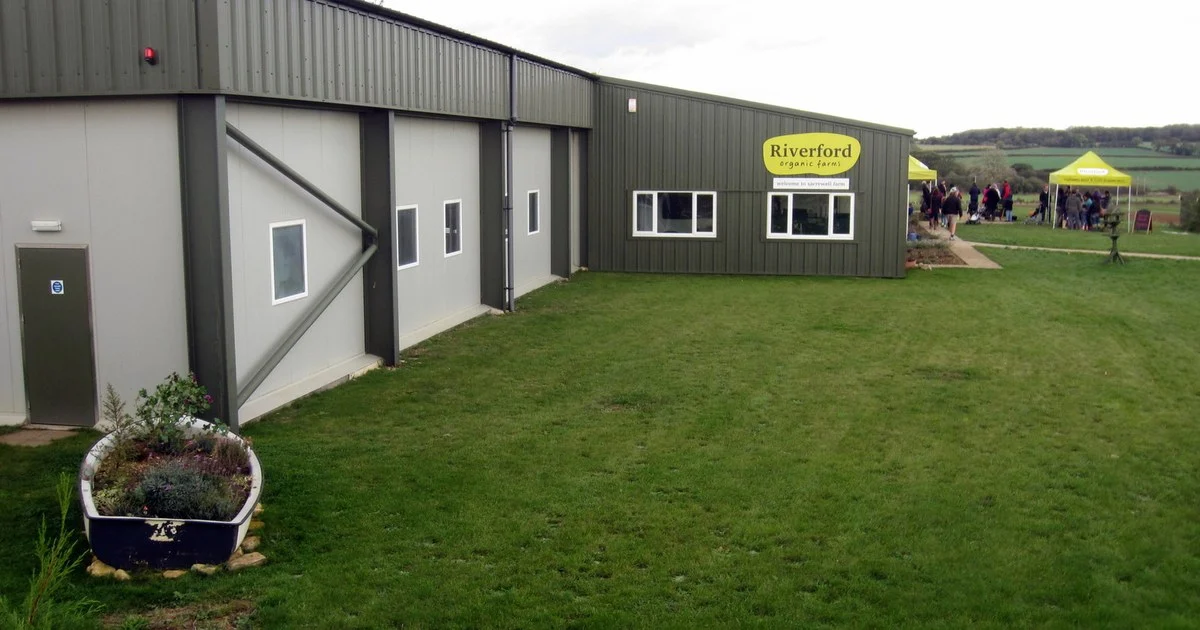
Cover photo: Philip Jeffrey (CC BY-SA 2.0, cropped) · Source
Last updated: June 2026. A working farmer’s walk through UK vegetable box schemes and Community-Supported Agriculture in 2026: the subscription economics, the customer-acquisition cost that decides whether a scheme scales or stalls, the pack-shed and logistics setup that actually works, the cropping plan a box scheme demands of the holding, the legal and food-safety overlay, the model that has done well and the models that haven’t, and the working box-scheme plan I’d write down if I were starting one on a small holding tomorrow. General information, not regulated business advice. See the launch-week checklist at the end for the six steps to take before the first box leaves the farm.
I drove past the old Riverford depot on the M5 last spring on the way back from a farm-shop trade visit and counted, on the slip-road, fourteen of their refrigerated vans waiting to head out for the evening delivery run. Riverford is the giant in the UK vegetable box scheme sector and has been since the mid-1990s. The fourteen vans in one parking lot, all of them owned and crewed by the same Devon farm-based operation, are a working illustration of what a vegetable box scheme can become when the operational discipline is in place. Twenty-three years on this holding, twenty-one of those in salad and field vegetables for wholesale and supermarket contract, and the box scheme question has come back round to the kitchen table every other year for a decade.
This is what I have learnt watching successful and unsuccessful box schemes across the UK, talking to operators at farm shows and reading the working economics, and what I would actually do if the missus and I were sitting at the kitchen table tonight deciding whether to launch a box scheme on a corner of this holding next year.
A way through this story
What a box scheme is and where it sits in the picture
A vegetable box scheme is a subscription-based direct-sales model: the customer pays a weekly or fortnightly fee, receives a box of seasonal produce from the farm (delivered or collected), and continues the subscription on a rolling basis. The variations are wide: small farm-direct schemes serving a few dozen local customers, mid-scale regional schemes serving a few hundred to a few thousand, and large national operators (Riverford, Abel and Cole) serving tens of thousands.[1]
Community-Supported Agriculture (CSA) is a related but distinct model that emerged in the US in the 1980s and the UK from the late 1990s.[2] The CSA difference is in the subscription structure: the customer commits at the start of the season, pays up-front (or in instalments) for a share of the season’s harvest, and takes their share weekly through the season. The customer carries some of the cropping risk; the farm has guaranteed cash flow and a fixed customer base. Variations of CSA include traditional share-based models, “pay-what-you-can” sliding-scale models on community-interest schemes, and hybrid box-and-CSA models.
The two models share most of their operational characteristics: a farm producing diverse vegetables on a small scale, a regular packing and distribution rhythm, a customer base that values seasonality and provenance, and a tight working margin. They differ mainly in the subscription mechanics and the risk-sharing structure.
Where they sit in the wider direct-sales picture is alongside farm shops (covered in our UK Direct Sales and Farm Shop 2026 guide), PYO (covered in our UK Pick-Your-Own Economics 2026 guide) and farmers’ markets. Box schemes and CSA are the most logistically demanding of the direct-sales models because the farm has to deliver produce, week after week, to a defined customer list on a defined schedule.
The customer who buys a box
The UK vegetable box subscriber profile, drawn from operator surveys and the Soil Association’s organic market reports, is reasonably consistent:[3]
- ABC1 socio-economic group, predominantly professional or managerial households
- Households with children at home (substantial proportion) or households of older adults (substantial proportion)
- Urban or suburban location (most are not rural)
- Cooks from scratch at home (most are competent home cooks who want raw ingredients, not prepared food)
- Values provenance, seasonality, organic certification or low food miles (most boxes are organic or near-organic)
- Willing to pay a price premium on vegetables (typically 20 to 50 per cent above the supermarket price for equivalent produce, in exchange for the convenience, the provenance and the curation)
The conversion from “interested in vegetables and willing to try a box” to “subscriber for 6+ months” runs at roughly 25 to 45 per cent on most operators, with significant variation by region, marketing channel and price point.[4]
The churn rate is the structural challenge. A vegetable box subscriber, on average, stays for 8 to 18 months before cancelling. The reasons for cancellation include changing household circumstances (children leaving home, moving house), holidays and seasonal demand changes, dissatisfaction with the produce mix, and the universal “we never get around to using it” cancellation. A scheme with a 12-month average tenure needs to replace roughly half its customer base every six months. That replacement cost, in marketing and customer acquisition spend, is the single biggest determinant of long-run scheme economics.
The subscription economics
A working UK box scheme in 2026 prices a small standard box (around 5 to 7 kilograms of mixed vegetables, enough for two adults for a week) at £18 to £24 per box delivered. A larger family box (8 to 12 kilograms) runs £26 to £36 per box.[5] The fortnightly equivalents discount marginally.
The cost stack on a delivered box:
- Produce cost (at wholesale equivalent, not retail) for 5 to 7 kg of mixed seasonal vegetables: £4 to £7 per box. For an organic box at organic wholesale prices the produce cost runs higher.
- Packing labour (pack-shed time, sorting, weighing, labelling): £2 to £4 per box
- Packaging (paper bag, cardboard box, labels, sealing tape): £0.60 to £1.20 per box
- Delivery cost (fuel, vehicle depreciation, driver labour, route planning): £4 to £7 per box for in-house delivery, or £3 to £5 per box for collection-only or pickup-point models
- Card transaction fees (typical 2 to 3 per cent of subscription value): £0.40 to £0.70 per box
- Customer service and admin (subscription management, complaints, missed-box rectification): £0.30 to £0.70 per box
- Marketing and customer acquisition (amortised across the customer’s tenure): £1 to £4 per box
Total variable cost per box: roughly £12 to £24, with the wide range reflecting the difference between a tight efficient operation and a thinly-spread one.
Net contribution per box: £4 to £12 at the median sale price.
A scheme delivering 500 boxes a week is grossing £10,000 to £14,000 a week in subscription revenue (£500,000 to £700,000 a year) and netting £2,000 to £6,000 a week in contribution (£100,000 to £300,000 a year) before fixed costs (the pack-shed building, the management overhead, the vehicles, the insurance). A scheme of that scale is a viable small business.
A scheme delivering 100 boxes a week (the working scale for a small one-farm operation) is grossing £1,800 to £2,400 a week (£90,000 to £125,000 a year) and netting £400 to £1,200 a week in contribution. It is, at that scale, a part-time business or a part-of-a-larger-farm-operation. It is not a stand-alone full-time wage for the operator without other revenue streams.
The transition from 100 boxes a week to 500 boxes a week is the structural challenge most box schemes face. Each step in scale requires a step up in pack-shed efficiency, delivery infrastructure and customer-acquisition spend. The ones that scale successfully usually invest in the infrastructure ahead of the customer base; the ones that don’t tend to stall in the 150 to 300 box-a-week range.
Customer acquisition: where the schemes win or lose
Customer acquisition is the single largest variable in long-run scheme success. A scheme spending £10 to £25 to acquire each new customer, with a customer who stays for 12 to 18 months at a £20 box, generates lifetime revenue of £240 to £540 per customer against acquisition cost of £10 to £25. The ratio works.
A scheme spending £60 to £150 per customer acquisition, with the same tenure and box value, generates the same lifetime revenue against much higher acquisition cost. The ratio still works but the scheme is operating closer to break-even and any rise in churn or fall in tenure pushes the scheme into loss-making.
The acquisition channels that have worked in 2026:
Word of mouth and existing customer referrals. A referral programme paying the referring customer £10 to £20 credit for each successful referral is the lowest-cost acquisition route. Conversion rate from a recommendation is high (the new customer trusts the existing customer) and the loyalty of the referred customer is often higher than a cold-acquired one.
Local social media (Facebook, Instagram). Targeted advertising within a 20-mile radius of the farm, with a defined audience profile (parents of school-age children, organic-food keywords, household income filter), delivers acquisition cost of £8 to £20 per new customer for an established scheme with a clear visual identity.
Local press and parish magazines. Modest results. Better for a community-oriented scheme than a commercial one.
Trade-show and farmers’-market presence. Each weekend’s market attendance can generate 5 to 15 new sign-ups for a scheme with a clear stall presentation. The cost per acquisition is moderate; the side benefit is direct customer contact.
Farm-shop crossover. A scheme running alongside a farm-shop with footfall can sign up new customers at near-zero cost through the shop, simply by handing out a sign-up sheet at the till.
National operator price competition. The presence of Riverford, Abel and Cole and similar national operators in most of the UK constrains the price ceiling that any local scheme can charge. A local scheme has to differentiate (provenance, organic certification, community-supported framing, ultra-fresh produce, ultra-local) to compete on something other than price.
The schemes that have failed have, almost universally, been the ones that under-invested in acquisition once the initial enthusiasm-driven sign-ups were used up. A box scheme is, in marketing terms, more like a gym membership than a corner shop: the recurring subscription is the asset and the recurring acquisition is the obligation.
The cropping plan a box scheme demands
A box scheme demands a different cropping plan from a wholesale or supermarket operation. The customer wants 8 to 14 different vegetable items per box. The farm must produce that diversity, week after week, across a 40 to 48-week subscription year.
The implications:
Diverse cropping. A box-scheme farm typically grows 25 to 50 different vegetable crops across the season, with 8 to 14 in active picking at any one time. The crop list spans roots (potatoes, carrots, parsnips, beetroot, swede, turnip), brassicas (cabbage, kale, broccoli, cauliflower, sprouts), salads (lettuce, rocket, spinach, chard), legumes (peas, beans, broad beans), alliums (leek, onion, garlic, spring onion), tomatoes and cucumbers (often protected cropping), squash and pumpkins, sweetcorn, herbs and the occasional novelty (kohlrabi, fennel, salsify, jerusalem artichoke).
Sequential planting. A continuous supply of (for example) lettuce across 30 weeks requires planting fresh trays every week for 30 weeks. The agronomy and labour rhythm is very different from a wholesale operation cropping 4 large blocks across 4 distinct windows.
Pack-shed and chill capacity. The pack-shed needs to handle 14 different items every box-packing day. Chill space (around 4 to 8 degrees Celsius for most vegetables) is essential.
Winter coverage. A box scheme running 48 weeks needs winter crops: stored potatoes and roots, brassicas (purple-sprouting broccoli, kale, leeks), polytunnel-grown winter salads. The off-season cropping calendar is harder than the main-season one.
Buying in to fill gaps. Almost every box scheme buys in some produce from neighbouring farms or wholesalers to fill gaps that the farm itself cannot economically produce (citrus, bananas in some schemes, tomatoes out of season, exotic herbs). The proportion bought in varies: a pure-CSA scheme might buy in nothing; a typical box scheme might buy in 15 to 35 per cent of produce by value.
Customer-mix curation. A box that contains six varieties of kale in late winter is a customer-disappointment problem. The mix needs to feel balanced: some staple items every week (potatoes, onions, carrots), some seasonal highlights (asparagus in May, sweetcorn in August), and some novelty items rotated through.
The cropping plan for a 500-box-a-week operation requires roughly 5 to 12 hectares of vegetable land, depending on the crop mix and the proportion of high-value vs. high-volume crops. The pack-shed, the chill, the staff and the polytunnel cover are the supporting infrastructure.
Logistics: delivery, collection points and the operational rhythm
The delivery model has settled, after years of experimentation, into three working variants in UK box schemes.
In-house delivery to the customer’s door. The farm runs vans on defined routes, drivers paid by hour or by box, with delivery on one or two fixed days each week. Customer experience is high (door-to-door); operational cost is the highest of the three models. This is Riverford’s model at national scale and is the model most small farm schemes use locally.
Collection-point distribution. The farm delivers a batch of boxes to a defined collection point (a community centre, a yoga studio, a workplace) on a fixed day; customers collect from the point during a defined window. The farm carries no last-mile delivery cost; the customer pays the inconvenience of collection. This model works well in urban areas where the customer commute is fixed and the collection point can be arranged with the host venue.
On-farm collection. Customers come to the farm to collect on a fixed day. Cheapest distribution model; smallest catchment area; works for very local schemes only.
The route planning for in-house delivery uses dedicated software (Onfleet, Routific, OptimoRoute) or simpler manual systems on smaller scales. A van running a typical urban delivery route handles 40 to 70 boxes per day depending on density and distance. The capital cost of the van (£20,000 to £35,000 for a panel van or chilled van, depending on age and refrigeration) and the running cost (£0.40 to £0.65 per mile fully loaded) are the dominant logistics line items.
The packing day rhythm:
- Morning: harvest from field and polytunnel, into chill
- Mid-morning: pack-shed setup, box folding, labels printed
- Late morning to afternoon: pack and weigh each box, working through the customer list
- Late afternoon: loading into vans, route confirmation
- Evening: delivery
- Following morning: customer service and missed-box rectification
A 500-box pack day typically employs 5 to 8 people for 6 to 10 hours, plus 2 to 4 drivers for 4 to 8 hours each. The pack-shed productivity (boxes per person-hour) is the key efficiency metric. Established schemes hit 12 to 25 boxes per person-hour; newer or less-organised schemes run 6 to 12 boxes per person-hour, which can be the difference between viability and loss.
The legal and food-safety overlay
A box scheme is a food business and is regulated as such.
Food business registration with the local authority Environmental Health department is mandatory and free.[6] Registration is straightforward for a single-site farm with no high-risk activities (no raw meat, no on-farm slaughter, no significant ready-to-eat foods).
Food Hygiene Rating Scheme (FHRS). Once registered, the scheme is subject to inspection and rating. The rating is published and can be displayed on the scheme’s website. A 5-star rating is the working norm for a well-run scheme.[7]
Allergens (Natasha’s Law for prepacked-for-direct-sale): if the scheme prepares any prepacked-for-direct-sale items (made-up salads, mixes, dressings), allergen labelling is required.[8]
Cold chain. Vegetables don’t carry the same cold-chain risk as meat or dairy, but the chill from harvest through pack-shed to delivery should keep most produce at 4 to 8 degrees Celsius. The customer’s home is outside the scheme’s control; messaging on the receipt or the welcome pack about onward refrigeration is sensible.
Vehicle hygiene and food-grade transport. Delivery vans used to transport food should be cleaned regularly and not used for purposes that contaminate the food (carrying livestock, animal feed, chemicals). A clean, food-grade van interior is the working standard.
Customer data. The Data Protection Act 2018 and UK GDPR apply to the customer database. Names, addresses, payment details, delivery preferences and any other personal data must be stored securely, processed for defined purposes, and deleted on request. A registered Data Protection Officer is not normally required for a small scheme but the legal obligations apply.[9]
Payment processing. Card payment processing under PCI-DSS standards is the responsibility of the payment processor for most schemes (Stripe, Square, GoCardless) and does not impose direct technical compliance on the scheme operator. The legal liability for fraudulent transactions remains a working concern.
VAT. Fresh fruit and vegetables are zero-rated for VAT. Most box schemes carry zero VAT liability on the main product. Add-ons (cheese, bread, eggs from outside the holding, prepared products, hot drinks at on-farm pick-up) may be standard-rated. Mixed VAT treatment is the working complexity.[10]
Vehicle and driver compliance. Vans over 3.5 tonnes need an O-licence and driver tachograph compliance. Most box-scheme vans are well below 3.5 tonnes and avoid this regime. Driver licence type (Category B is the working norm) and insurance must be appropriate to commercial delivery use.
CSA structures: the cash-flow advantage
Community-Supported Agriculture, in its true form, is structurally different from a box scheme in one important respect: the customer commits at the start of the season and pays up-front (or in fixed instalments) for the full season’s share. The farm gets the cash flow up front, before any of the cropping cost has been incurred.
The cash-flow advantage is real. A 100-share CSA charging £400 per share for a season gives the farm £40,000 in cash in February or March, before any seed is bought or any planting begun. The farm’s working capital position is transformed.
The risk-sharing dimension is also real. The customer takes a portion of the cropping risk: if a crop fails or a pest takes a block, the CSA share that week is smaller. The customer accepts this as part of the relationship.
The catch is that CSA depends on a level of customer commitment that is harder to find in a commercial context than in a community one. Most successful UK CSAs operate as community-interest companies or social enterprises rather than commercial farms, with a strong community organising dimension alongside the farm. The Soil Association’s CSA Network UK is the working trade body and publishes the working membership list.[11]
A hybrid model that some farms run: an annual CSA “core membership” at lower cost giving access to a weekly box at a guaranteed price, plus a flexible top-up of optional add-ons. The core membership provides the up-front cash flow; the add-ons provide flexibility for the customer.
Where box schemes have failed
The patterns of failure in UK box schemes over the last two decades:
Under-priced launch. Many schemes launch at a price point below cost recovery, on the assumption that scale will fix the margin. Scale doesn’t fix the margin if the price never moves. Schemes that launched at £12 a box in the 2010s and could not raise prices in line with inflation found themselves running at a loss by 2022 and closed.
Over-stretched logistics. A scheme expanding rapidly past 200 boxes a week without investing in the pack-shed and the van fleet ends up in operational chaos. The pack day runs 14 hours, delivery slips, customer complaints rise, and churn accelerates.
Customer-base saturation in a small catchment. A scheme can saturate the addressable market in a small rural catchment at 200 to 400 boxes a week. Once saturated, growth slows or stops. The scheme then runs as a steady-state operation rather than a growth business, which is fine if the steady state covers costs but a problem if the financing assumed growth.
Founder burnout. Box schemes are intense year-round operations. A single founder running every aspect (farming, packing, delivery, customer service, accounts) can burn out after 3 to 7 years. Successful schemes invest in a second-tier management layer to absorb operational load.
Over-dependence on a single distribution channel. A scheme delivering through a single supermarket-pickup partnership, when the supermarket withdraws, has no fallback. Diverse distribution is resilience.
Loss of organic certification. For a scheme positioning on organic credentials, loss of Soil Association or other certification (through a compliance issue or a paperwork lapse) is a major credibility problem. The certification overhead is real and ongoing.
Where box schemes have succeeded
The schemes that have done well share common operating features:
A clear value proposition. Riverford on organic provenance and West Country source. Abel and Cole on convenience and breadth. Local schemes on ultra-fresh, ultra-local, named-farm provenance.
Strong customer service. Quick response to missed boxes, damaged produce, holiday hold requests. Customer service quality drives retention more than produce quality (within reason on produce).
A pack-shed that scales. Investment in efficient packing layout, weighing technology, labelling automation. The boxes-per-person-hour metric is the operational bottom line.
A delivery model fit for the catchment. In-house delivery in dense suburban areas; collection points in urban centres; on-farm collection in rural areas.
A cropping plan with diversity and gap-filling. The farm produces what it produces well; gaps are filled by buying-in from trusted neighbours.
A 2 to 4-year capital and customer-acquisition runway. Schemes that planned for an extended ramp-up survived; schemes that needed immediate cash flow did not.
A worked example: launching a 100-box-a-week scheme
A worked example for a notional new box scheme launching on a corner of a Suffolk salad and veg holding in 2026:
Year 0 capital and set-up:
- Pack-shed conversion (existing barn with chill installation, weighing benches, lighting): £35,000
- Chilled van (used, 5-year-old panel van, fitted chiller): £18,000
- Website, e-commerce platform (Shopify or similar), branding, photography: £6,000
- Initial marketing campaign (local social media advertising, leaflet drop, opening event): £4,500
- Packaging stock (boxes, labels, paper bags): £2,500
- Working capital for the first 12 weeks: £15,000
- Total year-0 capital outlay: roughly £81,000
Year 1 operations (assumed 60 boxes per week ramping to 100 by week 26):
- Average box price: £22
- Gross revenue: 80 boxes/week average × 52 weeks × £22 = roughly £91,500
- Variable costs (produce, packing labour, packaging, delivery, fees): roughly £55,000
- Marketing and acquisition: roughly £6,000
- Fixed costs (van running costs amortised, pack-shed allocation, accountant, insurance): roughly £15,000
- Year 1 contribution before founder time: roughly £15,500
Year 1 founder time (the principal running the scheme 30 to 40 hours per week for a year) at a fair imputed wage of £20 per hour: roughly £30,000 to £40,000 of unpaid labour.
The honest year-1 picture is that the scheme covers its variable costs and contributes to fixed costs, but does not pay the founder a wage. This is consistent with the experience of most new box scheme operators.
Year 2 operations (assumed 100 to 150 boxes per week):
- Gross revenue: roughly £150,000
- Variable costs: roughly £85,000
- Marketing and acquisition: roughly £8,000
- Fixed costs (including a second part-time staff member): roughly £30,000
- Year 2 contribution: roughly £27,000
Year 2 starts to pay the founder a part-time wage.
Year 3 to 5: scale to 200 to 350 boxes per week, with linear gross revenue growth, sub-linear variable cost growth (efficiency gains), and a second full-time member of staff. At 300 boxes a week the scheme grosses roughly £340,000 and nets roughly £80,000 to £120,000 in contribution after all variable and fixed costs, enough to pay one and a half full-time wages and fund continuing growth.
The capital payback in this example is roughly 4 to 5 years on the year-0 outlay, with the founder taking a low or no wage for the first 18 to 24 months. This is the realistic profile of a new box scheme, and it is the profile most successful UK schemes have followed.
A six-step box-scheme-launch checklist
Six things to do before the first box leaves the farm.
Define the cropping plan and confirm the farm can produce the diversity the scheme needs. A blank spreadsheet with 30 columns (one per box-week of the season) and 25 rows (one per crop) is the working planning tool.
Set the price point. Work the cost stack back from a target net contribution per box, not forward from a competitor price. A box priced below cost is a charity, not a business.
Build the pack-shed before the first customer. Chill, weighing, packing benches, labelling, packaging stock. The pack-shed productivity is the operational floor.
Build the website and the subscription mechanics before the first customer. Shopify, Recharge, WordPress with WooCommerce Subscriptions, or a specialist box-scheme platform (Boxleo, Veggie Box). The subscription engine has to be reliable from day one.
Plan the route. Even at 60 boxes a week, the delivery route consumes 6 to 8 hours of driver time and £200 to £400 of running cost per week. Plan it before launching, not after.
Run a soft opening with 10 to 20 customers (family, friends, farm-shop crossover) for 4 to 6 weeks before public launch. The soft opening identifies the operational issues (pack-shed bottlenecks, delivery scheduling problems, packaging failures) before the customer base scales.
Where this is heading
Three forces will shape UK box schemes over the next five years.
The first is the cost-of-living context. Box-scheme subscriptions are a discretionary household expense and are sensitive to household budget pressures. The 2022 to 2024 cost-of-living squeeze saw churn rise across the sector. As real incomes recover in the latter half of the decade, the sector is likely to grow again.
The second is the regulatory and food-safety frame. Successive food-safety reviews (the McGuinness Review, the FSA strategic plans, the ongoing post-Horizon retailer regulatory attention) have raised the operational bar for all food businesses. Box schemes, traditionally lighter on compliance than supermarket-supplying farms, will face more attention.
The third is the climate and provenance message. Consumer interest in ultra-local provenance, low food miles and named-farm sourcing remains strong and is likely to strengthen. Box schemes are well-positioned to benefit from this positioning, particularly the small named-farm schemes against the larger national operators.
The thing that will not change is that a box scheme is a logistics business that happens to grow vegetables. The schemes that respect that fact and invest accordingly succeed; the schemes that treat it as a marketing exercise that happens to involve a pack-shed do not.
Further reading
The Soil Association’s organic market report, and CSA Network UK (the independent member co-operative), are the working references for the sector.[3][11] The Farm Retail Association (formerly FARMA) publishes operational guidance for direct-sales operations.[12] AHDB Cereals & Oilseeds publishes the working agronomic reference for diverse vegetable cropping. For BritFarmers readers, this guide sits alongside our UK Direct Sales and Farm Shop 2026 guide, our UK Pick-Your-Own Economics 2026 guide, our UK Salad and Vegetable Production 2026 guide and our UK Farm Diversification 2026 guide.
From the farm:
I’ve grown salad and veg for direct sale long enough to know the box itself is the easy part. What sinks a scheme isn’t the growing. It’s the week your customer-acquisition cost climbs past what a subscription is worth, and nobody’s watching that number closely enough. The romance of the model is real. So is the churn, and it’s quieter.
If I were starting a 100-box-a-week scheme tomorrow, I’d build the cropping plan around what holds a customer through the hungry gap, not what photographs well in June. A box that’s all courgette in August loses you the subscriber you spent good money to win. The CSA cash-flow advantage is the bit I’d lean on hardest — members paying up front buys you the season’s mistakes and the weeks the weather doesn’t cooperate.
If you take one thing from this guide, make it the launch-week checklist before the first box leaves the farm, not after. Cost your delivery round honestly, count the real packing hours, and price for the week it rains and half the round still needs driving. The growing was never the risk on a scheme like this. The logistics are.
Sources
[1] Soil Association, The Organic Market Report, soilassociation.org: https://www.soilassociation.org/our-campaigns/organic-market-report/.
[2] CSA Network UK, History and definition of Community-Supported Agriculture, communitysupportedagriculture.org.uk.
[3] Soil Association, Annual organic market report, soilassociation.org.
[4] Riverford and Abel and Cole, public investor and corporate information (Riverford Organic Farmers Ltd); independent retail industry sources for box-scheme retention data.
[5] National retail price benchmarks from Riverford, Abel and Cole, Oddbox and regional operators (price sheets, current at time of writing).
[6] Food Standards Agency, Food business registration, food.gov.uk: https://register.food.gov.uk/new.
[7] Food Standards Agency, Food Hygiene Rating Scheme, food.gov.uk.
[8] Food Information (Amendment) (England) Regulations 2019 (Natasha’s Law), legislation.gov.uk; Food Standards Agency, Allergen guidance, food.gov.uk.
[9] Information Commissioner’s Office, UK GDPR and Data Protection Act 2018 guidance for small businesses, ico.org.uk.
[10] HMRC, VAT on food and drink (VAT Notice 701/14), gov.uk.
[11] CSA Network UK, Membership and operational resources, communitysupportedagriculture.org.uk.
[12] Farm Retail Association (formerly FARMA), Direct sales operational guidance, farmretail.org.uk.
About the author
I run a salad and field vegetable holding in Suffolk, twenty-three years on the same ground, the last two with a slice of wheat and oilseed rape rotated in alongside the iceberg, baby-leaf and brassicas. We have considered launching a box scheme on a corner of the holding for as long as I can remember, and each time we have looked at the numbers we have come back to the conclusion that the customer-acquisition cost and the logistics intensity made more sense for a holding closer to a substantial population than ours is. That doesn’t make the model wrong; it makes the location wrong for our circumstances. The notes above are the working framework I have used each of the four or five times we have re-opened the conversation.
The headline: a box scheme is a logistics business that happens to grow vegetables. Plan the pack-shed and the route before the customer; plan the customer-acquisition cost and the price floor before the launch; build the founder runway for 18 to 24 months of low or no wage. The schemes that respect those facts succeed.
Disclaimer: This guide is general information about UK vegetable box schemes and Community-Supported Agriculture in 2026. It is not regulated business, planning, food safety or financial advice and is not a substitute for tailored guidance from your accountant, your local planning officer, the Food Standards Agency or your insurance broker. Subscription pricing, customer-acquisition costs and operational benchmarks are working planning numbers; actual performance varies materially with location, cropping mix and operator capability.
You’ve reached the end of this story.