Cover photo: Raymond Knapman (CC BY-SA 2.0, cropped) · Source
Last updated: June 2026. A working horticultural grower’s walk through frost protection in 2026: why a five-degree late-April night can take a season off the crop, the radiation-frost vs advection-frost distinction every grower should know, fleece, irrigation, wind machines and the working economics of each, the forecast tools every grower should be reading, the working frost-night protocol on a salad and brassica holding, the SFI overlay where it touches, and the practical decisions I’d actually make at midnight when the air temperature drops past minus one. General information, not horticultural advice. See the frost-night checklist at the end for the six steps to take before the next cold week.
The worst frost of my farming life was the 28th of April, 2017. The forecast had been three degrees above zero, the sky cleared at midnight, the wind dropped, and by 4 a.m. the field thermometer at the back of the bottom block read minus 1.8 degrees Celsius at crop height. I have a photograph somewhere of the iceberg crop at first light, every head silvered, every leaf glassy, every grower’s hope of an early April harvest gone in about three hours of clear-sky radiation. We lost the equivalent of nearly two weeks of pack-house turnover. Twenty-three years on this holding, twenty-one of those in salad and field vegetables, and the cold-night conversation is the conversation that has cost me more sleep than any other in horticulture.
This is what I have learnt about frost protection across more late-April nights than I care to count, and what I would actually do tonight if the forecast looked wrong. It is written for a working horticultural grower, the family or partnership running 30 to 200 hectares of vegetables, salad, soft fruit, top fruit or vines, sat at a kitchen table on a cold evening with the BBC weather app open in one tab and the forecast for the next morning’s harvest in another.
A way through this story
The two kinds of frost and the difference between them
The single most useful piece of knowledge any horticultural grower can carry around is the difference between a radiation frost and an advection frost. The protection strategies for each are different. The forecast tools for each are different. Mistaking one for the other is how you spend a thousand pounds on the wrong intervention and still lose the crop.
A radiation frost is the classic late-spring or early-autumn cold-night event. The sky is clear. The wind drops to near zero. The ground and the crop radiate heat upward into space, the surface cools rapidly, and a temperature inversion forms where the cold air pools near the ground while the air a few metres above stays warmer.[1] The air temperature at crop height drops faster than the air temperature at six-foot weather-station height, and damage occurs at temperatures the official forecast never predicted.
Radiation frosts are the frosts that protection systems are designed for. Wind machines work on radiation frosts. Sprinkler irrigation works on radiation frosts. Fleece and covers work on radiation frosts. The interventions move warm air down through the inversion, change the radiation balance, or insulate the crop from the cold sky.
An advection frost is the bulk movement of cold air across a region in a polar or arctic air mass. The wind keeps blowing. The air at six feet and the air at six inches are the same temperature. The protection systems designed for radiation frosts are mostly ineffective. Sprinkler irrigation can in fact make damage worse in an advection frost by wetting the crop with already-frozen water. Wind machines circulate cold air rather than mixing warm air down.
Advection frosts are the brutal mid-winter events that take whole crops in regions outside their normal cropping range. Radiation frosts are the late-April or early-May events that take the early salad off and the late-April plum blossom out. UK working horticulture deals with both. The protection systems on most UK holdings are designed for radiation frosts, because those are the frosts the systems can actually defend against.
The forecast tools every horticultural grower should read
The general public weather forecast (BBC, Met Office app, Sky Weather) gives air temperature at official observation height, two metres above ground, in the open. The relevant temperature for a horticultural crop is the temperature at crop height (10 cm to 1 metre, depending on crop) on the actual field. The difference can be 2 to 6 degrees Celsius on a clear, still night.[2] A six-degree-air forecast can produce a one-degree-crop reality, which on a leafy salad crop is the line between intact and destroyed.
The working forecast tools every horticultural grower should be checking before going to bed on a clear, still spring night:
Met Office Hazard Manager and Surface Pressure Charts. The free public version gives the synoptic picture (high pressure, clear sky, light winds = radiation frost conditions). The paid service for commercial users gives detailed hourly model output.[3]
The Pessl iMetos / Adcon / Davis on-farm weather station. A weather station at crop height with logging gives you the actual temperature on your field rather than the forecast for an air-mass. The capital cost is £600 to £2,500 depending on capability. The pay-back is one avoided frost event.
Frost forecast models from horticultural software (Fargro, Hutchinsons Omnia, ADAMA’s smart farming tools). These pull together synoptic data, on-farm weather station data and crop-specific damage thresholds.[4]
The simple grower’s tool: a six-inch and a six-foot thermometer set out at sunset. The difference between the two by midnight tells you whether an inversion is forming. If the six-inch is dropping faster than the six-foot, you have a radiation frost setting in.
The crystal-clear sky test at 9 p.m. Look up. If you can see the Milky Way, the radiation loss is unrestricted and the crop will cool fast. If there is cloud, the cloud is a thermal blanket and the radiation loss is dampened.
The forecast you should not trust on its own is the general consumer weather forecast for your nearest postcode. The temperature at crop height in the bottom corner of a slightly-frost-pocketed field is not the temperature the BBC is reporting.
Frost pockets, slopes and the topography that matters
Cold air is heavier than warm air. On a still, clear night, cold air pools in the low spots and flows downhill. The 4 a.m. temperature in a frost pocket can be 4 to 8 degrees Celsius colder than the temperature on the next-door rise.[5] Every horticultural holding has frost pockets, and every horticultural grower should know where they are.
Identifying frost pockets on a holding:
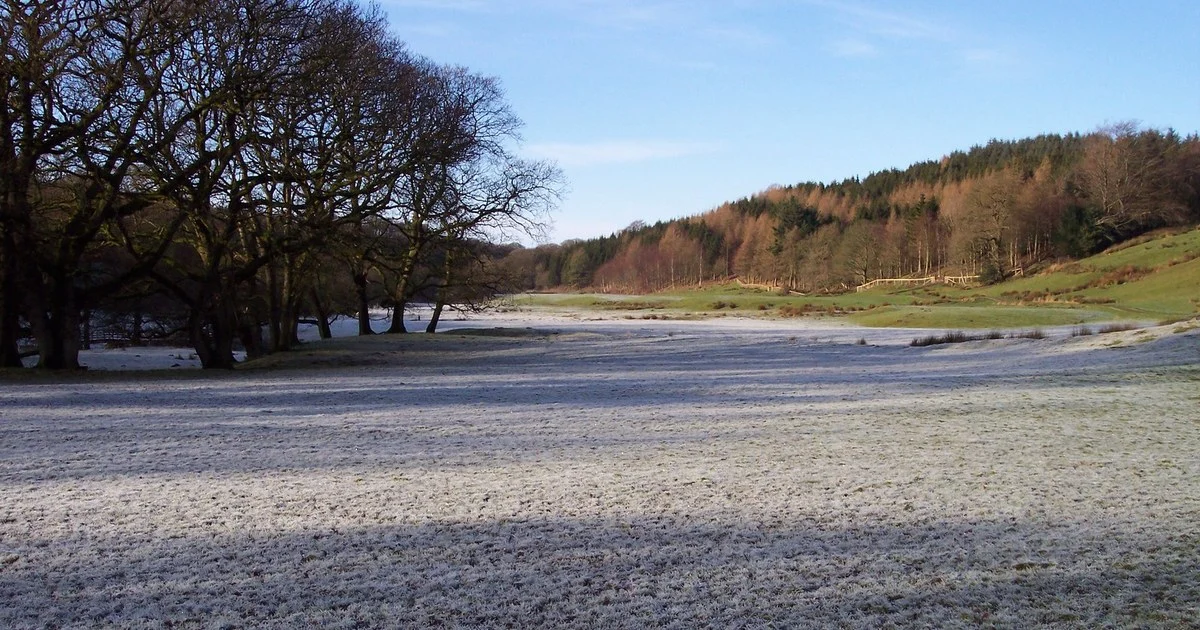
Walk the holding at dawn after a clear, still, cold spring night. Note the white patches and where they extend.
Look at the field-boundary trees and hedges. A solid hedge across a slope can dam cold air on the upslope side, creating a frost pocket where none existed previously.
Look at the historical crop performance. Fields that consistently set fruit late or take frost damage in a given crop are sitting in cold-air drainage paths.
The site-design implications:
Plant frost-tender crops on the upper slopes and the rises, not in the frost pockets.
Where a frost pocket cannot be avoided, design the field-boundary structure to let cold air drain out. A gap in the bottom hedge can be the cheapest frost protection a holding ever installs. The Met Office and Defra horticultural agronomy guidance both flag this.[6]
Plant the most frost-tolerant species in the pockets (cabbage, kale, mature brassicas) and the most frost-tender on the upper land (early salad, soft fruit, top fruit blossom).
On a salad and brassica holding, frost-pocket avoidance is the cheapest single piece of frost protection planning. The cost is zero. The benefit is two to four degrees of damage threshold on the most vulnerable cropping.
Fleece and crop covers: the workhorse protection
For most UK horticultural crops on most cold nights, fleece is the working frost protection that earns its keep. Spunbond polypropylene fleece (the white, lightweight, breathable material familiar to every UK grower) at typical weights of 17 to 30 grams per square metre gives 1 to 4 degrees Celsius of frost protection on a still night, depending on weight and condition.[7]
The economics on a salad and brassica holding:
Fleece cost: £180 to £350 per hectare for a heavier (30 g/m²) cover, £100 to £200 per hectare for a lighter (17 g/m²) cover. The fleece is usually reusable for 2 to 4 seasons.
Labour cost: 6 to 12 hours per hectare to lay and 4 to 8 hours per hectare to retrieve, depending on field size, shape and wind conditions. At an operator cost of £15 per hour fully loaded, that’s £150 to £300 per hectare per cycle of laying-and-retrieving.
The total cost of fleeced protection for a single frost event runs £300 to £650 per hectare on a working salad holding. The cost of an unfleeced loss in an early salad crop runs £6,000 to £20,000 per hectare depending on crop value and harvest stage. The arithmetic is clear most years.
The thing fleece doesn’t do well: protect against advection frosts (it doesn’t have the insulation value) or protect very tall crops (the structure isn’t there to support it). For low and medium-height crops on radiation-frost nights it is the workhorse.
The working procedure on a frost-protection-by-fleece operation:
The fleece is held in a dry barn between events, in a labelled stack by field and weight.
The forecast trigger is air temperature predicted below 4 degrees Celsius at 06:00 with clear sky and light winds. That triggers the laying decision.
Fleece is laid in the late afternoon before the cold night, with edges weighted by soil or sandbags. Working with wind is the operational challenge; even a 10 mph breeze makes the laying job miserable and risky on a field-scale fleece.
Fleece is retrieved the following morning after the air temperature rises above 4 degrees Celsius and dew has burned off. Wet fleece is heavy, dirty and unpleasant; dry fleece rolls back cleanly.
The fleece is folded back into the stack. Damaged sections are noted and replaced on the next purchase cycle.
A salad holding running fleece protection on 10 hectares of early crop might fleece 3 to 8 times in a typical spring. The all-in cost of the protection programme runs £1,500 to £5,000 per hectare per season. The harvest value of unprotected lost crop is materially higher.
Sprinkler irrigation as frost protection: the working physics
Sprinkler irrigation is the protection system used most heavily in commercial top fruit and viticulture, and increasingly in soft fruit. The physics is counter-intuitive and useful to understand.
When water freezes, it releases latent heat of fusion (approximately 334 kJ per kg of water frozen).[8] As long as water continues to be supplied to the crop and continues to freeze, the temperature of the wetted crop is held at zero degrees Celsius. The crop is encased in a continuously-forming layer of ice at zero, regardless of how cold the air gets around it.
The crop survives because zero degrees is above the damage threshold for many crops. Apple blossom, pear blossom, cherry blossom, vine buds and some soft fruit varieties tolerate zero degrees without damage but suffer damage at minus two or three degrees. The sprinkler system holds the crop at zero even when the surrounding air is at minus four or minus five.
The catch:
The system must run continuously through the entire frost event. If it stops while ice is still on the crop, the latent heat release stops, the ice cools rapidly, and damage occurs that would not have occurred without the sprinkler running.
The water rate must be sufficient (typically 2 to 4 mm per hour, depending on the lowest expected temperature) to keep ice continuously forming. Insufficient water makes the damage worse, not better.
The system needs reliable power, reliable water supply (an on-farm reservoir or a high-capacity mains connection capable of delivering 30 to 70 cubic metres per hour per hectare for the duration of the event) and reliable nozzle distribution.
The capital cost is significant: a fixed-overhead sprinkler frost-protection system for top fruit or vines runs £8,000 to £25,000 per hectare to install, depending on layout and pumping infrastructure.[9]
For top fruit and viticulture, the economics work for high-value crops where blossom damage destroys a year’s revenue. For salad and field vegetables, the capital cost rarely justifies the system. Fleece is the working answer in field-scale horticulture; sprinklers are the working answer in orchards and vineyards.
Wind machines and the inversion mix
Wind machines (large propeller fans mounted on towers) work by mixing the inversion layer. On a radiation-frost night with a 3 to 5-degree inversion (warmer air above, colder air at the surface), a wind machine spinning at the top of a 10-metre tower draws the warmer air down and mixes it with the colder air near the crop, raising the crop-level temperature by 1 to 3 degrees Celsius.[10]
Wind machines are the protection of choice in some North American fruit-producing regions and increasingly in UK viticulture and top fruit. The capital cost is £25,000 to £45,000 per machine, with one machine protecting roughly 4 to 6 hectares depending on topography. The running cost is the diesel or LPG fuel for the engine plus a labour cost for monitoring.
The advantages compared to sprinklers:
No water requirement. The system works wherever you can put the tower.
No risk of damage if the system stops (the protection is the air-mixing, not the latent heat of ice formation).
Lower capital cost per hectare on larger holdings.
The disadvantages:
No protection in an advection frost (no inversion to mix).
Noise (the engines run hard for 4 to 8 hours during an event). Some sites face planning objections from rural neighbours.
A smaller temperature uplift than the sprinkler system on the coldest nights.
The Defra and AHDB horticultural science programmes have published working comparisons of wind machines, sprinklers and fleece for UK conditions.[11] The right answer depends on crop, scale and topography. For a small vineyard or orchard in a known frost pocket, a wind machine is often the working solution. For a 10-hectare salad holding, fleece remains the working answer.
Heating: bougies, heaters and the older European tradition
Open-flame frost protection (the smudge pots, smoke pots and bougies seen in old photographs of French and Italian orchards) is a working tradition still used at small scale and in emergency conditions. The principle is simple: a heat source distributed across the field directly warms the air near the crop and produces a smoke layer that reduces radiation loss.[12]
The modern equivalents are propane and diesel heaters distributed at typical spacings of one heater per 25 to 50 square metres. The cost of fuel for a single frost event on a hectare of vines runs £100 to £400 depending on duration and temperature, and the labour to set up, light and monitor the system is substantial.
Heating is the protection of last resort in UK conditions, mostly used in viticulture as a back-up to sprinkler or wind-machine systems. The capital cost is modest but the running cost and labour requirement are higher than the alternatives.
Cropping calendar choices: planting dates and variety selection
The cheapest frost protection on any horticultural holding is choosing not to plant the crop until the frost risk has passed. The cost of delayed planting is forgone early-season market premium. The cost of frost damage on prematurely-planted crops is the entire crop value.
On a salad holding, the practical decision is the choice of first planting date for outdoor crops. We have shifted our first outdoor iceberg planting from late March to mid-April over the last decade, accepting a one-week loss of early market premium in exchange for a roughly 70 per cent reduction in frost-risk exposure.
Variety selection matters at the margin. Some salad varieties (notably the older, less marketable varieties) have higher cold tolerance than the modern, high-yielding varieties. The frost-tolerance information from seed companies (Tozer, Bejo, Rijk Zwaan, Enza Zaden) is often the working reference.[13]
For top fruit and soft fruit, the choice of variety influences blossom date and therefore frost-risk exposure. Late-blooming apple varieties (Bramley, Lord Lambourne, some Cox strains) have lower frost-risk than early-blooming varieties. The AHDB Top Fruit and Soft Fruit programmes publish working comparisons.[14]
For vines, site selection is the dominant variable; once the site is chosen, the bud-break date is largely fixed by the variety. UK vineyard planting decisions in the last decade have shifted heavily towards traditional method sparkling varieties (Chardonnay, Pinot Noir, Pinot Meunier) which bud-break later than the experimental cool-climate varieties planted in the 1970s and 1980s.[15]
Glasshouse and polytunnel frost protection
In protected cropping under glass or polythene, frost protection is a structural and energy management problem rather than a field-management problem. Our UK Glasshouse and Polytunnel Production 2026 guide covers the protected cropping picture in detail.
The working frost-protection systems in UK protected horticulture:
Thermal screens (single or double). A retractable thermal screen pulled across at sunset reduces overnight radiative loss by 30 to 50 per cent and is the single most cost-effective frost-protection investment in modern glasshouse design.[16]
Heating systems (hot-water, gas, biomass, heat-pumps). A modern Venlo glasshouse is heated through the night to a target temperature appropriate to the crop. The cost of energy for protected cropping has been the dominant operational cost since the 2022 energy price spike. UK protected horticulture has invested heavily in energy efficiency and CHP-cogeneration over the last three years.
Polytunnel single-skin vs double-skin polythene. Double-skin polythene with an air gap has roughly twice the thermal resistance of single-skin and is the working norm on commercial polytunnels for autumn-winter production.
Internal fleece secondary protection. On the coldest nights, a layer of fleece thrown over the crop under a polytunnel doubles the protection at low marginal cost.
The protected cropping conversation is energy-management rather than the field-grown frost-event conversation that takes up most of this guide. Both matter, and a mixed holding running both will be running both conversations through the spring.
SFI, agri-environment and frost protection investment
Frost protection infrastructure is not a Capital Grants-eligible item in the current Defra schemes. The grant funding for horticultural production tends to flow through the Farming Investment Fund (capital infrastructure for fruit and salad), the Farming Equipment and Technology Fund (smaller infrastructure items) and through trade body and producer organisation funding.[17]
The Farming Equipment and Technology Fund 2026 round, when it opens, includes items relevant to frost protection on a working horticultural holding: weather monitoring systems, irrigation systems with frost-protection capability, polytunnel upgrades. The list moves each round; the gov.uk pages are the canonical reference.[17]
For producer organisations (the formal co-operatives covered by EU and now UK regulation), the Producer Organisation Operational Programmes have historically funded frost-protection investment as part of crisis management. The current UK scheme replacing the EU Common Market Organisation horticulture scheme is in transition.[18]
The pragmatic answer for a working horticultural holding in 2026 is to fund the frost-protection infrastructure as a normal capital cost, model the AIA position with the accountant (covered in our UK Farm Tax 2026 guide and our UK Farm Machinery Costs 2026 guide), and watch the relevant grant rounds when they open.
The working frost-night protocol on our holding
Six steps that run on this holding when a cold night is forecast.
Step 1: Day-before forecast review. Met Office synoptic chart at 6 p.m. Check for clearing sky, dropping wind, dropping dew point. If air temperature predicted below 4 degrees Celsius at 06:00 with clearing sky, escalate to the next step.
Step 2: Pre-event preparation. Fleece team briefed at 4 p.m. day before. Fleece moved from store to the relevant fields. Tractor and water bowser fuelled.
Step 3: Late-afternoon walk. Walk the most frost-vulnerable fields at 5 p.m. Check the field thermometers. Note any wind shift. Confirm or stand-down the fleecing operation.
Step 4: Fleecing operation. If escalated, fleece the priority fields by sundown. The order of priority is fixed in advance and posted on the pack-house noticeboard: early iceberg first, then early lettuce, then early brassica seedlings.
Step 5: Overnight monitoring. A six-inch field thermometer with telemetry sends an alert if the temperature drops below minus 1 degrees Celsius at crop height. The overnight on-call decides whether further intervention is needed (a contingency irrigation cycle on the unfleeced fields, an extra fleece on the worst block).
Step 6: Morning assessment. Walk the fields at first light. Photograph any damage. Recall the fleece by mid-morning when the air is above 4 degrees Celsius. File the frost-event log on the kitchen-table laptop, with photographs, for the year’s records and the insurance file.
The protocol is not glamorous. It runs every spring on most working horticultural holdings in the South and East of England, often a dozen or more times across April and early May. The discipline of running it is the discipline that keeps the early-season cropping schedule on track.
Insurance and the limits of cover
Frost damage is largely uninsured on the UK working horticultural holding. The mainstream UK farm policies (NFU Mutual, Cornish Mutual, Lycetts-placed Lloyd’s policies) cover frost damage to crop in store, fire, theft and a defined set of named perils on standing crops. Frost in the field is generally not a named peril on UK field-grown horticulture policies.[19]
Specialist multi-peril cover is available through Lloyd’s syndicates for high-value top fruit and viticulture, at premiums that reflect the genuine actuarial risk. Field-scale salad and brassica multi-peril cover is rare.
The structural reason is the same one covered in our UK Farm Insurance 2026 guide and the Crop and weather insurance: the EU gap section. The UK does not have a state-subsidised multi-peril crop insurance scheme on the EU model. Working horticultural holdings carry frost risk on their own balance sheet.
The practical implication is that a single severe frost event can hit the annual P&L hard, with no insurance recovery. The case for investing in physical protection systems (fleece, sprinklers, wind machines, weather monitoring) is correspondingly stronger than it would be in a properly insured market.
Where this is heading
Three forces will shape frost protection on UK horticultural holdings over the next five years.
The first is climate variability. UK winters are getting warmer on average, but the variability of late-spring cold-air mass intrusions is not declining and the cropping calendar is shifting earlier (earlier bud-break, earlier first plantings) because of the warmer spring averages.[20] The net effect is that frost-risk exposure on the early-season crops is rising even as the average winter is warming. The protection-investment case is strengthening, not weakening.
The second is energy cost for protected cropping. The 2022 energy spike and the subsequent settling at higher levels has restructured the economics of glasshouse heating. Investment in thermal screens, CHP, biomass and heat-pump systems has been substantial. The frost-protection investment for protected crops is now better described as energy-management investment.
The third is the technology stack. On-farm weather stations have fallen in price. Frost-forecast precision has improved with hyper-local forecast models. The integration of weather, irrigation control and fleece-laying automation is at pilot stage on a handful of larger UK growers and is likely to move into the small-holding kit list over the rest of the decade.[21]
What will not change is that on a working horticultural holding in the South or East of England, the late-April cold night is the night that defines the harvest profile of the early season. The protection plan is part of the holding’s operational discipline as much as the planting plan.
A six-step frost-night checklist
Six things to do before the next cold spring week.
Walk the holding and identify the frost pockets. Mark them on the field plan. Re-plan early-crop allocations to avoid the pockets where possible.
Install at least one field weather station at crop height in the most vulnerable field. The £600 to £2,500 investment is repaid by one avoided frost event.
Buy fleece in the autumn for the following spring. Spring fleece supplies tighten in the worst frost years. Hold stock in a dry barn.
Brief the team in March on the frost-night protocol. Print the protocol on a single A4 sheet and post it on the pack-house noticeboard.
Review the forecast tools you trust. Subscribe to the Met Office commercial service if the holding scale justifies it. Bookmark the synoptic chart link.
Walk the fields at dawn after every cold night and log any damage. The log is the working record for variety selection, planting-date adjustment and protection-system improvement.
Further reading
The Met Office hazard manager and surface-pressure charts are the working forecast reference for UK frost events.[3] AHDB Horticulture (whose statutory levy was abolished in 2022, though its reference library remains online) published the working agronomic reference for field-scale frost protection.[14] The Horticulture Industries’ Crop Walkers’ Guide and the British Apples and Pears, NIAB EMR and East Malling research outputs are the working technical references for top fruit and soft fruit.[22] For BritFarmers readers, this guide sits alongside our UK Glasshouse and Polytunnel Production 2026 guide, our UK Salad and Vegetable Production 2026 guide, our UK Farm Insurance 2026 guide and our UK Water Resources and Abstraction 2026 guide.
From the farm:
Frost is the one risk on a salad holding that doesn’t give you a second chance. You can carry a wet week or a bad price. You can’t un-take a crop that froze at two in the morning because you read the forecast as a five and went to bed. The late-April nights are the ones that have cost me, every time, because the calendar tells you the danger’s past and the sky tells you otherwise.
What I’d actually do is learn the radiation-frost signs and stop trusting the daytime number. A still, clear, dry night after a warm afternoon is the one to sit up for, not the cold front everyone’s watching. Fleece is the workhorse and it earns its keep, but the decision that matters is made at dusk, not at midnight — once the temperature’s dropping past minus one you’re managing a loss, not preventing one.
If you take one thing from this guide, build the frost-night protocol before the season, not during it. Know which blocks go under fleece first, where the cold settles on your ground, and what the irrigation can and can’t save. The growers who lose least are the ones who decided in March what they’d do at midnight in May.
Sources
[1] Met Office, Radiation and advection frost: meteorological basics, metoffice.gov.uk: https://www.metoffice.gov.uk/weather/learn-about/weather/types-of-weather/frost.
[2] AHDB and ADAS, Field-level temperature variability in still nights: practical guidance, ahdb.org.uk.
[3] Met Office, Hazard Manager and Surface Pressure Charts: commercial weather services, metoffice.gov.uk: https://www.metoffice.gov.uk/services/business-services/agriculture.
[4] Pessl Instruments / iMetos, Hutchinsons Omnia, ADAMA smart farming tools (vendor literature).
[5] AHDB and Defra, Topography and frost-pocket identification on horticultural holdings, ahdb.org.uk.
[6] Defra and Natural England, Hedgerow management and microclimate effects, gov.uk.
[7] Fargro Ltd, Crop covers and fleece: working guidance, fargro.co.uk; AHDB, Crop cover trial summaries.
[8] Engineering Toolbox and standard physics references for latent heat of fusion (working figure 333.55 kJ/kg).
[9] AHDB Top Fruit and Soft Fruit Programme, Sprinkler frost protection: capital and operating cost data; East Malling Research, Frost protection in UK top fruit.
[10] Department of Agriculture (US) and OSU Extension, Wind machine frost protection: physics and design; AHDB, Wind machine evaluation in UK conditions.
[11] AHDB Horticulture, Frost protection systems: comparative evaluation, ahdb.org.uk.
[12] Vine Growers’ Association of Champagne (CIVC) and OIV technical bulletins on heating-based frost protection.
[13] Tozer Seeds, Bejo Zaden, Rijk Zwaan, Enza Zaden: variety frost-tolerance datasheets (vendor literature).
[14] AHDB Cereals & Oilseeds, with the former AHDB Horticulture reference library, Top fruit, soft fruit and field vegetable variety guidance, ahdb.org.uk.
[15] WineGB, UK viticulture: planting trends and variety selection, winegb.co.uk.
[16] Wageningen UR Greenhouse Horticulture, Thermal screen performance in commercial glasshouses; UK CHP Association, Combined heat and power in horticulture.
[17] Rural Payments Agency and Defra, Farming Equipment and Technology Fund and Farming Investment Fund, gov.uk.
[18] Defra, UK Fruit and Vegetable Producer Organisation Scheme: transition from EU CMO, gov.uk.
[19] NFU Mutual, Farm insurance policy summary: covered perils for standing crops; Lloyd’s market briefing on multi-peril crop insurance.
[20] Met Office, UK Climate Projections (UKCP18) and seasonal trend analyses, metoffice.gov.uk; Defra, Climate Change Risk Assessment.
[21] Innovate UK and Defra Farming Innovation Programme, Automated frost protection systems: trial outputs, gov.uk.
[22] NIAB EMR and East Malling Research, Horticulture research publications, niab.com; British Apples and Pears, Industry guidance, britishapplesandpears.co.uk.
About the author
I run a salad and field vegetable holding in Suffolk, twenty-three years on the same ground, the last two with a slice of wheat and oilseed rape rotated in alongside the iceberg, baby-leaf and brassicas. The cold-night conversation has been the conversation I’ve lost the most sleep over in horticulture, year after year, and the one where the smallest discipline (a fleece operation completed by sundown) makes the largest financial difference.
The headline: the cheapest frost protection is choosing not to plant the most vulnerable crop in the frost pocket; the second cheapest is a layer of fleece laid by sundown on the right night; everything more capital-intensive should be sized to the crop value and the holding’s frost-risk profile. The cost of getting it wrong in horticulture is real and uninsured.
*Disclaimer: This guide is general information about UK horticultural frost protection in 2026. It is not horticultural, engineering or financial advice and is not a substitute for tailored guidance from your agronomist, your insurance broker or your dealer of choice. Crop physiology, weather patterns and protection-system performance vary by site; always test the working assumptions on your own holding before relying on them. Frost damage is largely uninsured in UK field horticulture, so the case for spending money on protection rests on the losses you avoid, not on a payout that isn’t coming. Treat the figures here as a place to start your own sums, not a promise of what they’ll do on your ground.*
You’ve reached the end of this story.