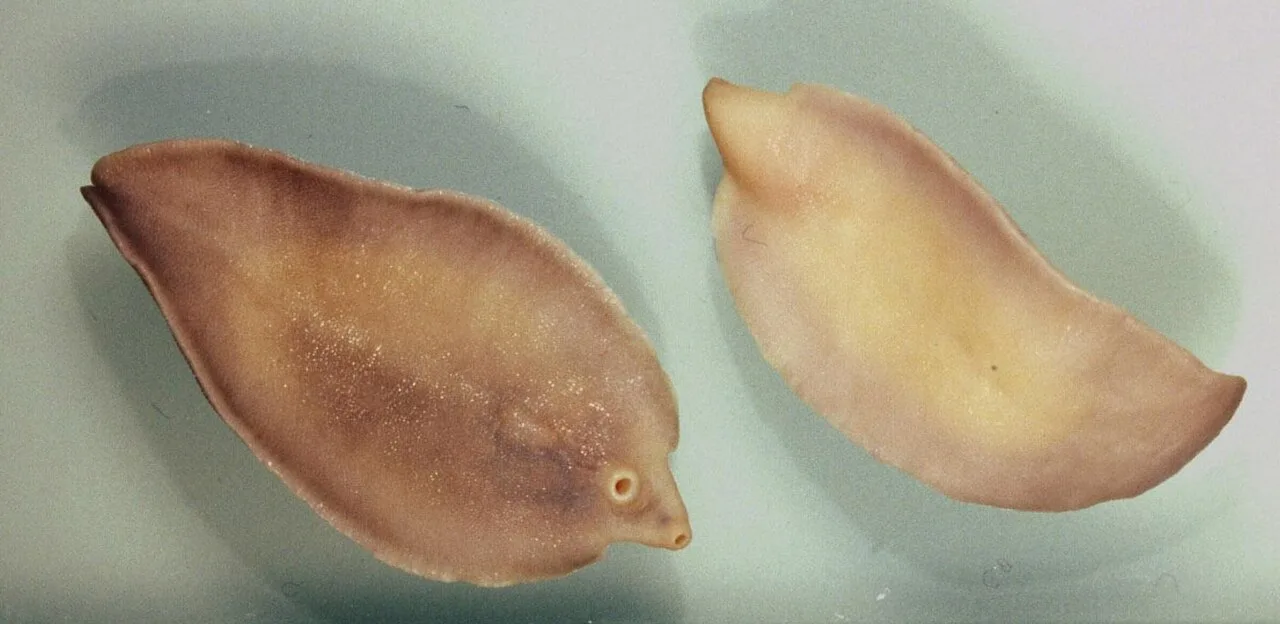
Cover photo: Two adult liver fluke (Fasciola hepatica). COWS says mature fluke are 3 to 5 cm long.
Published 17 October 2026 · Updated 17 October 2026 · By Tim Harfield
Liver fluke (Fasciola hepatica) is a parasitic flatworm that sheep and cattle pick up from wet pasture, where its life cycle runs through a mud snail. Risk rises after wet summers and peaks in autumn and winter. Sheep can die suddenly from acute fluke, while chronic fluke causes weight loss and “bottle jaw”. Flukicides differ in which stages of fluke they kill, so the product and the timing matter. Test first, and agree a plan with your vet or SQP.
I farm salad, vegetables and arable, not sheep or cattle. This page doesn’t come from my own flock or herd. It gathers the UK industry guidance, mainly from SCOPS (sheep), COWS (cattle), NADIS and the Veterinary Medicines Directorate, into one place and in season order. Every claim about timing or a product is linked to its source.
A way through this story
What liver fluke is and how sheep and cattle catch it
Sheep and cattle carry the same liver fluke, and either can infect pasture for the other. Deer, hares and rabbits can carry it too (COWS). The parasite can’t finish its life cycle without the mud snail Galba truncatula, which lives in mud around ponds, streams, hoof prints and tractor ruts.
- Eggs in dung. Adult fluke in the bile ducts lay eggs, which pass out in dung. They need temperatures above about 10°C to develop.
- Into the snail. The hatched larva lives only a few hours. It has to swim through water to find a mud snail.
- Multiplying. Inside the snail the parasite multiplies over about six weeks. One infection can produce more than 600 cercariae (COWS).
- Cysts on grass. Cercariae leave the snail and form cysts (metacercariae) on wet herbage. These can stay infective for months.
- Swallowed. Grazing stock eat the cysts. Young fluke burrow through the liver for about eight weeks before reaching the bile ducts. Eggs appear in dung 10 to 12 weeks after infection.
SCOPS puts the whole cycle at 18 to 20 weeks. Wet weather drives it, because both the snail and the free-living larva need water. SCOPS says disease “is highest in years when rainfall is above average during May, June and July” (SCOPS life cycle). In a wet summer, cysts pour onto pasture from late August to October, which is why autumn and winter are the danger months. COWS adds that earlier springs and milder winters are lengthening the season, and that about half the cysts on pasture may survive a normal UK winter.
Signs of liver fluke in sheep
Which form you see depends on how many cysts the sheep swallowed and how quickly. NADIS gives the usual timing: “Acute liver fluke is usually seen from August to October, sub-acute from October onwards and chronic from December onwards” (NADIS).
Acute fluke (sudden deaths, autumn)
Acute fluke follows a big intake of cysts over a short time. NADIS says cases start from three weeks after sheep eat large numbers of immature fluke, as the young fluke tear through the liver. “Sudden deaths are the usual first indication.” Others in the group may be lethargic, graze less, and be hard to gather because of abdominal pain. NADIS says sudden deaths can affect up to 10 per cent of the sheep at risk.
Subacute and chronic fluke (weight loss and bottle jaw)
In subacute fluke, NADIS describes “rapid loss of body condition and poor fleece quality despite adequate flock nutrition”. Some sheep become severely depressed and weak, and may not be able to stand. Losses usually start in December but can come as early as October after a heavy challenge.
Chronic fluke comes from adult fluke feeding on blood in the bile ducts. NADIS lists “very poor body condition, poor fleece quality and in many sheep, bottle-jaw” (swelling under the jaw), and affected sheep may die emaciated. Bottle jaw can have other causes, so don’t treat it as proof.
Signs of liver fluke in cattle
Cattle behave differently. COWS says acute disease “is seen rarely in cattle in the UK”. Cattle usually get chronic disease, showing as weight loss, poor weight gain and reduced milk yield, and they may become anaemic (COWS Technical Manual, September 2023).
Lighter burdens often cause no obvious signs, but the cost shows up elsewhere. In dairy cows, COWS lists lower yield, changes in milk quality and effects on fertility. In youngstock, it lists poorer feed conversion, slower growth and lower carcase value, including condemned livers. COWS also says fluke can interfere with bovine TB testing and make cattle more susceptible to infections such as Salmonella Dublin. Disease from autumn infection usually appears in late winter and early spring, and it can appear in housed cattle that weren’t treated with a suitable product after housing.
Abattoir returns are often the first sign. COWS advises beef and dairy farmers to check them for fluke-damaged livers.
Testing before you treat
COWS says the season “is much less predictable” than it used to be, so tests matter more. Each test sees a different stage of infection (SCOPS diagnosis; SCOPS/COWS test-based control chart).
- Blood antibody test (ELISA). Shows that an animal has been exposed. It picks up infection from two to four weeks after it starts. It works best in first-season lambs or calves used as “sentinels”, about ten per risk group. Antibodies can stay high after successful treatment, so it can’t confirm a treatment worked.
- Coproantigen test (dung). Detects mid- to late-stage infection. SCOPS says it gives two to three weeks’ more warning than an egg count, and suits late autumn and winter. Use individual samples rather than pooled ones, and re-test if the result is negative.
- Fluke egg count (dung). Only finds egg-laying adults, so it misses autumn infections still in the liver. COWS says sensitivity is 30 to 70 per cent and lower in cattle. If the result is negative, re-test in four to eight weeks.
- Bulk milk test (dairy). COWS says bulk tank ELISAs show whether the milking herd has been exposed and can be run three or four times a year.
- Post-mortem and abattoir returns. A post-mortem on fallen stock finds all stages. Abattoir returns are useful but, the chart notes, not as reliable as a vet’s post-mortem.
Ask your vet which lab to use. Prices vary and aren’t given here.
Treating liver fluke: which flukicide kills which stage
This is where most mistakes happen. Fluke take 10 to 12 weeks to mature, and most flukicides only kill older fluke. A product that kills adults but not immature fluke, used in October, can leave the damaging young fluke untouched. The tables below are the published industry figures. They are not dose advice. Product choice is for your vet, RAMA or SQP.
| Active ingredient | Age of fluke killed (kill rate) | SCOPS optimum time of year |
|---|---|---|
| Triclabendazole (assuming a fully susceptible population) | Week 1: 90–99%; weeks 2–14: 99–99.9% | Autumn |
| Closantel | Weeks 3–4: 23–73%; week 5: 91%; weeks 6–9: 91–95%; weeks 10–14: 97–100% | Autumn |
| Albendazole | Weeks 10–11: 50–70%; weeks 12–14: 80–99% | Spring/summer |
| Oxyclozanide | Weeks 10–11: 50–70%; weeks 12–14: 80–99% | Spring/summer |
The SCOPS sheep table also names nitroxynil among the products for the winter and spring period. The table shades rafoxanide for weeks 10 to 14 but gives no kill rate.
| Active ingredient | Route | Stage of fluke killed |
|---|---|---|
| Triclabendazole | Oral | 2 weeks onwards |
| Triclabendazole | Pour-on | 6–8 weeks onwards |
| Closantel | Injection or pour-on | 7 weeks onwards |
| Clorsulon | Injection | Adults only |
| Oxyclozanide | Oral | Adults only |
| Albendazole | Oral | Adults only |
COWS notes that its table was correct when written. Always check the current label or Summary of Product Characteristics (SPC). You can find any UK product’s SPC, withdrawal periods included, on the VMD Product Information Database.
Which wormer kills liver fluke? (and which don’t)
Only flukicides kill liver fluke. Ivermectin and moxidectin (the active in Cydectin) aren’t flukicides, and neither SCOPS nor COWS lists them for fluke. The confusion comes from combination products. COWS notes that “many flukicidal medicines are sold in combination with medicines used to treat roundworms”. The NOAH and VMD joint statement on flukicides in dairy cattle lists injections that pair ivermectin with clorsulon or closantel, and a pour-on that pairs moxidectin with triclabendazole. In each of these the fluke is killed by the clorsulon, closantel or triclabendazole, not the roundworm active.
Albendazole is the exception that trips people up. It’s a roundworm wormer that also kills adult fluke, but not immature fluke, so it doesn’t protect against autumn disease. COWS advises using combination products “only when both parasites need to be targeted, for example at housing”. For roundworm groups, see our guide to worming sheep and cattle.
Triclabendazole resistance
Triclabendazole is the only product that kills fluke from about two weeks old, which makes it the go-to in autumn and also the one most at risk. COWS says resistance “is widespread in sheep and has been reported in cattle in the UK”, with “severe” problems in flukey areas. SCOPS is more cautious, saying UK reports are “very much anecdotal” and that there are no validated field tests for resistance (SCOPS tackling resistance). Both bodies give the same practical advice: check whether treatment worked.
SCOPS suggests dung samples from ten individually identified animals before treatment, then from the same animals three weeks after. Use a coproantigen test or a fluke egg count reduction test. You want a fall of at least 90 per cent. To spare triclabendazole, SCOPS advises using other products in the winter and spring period when adults dominate.
Dairy cows and withdrawal periods
Treating milking cows is the hardest case. COWS says “many medicines are not licensed for use in cattle producing milk for human consumption and for others there are long withdrawal periods”. In the NOAH and VMD statement (revised April 2020), most flukicides were barred during lactation and several came with restrictions for dry cows and in-calf heifers. Products and licences change, so check the current SPC on the VMD database for every product. Ask your vet, and use bulk milk tests and youngstock monitoring to avoid treatments you don’t need.
When to treat: an autumn–winter timeline
This follows the SCOPS and COWS test-based chart. The exact start of each period depends on the farm and the weather.
- Late summer to autumn (acute risk period). Blood-test sentinel lambs or calves regularly, for example monthly. The chart advises holding off treatment until positive results show active infection, then treating with triclabendazole if the fluke on your farm are susceptible. SCOPS calls closantel “a useful drug to control immature fluke in autumn”. Where risk is low, the chart suggests a later dose (for example after housing) with closantel. If a vet advises a second closantel dose, the chart gives six weeks as the minimum interval to avoid toxicity.
- Housing (cattle). COWS suggests treating with a product that kills all stages about two weeks after housing, if tests show exposure. Blood-test first-season calves at or shortly after housing to see whether they were exposed.
- Winter (chronic risk period). Use dung tests: coproantigen or egg counts. For infections later in the season the chart says avoid triclabendazole, and consider closantel, albendazole or oxyclozanide. COWS suggests testing older cattle eight to twelve weeks after housing, “around Christmas”.
- Spring to early summer. Adult fluke dominate. SCOPS lists nitroxynil, albendazole, oxyclozanide or clorsulon as options. Consider re-testing two to three months after treatment in case young fluke were missed.
Flukicides have no lasting effect. Stock turned back onto flukey ground are exposed again straight away, and COWS says they may need treating again in six to twelve weeks, depending on the product.
Preventing fluke: grazing, snails and bought-in stock
SCOPS’s grazing advice is practical (SCOPS managing grazing):
- Keep stock off the wettest fields in autumn and winter.
- Fence off drinking spots and streams, and put in troughs instead.
- Fix leaking pipes and troughs, which “can create a perfect habitat for the mud snails”.
- Map your wet areas over the years, so you know where to target tests.
- Drainage removes snail habitat, but check it doesn’t conflict with any wetland agreement. See our guide to field drainage and our grass and pasture management guide.
Well-made silage is safe. COWS cites University of Liverpool work showing cysts don’t survive anaerobic silage, but freshly cut grass from flukey fields can carry infection.
Bought-in stock is how resistant fluke reach a farm. COWS advises assuming every farm has snail habitat and every bought-in animal carries resistant fluke. Its three steps are: house them (or keep them on snail-free ground), treat them, and test dung about six weeks later before they go onto pasture with snails. SCOPS adds that sheep can shed eggs for up to three weeks after adult fluke die, so keep them on quarantine pasture for at least four weeks after treatment. SCOPS also advises against giving two flukicides at the same time (SCOPS fluke quarantine). This applies to rams, bulls, tack sheep and stock back from common grazing too. If you’re buying in, see buying sheep.
Rumen fluke vs liver fluke
Rumen fluke (Calicophoron daubneyi) uses the same mud snail and is now very common in British livestock. Its eggs turn up in the same dung tests, so it’s easy to confuse with liver fluke. COWS says rumen fluke eggs are clear while liver fluke eggs are golden. Adult rumen fluke aren’t thought to harm productivity. Disease mostly comes from large numbers of immature rumen fluke in young stock, causing severe scour and sometimes deaths.
COWS doesn’t recommend treating for rumen fluke without confirmed clinical signs. Oxyclozanide is the only flukicide with reported activity against it, and no product has a label claim, so it needs a vet’s prescription. Get the lab to say which fluke it found before you treat (COWS Section 7).
Fluke and the weather: reading the risk for your region
Fluke forecasts are built from weather data. NADIS publishes monthly regional updates on fluke risk for Great Britain, which COWS recommends, and AFBI publishes forecasts for Northern Ireland using climate data. The driver is simple: summer rainfall and warmth. SCOPS links the worst years to above-average rain in May, June and July. A dry or cold summer means fewer snails and less contamination in autumn.
We don’t make our own fluke risk scores. What we can do is show what the weather has been doing. Our UK rainfall by region page tracks this season’s rain against normal. Use it alongside the official forecast and your vet’s advice, not instead of them. Risk also varies from farm to farm within a region, and forecasts can be wrong, as we explain in why weather forecasts go wrong.
Related reading: tupping season and ewe condition, UK sheep farming guide, UK beef farming, dairy herd guide, cattle diseases and orf in sheep and lambs.
Frequently asked questions
What are the signs and symptoms of liver fluke in sheep?
It depends on the form. Acute fluke usually shows as sudden deaths, with others in the group dull and slow to gather. Subacute fluke brings rapid loss of condition. Chronic fluke, from about December, means very poor body condition, poor fleece and often bottle jaw. NADIS notes bottle jaw can have other causes, so confirm with a test.
What time of year do sheep get fluke?
Sheep pick up most infection from late summer into autumn, after the mud snail has shed the parasite onto wet grass. NADIS says acute fluke is usually seen from August to October, subacute from October and chronic from December. A wet May, June and July raises the risk, according to SCOPS.
How often should sheep be dosed for fluke?
There is no fixed number. SCOPS and COWS advise testing to show a need before treating, then choosing a product that kills the stage of fluke likely to be present at that time of year. Flukicides have no lasting effect, so sheep left on risky ground may need further treatment. Agree the plan with your vet.
How do I treat sheep for liver fluke?
Confirm fluke first with a test, then use a flukicide that kills the age of fluke present. In autumn that means a product active against immature fluke; in late winter and spring SCOPS suggests products that target adults. Weigh the sheep, dose as the label says, and check the treatment worked.
Which wormer kills liver flukes?
Only flukicides. In the UK these are triclabendazole, closantel, nitroxynil, oxyclozanide and albendazole, plus clorsulon for cattle. Albendazole is also a roundworm wormer but only kills adult fluke. Most roundworm wormers kill no fluke at all. Combination products pair a flukicide with a roundworm wormer; check which active does the fluke work.
How long does it take to get rid of liver flukes?
It depends on the product and the age of the fluke. A product that misses young fluke leaves them to mature, so a second treatment may be needed. SCOPS suggests re-testing three weeks after treatment, and COWS suggests checking dung six weeks after treating bought-in cattle. Sheep can pass eggs for up to three weeks after adults die.
What are the signs and symptoms of liver fluke in cattle?
Cattle rarely get acute fluke in the UK. COWS lists weight loss, poor weight gain and reduced milk yield, and says cattle may become anaemic. Lighter burdens often show no clear signs but reduce growth, milk yield, milk quality and fertility. Condemned livers on abattoir returns are often the first sign that fluke is present.
How can I treat liver fluke in my cattle?
Test first, then treat with a product matched to the fluke stage and the animal. COWS suggests treating about two weeks after housing where tests show exposure. Many flukicides cannot be used in cows producing milk for human consumption, or carry long milk withdrawals, so check the product’s SPC and agree it with your vet.
Can ivermectin get rid of liver flukes?
No. Ivermectin is not one of the flukicides listed by SCOPS or COWS. Some injections combine ivermectin with clorsulon or closantel, and in those products the clorsulon or closantel kills the fluke while the ivermectin targets roundworms. The same applies to moxidectin, sold as Cydectin, which is paired with triclabendazole in one cattle pour-on.
How to prevent liver flukes in cattle?
Keep cattle off the wettest ground in autumn, fence off muddy areas and streams, and fix leaking troughs. Quarantine all bought-in stock: house them, treat, and test before they go onto pasture with snails. Remember that sheep and cattle share the same fluke, and co-grazing raises the risk in cattle, says COWS.
Sources
- SCOPS, Liver fluke life cycle, Diagnosis and detection, Choosing a flukicide product (including the “Treatment options for liver fluke” table), Tackling resistance, Fluke quarantine, Managing grazing. Read 17 October 2026.
- COWS, Control of liver and rumen fluke in cattle, Technical Manual chapter, September 2023. Read 17 October 2026.
- SCOPS and COWS, Liver fluke: a guide to test-based control (chart). Read 17 October 2026.
- NADIS, Liver fluke control in sheep. Read 17 October 2026.
- NOAH and VMD, Joint statement on the use of flukicides in dairy cattle, revised April 2020.
- Veterinary Medicines Directorate, Product Information Database.
Update log: 17 October 2026, first published.
You’ve reached the end of this story.