A way through this story
Valais Blacknose sheep at a glance
- Origin: the Upper Valais in Switzerland, where flocks summer on Alpine grazing from June to September
- History: evidence of the breed goes back to the 15th century; the Swiss breed standard dates from 1962
- UK arrival: first imported from Switzerland in 2014
- UK breed society: the Valais Blacknose Society, formed in January 2021 from two earlier societies
- Size (over two years): ewes 70 to 90 kg, rams 80 to 125 kg
- Horns: both sexes, spiralling outward from the head
- Fleece: white, long and coarsening with age; the society recommends shearing twice a year
Origin and how the breed reached the UK
The Valais Blacknose comes from the canton of Valais in the Swiss Alps. The UK society says there is evidence of the breed from the 15th century, although it once looked closer to a Scottish Blackface than the woolly, black-faced sheep seen today. The breed is housed through the Swiss winter and grazed on high Alpine pasture in summer. The society puts the Swiss registered population at around 13,700 sheep in the Valais flock book.
The first UK sheep came over in 2014, when Raymond Irvine and Jenni McAllister selected 13 animals from different Swiss bloodlines. A seven-year ban on imports from Switzerland followed from December 2014, which kept early UK stock scarce. Two breed societies formed in 2015, and they merged in January 2021 to become today’s Valais Blacknose Society. The first Blacknose Beauties national show and sale was held at Borderway Mart, Carlisle, in August 2016.
Markings and appearance
The breed standard is detailed and grading is strict. Pedigree stock should have:
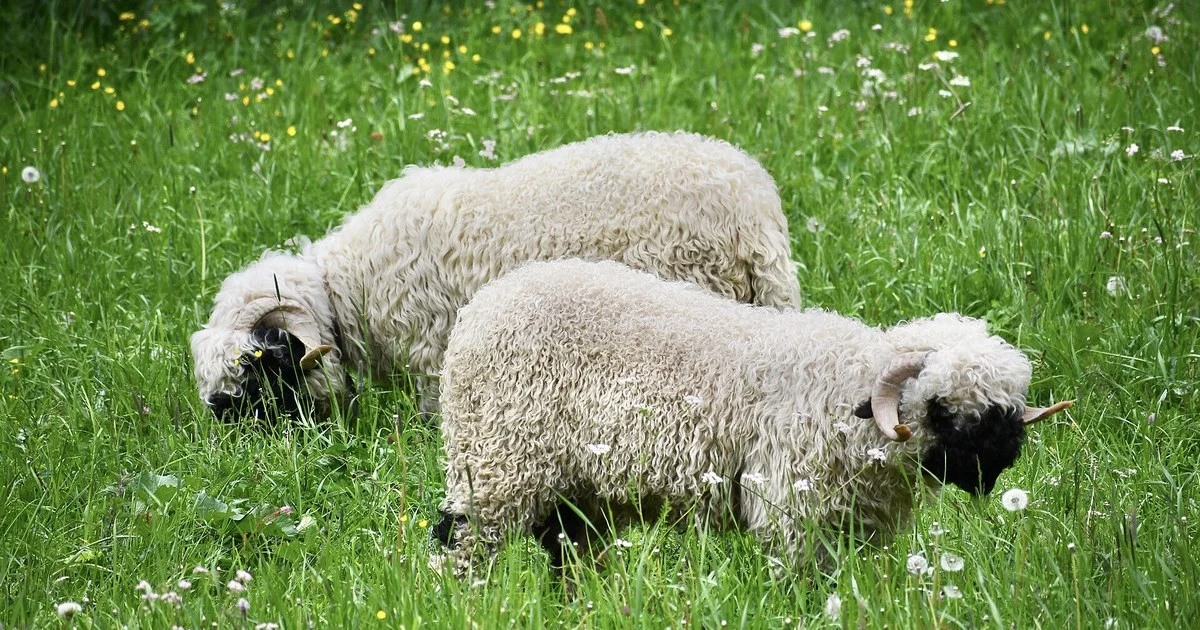
- A black nose running up to the centre of the head and joining the black around both eyes, with no gap
- Black ears where they meet the head
- Black feet and pasterns, the so-called black socks
- Black spots on the knees and hocks
- A black tail spot on ewes only; rams must not have one
- Spiral horns that grow outward, with room for a flat hand between horn and cheek
Occasionally purebred parents produce a lamb with reversed markings. UK breeders call these Spitti, and the society says Spitti ram lambs should be castrated and not used for breeding. Body spots, missing markings and kemp in the fleece are treated as serious faults at grading.
Fleece and shearing
Lamb fleece is soft but coarsens as the sheep matures. The society gives the Swiss grade as roughly 28 to 38 microns depending on age and sex, finest in lambs and coarsest in adult rams. Staple length is around 10 cm from six months’ growth.
Unlike most UK breeds, the society recommends shearing Valais Blacknose twice a year. From six months’ growth it puts fleece weight at about 1 to 1.5 kg for lambs and 2.5 to 3 kg for adult ewes and rams. The legs and head carry thick wool too, so check for dags, flystrike and overgrown wool around the eyes between shearings. Book a shearer who is happy to handle horned sheep with long fleeces.
Breeding and Valais Blacknose lambs
This is a large, slow-maturing breed. In Switzerland ewes are usually not put to the ram until they are over 12 months old and normally lamb for the first time at 18 to 24 months. The society notes the breed is non-seasonal with a reproduction rate of 1.6 lambs per year, but recommends breeding naturally once a year.
Lambs are registered through the society flock book, and DNA tissue tags are used for pedigree registration. If you are breeding, our sheep gestation calculator works out lambing dates from the tupping date, and the society publishes lambing, castration and tail docking guidance for members.
Role in UK flocks
In the UK the Valais Blacknose is kept mainly as a pedigree and show breed, and by smallholders who want a striking, quiet sheep. It is dual-purpose in Switzerland, but its slow growth, high feed needs over a long rearing period and the value of pedigree breeding stock mean it is not a commercial prime lamb breed here. Crossing Valais Blacknose ewes with other breeds produces unregistrable offspring, so most UK breeders keep them pure.
If you want a commercial flock rather than a pedigree enterprise, our guide to UK sheep farming covers the breeds and systems that pay their way on grass.
Prices and breed records
Pedigree Valais Blacknose sheep have sold for high prices at the society’s Blacknose Beauties sale. Society records show an overall breed record of 3,600 guineas in 2016, rising to 18,000 guineas in 2023 and 30,000 guineas for Ayrshire Ingrid in 2024. Those are top show and sale prices, not what a pet lamb or a commercial animal costs. For a wider view of what different sheep cost, see our guide to sheep prices in the UK.
Before you buy Valais Blacknose lambs
- Get a CPH number for the land and register your flock to get a flock mark before any sheep arrive
- Buy registered stock with society paperwork if you plan to breed or show
- Ask whether the lamb has been graded and see both parents if you can
- Check the vendor’s health status, including maedi visna accreditation, and agree a quarantine and health plan with your vet
- Never buy a single sheep; they are flock animals and need company
- Budget for twice-yearly shearing, regular foot trimming and worm control
Pros and cons of the breed
- Calm and friendly when handled regularly
- Distinctive appearance and strong show scene
- Active society with grading, shows and a national sale
- Slow to mature, with first lambing at 18 to 24 months
- Shearing twice a year adds cost and work
- Horns on both sexes need handling care
- Not suited to commercial lamb production
Frequently Asked Questions
When did Valais Blacknose sheep come to the UK?
The first sheep were imported from Switzerland in 2014. UK breed societies followed in 2015, and they merged in 2021 to form the Valais Blacknose Society.
How often do Valais Blacknose sheep need shearing?
The society recommends shearing twice a year. Fleece from six months’ growth weighs about 1 to 1.5 kg in lambs and 2.5 to 3 kg in adults.
Do Valais Blacknose ewes have horns?
Yes. Both ewes and rams carry spiral horns that grow outward from the head.
How big do Valais Blacknose sheep get?
Over two years old, ewes weigh 70 to 90 kg and rams 80 to 125 kg. Ewes stand 72 to 78 cm at the withers and rams 75 to 83 cm.
Are Valais Blacknose sheep good for meat?
They are dual-purpose in Switzerland, but in the UK they are slow-maturing and valuable as pedigree stock, so they are kept mainly for breeding, showing and as smallholder sheep rather than for prime lamb.
BritFarmers Weekly
One email a week: what’s moved on schemes, prices, disease control and policy, with links to primary sources. Free. No sponsors. Unsubscribe anytime. Subscribe.
Source: Valais Blacknose Society
You’ve reached the end of this story.