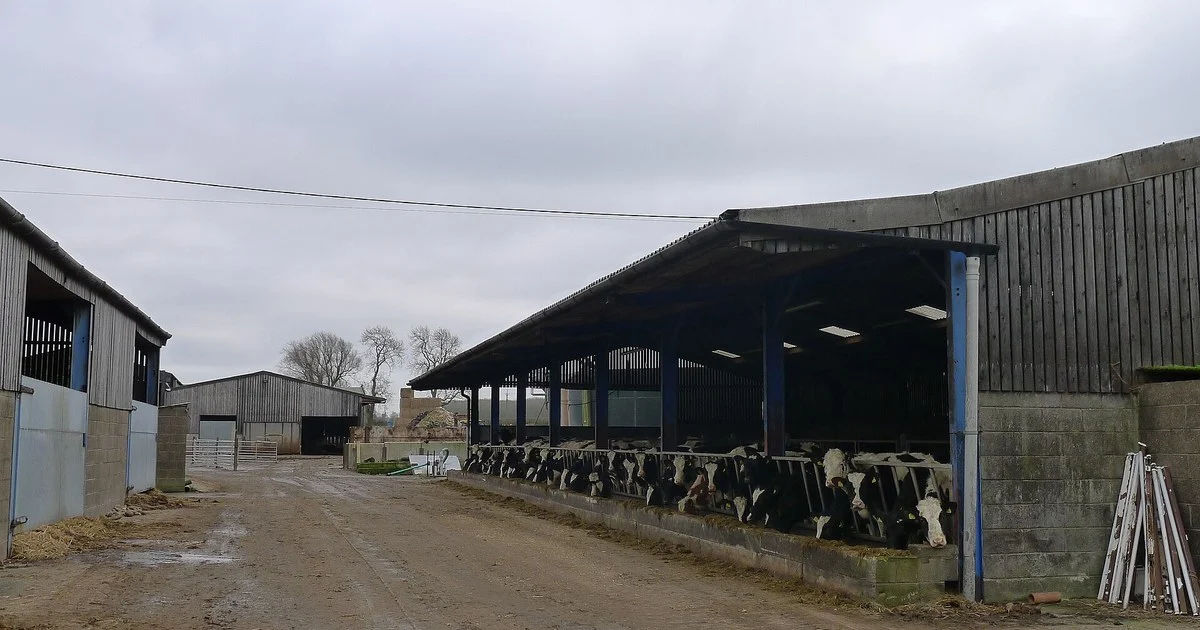
Cover photo: Tim Heaton (CC BY-SA 2.0, cropped) · Source
When a herd has a bovine TB breakdown, it is put under movement restrictions and loses its officially TB free (OTF) status. Reactors are isolated, valued and taken for slaughter, and the keeper is paid compensation. The rest of the cattle then have short interval tests about every 60 days until the herd passes the clear tests needed to lift restrictions. The detail differs in England, Wales, Scotland and Northern Ireland, so check your nation’s rules.
This is a reporter’s guide, not veterinary advice. Every rule below links to the official page it came from. Your APHA or DAERA case vet and your own vet have the final word on your herd.
Which nation are you in? The official “TB in your herd” pages
- England: GOV.UK: get your cattle tested in England and TB Hub
- Wales: GOV.UK: TB in your herd, Wales
- Scotland: GOV.UK: TB in your herd, Scotland
- Northern Ireland: DAERA: bovine tuberculosis
Reactor or IR found. Herd restricted, reactors isolated.
Reactors valued and removed by APHA.
First short interval test, severe interpretation.
Second clear test. Cleansing declaration (BT05) returned.
Restrictions lifted. Extra check test 6 to 12 months later.
A way through this story
The first days: reactor, inconclusive or lesion at slaughter
A breakdown usually starts in one of three ways. An animal fails the skin test (a reactor). An animal gives a result that is neither clear nor a fail (an inconclusive reactor, or IR). Or an animal you sent to slaughter is found with lesions that look like TB. In each case APHA, or DAERA in Northern Ireland, writes to tell you what has happened and what status your herd now has.
That status matters, because it sets how long you will be shut down. GOV.UK uses two terms:
- OTF suspended (OTFS): TB is suspected but not confirmed. A skin reactor, two inconclusive results in a row, TB-like lesions at slaughter, or an overdue routine test can all trigger it.
- OTF withdrawn (OTFW): a higher-risk breakdown, where visible lesions are found or the lab confirms infection by PCR or culture.
Northern Ireland calls these OTS and OTW, but DAERA defines them the same way: OTS means the herd’s status is uncertain, and OTW means it is being treated as a confirmed breakdown. In Wales, the Welsh guidance says herds with a new breakdown have their OTF status withdrawn.
Your first job is isolation. Reactors and IRs must be kept apart from the rest of the herd straight away. In Wales you must also tell your milk buyer when restrictions go on, and milk from reactor cows must not go into the bulk tank. Bovine TB is notifiable, and our guide to reporting a notifiable disease explains how that process works in general.
Reading the skin test: which lump is which?
The routine test is the single intradermal comparative cervical tuberculin (SICCT) test. TB Hub describes it like this: two sites on the neck are clipped and measured with callipers, avian tuberculin is injected at the upper site and bovine tuberculin at the lower site, and the vet reads both 72 hours later (give or take four hours). A reaction at the bovine site that is larger than the avian one points to bovine TB. Depending on the difference, the animal is clear, an IR or a reactor.
Don’t try to read a neck yourself. The result depends on calliper measurements against set cut-offs, and a lump on its own tells you nothing. Only the testing vet’s result counts.
Movement restrictions: what you can and can’t do
Under restriction, nothing moves on or off without a licence unless the rules say otherwise. APHA licenses moves only when a veterinary risk assessment says the risk of spreading TB is low. What that means in each nation:
- England: licensed moves to slaughter or to approved finishing units are the usual outlets. Resolved IRs in the High Risk Area, Edge Area or an LRA breakdown herd can only ever go to slaughter or an approved finishing unit (GOV.UK).
- Wales: no movement is the default. Clear cattle can go to slaughter under a general licence (TB24c), higher-risk cases need a specific TB24 licence applied for at least five days ahead, and other routes include approved finishing units, TB isolation units, red markets and dedicated TB sales (Welsh guidance).
- Scotland: licence applications must go in at least five days before the move, and you can move cattle between linked holdings under the same restriction without one (Scottish guidance).
- Northern Ireland: see DAERA’s movement restrictions page. Once restrictions are lifted in writing (notice BT26), animals can move freely again.
Removing reactors and compensation
Why slaughter at all? Bovine TB is a notifiable disease, and the UK control programmes are built on test and slaughter: find the infected animals and take them out before they pass Mycobacterium bovis on to the rest of the herd or to the farm next door.
In England, TB Hub says APHA normally removes reactors within 10 working days. A cow due to calve within 60 days can sometimes stay to calve, but you have to apply with a keeper’s declaration and a vet’s declaration (forms TB211 and TB212), and you carry the cost. Wales uses Welsh versions of the same forms plus a pregnancy declaration (TR531), returned within five working days.
Compensation works differently in each nation:
- England: table valuation. Almost every case is paid from a monthly table of average market prices for each category of animal. The table that applies is the one for the date the test was read. The latest at the time of writing is September 2026 (updated 28 September 2026).
- Wales: individual valuation. An APHA-appointed valuer values each animal, the valuation is final, and the most paid for a single animal is £5,000. Cattle without valid tags or passports are valued at nil, with £1 paid (Welsh guidance).
- Scotland: agreement or valuer. Value is agreed with APHA or set by a valuer, capped at £7,500 for pure-bred pedigree animals and £5,000 for other cattle. Without a pedigree certificate, an animal is valued as commercial stock (Scottish guidance).
- Northern Ireland: individual valuation. A DAERA valuation officer visits to set the market value, and DAERA says it currently pays 100% of market value. A reactor that dies before DAERA removes it gets nothing, even if it was already valued.
Payments can be cut hard. In England, reactors found at a test more than 60 days overdue lose 25% (61 to 90 days late), 50% (91 to 180 days) or 95% (over 180 days). There is also a 50% cut for cattle moved into a breakdown herd and for animals too dirty to be processed for food (TB Hub). Scotland cuts 50% for a test 61 to 90 days late, pays only 5% beyond that, and cuts 95% for reactors that were not properly isolated. Wales can cut payments as low as 5% of market value for breaches of testing, isolation or movement rules. The lesson is simple: keep tests on time and isolate properly, because both cost you money if you don’t.
Compensation covers the animal, not the knock-on costs. In Northern Ireland, a study by The Andersons Centre, commissioned by the Ulster Farmers’ Union, the LMC and the Dairy Council, put those indirect costs at just over £96 million a year. We covered that in the £96m yearly TB bill in NI.
Can you eat meat from a cow with TB?
Sometimes, yes. Reactors and inconclusive reactors are slaughtered separately from other animals, with precautions against contaminating other carcases, the line and staff. The carcase is then judged under Article 33 of Regulation (EU) 2019/627, the official-controls rule that FSA meat inspection teams apply. If TB-like lesions turn up in several organs or areas of the carcase, all of the meat is declared unfit for human consumption. If a lesion is found only in the lymph nodes of one organ or part, just that organ or part and its lymph nodes are condemned, and the rest can be passed. Milk is stricter: milk from reactor cows must not go into the bulk tank or the human food chain.
Testing while you’re under restriction
Once the reactors have gone, the rest of the herd moves on to short interval tests (SITs). In England, GOV.UK says all cattle except calves under 42 days are tested every 60 days, usually starting 60 days after the last reactor, IR or direct contact leaves. TB Hub explains why the clock runs from removal rather than detection: infected animals need time to build an immune response the test can pick up. Delaying removal delays your next test.
Breakdown tests are usually read at severe interpretation. That lowers the cut-off for calling an animal a reactor, so some animals that would be IRs on a routine test become reactors. It finds more infection but throws up more false positives, which is why routine tests use standard interpretation instead. TB Hub notes that the Welsh severe interpretation differs slightly from the one used in England and Scotland. In Northern Ireland, DAERA says breakdown herd tests are routinely read at severe interpretation.
IRs are isolated and retested no sooner than 60 days after the injection that gave the inconclusive result. An IR that is inconclusive again is treated as a reactor. One that comes back clear becomes a “resolved IR”. In England’s High Risk and Edge Areas, and in LRA breakdown herds, a resolved IR is restricted for life, though a negative interferon gamma test can lift that (GOV.UK).
The interferon gamma (gamma interferon) blood test is an additional test, used on veterinary advice, mostly in severe or recurring breakdowns and in breakdowns in England’s Low Risk and Edge Areas. Any animal that tests positive is treated as a reactor, and the blood tests have to be finished before restrictions can be lifted. Wales uses interferon gamma and IDEXX blood tests in similar situations, and a positive is compensated in the same way as a skin test reactor.
Test days under restriction come round often, so a working crush and handling system matters. Our guides to cattle handling on test days and the cattle crush buyer’s guide cover the kit.
Who pays for TB testing?
- England: GOV.UK says you do not pay for routine TB tests or for the extra tests during a breakdown, though you must get them done on time. You may pay if you choose a vet other than the one appointed.
- England and Wales, pre-movement tests: the GB pre-movement guidance calls the cost “a private transaction between you and your OV or ATT”, so prices vary by practice. A pre-movement test is valid for 60 days from injection.
- Wales, Scotland and Northern Ireland, routine tests: check GOV.WALES, the Scottish Government or DAERA. The Welsh guidance does say APHA pays for reactor removal, slaughter and disposal, and the Welsh Government pays for valuations.
Cleansing, disinfection and the epidemiological investigation
APHA will look at how TB got in. In Wales, the guidance says that can mean tracing animals that left your herd during the period they may have been infectious, testing neighbouring herds (contiguous testing) and taking higher-risk animals as direct contacts. Expect questions about bought-in cattle, shared grazing, boundaries and wildlife.
You will also get a cleansing and disinfection notice (BT05). Buildings and equipment must be cleaned and disinfected with an approved disinfectant at the right strength, and you sign a declaration. Restrictions can’t be lifted until APHA has it back. In Northern Ireland, DAERA inspects the cleansing before it will derestrict the herd. TB Hub’s biosecurity pages cover badger-proofing feed stores and water troughs, and our article on the environmental pressures on TB-restricted farms looks at the knock-on effects.
Badgers are the subject people argue about most. Culling and badger vaccination policy differs between the four nations and has changed several times. It is not the subject of this guide, so for the current position see the GOV.UK bovine TB pages and your own administration’s policy pages.
Getting your OTF status back
- England: two clear short interval tests in a row. In a lower-risk LRA breakdown, one negative skin test may be enough. Any interferon gamma tests must be complete and the BT05 returned. Herds on annual or four-yearly testing then get an extra test 6 to 12 months after regaining OTF, and possibly a second 12 months after that.
- Wales: an OTFW herd needs two consecutive clear SITs after the reactors have gone, plus clear tests for any IRs. After that comes a 6-month test, then a 12-month test, then routine testing.
- Scotland: an OTFS herd needs one clear SIT after reactors are removed, an OTFW herd needs two in a row, and an OTFW herd then has a skin test 6 to 12 months later.
- Northern Ireland: an OTS herd needs one clear herd test, and an OTW herd needs at least two consecutive clear herd tests, usually 60 days or more apart. After derestriction, an OTW herd has two more clear tests at six-month intervals before returning to annual testing (DAERA).
In practice that means a confirmed breakdown with no further reactors lasts at least four to five months from the first reactor to lifting restrictions: removal, a 60-day wait, one test, another 60 days, a second test. Every new reactor starts that sequence again, and that is how some herds end up shut down for a year or more.
Running the farm while you’re shut down
The rules are only half of it. When stock can’t leave, the farm fills up. Calves that would have been sold stay at home, so you have more mouths on the same grass, silage and shed space, and more slurry to store. Store cattle you meant to sell become a cost, not income. Our guides to slurry and silage storage, UK beef farming and the dairy herd guide cover the background, and what a cow costs helps when you price replacements.
Things worth doing early:
- Talk to your vet and to APHA or DAERA about which outlets are open to you, such as approved finishing units or licensed moves to slaughter, before the sheds are full.
- Ring your bank and your milk or meat buyer before cash gets tight, not after.
- Check whether your policy includes TB cover. Our farm insurance guide explains what to ask.
- Keep every test, isolation and movement on time and on record. As the compensation section shows, mistakes cost real money.
A breakdown is hard on people as well as on the business. The Farming Community Network helpline is 03000 111 999, open every day from 7am to 11pm. RABI runs a free, confidential 24-hour helpline on 0800 188 4444 for farming people in England and Wales. Your vet and the TB Hub advice pages are the place to start for the practical side.
How common is bovine TB in the UK?
From Defra’s quarterly statistics notice (updated 16 September 2026), covering July 2025 to June 2026:
- England: herd incidence 6.4, and herd prevalence 3.4% at the end of June 2026.
- Wales: herd incidence 5.7, and herd prevalence 4.3%, down 1.4 percentage points.
- Scotland: herd incidence 0.7, and herd prevalence 0.1%. Scotland has been officially TB free since 2009.
Herd incidence here means new breakdowns per 100 herd-years that herds were unrestricted and at risk. Northern Ireland measures it differently: DAERA’s August 2026 statistics put the 12-month herd incidence at 9.58% of herds tested, with 19,215 reactors in the previous 12 months. Don’t compare the two figures directly.
To see breakdowns near you in England and Wales, use the ibTB map.
Bovine TB in England, Wales, Scotland and Northern Ireland: key differences
- England: testing every 6 months in the High Risk Area, every 6 or 12 months in the Edge Area, and every 4 years in the Low Risk Area (more often for higher-risk herds). Compensation by monthly table value. More at GOV.UK and TB Hub.
- Wales: regional TB areas with different rules, including an Intensive Action Area with more frequent testing. Individual valuation, capped at £5,000. More in the Welsh guidance.
- Scotland: officially TB free since 2009. Cattle arriving from annual or more frequent testing areas of England and Wales need a pre-movement test within 30 days and a post-movement test 60 to 120 days after arrival. Agreed or valuer-set compensation, capped at £7,500 (pedigree) and £5,000. More in the Scottish guidance.
- Northern Ireland: herds return to annual testing after the post-breakdown checks, breakdown tests at severe interpretation, and compensation at 100% of market value. More at DAERA.
For other notifiable and production diseases, see our cattle diseases guide and the bluetongue checklist.
Frequently asked questions
What happens if a farm gets bovine TB?
The herd loses its officially TB free status and goes under movement restrictions. Reactors are isolated, valued and taken for slaughter, and the keeper is compensated. The rest of the herd is skin tested roughly every 60 days until it passes the clear tests needed to lift restrictions, which is two in a row for a confirmed breakdown in all four UK nations.
Do farmers get compensation for cows with TB?
Yes, for animals removed for TB control. England mostly uses monthly table values by category. Wales uses an individual valuation capped at £5,000. Scotland uses agreement or a valuer, capped at £7,500 for pedigree and £5,000 for other cattle. DAERA pays 100% of market value in Northern Ireland. Overdue tests and rule breaches cut payments.
Why are cows slaughtered if they have TB?
Bovine TB is notifiable, and all four UK administrations control it by test and slaughter. Removing reactors takes infected animals out before they pass Mycobacterium bovis on to the rest of the herd or to neighbouring herds. Clear-testing herd mates are then retested every 60 days or so to catch any infection the first test missed.
How common is bovine TB in the UK?
In the year to June 2026, Defra put herd incidence at 6.4 in England, 5.7 in Wales and 0.7 in Scotland, measured per 100 herd-years at risk. Herd prevalence was 3.4% in England and 4.3% in Wales. DAERA put Northern Ireland’s 12-month herd incidence at 9.58% in August 2026, using a different measure.
Can you eat meat from a cow with TB?
Sometimes. Under Article 33 of Regulation (EU) 2019/627, which governs meat inspection, a carcase with TB-like lesions in several organs or areas is wholly unfit for human consumption. If the lesion is confined to the lymph nodes of one organ or part, only that part is condemned and the rest can be passed. Milk from reactor cows must not enter the food chain.
How much does it cost to TB test a cow?
In England you do not pay for routine tests or for the extra tests during a breakdown, according to GOV.UK. Pre-movement tests in England and Wales are a private arrangement with your vet, so the price varies by practice. In Wales, Scotland and Northern Ireland, check your administration’s guidance on routine test costs.
Which lump is TB in cattle, top or bottom?
In the standard skin test, TB Hub says avian tuberculin goes into the upper site on the neck and bovine tuberculin into the lower site. The vet measures both 72 hours later. A larger reaction at the lower, bovine site than at the upper one points to bovine TB. Only the testing vet’s measurement counts.
Sources and rules checked
- England: GOV.UK, Bovine TB: get your cattle tested in England (page updated 26 June 2026). TB Hub valuation, SIT scheduling and skin-test pages. Compensation table, September 2026. Rules checked on 17 October 2026.
- Wales: GOV.UK: TB in your herd, Wales (updated 27 October 2025). Rules checked on 17 October 2026.
- Scotland: GOV.UK: TB in your herd, Scotland (updated 27 October 2025). Rules checked on 17 October 2026.
- Northern Ireland: DAERA valuation and removal, herd statuses and derestriction pages. Rules checked on 17 October 2026.
- Statistics: Defra quarterly notice, June 2026 (updated 16 September 2026); DAERA monthly statistics, August 2026.
- Meat inspection: Regulation (EU) 2019/627, Article 33 (legislation.gov.uk; no outstanding UK changes listed). Checked on 17 October 2026.
- Pre-movement testing: GOV.UK GB guidance (updated 1 February 2024).
You’ve reached the end of this story.