Cover photo: John H Darch (CC BY-SA 2.0, cropped) · Source
Data to September 2026 (Met Office, provisional) and daily regional figures to 15 October 2026. Updated 17 October 2026.
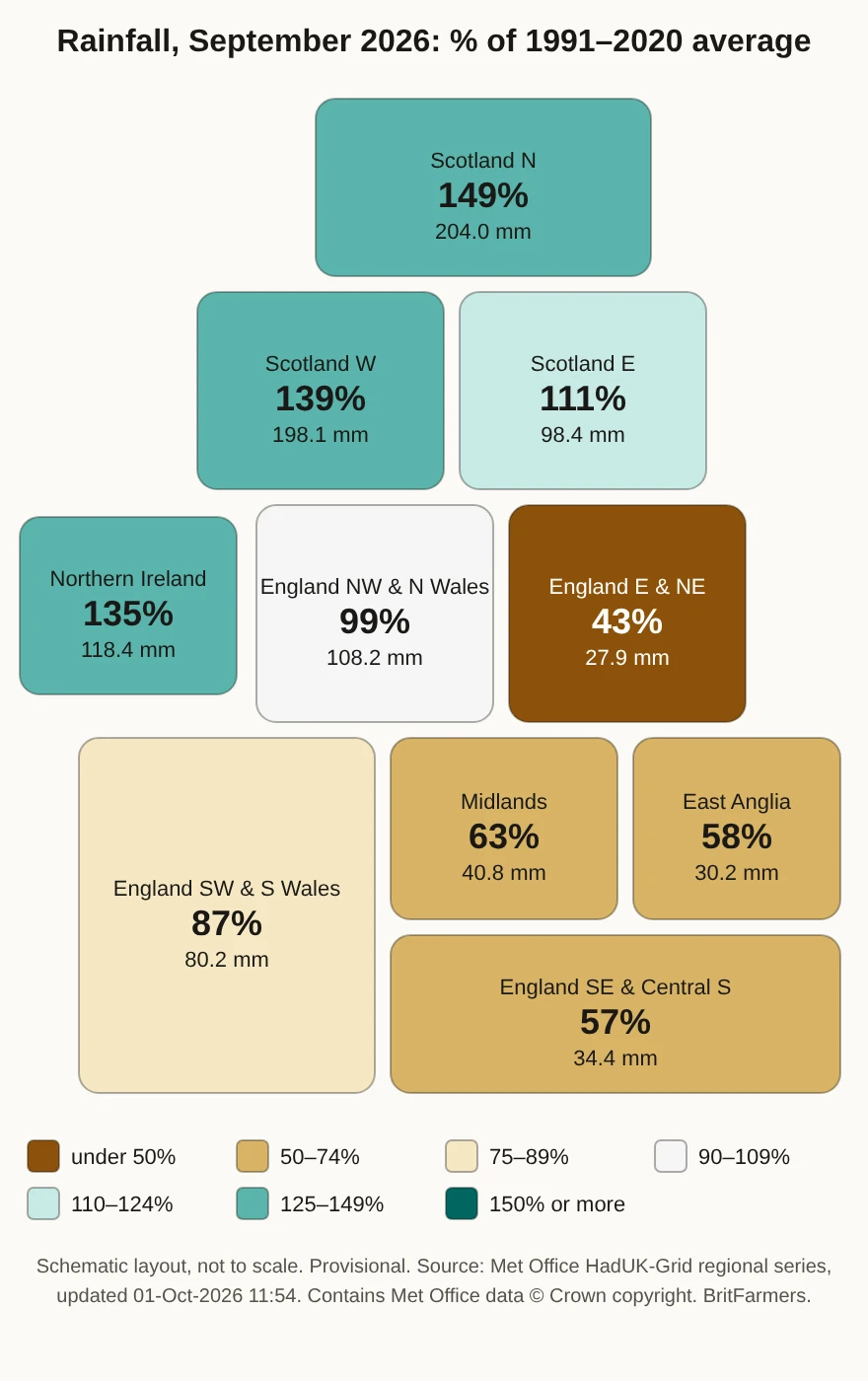
In September 2026 the UK had 94.7 mm of rain, 104% of the 1991–2020 average, according to provisional Met Office figures. The wettest district against normal was Scotland N at 204.0 mm (149% of average), and the driest was England E & NE at 27.9 mm (43%). East Anglia had 30.2 mm (58%) and England SE & Central S 34.4 mm (57%). The map below shows every district.
Tim’s take:
When people ask when it last rained, what they usually mean is whether it has rained enough to matter. A national total can’t tell you that. In September 2026 the UK came out close to average while East Anglia had just over half its normal rain, after the driest summer half-year on record in the region. This page is the one I’d use on our own farm in Suffolk: this month against normal by region, the last properly wet day, and the long-term picture underneath. Every number comes from a named Met Office or Environment Agency series, with its date.
A way through this story
UK rainfall map: September 2026 by region
Each box is one of the Met Office’s ten climate districts, coloured by how that month’s rainfall compares with the district’s own 1991–2020 average. Brown means drier than normal, green wetter. The layout is schematic so that every district is readable on a phone. It is not drawn to scale. This is a monthly totals map, not a radar: for rain falling right now, use the Met Office rainfall radar.
Rainfall totals by region this month
The table gives the four nations and the ten Met Office districts for September 2026, with the running total for the year so far. Totals are averaged across the whole area from the Met Office’s 1 km grid, so they will not match any single rain gauge, including your own.
| Region | Sep 2026 (mm) | % of average | Jan–Sep 2026 (mm) | % of average |
|---|---|---|---|---|
| UK | 94.7 | 104% | 747.9 | 95% |
| England | 44.8 | 65% | 526.4 | 88% |
| Wales | 112.5 | 101% | 850.7 | 88% |
| Scotland | 169.0 | 137% | 1062.7 | 100% |
| Northern Ireland | 118.4 | 135% | 901.6 | 113% |
| Scotland N | 204.0 | 149% | 1174.4 | 102% |
| Scotland W | 198.1 | 139% | 1190.6 | 97% |
| Scotland E | 98.4 | 111% | 805.2 | 99% |
| Northern Ireland | 118.4 | 135% | 901.6 | 113% |
| England NW & N Wales | 108.2 | 99% | 793.2 | 88% |
| England E & NE | 27.9 | 43% | 454.4 | 81% |
| Midlands | 40.8 | 63% | 508.0 | 90% |
| East Anglia | 30.2 | 58% | 329.6 | 75% |
| England SW & S Wales | 80.2 | 87% | 794.8 | 95% |
| England SE & Central S | 34.4 | 57% | 482.5 | 90% |
When did it last rain properly?
“Properly” means different things to different people, so the table gives three thresholds: the last day with at least 1 mm, 5 mm and 10 mm of rain averaged across each region. These come from the Met Office’s HadUKP daily regional series, which uses different, older region boundaries from the map above. A heavy shower on your farm will not show here unless the whole region got wet. That is the point: it tells you whether the region has had rain, not whether your field has.
| Region (HadUKP) | Last day ≥1 mm | Last day ≥5 mm | Last day ≥10 mm | This month so far |
|---|---|---|---|---|
| South East England | 15 October 2026 | 7 October 2026 | 8 September 2026 | 18.0 mm (Oct 1–15) |
| Central England | 15 October 2026 | 3 September 2026 | 3 September 2026 | 19.4 mm (Oct 1–15) |
| South West England & Wales | 15 October 2026 | 15 October 2026 | 7 September 2026 | 30.6 mm (Oct 1–15) |
| North West England & Wales | 15 October 2026 | 15 October 2026 | 8 October 2026 | 52.8 mm (Oct 1–15) |
| North East England | 15 October 2026 | 8 October 2026 | 19 August 2026 | 25.7 mm (Oct 1–15) |
| East Scotland | 14 October 2026 | 8 October 2026 | 22 September 2026 | 22.1 mm (Oct 1–15) |
| North Scotland | 15 October 2026 | 15 October 2026 | 12 October 2026 | 111.6 mm (Oct 1–15) |
| Northern Ireland | 14 October 2026 | 14 October 2026 | 8 October 2026 | 47.5 mm (Oct 1–15) |
For individual sites, our daily weather briefing gives the latest provisional readings from named Met Office and UKCEH monitoring sites in each region. Those are single-site readings, not regional totals, and the briefing says so on every card.
Average rainfall by month in the UK
December is the UK’s rainiest month on the 1991–2020 averages, at about 127 mm, with October and November close behind. April and May are the driest. The gap between the nations is wider than the gap between months: Scotland’s average year is nearly twice England’s.
| Month | UK | England | Wales | Scotland | Northern Ireland |
|---|---|---|---|---|---|
| January | 121 | 83 | 155 | 178 | 115 |
| February | 96 | 66 | 120 | 141 | 92 |
| March | 85 | 58 | 103 | 124 | 87 |
| April | 72 | 56 | 88 | 93 | 74 |
| May | 71 | 57 | 87 | 89 | 74 |
| June | 77 | 65 | 92 | 93 | 81 |
| July | 82 | 66 | 99 | 104 | 89 |
| August | 94 | 75 | 112 | 120 | 99 |
| September | 91 | 68 | 112 | 123 | 87 |
| October | 123 | 90 | 158 | 168 | 114 |
| November | 123 | 92 | 162 | 165 | 122 |
| December | 127 | 92 | 176 | 174 | 121 |
| Year | 1,163 | 870 | 1,465 | 1,573 | 1,156 |
Is the UK getting wetter or drier?
Wetter in winter. Summer totals have barely moved, but the water is less use. To get beyond the headline I compared the most recent 30 years with the 1961–1990 baseline in the Met Office HadUKP regional series. Winter here is the October-to-March half-year, comparing the 30 winters from 1996/97 to 2025/26 with 1961/62 to 1990/91. Summer is April to September, 1996–2025 against 1961–1990.
- South East England: 771 mm a year; winter +13.7%, summer −0.5%
- North East England: 856 mm a year; winter +11.7%, summer +9.6%
- England & Wales: 983 mm a year; winter +10.8%, summer +4.2%
- North West England & Wales: 1,095 mm a year; winter +10.1%, summer +5.9%
- Scotland: 1,456 mm a year; winter +9.9%, summer +4.8%
- Central England: 683 mm a year; winter +9.1%, summer +4.2%
- East Scotland: 808 mm a year; winter +9.1%, summer +5.9%
- South West England & Wales: 1,093 mm a year; winter +9.0%, summer +3.7%
- North Scotland: 1,658 mm a year; winter +5.6%, summer −0.7%
- Northern Ireland: 1,042 mm a year; winter +0.2%, summer +3.9%
Annual figures are 1996–2025 averages. Two things stand out. The driest region, South East England, has seen the biggest winter increase. And Northern Ireland’s winters have barely changed, so any national figure hides real differences.
The record itself needs care. The England and Wales series starts in 1766, but a 2020 study in the International Journal of Climatology found that early gauges under-caught snow and that the pre-1820 network was thin. Correct for both and the famous multi-century trend to wetter winters and drier summers largely disappears. The authors recommend using the series only from 1865 for winter and 1820 for summer. The better-measured recent record still shows a clear winter signal. Six of the ten wettest October-to-March half-years in the England and Wales series have come since 2000, and the wettest of all was 2023/24, at 826.8 mm.
Summer is where the usual story needed qualifying, and 2026 has now qualified it again. Until this year, the five driest April-to-September half-years in the England and Wales series were 1870 (242.4 mm), 1921 (253.8 mm), 1995 (266.8 mm), 1959 (268.9 mm) and 1990 (273.8 mm), and none came from the last 30 years. April to September 2026 provisionally came in at 254.7 mm, the third driest since 1766. It followed 2025, when England’s spring rainfall of 75.6 mm was the lowest since 1893. Meanwhile Northern Ireland had 447.1 mm in autumn 2025, the fourth-wettest autumn in the Met Office series. One dry summer does not make a trend in the totals, but hotter summers mean the same rain goes less far. The UKCP18 projections point to drier summers and wetter winters, with heavier individual downpours. The often-quoted 47% summer fall and 35% winter rise are the top of the range under the highest-emissions scenario by 2070, not a forecast.
Wettest and driest places in the UK
Of the Met Office’s climate districts, Scotland W is the wettest, averaging 1,818 mm a year over 1991–2020, and East Anglia is the driest at 627 mm, about a third as much. Individual sites in the Lake District, Snowdonia and the western Highlands record far more than their district average, because rainfall rises steeply with height. The UK’s wettest year in the HadUK-Grid series, which starts in 1836, was 1872, at 1,437.9 mm.
How much rain is a lot?
The honest answer is: compared with what normally falls where you are. Here is how often different amounts turned up in the Met Office regional series between 1991 and 2020. These are averages across a whole region, which smooths out the heaviest local storms, so a single gauge will see big days more often.
- 6 mm in a day is ordinary: South East England got that much on about 42 days a year, and Scotland on about 87. It interrupts spraying and wets the surface, but after a dry summer it barely dents the soil moisture deficit.
- 10 mm in a day happened across the South East on about 18 days a year. That is enough to stop drilling on heavy land and to start runoff from compacted tramlines.
- 30 mm in a day over the whole South East came roughly once every three years, and the wettest regional day in that period was 42.6 mm on 2 October 2020. On a single field, 30 mm brings real runoff and erosion risk, and it is a day to keep slurry in the store.
- 200 mm in a month never happened for England as a whole in those 30 years, but western Scotland had it in 84 of the 360 months.
For spreading decisions, the rules on slurry storage and spreading matter more than any rainfall label. The Environment Agency’s current advice is to check ground and weather conditions before spreading slurry or other organic manures, to keep it out of rivers.
Rain, soil moisture and the ground: what it means for field work
Rain that falls on dry ground goes into the soil before it goes anywhere else. The Environment Agency’s water situation report for September 2026 says soils at the end of the month were much drier than would be expected across most of England. That is why a wet fortnight in October can leave rivers and reservoirs low: most of the water is still filling the soil.
The site readings in our daily briefing come from UKCEH’s COSMOS-UK network. They show soil water content by volume at named sites. That is useful for spotting a change, but it is not a workability score, and the same percentage means different things on sand and on clay. For decisions on the ground, see our guides to winter wheat drilling, field drainage, soil health and grass and pasture management Wet summers matter for livestock too: SCOPS links the worst liver fluke years to above-average rain in May, June and July. See our guide to liver fluke in sheep and cattle.
The winter signal in the long-term data has a practical answer, and it starts with drainage and soil structure. AHDB’s field drainage guidance notes that medium-textured soils in high-rainfall areas need drainage too, not just heavy clays. AHDB also notes that falling organic matter has made arable soils more prone to waterlogging. Part of the wetter-winter problem is a soil condition, and that part is within your control in a way the rainfall is not.
Drought and water resources: where things stand
England. In its dry weather report for 2 to 8 October 2026, the Environment Agency lists eleven areas in drought. They are East Anglia; Hertfordshire and North London; Thames; Devon, Cornwall and the Isles of Scilly; the West Midlands; Wessex; Kent and South London; Solent and South Downs; the East Midlands; Lincolnshire and Northamptonshire; and Yorkshire (from 9 October). The North East, Cumbria and Lancashire, and Greater Manchester, Merseyside and Cheshire are in prolonged dry weather. On 15 October 2026 severe drought was declared in parts of Cornwall, Devon, Dorset, Somerset, East Sussex and West Sussex, after the driest April to September there in over a century. Reservoir storage across England was 55% at the end of September, 19% below normal for the time of year.
For farms, the same report counts 536 formal restrictions on abstraction licences and 1,383 voluntary ones, with some irrigation reservoirs at 0 to 20% of capacity. The focus has now turned to winter refill. RPS 382 lets existing licence holders abstract outside their authorised period to fill reservoirs, subject to conditions, and formal restrictions remain in parts of East Anglia until 31 October. Our guide to water resources and abstraction covers licences, trading and abstractor groups.
Scotland and Northern Ireland. SEPA’s water scarcity report of 15 October 2026 has the Lower Tweed at significant scarcity, with two catchments at moderate scarcity, seven at alert and four at early warning. We have not found a current published drought status for Northern Ireland, where September rainfall was well above average.
Frequently asked questions
What is the rainiest month in the UK?
December, on the 1991–2020 averages, with about 127 mm across the UK, followed closely by November and October at around 123 mm each. The driest months are April and May, at about 72 mm and 71 mm. These figures are calculated from the Met Office HadUK-Grid UK series.
What has been the wettest year in the UK?
1872, with 1,437.9 mm across the UK in the Met Office HadUK-Grid series, which starts in 1836. It is also the wettest year on record for England, Wales and Northern Ireland. Scotland’s wettest year in the series was 1990, at 1,891.8 mm.
Is 2026 the wettest year in history?
No. Provisional Met Office figures put the UK at 747.9 mm, 95% of the 1991–2020 average for January to September. In much of England 2026 has been one of the driest years on record, with April to September in England and Wales the third-driest summer half-year since 1766.
Is the UK getting wetter or drier?
Wetter in winter, broadly unchanged in summer. Comparing 1996–2025 with 1961–1990 in the Met Office HadUKP series, October-to-March rainfall is up 9–14% in most English, Welsh and Scottish regions, while April-to-September totals are within a few per cent of the old average. Northern Ireland’s winters have barely changed.
Is 200mm of rain a lot in a month?
In England, yes, exceptionally so: England as a whole did not have a single 200 mm month between 1991 and 2020. In western Scotland it is routine, happening in 84 of those 360 months. It depends entirely on where you are, so compare it with your region’s average in the table above.
Is 30 mm of rain a lot in a day?
Yes, if it falls across a whole region. In the HadUKP series, South East England averaged 30 mm or more over the whole region on roughly one day every three years between 1991 and 2020. Single gauges see it more often, because storms are patchy, but 30 mm on one field is still a heavy day.
How bad is 6 mm of rain?
Not unusual. South East England averaged 6 mm or more across the region on about 42 days a year between 1991 and 2020, and Scotland on about 87. It is enough to wet the surface and interrupt spraying, but after a dry summer it will barely touch a deep soil moisture deficit.
How far back do reliable UK rainfall records go?
The England and Wales series starts in 1766, the longest instrumental rainfall record in the world. A 2020 study found early gauges under-caught snow and the pre-1820 network was thin, so it recommends using the series from 1865 for winter and 1820 for summer. The English regional series start in 1873.
Which UK region has seen the biggest rainfall change?
South East England. Its October-to-March rainfall is up 13.7% on the 1961–1990 average, the largest increase of any region, although it is the driest of the HadUKP regions at 771 mm a year. The wet west is changing more slowly than the dry east.
Sources and method
- Met Office UK and regional series (HadUK-Grid areal rainfall, monthly, from 1836). Used for the map, the totals table, the monthly averages and the records. Recent months are provisional. Averages and percentages are calculated by BritFarmers against 1991–2020 and match the Met Office’s own published September 2026 figures.
- Met Office HadUKP (Alexander and Jones, 2001, Atmospheric Science Letters), daily and monthly regional series. Used for the last-rain table and the long-term analysis. Recent daily values are automated and can change after quality control.
- Met Office: September 2026 weather stats, a regional breakdown, 1 October 2026.
- Environment Agency: water situation, September 2026 and dry weather and drought, 2 to 8 October 2026; GOV.UK severe drought announcement, 15 October 2026.
- SEPA water scarcity report, 15 October 2026.
- Murphy and others (2020), International Journal of Climatology, on biases in the early England and Wales record.
How the map is made: each Met Office district’s total for the month is divided by its 1991–2020 average for that month and coloured into seven bands. The page is refreshed each month once the Met Office publishes the previous month’s provisional figures. Contains Met Office data © Crown copyright, used under the Open Government Licence v3.0. All sources accessed 17 October 2026.
Update log
17 October 2026: page rebuilt around this month’s data. Added the regional rainfall map, totals table, last-rain table, monthly averages, how-much-is-a-lot, soil and drought sections. Long-term analysis checked against the HadUKP series and tightened. The winter method is now stated. Summer 2026 has been added to the driest half-years, and Northern Ireland’s autumn 2025 corrected to fourth-wettest. A wrong figure for June 2025 has been removed (England and Wales had 55.2 mm, not 4.1 mm), along with an unsourced river-flow ranking.
13 October 2026: previous update. 27 July 2026: page first published.
You’ve reached the end of this story.