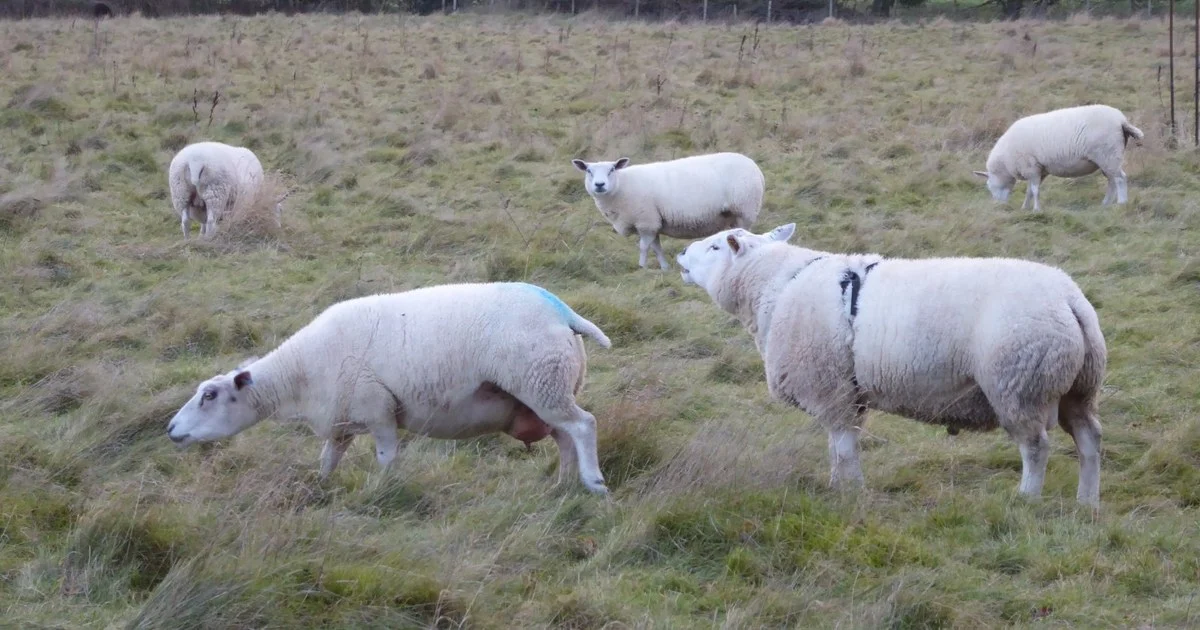
Tim’s take:
Tupping season is the six or so weeks each autumn when the rams go in with the ewes, and it decides more of the sheep year than anything that happens at lambing. The date the tup goes in fixes the date the lambs arrive; the condition of the ewes on that date fixes how many there are; and the state of the ram fixes whether there are any at all. This guide covers when tupping season falls across the UK, how to pick the date for the lambing you want, what the ewes and rams need to be by then, and how to read what the raddle tells you afterwards. Our sheep breeding guide covers the wider decisions on which ewes to keep and which ram to buy; this page is about the season itself.
A way through this story
When is tupping season in the UK?
For most of the national flock, tupping season runs from late September to the end of November. The timing is set by the sheep, not the calendar. Most British breeds are seasonal breeders: ewes start to cycle as the nights lengthen from September, and NADIS puts peak fertility in October and November. A ewe comes into season for around 30 hours and, if she is not caught, cycles again about 17 days later.
The practical consequence is a window. Put the rams in too early, before the ewes are cycling properly, and the first cycle is thin and the lambing spread out. Leave it until December and the lambs arrive onto cold ground in late April with the grass still asleep. Between those two, the date is a management choice, and it should be picked from the lambing end, not the tupping end.
Three broad systems sit inside the window. Early lambing lowland flocks chasing the Easter trade tup in September and lamb in February. The bulk of lowland and upland flocks tup in October for a March lambing. Hill flocks, and anyone lambing outdoors, tend to tup in November so lambs arrive in April as the hill starts to grow.
Tupping calendar 2026: pick the lambing date, count back
A ewe carries her lambs for about 147 days, with most falling between 144 and 152. That makes the arithmetic simple: choose the week you want the first lambs, count back 21 weeks, and that is the day the ram goes in. Our lambing calculator does it date by date. The table below gives the anchor points for autumn 2026, with the two dates that matter before the ram goes in: the ram check, which AHDB says should be ten weeks ahead, and the start of flushing, three weeks ahead.
| Rams in | Ram MOT done by | Flushing starts | End of second cycle (34 days) | First lambs due |
|---|---|---|---|---|
| 15 September 2026 | 7 July | 25 August | 19 October | 9 February 2027 |
| 1 October 2026 | 23 July | 10 September | 4 November | 25 February 2027 |
| 15 October 2026 | 6 August | 24 September | 18 November | 11 March 2027 |
| 1 November 2026 | 23 August | 11 October | 5 December | 28 March 2027 |
| 15 November 2026 | 6 September | 25 October | 19 December | 11 April 2027 |
| 1 December 2026 | 22 September | 10 November | 4 January 2027 | 27 April 2027 |
Two things to notice. If the plan is a mid-October tupping, the ram MOT date has already gone, so the check needs doing now and any problem found has less time to fix. And the lambing dates are for the first ewes caught; a flock tupped over two cycles lambs over roughly five weeks, so the last lambs from a 1 October tupping arrive at the very end of March.
Ewes: condition on the day the ram goes in
Body condition at tupping has the biggest single effect on the scanning result, and it cannot be fixed in the last fortnight. NADIS and AHDB both give the same targets: lowland ewes at condition score 3.5, hill ewes at 2.5, and the aim is for nine ewes in ten to hit the number on the day. A ewe gains roughly a score for every 10 per cent of bodyweight, so a 70 kg lowland ewe a score short needs to put on 7 kg, and NADIS allows 100 days for it. That is why the sorting starts at weaning, with thin ewes split off onto the best grass and fat ewes held back.
Flushing is the short-term version: lifting the plane of nutrition for the three weeks before the rams go in, aiming for half a condition score gained across the group. It raises ovulation rate and lambing percentage in ewes that are a little under target. It does nothing for ewes already over 4.0 or under 2.0, and in older ewes and prolific breeds it can push up triplets, which is not always the result wanted.
The last check before the rams go in is teeth, udders and feet. A ewe with a broken mouth or a lumpy udder will not rear what she conceives, and the tupping field is the last sensible place to take her out.
Rams: the ten-week MOT
AHDB’s rule is a ram MOT ten weeks before tupping, and the reason is biology rather than paperwork. The sperm a ram uses today was made about six weeks ago. A ram that was lame, feverish or overheated in August is firing blanks in October whatever he looks like on the day. The MOT runs through the five Ts:
- Toes**: walk him and watch. A ram that cannot cover ground cannot cover ewes.
- Teeth**: undershot or overshot jaw, gaps, molar abscesses. He needs to keep eating through six hard weeks.
- Testicles**: firm like a flexed bicep, even, no lumps. Soft testicles mean poor semen and it takes weeks to recover.
- Tone**: body condition 3.5 to 4.0, spine well covered. Thin rams run out of steam; fat rams cook their own testicles lying down in the heat.
- Treat**: clostridial and pasteurella vaccines up to date, parasites dealt with, feet trimmed, shorn if needed.
If tone or testicle size is short, AHDB’s suggestion is 500 g a day of an 18 per cent protein feed through the ten weeks, with an eye on magnesium and calcium to avoid urinary calculi. A bought-in ram needs three weeks for his rumen to adjust to the new farm’s diet, so buying in the sale ring the week before tupping is buying a problem.
On numbers, FAS Scotland‘s working figure is one mature ram to 40 ewes in a lowland flock. Ram lambs, and any ram working after teasers have synchronised the ewes, need more help: one to 25 or 30. Rams work harder and lose more condition than most people expect. A spare ram is cheap insurance against the one that goes lame in week two.
Teasers and the ram effect
Ewes that have been kept well away from any ram will often show a silent heat three or four days after a ram is introduced, then cycle properly around 18 and 26 days later. Flocks use this ram effect to tighten the lambing. The cleanest way is with teasers: vasectomised rams that look, smell and behave like an entire ram but cannot get anything in lamb. NADIS gives the working numbers: keep ewes at least a mile from any ram for six weeks beforehand, run two teasers per hundred ewes for the fortnight before the fertile rams go in, and then stock the fertile rams at one per 25 to 30 ewes because so many ewes will come on at once.
It is a tool for flocks that want a compact lambing and have the labour to handle it. Compressing 300 ewes into ten days of lambing is only an advantage if there are enough hands and pens for it.
Raddle: reading what happened
A raddle harness with a crayon, or raddle paste on the ram’s brisket, marks each ewe as she is served. Start with a light colour and change to a darker one each cycle, so the second colour picks out ewes returning to the ram. FAS suggests changing every 7 to 10 days; other advice runs to every 17 days, one change per cycle. Either way, the crayon needs to match the weather: a hard crayon in a warm October marks nothing, a soft one in the wet marks everything.
What the marks say. A steady run of first-colour marks in the first 17 days is a ram doing his job. A rush of marks in the first three days, then a lull, then another rush around day 18 is the ram effect at work. Ewes carrying the second colour on top of the first came back, which is normal in small numbers. If most of the flock is coming back, the ram is not working and needs swapping today, not at scanning.
Most flocks leave the rams in for two cycles, around 34 to 35 days, which gives every ewe two chances. A third cycle picks up stragglers at the cost of a long lambing tail. Note the date the rams come out: it sets the last possible lambing date, which matters for the scanner and for anyone planning to be away.
After the rams come out
The first few weeks of pregnancy are when the embryo implants and the placenta forms, and the guidance from NADIS is to avoid sudden changes of diet and unnecessary stress in that period. Keep the ewes on the same grass, leave the gathering, foot-bathing and long journeys until later, and do not let condition slide. Ewes that lose condition sharply after tupping can lose lambs with it.
Book the scanner early. Scanners are busiest in December and January and the appointment needs to sit at the right stage of pregnancy for a reliable count, so give them the dates the rams went in and came out. The scan result is the first hard number on the tupping season, and the raddle record is what makes sense of it: a low scan with a clean raddle record points at the ewes; a low scan with a lot of returns points at the ram.
Tupping season checklist
- Ten weeks out: ram MOT on the five Ts. Buy any replacement ram now, not in September.
- At weaning: condition score every ewe and split into groups. Cull broken mouths and bad udders.
- Three weeks out: flushing on the best grass for ewes under target. Check trace elements with the vet if the flock has a history.
- One week out: raddle harnesses fitted and checked, crayons chosen for the weather, spare ram identified.
- Rams in: note the date. Count back from it for scanning, and forward 147 days for lambing.
- Every 7 to 17 days: change raddle colour, walk the field, count marks.
- Day 34 or 35: rams out. Note the date.
- Weeks 1 to 4 after: no diet changes, no stress, no handling that can wait.
Frequently Asked Questions
When is tupping season in the UK?
Late September to the end of November for most flocks. Ewes of most British breeds start cycling as days shorten from September, with peak fertility in October and November. Early lambing flocks tup in September, most lowland flocks in October, and hill flocks in November.
When should I put the tup in?
Pick the date you want the first lambs and count back 147 days, or 21 weeks. A 1 October tupping gives first lambs on 25 February; 15 October gives 11 March; 1 November gives 28 March. Our lambing calculator does the counting for any date.
How many ewes can one ram cover?
FAS Scotland’s working figure is one mature ram to 40 ewes in a lowland flock. Ram lambs, and rams working after teasers have synchronised the ewes, should be stocked at one to 25 or 30.
How long should the rams stay in with the ewes?
Two cycles, about 34 to 35 days, gives every ewe two chances. A third cycle catches stragglers but stretches the lambing. Note the date the rams come out; it sets the last lambing date.
What condition should ewes be in at tupping?
Body condition score 3.5 for lowland ewes and 2.5 for hill ewes, with nine in ten on target on the day. Sort at weaning, allow 10 to 12 weeks to put condition on thin ewes, and flush for the last three weeks.
How often should I change the raddle colour?
Start light and go darker. FAS suggests every 7 to 10 days; the traditional rule is once per 17-day cycle. The point is that ewes carrying a second colour over the first have returned to the ram.
BritFarmers Weekly
One email a week: what’s moved on schemes, prices, disease control and policy, with links to primary sources. Free. No sponsors. Unsubscribe anytime. Subscribe.
Source: AHDB Ram MOT leaflet; NADIS; Farm Advisory Service Scotland TN767
You’ve reached the end of this story.