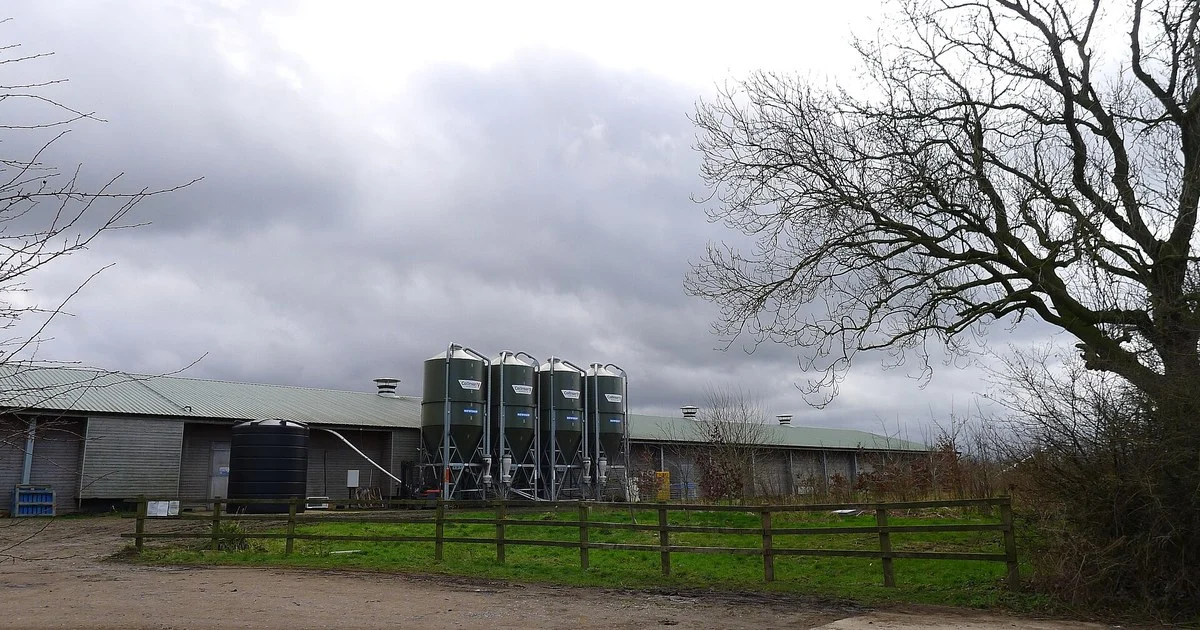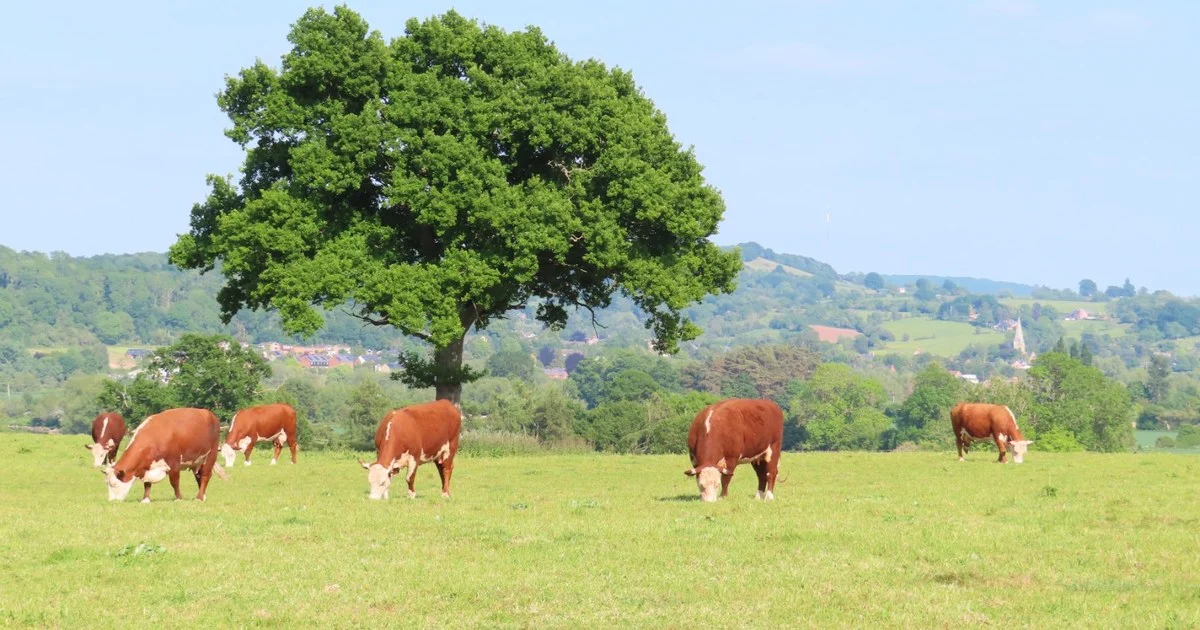
Cover photo: Philip Halling (CC BY-SA 2.0, cropped) · Source
Hereford cattle explained: origins, size, horned and polled types, dairy and suckler use, Hereford Beef schemes, 2026 sale prices and buying tips.
A way through this story
Hereford cattle at a glance
- Origin: Herefordshire, in the west of England
- Breed society: the Hereford Cattle Society, founded in 1878; the first Hereford herd book was published in 1846
- Colour: a deep red body with a white face, a white stripe from the neck to the withers and white patches underneath
- Horns: horned and polled strains both exist
- Size: medium to large; the RBST puts typical weight at 500 to 600 kg, and mature bulls of the modern type can top a tonne
- Temperament: docile and easy to handle
- Main uses: beef sire on dairy cows, terminal sire and suckler cow in beef herds, and conservation grazing
- Status: the RBST lists the Hereford as a native breed and the separate Traditional Hereford as At Risk
Where the Hereford comes from
Herefordshire was known for big, hardy cattle long before the breed had a herd book. The Hereford Cattle Society says agricultural writers of the 17th and 18th centuries remarked on the size and quality of the county’s cattle, and that by the end of the 18th century the white face and deep red coat of the modern breed were established. The RBST adds that Herefordshire farmers selected cattle that could work the fields for five or six years before being sold for fattening, which helps explain the breed’s hardiness and quiet nature.
The society’s timeline says Richard Tomkins, who died in 1723, is considered the founder of the breed. His son Benjamin Tomkins the Elder, and then his grandson Benjamin Tomkins the Younger, carried the cattle on. Thomas Eyton of Wellington, Shropshire, published the first volume of the herd book in 1846. The society that is now the Hereford Cattle Society followed in 1878, founded by J H Arkwright of Hampton Court, Herefordshire, under the patronage of Queen Victoria. Since 1886 the herd book has been closed to any animal whose sire or dam was not already recorded.
The breed travelled early. Henry Clay of Kentucky took two pairs to the United States in 1817, and Herefords reached Australia in 1825. In 1838 they were described as the predominant breed in 15 English and Welsh counties. The society says Herefords have since been exported to more than 120 countries, and at least 25 countries keep their own Hereford records. In 2023, populations reported to the FAO by 62 countries totalled more than seven million head.
Appearance and size
A Hereford is easy to pick out from across a field. The body is red, the face is white, and the white usually carries on as a stripe from the neck to the withers and in patches across the underparts. The RBST notes a thick winter coat that protects against cold, wet weather and sheds in warmer months.
Weight figures depend on the source and the type of Hereford. The RBST describes Herefords as medium-sized cattle typically weighing 500 to 600 kg. The FAO breed figures quoted on Wikipedia are higher, at about 675 kg for mature cows and 1,075 kg for bulls, with heights at the withers of about 140 cm and 152 cm. The Traditional Hereford, covered below, is smaller and shorter in the leg than the modern type.
Both horned and polled Herefords exist. The Polled Hereford was selected as a separate breed in the United States from 1889, from cattle carrying a natural hornless mutation. If you want to avoid disbudding calves, ask whether a bull is polled before you buy.
The Traditional Hereford
During the 20th century the Hereford was exported widely, and cattle from overseas bloodlines were later brought back into the UK. The RBST says these imported Herefords became so popular that the native bloodlines became endangered. The cattle descended only from the old British lines are now known as the Traditional Hereford, or Original Population Hereford, and the RBST lists them as At Risk on its Watchlist.
Traditional Herefords are shorter-legged than modern Herefords. The RBST gives mature working cows at 500 to 600 kg and bulls at 750 to 850 kg. They are usually horned, although horns are often removed for safety. On a forage diet they reach carcase grades of O+ to R, fat class 3 to 4L, at 24 to 30 months. The letter is conformation on the EUROP grid and the number is fat cover; AHDB’s guide to beef carcase classification explains how the grid works and why price per kilo depends on hitting the buyer’s specification. The RBST describes them as suited to low-input, forage-based systems, outwintering and conservation grazing. The Traditional Hereford Breeders Club collects data on the cattle, and registration goes through the Hereford Cattle Society.
Hereford bulls in the dairy herd
Many UK farmers first meet the breed as a beef bull on dairy cows. The Hereford Cattle Society makes four points for using one:
- Shorter gestation: the society says a Hereford bull’s calves are carried about a week less than those of the average continental bull, so cows get back into the parlour sooner.
- Easy calving: it calls the Hereford an ideal choice on maiden heifers, where a difficult calving can cost milk later.
- Temperament: a docile bull is easier and safer to manage around the yard.
- A marked calf: the white face makes Hereford-sired calves easy to identify and gives them a saleable, recognisable look.
Several of the society’s dairy case studies use Hereford bulls as sweeper bulls. Calving ease still varies from bull to bull, so look at calving ease and birth weight figures for the individual bull rather than relying on the breed’s reputation. Our cattle gestation calculator helps you plan calving dates once the bull goes in.
There is buyer demand from dairy farms for young Hereford bulls. At the Shrewsbury Autumn Show and Sale held by Halls in October 2026, two young bulls sold to dairy farmers at 4,000gns and 3,800gns, and a third went at 3,600gns to a local dairy farm coming back for another Hereford bull.
Herefords in suckler herds
In a beef herd the Hereford can be the terminal sire, the suckler cow, or both. The society says continental suckler herds are increasingly turning to the Hereford to save management time and to rely less on the feed bag.
As a suckler cow, the society says Herefords are fertile, easy calving and milky, and that cows “can last well over a decade” in a herd. They produce moderate birthweight calves. Their quiet nature makes them easier to manage, and the society reports that some farmers stock Herefords more heavily than less docile breeds.
As a terminal sire, the society says Hereford bulls give a carcase size suited to current market requirements and let farmers sell into breed beef schemes. On grass, the RBST describes Herefords as among the easiest cattle breeds to fatten, often reaching market weight by 24 months on unimproved summer pasture. Purebred Herefords gain condition quickly, while crossbreds may need slightly more inputs. Because they lay down condition easily, keep an eye on body condition on rich grazing and finish to your buyer’s fat class specification.
Hereford Beef and processor schemes
Hereford beef is stocked in Co-op, Lidl and Waitrose, where it is sold under Waitrose’s own label, as well as by independent retailers and farm box schemes. The Hereford Cattle Society lists three processors:
- Dunbia, which processes the Co-op’s Irresistible Hereford Beef range, sold in England, Northern Ireland and Wales. Lidl also stocks Hereford steaks.
- Dovecote Park, the dedicated meat processor to Waitrose, which supplies Hereford beef under the Waitrose label.
- WD Meats in Northern Ireland, which buys Hereford cattle and supplies Dovecote Park.
The RBST notes that dedicated markets such as Dovecote Park pay premiums for Hereford beef. The size of any premium, the eligibility rules and the carcase specification are set by each processor, so check the current terms with the buyer before you plan a system around a scheme.
Breedplan, EBVs and the superior carcase sire scheme
The Hereford Cattle Society runs performance recording through Breedplan, which produces the estimated breeding values (EBVs) that the society’s superior carcase sire scheme is based on. The society says it is the only UK beef breed society that provides Breedplan membership to its members free of charge.
To encourage commercial farmers to buy high-performing bulls, the society runs a superior carcase sire scheme. A qualifying bull must:
- be in the top 20% of the breed for retail beef yield, the top 25% for eye muscle area, the top 75% for calving ease direct and the top 25% for terminal index
- be fully registered, from a Breedplan recorded herd, with its birth weight and two further live weights recorded
- be under 30 months old at the point of sale, DNA tested before sale and tested free of hypotrichosis
- have a scrotal circumference of at least 32 cm, measured by the technician at scanning
The original buyer of a qualifying bull can claim £5 for each calf it sires. Claims are accepted twice a year for up to four years from the date of purchase, or up to a total of 100 calves per sire, so the most you can get back is £500. Calves must be under six months old when the claim is made, and the society may DNA test calves to check the sire.
Hereford cattle prices in autumn 2026
Pedigree sale reports give a guide to what breeding stock is making. The Hereford Cattle Society reported these results from two sales on 17 October 2026:
- Shrewsbury Autumn Show and Sale (Halls): 11 bulls averaged £5,220, up £860 on the year. The top price was 7,800gns for Midford 1 Crackerjack. Three show heifers averaged £5,425, and three heifer calves averaged £1,890.
- Commercial bulls at Shrewsbury: young bulls sold into commercial suckler and dairy herds made 3,600 to 4,400gns.
- Stirling (United Auctions): the top female made 9,000gns, a centre record for a Hereford female. All females offered were sold, at an average of £6,912.
“I think there’s a great opportunity in Stirling for the Herefords to grow,” said United Auctions auctioneer Murray Steel after the sale.
A guinea is £1.05, so 7,800gns is £8,190. These are prices for selected pedigree stock at show-and-sale events. Commercial cattle are valued differently, and our guide to how much a cow costs in the UK covers what drives prices for everyday stock.
Health points to check
Herefords are generally regarded as a hardy breed, but a few breed-linked problems are worth knowing about:
- Eye cancer: ocular squamous cell carcinoma occurs in Herefords, mostly in countries with strong sunshine, and in cattle with little red pigment around the eye. Research in the US and Canada found eyelid pigment is heritable and lowers the risk, so pigmented eyes are a sensible thing to select for.
- Sunburn: light-pigmented skin on the udder can burn.
- Vaginal prolapse: this is considered heritable, although nutrition may also play a part.
- Dwarfism: it is caused by an autosomal recessive gene, so it can appear when two carriers are mated.
- Hypotrichosis: a genetic condition the society tests for. Bulls in the superior carcase sire scheme must be tested free of it.
Beyond these, the usual herd health checks apply. Our guide to cattle diseases covers TB, BVD, Johne’s and IBR, and what to discuss with your vet.
Pros and cons
Pros:
- Docile and easy to handle
- Easy calving, with what the society describes as a shorter gestation than the average continental bull
- Thrives on grass and coarse forage, with little reliance on bought feed
- Long-lived suckler cows
- White-faced calves that are easy to identify and sell
- Hereford beef stocked by Co-op, Lidl and Waitrose
- Free Breedplan recording for society members
Cons:
- Horned strains need disbudding unless you use a polled bull
- Cattle lay down condition easily, so they need managing on rich grazing
- Low eye pigment raises the risk of eye cancer, so check pigment when selecting breeding stock
- Traditional Herefords take 24 to 30 months to finish on forage
Before you buy Hereford cattle
- Decide whether you want modern Herefords or Traditional Herefords. The two suit different systems and markets.
- Check registration with the Hereford Cattle Society, and ask whether the animal has been DNA tested for parentage and genetic defects.
- Look at the bull’s EBVs for calving ease direct, birth weight, terminal index and retail beef yield.
- If you want the £5 a calf payment, confirm before you buy that the bull qualifies as a superior carcase sire.
- Ask for herd health status, including TB history, BVD, Johne’s and IBR.
- Have a new bull fertility tested by your vet before the breeding season.
- Look for good pigment around the eyes.
- If you plan to sell into a Hereford beef scheme, check the processor’s current rules and specification first.
- Make sure passports and tags match, and quarantine new stock on arrival.
Frequently Asked Questions
Do Hereford cattle have horns?
Some do. Both horned and polled (naturally hornless) Herefords exist. The Polled Hereford was developed as a separate breed in the United States from 1889. Traditional Herefords are usually horned, although horns are often removed for safety.
How big do Hereford cattle get?
The RBST puts typical weight at 500 to 600 kg. FAO breed figures give about 675 kg for mature cows and 1,075 kg for bulls. Traditional Herefords are smaller, with working cows at 500 to 600 kg and bulls at 750 to 850 kg.
Why do dairy farmers use Hereford bulls?
The Hereford Cattle Society points to easy calving, especially on maiden heifers, a gestation about a week shorter than the average continental bull, a docile temperament and white-faced calves that are easy to identify and sell.
What is a Traditional Hereford?
A Traditional Hereford, or Original Population Hereford, descends only from the old British bloodlines, without imported genetics. The cattle are shorter-legged and smaller than modern Herefords, and the RBST lists them as At Risk.
How much does a Hereford bull cost?
At the Shrewsbury Autumn Show and Sale on 17 October 2026, 11 pedigree bulls averaged £5,220, with a top price of 7,800gns. Young bulls sold into commercial suckler and dairy herds made 3,600 to 4,400gns.
BritFarmers Weekly
One email a week: what’s moved on schemes, prices, disease control and policy, with links to primary sources. Free. No sponsors. Unsubscribe anytime. Subscribe.
Sources
Sources checked on 3 November 2026.
- Hereford Cattle Society: Our history
- Hereford Cattle Society: The breed
- Hereford Cattle Society: Herefords for dairy
- Hereford Cattle Society: In the suckler herd
- Hereford Cattle Society: Hereford Beef
- Hereford Cattle Society: Superior carcase sire
- Hereford Cattle Society: Shrewsbury Autumn Show and Sale report (October 2026)
- Hereford Cattle Society: Stirling sale report (October 2026)
- RBST: Hereford
- RBST: Traditional Hereford
- Wikipedia: Hereford cattle
You’ve reached the end of this story.