A way through this story
Jacob sheep at a glance
- Type: a piebald, multi-horned British breed kept for wool, meat and as a smallholder’s sheep
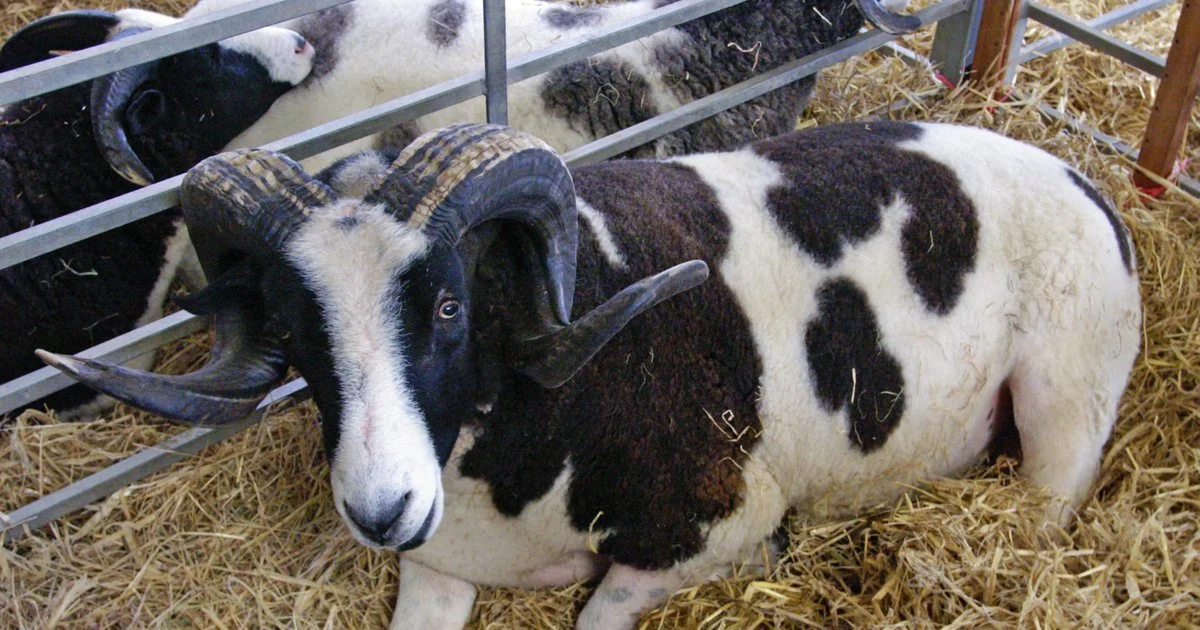
- Horns: both sexes are always horned, with two or four horns (occasionally more)
- Colour: a white fleece with black or brown patches; the head and neck are usually black with a white blaze down the face
- Size: medium to large; British Jacob ewes usually weigh 60 to 65 kg and rams 80 to 100 kg
- Fleece: about 2 to 3 kg a year, according to the RBST, and popular with hand spinners
- Breed society: the Jacob Sheep Society, formed in 1969, which has published a flock book since 1972
- Status: the RBST lists the Jacob as a native breed rather than in one of its at-risk categories
Where the Jacob comes from
Nobody knows where the Jacob came from. The name comes from the story in the Book of Genesis in which Jacob takes the speckled and spotted sheep from his father-in-law Laban’s flock and breeds from them. The Jacob Sheep Society tells the legend of spotted sheep travelling from the Middle East through North Africa to Spain, but there is little genetic evidence that today’s breed descends from Jacob’s flock.
What is better documented is the breed’s long history on English estates. For much of its recorded history the Jacob was called the “Spanish sheep”. Piebald, many-horned sheep much like the modern breed appear in paintings from about 1760 at Tabley House in Cheshire, and in work by George Stubbs at Wentworth Woodhouse in Yorkshire. The de Tabley family’s tradition was that their sheep came ashore in Ireland from a wrecked ship of the Spanish Armada in 1588. A 2009 study using genetic markers found the Jacob more closely linked to sheep from Africa and south-west Asia than to other British breeds.
For centuries Jacobs were kept as ornamental “park sheep” by landowners. The society notes that they grazed alongside deer in parks such as Charlecote Park.
How the breed was saved
By the middle of the 20th century the Jacob had become rare. Breeders formed the Jacob Sheep Society in 1969 with 96 members, and its first president was Mary Cavendish, the Dowager Duchess of Devonshire, who kept a flock at Chatsworth. The society began publishing a flock book in 1972.
The recovery was quick. In 1974 the Rare Breeds Survival Trust called the Jacob “a success story of recent years”, with over 5,000 registered sheep, the society says. The society now has more than 850 members. In 2017 the RBST placed the Jacob in its “other UK native breeds” category, which is for breeds with more than 3,000 registered breeding females, and its current breed page lists the Jacob as native rather than at risk.
Appearance and the breed standard
The Jacob Sheep Society’s breed standard describes an alert, active sheep that is upstanding and deep-bodied, white with well-defined black patches. The main points are:
- Head: clear of wool in front of the horns, with a clear white blaze; a symmetrical blaze with even black cheeks, black ears and a dark nose are preferred. A pink nose with a broad white face is undesirable in adult sheep.
- Horns: always two or four. With four, the top pair should grow upward with no tendency to grow forward, ideally with space between the top and lower horns. Black horns are preferred, and horns must never injure the sheep or get in the way of feeding.
- Body: a straight, level back, a broad tail set well up, well-sprung ribs and a strong neck of medium length.
- Legs: medium boned, clear of wool below the knee and hock, and preferably white with little or no black.
- Fleece: medium quality, white with well-defined black patches, pink skin under the white wool and black skin under the dark wool, and little or no kemp. Mottled wool and skin are undesirable.
The RBST adds that patches can be black or brown and that every animal’s markings are unique. That is why a shepherd can pick out individual Jacobs from a distance. Polled (hornless) sheep are not accepted in the society’s flock book.
British and American Jacobs
If you research the breed online you will find a lot of American material, and the two populations have drifted apart. British breeders have selected Jacobs for meat, so British Jacobs tend to be larger, heavier and more uniform. American Jacobs have been bred with less selection and are smaller: American ewes weigh about 40 to 50 kg and rams about 55 to 80 kg, against 60 to 65 kg and 80 to 100 kg for British sheep. Bear this in mind when you read figures for size, carcase or management that come from the United States.
Jacob wool and fleece
The fleece is the main reason many people keep Jacobs. The RBST gives an average fleece weight of about 2 to 3 kg a shearing, with a medium wool whose natural colours are prized by hand spinners and weavers.
The society’s introductory guide describes a springy fleece with a staple length of 75 to 180 mm, and gives two grades for Jacob wool:
- Jacob 1 (grade 350): good uniformity of style, length and colour with a sound staple; Bradford count 54s to 58s, about 25 to 27.5 microns
- Jacob 2 (grade 351): average uniformity, possibly with slight discolouration or staple weakness; Bradford count 46s to 52s, about 30 to 33 microns
A lower micron figure means finer wool. One fault to watch for is a “quilted” fleece, where the dark wool grows longer or shorter than the white. The society keeps a list of members who sell Jacob wool and meat.
Jacob meat
Jacobs are dual-purpose sheep. The RBST describes the lamb and hogget as lean and flavoursome and well suited to niche markets, and the society promotes Jacob hogget and mutton as well as lamb. British breeders have selected for productivity, and a British Jacob is larger and heavier than its American cousin. The society keeps a list of members who sell Jacob meat, many of them with their own websites.
Breeding and lambing
Jacob ewes have a strong reputation as mothers. The RBST says they are known for lambing ease and often rear twins or triplets, with good milk. A ewe’s first lamb is usually a single, and later litters are usually one or two lambs, with triplets not unusual. Their ease of lambing and mothering instinct are why some commercial flocks in England keep Jacobs.
The society’s guide for new keepers gives these practical points:
- Gestation is about five months, or 147 to 150 days. Our lambing calculator works out the dates from your tupping date.
- Ewes come into season about every 16 days, so leave the ram in for at least six weeks so that each ewe has at least two chances to be served.
- New keepers may do better buying older ewes than breeding from ewe lambs, and planning lambing for the end of March or early April so lambs go straight onto spring grass.
- Because Jacobs often carry twins, feed ewes well in the last six weeks before lambing, introducing concentrates gradually, to avoid twin lamb disease.
- Never use a ram on his dam or full sisters, to reduce the risk of hereditary defects.
For flocks putting the ram in this autumn, our guide to the tupping season covers ram preparation and ewe condition.
Health and handling points
Jacobs are generally hardy, but a few points are specific to a horned, multi-horned breed:
- Split eyelid: a congenital defect found in several British multi-horned breeds and genetically linked to the multi-horn trait. Mild cases show a small peak in the upper eyelid without causing problems, while severe cases leave the upper lid split in the middle. The breed standard asks for sheep with no tendency to it, so check the eyes of any breeding stock.
- Horn growth: check that horns are not growing into the face or eye. The breed standard requires horns that leave the sheep free from injury and comfortable when feeding.
- Hay nets: avoid them. The society warns that horned sheep easily become entangled in nets and can hang or strangle themselves; use a rack instead.
- Water: wide horns make it awkward for sheep to drink from a half-full bucket, so a low trough is better.
- Flystrike: in adult rams the society lists the area around the horns as a danger spot, along with dirty back ends, sweaty shoulders, wounds and feet with foot rot.
The usual routine of vaccination against clostridial diseases, foot care and worm control applies as with any breed.
Registering Jacob lambs before 30 November
Pedigree Jacobs are recorded in the society’s flock book, and the society says registration increases a sheep’s potential value. Registered sheep are eligible for the society’s show and sales and for shows with Jacob classes. Only the breeder of an animal can register it, and applications must reach the society by 30 November to be included in the following year’s flock book. The society charges double fees for applications made after that date.
Members can register online through the Grassroots system or by post. Registration produces a three-generation pedigree certificate, and registered sheep can be entered in the society’s annual show and sales and any show with Jacob classes. Non-members’ sheep can be registered only in certain circumstances, with parentage verified by a DNA test taken by a vet.
Buying Jacob sheep
The society’s official show and sales run from late July to September. The society’s 2026 programme listed sales at Worcester, Tullow, Carlisle, Gortin in County Tyrone, Skipton, Melton Mowbray and the Monmouthshire Livestock Centre. Registered sheep offered at these sales are inspected by experienced judges against the breed standard before the sale. Outside the sale season, the society’s Regional Council Members, who run local Jacob groups, are a useful first contact.
The society’s guide suggests looking for:
- a well-rounded sheep with an evenly marked face, a broad chest with the front legs well apart, and a straight back with the tail set high
- strong, evenly balanced horns that do not grow forward
- sound feet, and teeth that meet the pad of the upper jaw, with a jaw that is neither undershot nor overshot
- in ewes that have lambed, a soft, supple udder with no lumps, which can be a sign of mastitis
Always ask the seller to confirm that the sheep are registered with the Jacob Sheep Society, and buy at least two, because a single sheep needs company. Our guide to how much a sheep costs in the UK covers what affects prices.
Rules for keeping Jacobs in England
Even a few pet or smallholder sheep bring legal duties. In England you must get a county parish holding (CPH) number for the land where you keep livestock, whether as a business, a hobby or pets, through the Rural Payments Agency’s CPH guidance. You can apply up to six weeks before the animals arrive, and once the Rural Payments Agency has your details, the Animal and Plant Health Agency emails you a flock number.
Sheep keepers must also complete an annual inventory. Defra sends a letter or email at the end of November, and you must record the number of sheep on your holding on 1 December in your holding register and return the inventory by 31 December, according to the GOV.UK annual inventory guidance. Scotland, Wales and Northern Ireland have their own rules. Lambs must be tagged on the holding where they were born, within six months of birth if reared indoors or nine months if reared outdoors, or before they leave the holding if that is sooner (GOV.UK tagging guidance). You must also report sheep moved onto your holding within three days of arrival (GOV.UK movement reporting guidance).
Pros and cons
Pros:
- Striking looks, with every sheep’s markings different
- Easy lambing and strong mothering, often with twins
- A naturally coloured fleece that hand spinners want
- Lean meat suited to direct sales
- An active breed society with a breed standard, flock book and regional groups
Cons:
- Horns bring risks: entanglement, horns growing into the face, and flystrike around the horns in rams
- Split eyelid, linked to the multi-horn trait, needs watching when you select breeding stock
- Meat suited to niche markets rather than the mainstream lamb trade, in the RBST’s description
- Registration has a strict deadline of 30 November, with double fees after it
Frequently Asked Questions
How many horns does a Jacob sheep have?
Jacob sheep of both sexes are always horned, usually with two or four horns and occasionally more. The breed standard accepts two or four, and polled (hornless) sheep are not accepted in the Jacob Sheep Society’s flock book.
Why are they called Jacob sheep?
The name comes from the story in the Book of Genesis in which Jacob breeds a flock from the speckled and spotted sheep of his father-in-law Laban. The breed’s real origins are unknown, and for much of its recorded history it was called the Spanish sheep.
How big do Jacob sheep get?
British Jacob ewes usually weigh 60 to 65 kg and rams 80 to 100 kg. American Jacobs are smaller, at about 40 to 50 kg for ewes and 55 to 80 kg for rams, reflecting British selection for productivity.
What is Jacob wool used for?
Jacob fleece is a medium wool of about 2 to 3 kg a year. Its natural white and dark colours are prized by hand spinners and weavers.
When do Jacob lambs need to be registered?
Applications must reach the Jacob Sheep Society by 30 November to be included in the following year’s flock book. Only the breeder can register a lamb, and later applications are charged double fees.
BritFarmers Weekly
One email a week: what’s moved on schemes, prices, disease control and policy, with links to primary sources. Free. No sponsors. Unsubscribe anytime. Subscribe.
Sources
Sources checked on 3 November 2026.
- Jacob Sheep Society: Sheep and Society (history)
- Jacob Sheep Society: Breed Standard
- Jacob Sheep Society: Registrations
- Jacob Sheep Society: Shows and Sales
- Jacob Sheep Society: An Introduction to Jacob Sheep (updated January 2024)
- Jacob Sheep Society: Jacob Member Meat and Wool
- RBST: Jacob
- GOV.UK: Apply for a county parish holding (CPH) number
- GOV.UK: Sheep and goat keepers: complete your annual inventory
- GOV.UK: Tag sheep with ear tags, pastern bands and boluses
- GOV.UK: Report sheep and goat movements
- Wikipedia: Jacob sheep
You’ve reached the end of this story.