Cover photo: John Welford (CC BY-SA 2.0, cropped) · Source
UK sheep breeds explained: hill, crossing and terminal sire breeds, how the stratified system produces the Mule, which breeds are most common, rare breeds.
A way through this story
How many sheep breeds are there in the UK?
The National Sheep Association counts around 90 sheep breeds and crosses in the UK. That variety is not an accident. Breeds were developed for very different ground, from Welsh mountains and Pennine moors to lowland grass, and most commercial lambs today are the product of several breeds working together.
The easiest way to make sense of UK sheep breeds is to group them by the job they do: hill breeds, longwool crossing sires, the crossbred ewes they produce, lowland and maternal breeds, terminal sires, and rare and primitive breeds. There is a full A to Z further down.
The stratified system: hill, upland and lowland
Much of the UK flock is linked through what is called the stratified system. It has three tiers.
On the hills, hardy breeds such as the Scottish Blackface, Swaledale and Welsh Mountain live on rough grazing and are bred pure to keep the flock going. Older ewes that are past their best on the hill are drafted down to kinder ground.
In the uplands, those hill ewes are crossed with a longwool ram, most often the Bluefaced Leicester. The female lambs from that cross are the Mules, which have the hill ewe’s hardiness and mothering with more size, milk and prolificacy.
On lowland farms, Mule ewes are put to a terminal sire such as the Texel or Suffolk. Every lamb from that cross goes for meat, and the lowland farmer buys in more Mule ewe lambs to replace the flock.
The system has been shrinking for decades. In 1971, 85% of sheep were in a traditional crossbreeding structure. The 2020 sheep breed survey, funded by the red meat levy boards in England, Scotland and Wales, put the split between traditional and lowland self-replacing flocks at roughly 51 to 49, as more lowland farmers breed their own replacements.
Hill breeds
Hill breeds are small to medium, thick-coated and good mothers, able to rear a lamb on poor grazing in hard weather. Many are hefted, meaning they learn and keep to their own patch of open hill. The main hill breeds include the Scottish Blackface, Swaledale, Welsh Mountain, Cheviot, Herdwick, Rough Fell, Dalesbred, Derbyshire Gritstone and Lonk, along with Welsh hill types such as the Beulah Speckled Face and Welsh Hill Speckled Face.
Longwool crossing sires and the Mule
Longwool rams are used on hill ewes to breed crossbred females. The Bluefaced Leicester is the dominant crossing sire, while the Border Leicester, Teeswater, Wensleydale and Devon and Cornwall Longwool are also used.
The Mule takes its name from its hill mother. A Bluefaced Leicester on a Swaledale gives the North of England Mule, on a Scottish Blackface the Scotch Mule, and on a Welsh Mountain or other Welsh hill ewe the Welsh Mule. The Scotch Halfbred, from a Border Leicester on a Cheviot, is another long-established cross. These crossbred ewes are the backbone of many lowland flocks.
Terminal sire breeds
Terminal sires are rams used to breed lambs for meat, with all their offspring going for slaughter. They are chosen for growth rate and carcass shape. The Texel is the most widely used terminal sire in the UK, followed by the Suffolk, Charollais and Beltex. Down breeds such as the Southdown, Dorset Down, Hampshire Down and Oxford Down are also used, especially where an earlier-finishing or smaller lamb suits the market.
If you are choosing a ram, our guide to sheep breeding in the UK covers selection and our tupping season guide covers ram preparation.
Lowland, maternal and easy-care breeds
More lowland farmers now run self-replacing flocks rather than buying Mules. That has boosted maternal breeds such as the Lleyn, Romney and Clun Forest, which combine mothering ability with a decent carcass.
Wool-shedding breeds have grown too. With fleece prices low, breeds such as the Easycare, Exlana and Wiltshire Horn save on shearing costs. The 2020 breed survey also recorded more use of composite breeds such as the Aberfield and Innovis.
Which sheep breeds are most common in the UK?
The 2020 breed survey found that the traditional hill breeds are in decline. Scottish Blackface numbers fell 36% from 2012, and the Welsh Mountain, Beulah, Welsh Hill Speckled Face and Swaledale each fell by 15 to 19%. The Cheviot was the only traditional breed to grow, up 4%.
At the same time, Texels spread further into crossbred ram and ewe lines, and Lleyns kept gaining ground as a maternal breed. The overall picture is a flock moving from hill crossbreeding towards lowland self-replacing systems.
Rare and primitive sheep breeds
The Rare Breeds Survival Trust tracks native breeds whose numbers are low. In its 2025 Watchlist, the Manx Loaghtan and Leicester Longwool moved into the most urgent Priority category, after the number of breeding ewes fell by 34% and 29%. Some breeds are improving: Llanwenog ewe numbers rose 23%, and Devon and Cornwall Longwool female registrations rose 45%.
Primitive breeds are small, often multi-horned and close to ancient types. The Soay from St Kilda, the North Ronaldsay from Orkney, the Hebridean, the Castlemilk Moorit and the Portland are the best known. They are popular with smallholders and for conservation grazing.
A to Z of UK sheep breeds
The list below covers 45 breeds you are likely to see in UK fields, showing where each comes from and what it is mainly kept for.
- Badger Face Welsh Mountain (Wales): hill breed with distinctive dark face stripes
- Balwen (Carmarthenshire, Wales): small hill breed, dark with a white blaze, white socks and white tail tip
- Beltex (Belgium, bred up in the UK): heavily muscled terminal sire
- Beulah Speckled Face (Powys, Wales): hill breed with a speckled black and white face
- Bluefaced Leicester (northern England): longwool crossing sire behind most Mules
- Border Leicester (Scottish Borders): large longwool crossing sire with prick ears and a Roman nose
- Castlemilk Moorit (Dumfriesshire, Scotland): small rare breed with a light brown fleece
- Charollais (France, widely bred in the UK): terminal sire for fast-growing lambs
- Cheviot (Cheviot Hills, Scottish Borders): white-faced hill breed
- Clun Forest (Shropshire, England): dark-faced lowland breed used as a maternal ewe
- Cotswold (Cotswolds, England): longwool with a curly, lustrous fleece, known as the Cotswold Lion
- Derbyshire Gritstone (Pennines, England): hill breed with a mottled black and white face
- Devon and Cornwall Longwool (south-west England): longwool that gives a very heavy fleece
- Dorset Down (Dorset, England): down breed used as a terminal sire
- Easycare (Wales): wool-shedding breed for low-input flocks
- Exmoor Horn (Exmoor, England): horned hill breed known for meat and fine wool
- Greyface Dartmoor (Dartmoor, England): longwool with a curly fringe and grey-mottled face
- Hebridean (Western Isles, Scotland): small black breed, often with four horns
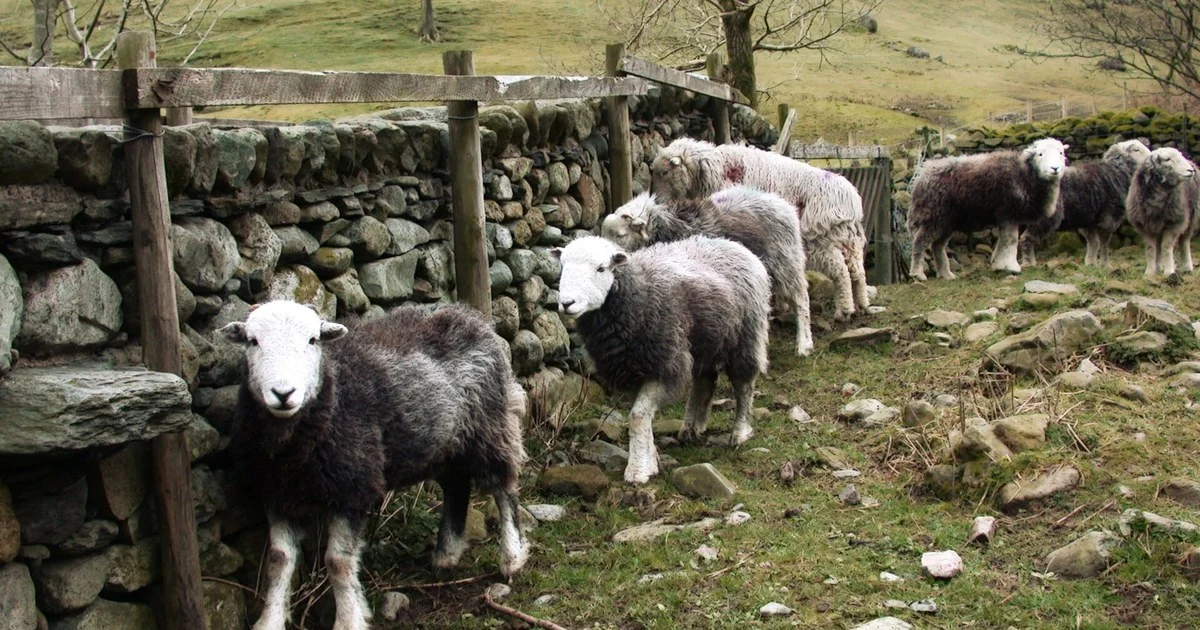
- Herdwick (Lake District, England): hardy hill breed with a white face and grey fleece
- Jacob (England): piebald, often multi-horned breed popular with smallholders
- Kerry Hill (Powys, Wales): white face with black ear, eye and nose markings
- Leicester Longwool (Leicestershire, England): rare longwool, now on the RBST priority list
- Llanwenog (Teifi valley, Wales): black-faced maternal breed
- Lleyn (Llyn Peninsula, Wales): white-faced maternal breed for self-replacing flocks
- Lonk (Pennines, England): large black and white faced hill breed
- Manx Loaghtan (Isle of Man): brown, multi-horned rare breed, now on the RBST priority list
- North Country Cheviot (Caithness and Sutherland, Scotland): larger white-faced hill and upland breed
- North Ronaldsay (Orkney): small primitive breed that lives largely on seaweed
- Portland (Isle of Portland, Dorset): small primitive breed with a tan face and spiral horns on rams
- Romney (Romney Marsh, Kent): longwool lowland breed suited to wet ground
- Rough Fell (Cumbria, England): horned hill breed with a black and white face
- Ryeland (Herefordshire, England): small, polled breed popular with smallholders
- Scottish Blackface (Scotland): the most common hill breed in the UK
- Shetland (Shetland): small breed known for fine wool in many colours
- Shropshire (Shropshire, England): down breed, often used for grazing under trees
- Soay (St Kilda, Scotland): small primitive breed that sheds its fleece naturally
- Southdown (South Downs, England): small down breed used as a terminal sire
- Suffolk (Suffolk, England): black-faced terminal sire
- Swaledale (Yorkshire Dales, England): horned hill breed, the mother of the North of England Mule
- Teeswater (Teesdale, England): longwool crossing sire
- Texel (Netherlands, widely bred in the UK): the UK’s leading terminal sire
- Welsh Mountain (Wales): small, hardy hill breed
- Wensleydale (Yorkshire, England): large longwool with a lustrous fleece
- Whitefaced Woodland (Pennines, England): large horned hill breed
- Wiltshire Horn (Wiltshire, England): wool-shedding breed
Frequently Asked Questions
How many sheep breeds are there in the UK?
The National Sheep Association counts around 90 sheep breeds and crosses in the UK.
What is the most common sheep breed in the UK?
The Scottish Blackface has long been the most numerous pure breed, although its numbers fell 36% between 2012 and 2020. The Mule is the most common crossbred ewe, and the Texel is the most used terminal sire.
What is a Mule sheep?
A Mule is a crossbred ewe from a Bluefaced Leicester ram on a hill ewe. A North of England Mule comes from a Swaledale ewe, a Scotch Mule from a Scottish Blackface and a Welsh Mule from a Welsh hill ewe.
What is a terminal sire?
A terminal sire is a ram used to breed lambs for meat, with none of the lambs kept for breeding. The Texel, Suffolk, Charollais and Beltex are the main terminal sires in the UK.
Which UK sheep breeds are rare?
The Rare Breeds Survival Trust’s 2025 Watchlist put the Manx Loaghtan and Leicester Longwool in its most urgent Priority category. Other rare breeds include the North Ronaldsay, Portland and Castlemilk Moorit.
BritFarmers Weekly
One email a week: what’s moved on schemes, prices, disease control and policy, with links to primary sources. Free. No sponsors. Unsubscribe anytime. Subscribe.
Source: National Sheep Association: UK sheep farming
You’ve reached the end of this story.