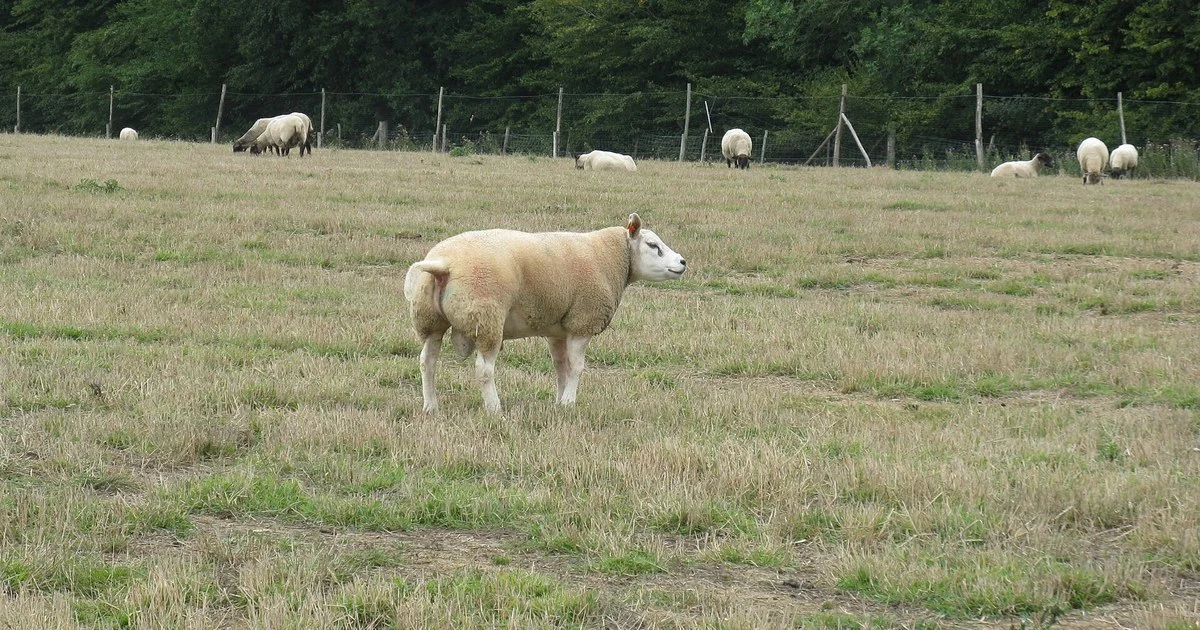
Cover photo: Dave Spicer (CC BY-SA 2.0, cropped) · Source
Texel sheep explained: Dutch origin, UK imports from 1970, muscling and carcass, Texel rams as terminal sires, lambing ease and what to check when buying.
A way through this story
Texel sheep at a glance
- Origin: the island of Texel, the largest of the Wadden Islands off the north coast of the Netherlands
- UK breed society: the British Texel Sheep Society, formed in 1974
- UK arrival: four trial rams in 1970, four more in 1971, then a larger import from France in 1973
- Type: white-faced, polled, heavily muscled terminal sire
- Mature weight: British rams up to about 120 kg, ewes up to about 85 kg
- Fleece: usually 3.5 to 5.5 kg, averaging about 32 microns
- Market position: 27% of the UK ram market in the 2020 British sheep breed survey
From a Dutch island to Lanarkshire
The breed takes its name from Texel, the biggest of the Wadden Islands. The native island sheep were long-legged marsh types, and from the early 1800s Dutch breeders crossed them with British longwools including the Border Leicester, Leicester Longwool, Lincoln and Wensleydale. A Dutch society was set up in North Holland in 1909, with the first type description following in 1911. Texels reached France around 1933.
Britain came late. The British Texel Sheep Society records that the Animal Breeding Research Organisation imported four rams for experimental work in 1970 and another four in 1971. In 1973, thirteen Lanarkshire breeders joined with the research body to bring in 27 females and 13 rams from France. The society followed in 1974, and British breeders have since selected for size, so the British Texel is larger and heavier than the original Dutch stock.
Appearance and conformation
A Texel is a blocky, white-faced, hornless sheep with a short, wide head, a black nose and black feet. The body is deep and wide with heavy muscling over the back, loin and gigot, and the breed often shows extreme muscle development. Researchers have linked that muscling to a mutation in the myostatin gene, which normally limits muscle growth.
The fleece is dense and medium in quality. Typical figures are a staple length of 8 to 15 cm and a fibre diameter of about 32 microns. Wool is a minor part of the breed’s value; the carcass is what pays.
Carcass and performance
Texel lambs are known for lean meat yield and good conformation. The society promotes faster-growing lambs with better killing-out percentages, and its own figures say 85% of Texel lambs grade in specification. It also claims high-index Texel rams add around £690 to the value of their commercial progeny over the ram’s working life. Treat both as breed society figures, but they explain why buyers pay for recorded rams.
The leaner carcass suits processors paying on grid, where overfat and poorly conformed lambs lose money. Lambs can be finished off grass, forage crops or concentrate, and the breed holds conformation at lighter weights better than many longer-framed sires.
Texel rams in UK flocks
Most Texel rams in the UK work as terminal sires. Put over Mule, Welsh or hill crossbred ewes, they produce prime lambs with more muscle than the ewe alone would give. The society says Texel genetics are found on nearly 18,000 farms, making it the second most widespread breed nationally.
The breed also matters on the maternal side. Texel-cross ewes, often kept back from Texel x Mule lambs, are common replacements in lowland flocks, and the society estimates around 1.6 million crossbred ewes carry Texel genetics, more than 12% of the national ewe flock. A Texel-cross ewe tends to carry more muscle and leaves a better lamb from a terminal sire, though she may be less prolific than a pure Mule.
For tup ratios, tupping dates and ewe lamb management, see our guide to sheep breeding in the UK.
Lambing ease: the known weakness
Heavy muscling has a cost at lambing. A Scottish study by Dwyer and Bunger, published in Preventive Veterinary Medicine in 2012, found that 55.7% of purebred Texel lambs needed help at birth, against 30.7% of Suffolk lambs, 22.7% of Blackface and 24.9% of Mule-cross lambs. Texel and Suffolk lambs also had higher rates of malpresentation.
On hill farms in Northern Ireland, a 2009 study in the journal Animal found more ewes had difficult births when put to Texel sires than to Lleyn, Swaledale or Blackface sires, mainly because Texel-sired lambs were heavier at birth.
The practical answer is ram selection. Check recorded figures for lambing ease and birth weight where they are available, avoid very heavy-shouldered rams on small or young ewes, and keep body condition in check in late pregnancy so lambs are not oversized. Our sheep gestation calculator helps you plan supervision around the due dates.
Record prices
Texel rams hold the UK record for a sheep sold at auction. Sportsmans Double Diamond, a ram lamb, made 350,000 guineas (£367,500) at the Scottish National Texel Sale in Lanark in 2020. The previous record, Deveronvale Perfection, sold for 220,000 guineas (£231,000) at Lanark in 2009.
These are exceptional pedigree sales between breeders and say nothing about the price of a working commercial tup, which is a fraction of that.
Pros and cons of Texel sheep
- Strong muscling and good conformation for grid-based lamb sales
- Lambs hold conformation at lighter weights
- Large pedigree base with a recorded, indexed ram supply
- Texel-cross ewes make useful replacements
- Higher rate of assisted lambing, especially in purebred flocks
- Lambs can be slow to get up and suck after a hard birth
- Pure Texel ewes are less prolific than many crossbred ewes
Buying a Texel ram
The society and its 18 regional clubs sell around 8,500 breeding rams a year through 35 sales, so there is plenty of choice. When buying a tup:
- Ask for performance records and estimated breeding values, and match them to your system
- Check feet, teeth, testicles and legs before anything else
- Buy from flocks with a known health status and ask about the vendor’s health scheme membership
- Quarantine new rams on arrival and agree a treatment plan with your vet
- Give rams time to settle well before the tups go in; our sheep tupping season guide covers timing
Frequently Asked Questions
What is a Texel sheep used for?
Mainly as a terminal sire to produce well-muscled prime lambs. Texel-cross ewes are also widely kept as breeding ewes in lowland flocks.
Where do Texel sheep come from?
From the island of Texel off the north coast of the Netherlands. The first animals reached Britain in 1970, and the British Texel Sheep Society was formed in 1974.
How big is a Texel ram?
British Texel rams reach up to about 120 kg and ewes up to about 85 kg. The British type is larger than the original Dutch Texel.
Are Texel sheep hard to lamb?
They need more help than many breeds. A 2012 study found 55.7% of purebred Texel lambs were assisted at birth. Choosing rams with good lambing ease figures and managing ewe condition helps.
What is the most expensive Texel sheep?
Sportsmans Double Diamond, a ram lamb sold for 350,000 guineas (£367,500) at Lanark in 2020, which is the UK record price for a sheep.
BritFarmers Weekly
One email a week: what’s moved on schemes, prices, disease control and policy, with links to primary sources. Free. No sponsors. Unsubscribe anytime. Subscribe.
Source: British Texel Sheep Society
You’ve reached the end of this story.