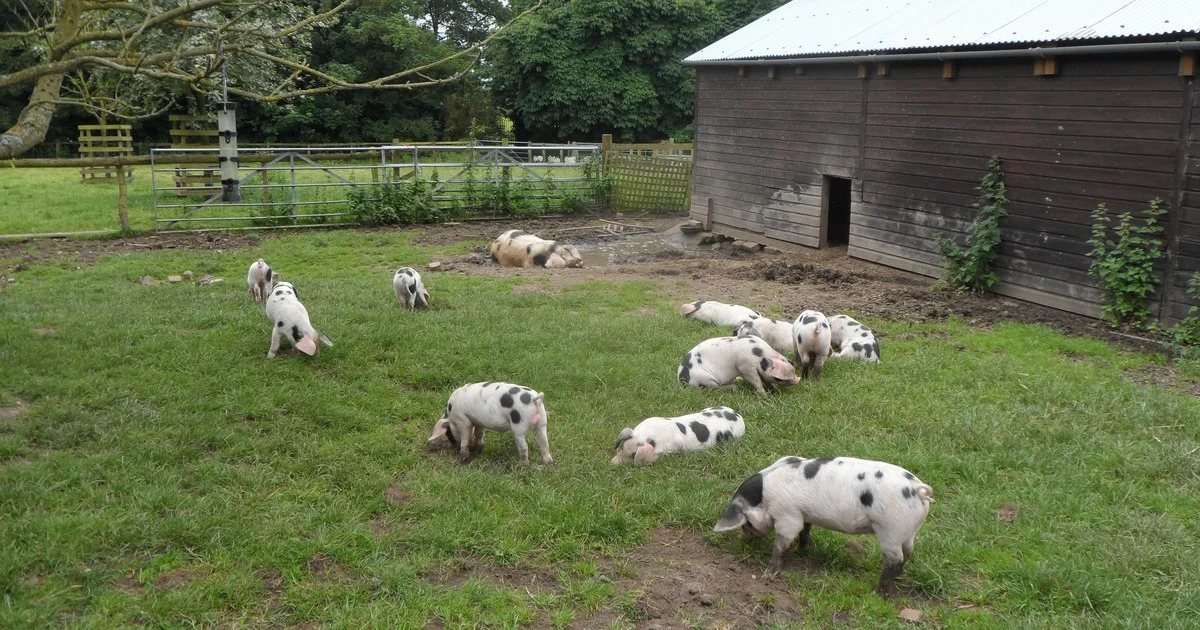
Cover photo: Anthony Parkes (CC BY-SA 2.0, cropped) · Source
Gloucester Old Spot pigs explained: history, breed standard, size, TSG pork rules, rearing outdoors, the law for pig keepers in England and buying tips.
A way through this story
Gloucester Old Spot pigs at a glance
- Full name: the Gloucestershire Old Spots, also called the Gloucester Old Spot, the Old Spot, the Orchard Pig and the Cottager’s Pig
- Type: a large, traditional dual-purpose pig for pork and bacon, suited to outdoor and non-intensive systems
- Colour: white with at least one clear black spot on black skin, and lop ears that almost cover the face of a mature pig
- Size: the RBST gives typical weights of about 280 kg for sows and 350 kg for boars
- Breed society: formed in 1913, which makes the GOS the oldest pedigree spotted pig breed in the world. The herd book is kept by the British Pig Association, and the Gloucestershire Old Spots Pig Breeders’ Club supports keepers
- Status: listed as At Risk by the Rare Breeds Survival Trust, with an estimated 424 breeding females in 2024
- Meat: “Traditionally Farmed Gloucestershire Old Spots Pork” is a protected food name with Traditional Speciality Guaranteed (TSG) status
Where the breed comes from
The Gloucester Old Spot comes from the Berkeley Vale, on the southern shore of the River Severn in Gloucestershire. According to the breeders’ club’s history of the breed, it was usually kept in the cider and perry pear orchards of the area and on dairy farms, where windfall fruit and dairy waste added to what the pigs found by grazing. Local folklore says the spots on its back are bruises from falling fruit, which is where the name Orchard Pig comes from.
Little is recorded of how the breed developed. Victorian writers such as William Youatt concluded that it came from crossing the old Gloucestershire pig, a large off-white pig with wattles on its neck, with the unimproved Berkshire, a sandy, prick-eared pig with spots.
The Gloucestershire Old Spots Breed Society was formed in 1913. Its founders called the breed “Old” Spots because the pig had been known for as long as anyone could remember. Pedigree records for pigs in the UK only began in 1885, much later than for cattle, sheep and horses, and no other pedigree spotted breed was recorded before 1913. That is why the club and the RBST describe the GOS as the oldest pedigree spotted pig breed in the world. The club also tells the story of a boar ordered and paid for by the German Kaiser in 1914, which was never sent because war broke out first.
Why the Old Spot became rare
The breeders’ club puts it plainly: the breed’s lack of suitability to intensive systems is what turned it into a rare breed for almost all of its history. It is a traditional pig suited to extensive production, not to the indoor systems that modern commercial pig farming is built on.
The RBST says the breed has survived on low numbers since the 1920s, and that pedigree numbers have been declining in recent years. Its watchlist puts the Gloucestershire Old Spot in the At Risk category, with an estimated breeding population of 424 females in 2024. The club says the biggest single factor in the breed’s revival has been growing awareness of the eating quality of its pork, but it is still rare.
Appearance and the breed standard
The breed standard is set by the British Pig Association, and the breeders’ club publishes it with notes for buyers. It describes a large white pig with at least one distinct black spot and lop ears that will almost cover the face of a mature pig. The main points are:
- Head and nose: medium length, with a slightly dished nose
- Ears: well set apart and dropping forward, not thick or coarse, and no longer than the nose
- Neck: medium length with little jowl
- Shoulders: fine but not raised
- Back: long and level, not dropping behind the shoulders
- Body: deep, well-sprung ribs, a very broad loin and deep sides, with a full, thick belly and flank
- Hams: large and well filled to the hocks, with a thick tail set well up
- Legs: straight and strong
- Coat and skin: silky, not curly, with no mane bristles, and at least one clean, decisive spot of black hair on black skin. Black should not predominate
- Underline: straight, with at least 14 sound, evenly spaced teats starting well forward
The standard lists objections too. A rose (a swirl in the coat) disqualifies a pig, sandy colour may disqualify, and a line of mane bristles, a heavy jowl, short, thick or upright ears, serious wrinkles and a blue tinge to the skin that is not part of a spot all count against it.
The club’s advice for buyers is not to worry about every point. On an eight-week-old piglet you cannot judge a heavy jowl, so concentrate on the legs, the underline (teats) and overall conformation.
Size, temperament and mothering
The GOS is a big pig. The RBST gives typical weights of about 280 kg for a sow and 350 kg for a boar. Other sources, including Wikipedia, give lower mature weights of about 227 kg for sows and 272 kg for boars, so check where any figure comes from.
The breeders’ club lists the breed’s advantages as:
- Docile, which makes it a sensible choice for first-time pig keepers and easier to handle in larger herds
- Excellent mothers: the sows are milky and good dams, and in many cases keep breeding to a greater age than many other breeds and hybrids
- Hardy, and kept in parts of the UK with extremes of temperature and weather
- Good for crossing: put to a white breed, the offspring are white and gain hybrid vigour
The RBST records an average litter size of about 9.06 piglets in 2009.
Traditionally Farmed Gloucestershire Old Spots Pork
In 2010 the breeders’ club won Traditional Speciality Guaranteed status for “Traditionally Farmed Gloucestershire Old Spots Pork”. Defra announced the protection on 18 June 2010, the EU register records it from 29 July 2010, and after Brexit it moved onto the UK register of protected food names on 31 December 2020. The RBST and the club both say it was the first breed of any species in the world to receive TSG status for its meat.
“For the Gloucestershire Old Spots breed to be the first of any species in the world to be granted TSG status throughout Europe is a significant achievement,” said Dave Overton, then president of the breeders’ club, in the Defra announcement of June 2010.
The name covers pork and products such as bacon, sausages, gammons and hams, but only when the pigs meet the product specification. The main rules are:
- The pigs must be pedigree Gloucestershire Old Spots registered as purebred by the British Pig Association or another licensed herd book
- They are fed a lower-protein ration, 15 to 18% protein, supplemented with fruit, vegetables or sugar beet pulp, so they grow at a natural rate. Backfat is expected to be 12 to 16 mm at the P2 point, against 5 to 8 mm for commercial pigs
- They reach pork weight (55 to 61 kg dead weight) at an average of 180 days and at least 160, compared with 140 to 165 days for commercial pigs
- Outdoor herds are kept at 15 to 20 sows per hectare, and growing pigs at no more than 100 per hectare, with shelter, shade and wallows, and dry ground in winter
- Indoor pigs must have daylight, ample clean bedding and no slatted floors
- Routine tail docking and teeth clipping are not allowed, and piglets are weaned at no less than 42 days, with 56 recommended
- Pigs go direct from the farm to small-scale abattoirs, and carcases are hung on the bone for three to four days
To sell under the TSG name, the club says producers apply to it first. Applicants must be members of the British Pig Association and nominate a vet to inspect their herd, and there is a £15 administration charge plus the vet’s fee, according to the club’s TSG page.
Even outside the TSG scheme, breed labelling is policed. The club publishes 2009 guidance issued to trading standards officers by LACORS, the local authorities’ coordinating body at the time. It says meat sold under a breed name should come from pigs of that breed registered with an officially recognised body such as the British Pig Association. Pork from a pedigree GOS boar crossed with a sow that is not a registered pedigree GOS, such as a commercial hybrid, should be labelled as cross-bred, for example “Cross Breed Gloucestershire Old Spot Bacon”. The simplest way to prove provenance, the club says, is to birth notify and tattoo every pig you breed and download the free BPA meat certificate. Our guide to selling direct from the farm covers the wider rules on selling meat.
Rearing Old Spots outdoors and for the freezer
The GOS is at its best outdoors. The RBST describes it as an excellent grazer whose rooting tends to be localised but not always predictable, depending on the size of the paddock, stocking density and the site. Areas with acorns, nuts and berries are usually favoured. Used carefully, that rooting can clear unwanted plants and create bare ground for regeneration.
The breed carries more fat than modern commercial pigs. The TSG specification manages the ration to avoid excessive backfat, with a lower-protein feed and fruit and vegetables as a supplement, and the club says good management produces good carcases without excessive fat cover. Our guide to fattening pigs covers growth stages, feeding, space and getting pigs to slaughter.
The breeders’ club calls the GOS an ideal starter pig, and says that with a little land and basic equipment you can start keeping pigs quite easily. Its free articles for new keepers cover the paperwork, housing, feeding and taking pigs for pork.
Rules for keeping pigs in England
Whether you keep two weaners for the freezer or a pet pig, the law treats you as a pig keeper. In England you must:
- Get a county parish holding (CPH) number from the Rural Payments Agency for the land where the pigs will live, through the GOV.UK CPH guidance
- Register with the Animal and Plant Health Agency (APHA) for a herd mark before the pigs arrive. The GOV.UK herd mark guidance says this usually takes 10 working days
- Identify pigs with an ear tag, an ear tattoo or two slap marks showing your herd mark before they leave your holding. A pig under 12 months old moving straight from its holding of birth to another farm can carry a temporary paint mark instead, according to the GOV.UK pig identification guidance
- Report movements through the electronic animal movement licensing service, eAML2: the keeper sending pigs sets up (pre-notifies) the move before the pigs leave, and the keeper receiving them confirms their arrival, as set out in the GOV.UK pig movement guidance
- Record movements in a holding register within 36 hours, and once a year record the number of pigs on the holding, under the GOV.UK holding register rules
- Follow the standstill rule: after pigs arrive, you cannot move pigs off your holding for 20 days, or cattle, sheep and goats for 6 days, unless an exemption applies, according to the GOV.UK guidance on moving pigs
Feeding rules matter for a breed with an orchard history. You must never feed pigs catering waste or kitchen scraps, including from vegetarian and vegan kitchens. The GOV.UK rules on animal by-products in feed ban it to prevent major disease outbreaks such as foot and mouth, and the GOV.UK African swine fever guidance says you can feed fruit and vegetables only if they have never been taken into a domestic or commercial kitchen or come into contact with material of animal origin. Fallen apples picked up in the orchard are a different matter from peelings from the house. If you suspect a notifiable disease, our guide to reporting a notifiable disease explains what happens next.
Scotland, Wales and Northern Ireland have their own rules.
Breeding Old Spots
The breeders’ club calls GOS sows excellent, long-lived dams. Its breeding guide gives a gestation of about three months, three weeks and three days, and says two litters a year is normal practice.
If you start with a couple of gilts, the club advises against keeping your own boar: he is expensive to keep and needs regular work. Artificial insemination is available for the breed, or you can use a boar from another herd. Check that he is not closely related to your sows using the British Pig Association’s online herd book, and that he is of a similar size.
To register piglets as pedigree, you need to be a member of the British Pig Association. Litters must be birth notified and the piglets correctly identified, especially if you want to show them or sell them for breeding. The TSG specification quotes the BPA’s rule that piglets must be birth notified and permanently ear-marked with their registered numbers by eight weeks old, or before they are mixed with other pigs.
Conservation is part of breeding a rare breed. The club says it has worked with the British Pig Association and the RBST on genebanking boar semen, and that the GOS was the first breed to have semen from 10 boars stored. It also runs a Gene Pool Distribution Fund that pays £100 towards transport costs to help spread bloodlines around the UK, if the move meets the scheme’s criteria.
Buying Gloucester Old Spot pigs
The breeders’ club keeps a map of breeders and producers, and specialist sales are listed on its website. Buying registered pedigree stock matters if you want to breed, show, or sell meat under the breed name.
On price, the club’s guide to what you should pay for a pig gives a rule of thumb of £6 a week of age, which makes an eight-week-old weaner £48 and a nine-month-old maiden gilt £216. Its guide prices for pedigree pigs, before registration costs, are:
- Weaners at 8 to 12 weeks: £40 to £70
- Maiden gilts at 6 to 12 months: £180 to £300
- In-pig gilts at 11 to 16 months: £250 to £450
- Boars at 6 to 12 months: £200 to £350
The page is not dated, so treat these as a starting point and check current prices with breeders and at sales. The club stresses that good examples of the breed, and stock from leading breeders, cost more.
When you buy:
- Look at the legs, the underline (at least 14 evenly spaced teats) and overall conformation, as the breed standard advises
- Ask for the herd book details and check the parents on the British Pig Association’s online records
- Make sure the pigs carry the seller’s herd mark, and that the move is pre-notified on eAML2
- Have your CPH number and herd mark in place, and your fencing, shelter and water ready, before the pigs arrive
Pros and cons
Pros:
- Docile and good-natured, so a sensible first pig
- Hardy and well suited to outdoor and orchard systems
- Excellent, milky mothers that often breed for longer than many other breeds
- Well-flavoured pork with protected TSG status when reared to the specification
- A rare breed, so keeping registered stock helps its conservation
Cons:
- A large pig that needs space and shelter, with wallows or shade in summer
- Slower growing than commercial hybrids, so more feed and time per pig
- Carries more fat than modern breeds, so the ration needs managing
- Rooting can damage pasture if stocking or paddock size is wrong
- Pedigree and TSG claims need registered stock and proper records
Frequently Asked Questions
Is it Gloucester Old Spot or Gloucestershire Old Spots?
Both are used. The breed’s formal name is the Gloucestershire Old Spots, and the protected meat name is Traditionally Farmed Gloucestershire Old Spots Pork. Gloucester Old Spot, Old Spot and Orchard Pig are common everyday names for the same breed.
How big do Gloucester Old Spot pigs get?
They are a large breed. The Rare Breeds Survival Trust gives typical weights of about 280 kg for sows and 350 kg for boars. Pigs reared for pork under the TSG specification reach 55 to 61 kg dead weight at about 180 days.
Are Gloucester Old Spots good for beginners?
The breeders’ club describes the breed as docile and a suitable choice for first-time pig keepers. They still need space, shelter and a controlled ration, and you must get a CPH number and herd mark before they arrive.
Are Gloucester Old Spot pigs rare?
Yes. The Rare Breeds Survival Trust lists the Gloucestershire Old Spot as At Risk, with an estimated 424 breeding females in 2024, and says pedigree numbers have been declining in recent years.
Can I feed my pigs windfall apples and kitchen scraps?
You must never feed pigs kitchen scraps or catering waste, including from vegetarian and vegan kitchens. GOV.UK guidance allows fruit and vegetables that have never been in a domestic or commercial kitchen or in contact with material of animal origin, so windfalls picked up in the orchard can be fed as a supplement to a proper pig ration.
BritFarmers Weekly
One email a week: what’s moved on schemes, prices, disease control and policy, with links to primary sources. Free. No sponsors. Unsubscribe anytime. Subscribe.
Sources
Sources checked on 3 November 2026.
- Gloucestershire Old Spots Pig Breeders’ Club: Breed History
- Gloucestershire Old Spots Pig Breeders’ Club: Breed Standard
- Gloucestershire Old Spots Pig Breeders’ Club: Breed Advantages
- Gloucestershire Old Spots Pig Breeders’ Club: Superior Meat from GOS Pigs
- Gloucestershire Old Spots Pig Breeders’ Club: Traditional Speciality Guaranteed GOS Meat
- Gloucestershire Old Spots Pig Breeders’ Club: Breeding introduction
- Gloucestershire Old Spots Pig Breeders’ Club: What Should I Pay for a Pig?
- RBST: Gloucestershire Old Spot
- GOV.UK: Traditionally Farmed Gloucestershire Old Spots Pork (protected food name)
- Defra: Traditionally Farmed Gloucestershire Old Spots Pork product specification (PDF)
- Defra press release: Gloucestershire Old Spots: Crackling good protected pork (18 June 2010)
- GOV.UK: Apply for a county parish holding (CPH) number
- GOV.UK: Register livestock to get a flock or herd mark
- GOV.UK: Tag, tattoo or slap mark pigs
- GOV.UK: Report pig movements
- GOV.UK: Pig keepers: how to keep a holding register
- GOV.UK: Moving pigs: what keepers need to know
- GOV.UK: Supplying and using animal by-products as farm animal feed
- GOV.UK: African swine fever: how to spot and report the disease
- Wikipedia: Gloucestershire Old Spots
You’ve reached the end of this story.