Cover photo: Caroline Ford (CC BY-SA 3.0, cropped) · Source
Fattening pigs in the UK: weaner to finisher growth, pork and bacon weights, feeding rules, space, ear tags, eAML2 movements and getting pigs to slaughter.
A way through this story
Fattening pigs at a glance
Buying a few weaners in spring and finishing them for the freezer is a common way into pigs. The growing is the easy part; the work is in getting registration, feed, housing and the trip to the abattoir right.
- Register for a CPH number and herd mark.
- Feed a proper pig ration: kitchen scraps and catering waste are banned for all pigs.
- Give enough space, water at all times, bedding and something to root in.
- Decide early on pork or bacon weight, because that sets how long you keep them.
- Identify, report and record every movement, including the last one.
Before the weaners arrive: CPH number and herd mark
Anyone with day to day care of pigs is a pig keeper, even for two pigs kept a few months. GOV.UK guidance says you must:
- Apply to the Rural Payments Agency for a county parish holding (CPH) number for the land and buildings where the pigs will live.
- Register with the Animal and Plant Health Agency (APHA) for a herd mark. The moving pigs guidance says this must be done within 30 days of your pigs arriving; registration usually takes about 10 working days, so apply early.
- Register with eAML2, the electronic pig movement service.
- Keep a holding register of movements, births and deaths, plus a once-a-year count of the pigs on the holding. Records must be kept for 3 years after you stop keeping pigs.
These are the rules in England. Wales, Scotland and Northern Ireland run similar registration, identification and movement systems with their own details, so check the guidance for your nation before you buy.
Growth stages from weaner to finisher
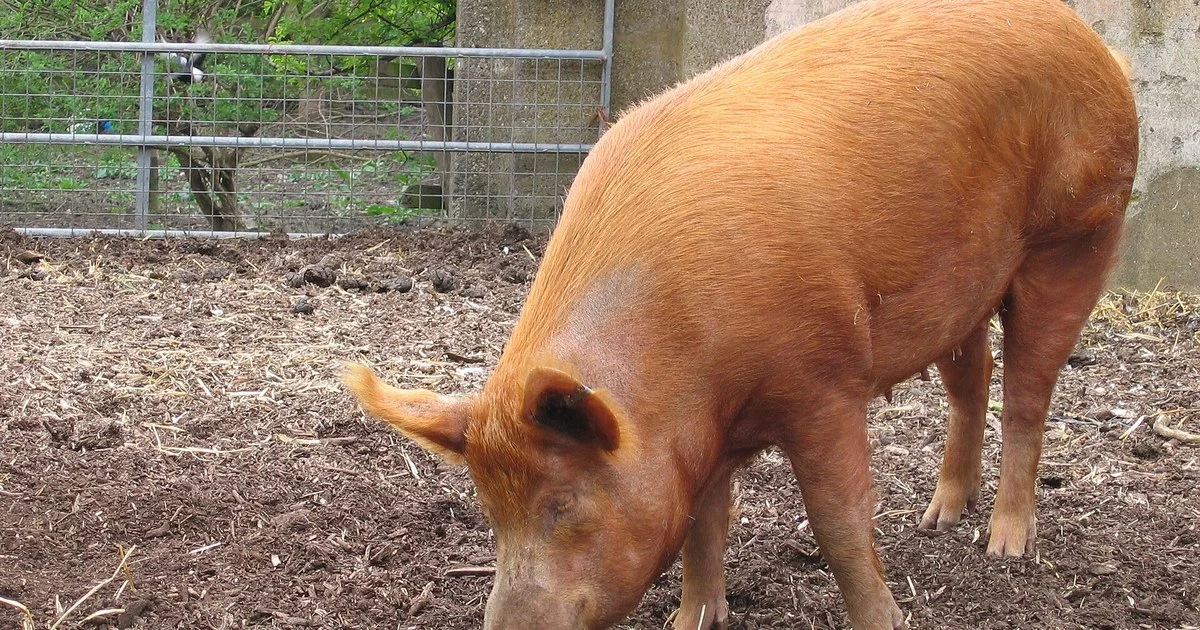
Smallholders usually buy weaners, piglets that have been weaned and are eating only solid food. The Accidental Smallholder guide puts weaning at anywhere from five to ten weeks old. From there, pigs are grown on and then finished to the weight you want:
- Porker: reared to pork weight, about 60 kg liveweight, which the same guide says is usually reached at four to six months depending on breed.
- Cutter: a pig taken between pork and bacon weight, for larger joints.
- Baconer: slaughtered at about 80 to 100 kg liveweight, at roughly eight to ten months of age on a smallholding.
Commercial pigs grow much faster. In the 12 months to March 2021, GB commercial finishing herds averaged 865 g of daily liveweight gain with a feed conversion ratio of 2.72, and carcases averaged 90 kg, according to the levy board’s herd costings. Traditional breeds grow more slowly and lay down fat earlier, which is why many smallholders finish them younger and lighter.
Feeding finishing pigs
Feed a complete commercial pig ration suited to the stage of growth, such as a grower ration followed by a finisher ration. The welfare code says all pigs need a balanced daily diet, that changes should be planned and introduced gradually, and that stale feed can grow moulds that are harmful to pigs, so keep feed stores and troughs clean.
GOV.UK guidance says you cannot feed pigs catering waste from any domestic or commercial kitchen, including vegetarian kitchens, and catering waste includes used cooking oil. You generally cannot feed pigs material of animal origin. Milk or colostrum produced on the same holding is allowed, as are certain former foodstuffs where milk or eggs are not the main ingredient. If unsure, ask APHA first.
Where pigs are fed together and not ad lib, everyone must be able to eat at once. The welfare code suggests trough space of about 20 cm per pig at 35 kg, 23 cm at 60 kg, 28 cm at 90 kg and 30 cm at 120 kg. Pigs over two weeks old must have continuous access to fresh drinking water: the code gives 5 to 6 litres a day as a guide minimum for finishing pigs up to 100 kg, with a nipple drinker flow of 1.0 to 1.5 litres a minute, and more in hot weather.
Space and housing for fattening pigs
The welfare regulations set minimum unobstructed floor areas for groups of growing pigs, based on the average weight of the group:
- 0.30 square metres per pig from 20 to 30 kg
- 0.40 square metres from 30 to 50 kg
- 0.55 square metres from 50 to 85 kg
- 0.65 square metres from 85 to 110 kg
- 1.00 square metre over 110 kg
These are minimums. The code says the lying area, not counting the dunging area, should let all the pigs lie on their sides at the same time. All pigs must have permanent access to enrichment they can investigate, root in and chew, and the code names straw and hay as the best materials. A football or chain on its own is not acceptable.
Finishing pigs outdoors
Many smallholders finish pigs outside in paddocks or woodland. The law requires pigs kept outside to have protection from bad weather, predators and health risks, and access to a well-drained lying area at all times. The welfare code adds:
- Free-draining soils in lower rainfall areas suit outdoor pigs best.
- Arcs and huts need bedding suited to the season and a warm, draught-free lying area.
- Pigs need shelter from sunburn, such as shade or wallows, and enough water for wallows as well as drinking.
- Electric fencing should give no more than momentary discomfort, and power units must be properly earthed.
- Plan for frozen water supplies and feeding in snow or heavy rain.
Ear tags, slap marks and movement reporting
Pigs must be identified with your herd mark before they leave your holding, even if they already carry another keeper’s tag. GOV.UK guidance allows any of:
- an ear tag in either ear
- a tattoo on either ear
- two slap marks, one on each front shoulder
Within Great Britain, tags and tattoos start with UK followed by your six-character herd mark, for example UK AB1234. Tags must be tamper resistant and heat resistant so they survive carcase processing. A pig under 12 months moving from its holding of birth directly to another farm can carry a temporary paint mark instead.
Every movement has to be pre-notified on eAML2 before the pigs move, and the movement document must travel with them. The sending keeper must confirm the move within 24 hours of the pigs leaving, and the receiving keeper confirms arrival. When pigs arrive on your holding, the standstill rule means no pigs can move off for 20 days and no cattle, sheep or goats for 6 days, unless an exemption applies, such as moving pigs direct to slaughter.
Getting pigs to slaughter
Book the abattoir well ahead and ask what they need from you. Then:
- Make sure each pig is identified with your herd mark, usually by slap marks or ear tags.
- Pre-notify the move to the slaughterhouse on eAML2 and print the movement document.
- Complete the food chain information form. The welfare code says it covers the pigs’ health and confirms that withdrawal periods have been met for any treated pigs.
- Only send pigs that are fit for the journey. Pigs that cannot walk without pain, or have a severe open wound or prolapse, are unfit to transport. Ask your vet if in doubt.
- Load calmly with pig boards: the code says pigs must not be struck or kicked.
The Accidental Smallholder guide puts the killing out percentage for pigs at about 72% to 74%, so a 90 kg pig gives a carcase of roughly 65 to 67 kg. Without a scale, it offers a weight tape formula: girth times girth times length, in inches, divided by 400 gives liveweight in pounds, or divided by 880 gives kilograms.
Welfare code and health
The code of practice for the welfare of pigs explains how to meet the Animal Welfare Act 2006 and the Welfare of Farmed Animals (England) Regulations 2007. GOV.UK says everyone looking after pigs must read, understand and have access to it. The code is not law in itself, but not following it can be used as evidence in court.
Check pigs daily for lameness, tail or ear biting, scouring, coughing or poor appetite, and agree a simple health plan with your vet. You must report any suspicion of a notifiable disease, such as African swine fever, to APHA straight away.
Frequently Asked Questions
How long does it take to fatten a pig?
On a smallholding, pigs usually reach pork weight of about 60 kg at four to six months and bacon weight of 80 to 100 kg at around eight to ten months. Commercial hybrids grow faster.
What should I feed pigs to fatten them, and can they have leftovers?
A complete commercial pig ration matched to the stage of growth, with constant access to clean water. Leftovers are out: it is illegal to feed pigs catering waste or kitchen scraps, even from a vegetarian kitchen.
How much space does a finishing pig need?
The legal minimum unobstructed floor area is 0.55 square metres per pig for groups averaging 50 to 85 kg and 0.65 square metres for 85 to 110 kg.
Do I need a CPH number to keep two pigs?
Yes. Anyone keeping pigs, even as pets or for a few months, needs a CPH number from the Rural Payments Agency and a herd mark from APHA, and must report movements on eAML2.
BritFarmers Weekly
One email a week: what’s moved on schemes, prices, disease control and policy, with links to primary sources. Free. No sponsors. Unsubscribe anytime. Subscribe.
Source: GOV.UK: Moving pigs, what keepers need to know
You’ve reached the end of this story.