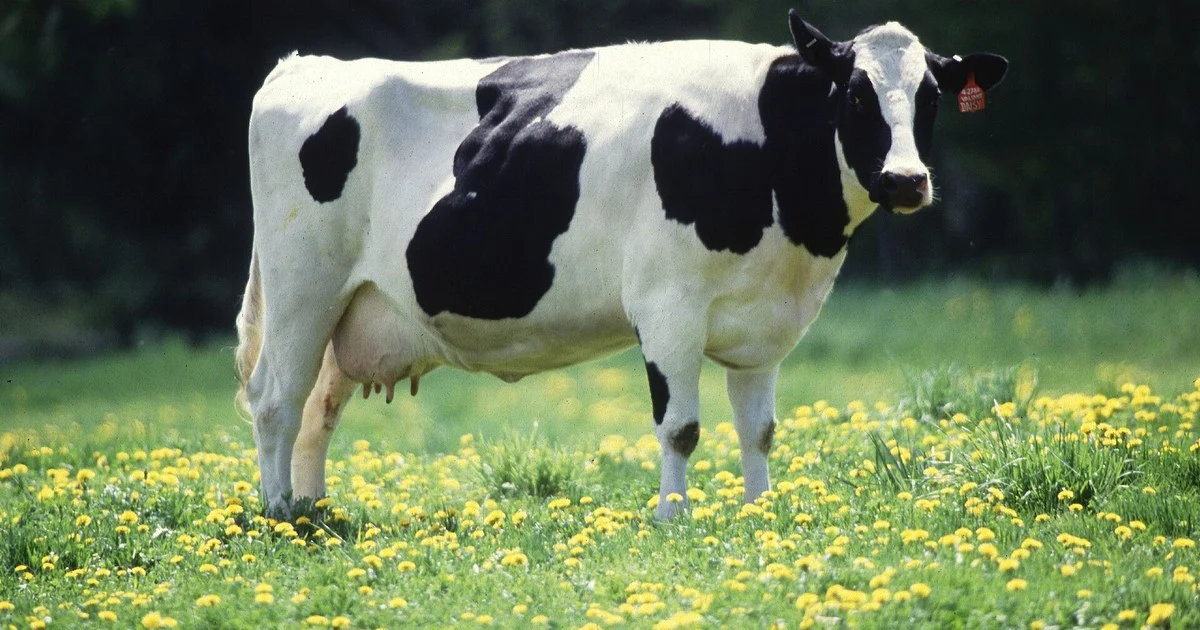
Cover photo: Keith Weller/USDA (Public domain, cropped) · Source
Holstein Friesian cows explained: Holstein vs Friesian, history in the UK, size, breeding, bull calves, pros and cons, and what to check before you buy.
A way through this story
Holstein Friesian cows at a glance
- Type: specialist dairy breed, the black and white cow seen on most UK dairy farms
- Origin: the North Sea coast, from North Holland to Schleswig-Holstein, with the modern Holstein developed in North America
- Breed society: Holstein UK, formed when the British Friesian and British Holstein herd books merged in 1999
- Colours: black and white is usual, with red and white also registered
- Size: mature cows weigh about 680 to 770 kg and stand 145 to 165 cm at the shoulder
- Calves: around 40 to 50 kg at birth
- Breeding: heifers are usually served at 15 to 21 months, with the aim of a calf each year
- Lactation: a standard lactation is recorded over about 305 days
Holstein vs Friesian: what is the difference?
Both types share the same roots in the black and white cattle of Friesland and North Holland, which is why the names are so often run together. The split came when the cattle were taken to North America. Breeders there selected hard for milk yield, producing a taller, more angular cow. That North American type is what people mean by a Holstein.
In Europe, and in Britain, the original Friesian kept more of a dual-purpose shape: a smaller, stockier, fleshier cow, bred to graze, to last and to give a bull calf with some value for beef. The British Friesian breeders’ own history describes their cow as pre-eminently a grazing animal with proven longevity and high fat and protein levels.
Most black and white cows in UK herds today carry a lot of Holstein blood, so in practice Holstein Friesian, or just Holstein, covers the national herd. The pure British Friesian survives as a distinct type. Within the Holstein UK herd book, an animal reaching 87.5% British Friesian breeding is registered as British Friesian under breed code 20, and the breed has its own classification scheme with a minimum height of 140 cm for Excellent, judged on Friesian character rather than dairy character.
History of black and white cattle in Britain
Holstein UK records that black and white cattle came into the east coast ports of England and Scotland from the Low Countries during the 19th century, until live imports were stopped in 1892 over foot and mouth disease. The British Holstein Cattle Society was formed in 1909. It became Holstein-Friesian in 1914 and the British Friesian Cattle Society in 1918, the name it kept for 70 years.
Imports of bulls descended from the Dutch bull Ceres in 1914, and from South Africa in 1922, built up the British Friesian as a long-living dairy cow. A Dutch importation in 1936 brought in a more dual-purpose type.
North American Holsteins arrived in the years immediately after the Second World War, when around 2,000 in-calf heifers plus a few bulls and cows were brought in from Canada, and the British Canadian Holstein-Friesian Association was formed in 1946. The two herd books finally merged in 1999 to create what is now Holstein UK.
Size, appearance and performance
The Holstein is a big cow. Mature cows typically weigh 680 to 770 kg and stand 145 to 165 cm at the shoulder, with a long, angular frame and a large udder. Coat pattern is piebald, mostly black and white. Red and white Holsteins are a recognised colour variant.
Holsteins are chosen for yield. They give more milk per cow than any other common dairy breed, though at lower fat and protein percentages than Jerseys or other Channel Island cattle. Yield depends heavily on the system: a housed, high-input herd milking three times a day and a grazing herd on a spring block will get very different results from similar cows. Breeders in grazing systems often look for smaller, more fertile Holstein or British Friesian bloodlines, or crossbreed.
Breeding and calving
Holstein UK’s guidance is for heifers to be mated at 15 to 21 months, with each cow calving once a year. Gestation is about nine months, and our cattle gestation calculator will give you a due date from a service date. A lactation is recorded over about 305 days, followed by a dry period before the next calving.
University of Edinburgh vets suggest bulling Holstein heifers at about 60% of adult weight, around 420 kg for an average Holstein, so they calve at 22 to 24 months. Calves are big, at 40 to 50 kg or more, which is one reason heifers are often served to an easy-calving beef or dairy sire.
By law, every calf must be identified with two ear tags, and every calf needs colostrum as soon as possible after birth to protect it against disease.
Sexed semen and the bull calf question
The male Holstein calf has long been the weak point of the breed. Pure Holstein bull calves are slow to finish and lightly muscled, so they are worth little. Many herds now get round this by using sexed dairy semen to breed replacements and beef semen on the rest. Levy board figures for the 12 months to March 2022 showed sexed semen made up 76% of all Holstein dairy semen purchases, and beef semen made up 48% of semen sales to dairy herds overall.
That shift means more of the calves leaving Holstein herds are beef crosses, often by Aberdeen Angus, British Blue or Hereford bulls, which are worth considerably more to a rearer.
Uses in UK systems
Holstein Friesians are the main breed in most UK dairy systems, from all-year-round calving housed herds to block calving herds. The taller, high-yielding Holstein suits housed systems with a carefully balanced ration. The British Friesian and the more moderate Holstein lines suit grazing and lower-input herds where cow longevity and a saleable calf matter as much as litres. Friesian and Holstein cows crossed with a beef bull also produce the dairy-bred suckler cows found on some beef farms.
Pros and cons
Pros:
- The highest milk yield per cow of the common dairy breeds
- Huge choice of genetics, with genomic and progeny-tested bulls widely available
- Easy to buy and sell, with a deep market for heifers and cows
Cons:
- Lower milk fat and protein percentages than Jerseys and other breeds
- High-yielding cows need careful nutrition and management to hold fertility and condition
- Pure Holstein bull calves have low value unless sexed or beef semen is used
- Large cows need large cubicles, wide passages and a strong handling system
Before you buy Holstein Friesian heifers or cows
- Ask for health status first: TB testing history, BVD, Johne’s and IBR status, and any vaccination records. Our guide to cattle diseases covers what to discuss with your vet.
- Check milk recording data, somatic cell count history and fertility records for cows, and the sire and dam details for heifers.
- Look at feet, legs and udders, which decide how long a cow lasts in the herd.
- Check registration with Holstein UK if pedigree status matters to you.
- Make sure passports and ear tags match, and quarantine bought-in cattle.
- Our guide to how much a cow costs in the UK covers what affects the price.
Frequently Asked Questions
What is the difference between a Holstein and a Friesian?
Both come from the same black and white stock in the Netherlands and northern Germany. The Holstein is the taller, higher-yielding type developed in North America. The Friesian is the original European type: smaller, stockier and more dual purpose, with better beef value in its calves.
How much does a Holstein Friesian cow weigh?
Mature cows usually weigh around 680 to 770 kg and stand 145 to 165 cm tall at the shoulder. Calves weigh about 40 to 50 kg at birth.
At what age are Holstein heifers bred?
Holstein UK suggests mating heifers at 15 to 21 months. Many herds aim to serve at about 60% of mature weight so heifers calve at 22 to 24 months.
Are all black and white cows Holstein Friesians?
Most black and white dairy cows in the UK are Holstein Friesians or Holsteins, but British Friesians are registered as a separate type once they reach 87.5% Friesian breeding. Black and white colouring also appears in some crossbreds.
Why are Holstein bull calves worth so little?
They are lightly muscled and slow to finish for beef. Many dairy farms now use sexed semen for replacements and beef bulls on the rest to produce more valuable calves.
BritFarmers Weekly
One email a week: what’s moved on schemes, prices, disease control and policy, with links to primary sources. Free. No sponsors. Unsubscribe anytime. Subscribe.
Source: Holstein UK
You’ve reached the end of this story.