Cover photo: Paul Gillett (CC BY-SA 2.0, cropped) · Source
UK Crop Protection — Last updated: April 2026. This guide explains the post-Brexit pesticide regime in Great Britain, the active-substance withdrawals that have hit working salad and veg holdings since 2018, the residue specs supermarkets now run, and what an IPM programme actually looks like on a working holding. It is general information, not tailored agronomy advice. See the action checklist near the end for what to do this season.
The phone call I dread comes about three days after the lorry tips. It’s the buyer’s QC team ringing to say a residue lab has flagged a sample. Most of the time it clears. Once or twice in twenty-odd years it hasn’t, and a load that left our packhouse worth thousands has been parked in a chilled bay while everyone goes through the spray diary line by line.
That conversation is the bit of UK crop protection most people outside the trade don’t see. The regulator sets the rules, the supermarket sets the spec, and the working grower sits between them with a sprayer and a spray diary trying to get a clean sample to the depot. After 21 years growing salad and field veg in Suffolk, the last two with a slice of arable in the rotation, this guide is the conversation I’ve had with our agronomist, our packhouse manager and most of the neighbours about how that works in 2026.
The active-substance cupboard has thinned every year since I came into the trade. The supermarket residue specs have tightened. The IPM programme that used to be the optional bit on the agronomy plan is now the working spec the contract relies on. If you grow anything sold on a fresh-produce spec, this is the year that reality has nowhere to hide. For the wider context on the salad and veg side, see the /uk-salad-vegetable-production-guide-2026/; on the arable end, the /uk-arable-farming-guide/; for other long-form, the /knowledge-hub/.
A way through this story
The 2026 regulatory reality: HSE, retained EU law, and divergence — UK Crop Protection
Pesticide approvals in Great Britain sit with the Health and Safety Executive’s Chemicals Regulation Division. The framework is retained EU Regulation 1107/2009 on plant protection products and assimilated Regulation 396/2005 on Maximum Residue Levels (MRLs), both carried over into UK law on 1 January 2021 with operational amendments.[1] The HSE Pesticides Register is the canonical place to check whether an active substance is approved, and any working agronomist has it bookmarked.[2]
Northern Ireland is a different regime. Under the Withdrawal Agreement and what’s now the Windsor Framework, EU plant protection product law continues to apply in NI.[1] If you farm across the Irish Sea, you’re working two sets of rules.
Five years on from Brexit, divergence between GB and EU approvals is real but slow. GB has held some authorisations the EU has dropped, and the other way round on a smaller list. The gap that matters most for fresh produce is glyphosate pre-harvest use: the EU banned that application in 2023; GB has so far kept it.[3] On MRLs the GB and EU registers were essentially identical at the point of departure and have drifted apart over particular actives since.[4] If you export, the import country’s MRL is the binding line, not GB’s.
Active substance withdrawals since 2018: what actually went
The neonicotinoids are the headline. Outdoor use of clothianidin, thiamethoxam and imidacloprid was banned in 2018: authorisations for sale ended on 19 September 2018; storage and use of existing stocks ended on 19 December 2018.[5] Outdoor neonics have been off the list since.
The story didn’t end there. The sugar beet sector applied annually for emergency authorisation of Cruiser SB, the thiamethoxam seed treatment, to control aphids transmitting virus yellows. Authorisations were granted from 2021 to 2024. In January 2025 the Minister refused the application for the 2025 crop, the first refusal in five years, and the same refusal stood in 2026.[6] Sugar beet is now a fully neonic-free crop in GB, with the disease pressure that implies in a bad aphid year.
Oilseed rape took the bigger hit, earlier. Neonicotinoid seed treatments came off OSR in December 2013. The crop area dropped from 756,000 hectares in 2012 to 307,000 hectares in 2021, the lowest planting since 1989, with cabbage stem flea beetle (CSFB) cited as the principal driver and pyrethroid resistance on top.[7] On our two recent arable seasons we’ve watched the neighbours stay out of OSR for exactly this reason. The crop hasn’t disappeared but it’s a riskier proposition than it was when I came into the trade.
Chlorothalonil was the second big loss. The non-renewal under EU Regulation 2019/677 took effect on 20 May 2020, with the use-up window expiring on the same date.[8] Chlorothalonil had been the workhorse multi-site fungicide in cereals, asparagus, narcissus, peas and brassicas. Its replacement set is a thinner stack of triazoles, SDHIs and folpet, and the resistance management arithmetic is harder than it used to be.
Older organophosphates, dimethoate, chlorpyrifos and others have come off the GB register since 2018 as well. The HSE register lists what’s still approved; the relevant column is the “approval expiry” date, which most working growers read once a season at a minimum.[2]
Glyphosate: the renewal in flight, the supermarket pressure underneath
Glyphosate is the one most working farmers will be watching this autumn. The HSE extended GB approval to 15 December 2026 to allow the renewal assessment to complete.[9] The Glyphosate Renewal Group has lodged the dossier; the HSE has signalled a statutory public consultation in summer 2026 with a final decision expected in Q4 2026.[9]
GB and EU diverge sharply on pre-harvest use. The EU banned pre-harvest desiccation in 2023. GB has so far defended the use for northern, wetter regions on grain quality grounds.[3] The supermarkets, however, are running ahead of the regulator. Several major UK retailers restrict or penalise pre-harvest glyphosate residues in cereal-derived products, especially own-label oats and breakfast cereal lines. A spray decision in late August on a cereal block isn’t just a regulatory question; it’s a contract question.
For salad and veg the residue position has been stricter for longer. We don’t use glyphosate in-crop on leafy salad; we use it as a pre-drilling burndown and on stale seedbeds. Retailers report results in detail (Co-op, M&S, Morrisons and Waitrose publish; the rest do their own and don’t share).[10] The default international convention is to apply a 50% measurement-uncertainty correction before flagging an MRL exceedance, which sounds generous until you realise that residues sitting between 50% and 100% of MRL are tracked as a separate category and used in supplier scoring.[10]
What I’d say on glyphosate: assume the 2026 GB renewal goes through with conditions, the EU pre-harvest divergence holds for now, and the supermarket pressure on pre-harvest use of any chemistry is a one-way ratchet. Plan the rotation so burndowns happen in windows where the residue arithmetic works for the buyer.
IPM in practice: prevention, monitoring, intervention, evaluation
Defra’s working definition of Integrated Pest Management is the four-pillar version: prevention, monitoring, intervention and evaluation.[11] The Voluntary Initiative, the industry-led scheme that runs IPM stewardship in the UK, has been the working delivery mechanism for over two decades and runs the IPM Plan that most farm assurance schemes now ask for in some form.[12]
That sounds tidy on paper. On a working holding it looks like this.
Prevention starts with the rotation and the variety. Iceberg back on iceberg ground inside three years is asking for sclerotinia. We push for five. Every iceberg line we drill carries a Bremia (downy mildew) resistance code, and you read it the way an arable grower reads protein on a wheat sample. Hygiene between crops is part of prevention too, and on the bagged-salad line that means cleaning carryover crop debris before the next drilling, not the next morning.
Monitoring is the part that’s easiest to under-do. Sticky traps for aphids and thrips on every block, scout walks twice a week through the active growing window, weather-driven mildew forecasting alongside our own field thresholds, and a written record. The spray diary isn’t a record-keeping exercise; it’s the document that defends a £20,000 lorry of iceberg when a residue lab raises an eyebrow.
Intervention is the bit the public thinks IPM is about and it’s actually the smallest part. The principle is the right control method at the right time, with chemistry as one tool among several and not the default. Threshold-based decisions, biological agents where they work, and targeted spot sprays before whole-field passes.
Evaluation is the unglamorous fourth pillar. Read the spray diary and the residue results at the end of the season, mark which actives were borderline at intake, replace them next year. Most growers I know do this badly and pay for it.
Where I land on IPM: it’s not a marketing badge. The contract demands it now and the spec line proves whether your programme worked. Treat the agronomist as the most important hire on the farm and pay accordingly.
Biological controls: the working economics
Biologicals are the part of IPM that’s moved fastest in the last decade. On a protected crop in particular they’ve gone from optional add-on to standard practice.
Encarsia formosa, the parasitic wasp that lays its eggs in greenhouse whitefly scales, was one of the first commercial biocontrols and has been used in UK glasshouses since the 1920s.[13] Macrolophus pygmaeus, a generalist mirid bug, has been a backbone of UK protected tomato programmes for over twenty years, particularly against Tuta absoluta and whitefly.[14] Aphidoletes aphidimyza, a predatory midge, is the standard against aphids in protected lettuce, peppers and ornamentals. Predatory mites (Phytoseiulus persimilis against red spider mite, Amblyseius and Neoseiulus species against thrips) round out the catalogue.
The economics, on protected crops, work. The costs through Koppert, Bioline, Biobest and the other UK-active suppliers are real, but the alternative isn’t a cheap chemical programme any more. It’s a thin, resistance-pressured chemical programme that costs as much, fails more often, and torpedoes residue specs the buyer is now testing against.
On outdoor field veg the economics are fiddlier. Trichogramma releases against caterpillars in protected baby-leaf and brassica modules work; full outdoor releases on a 50-hectare block of cabbage are harder to justify. Aphidius parasitoids against aphids on outdoor lettuce can work if the temperature window is right; if it isn’t, you’ve spent money on a release that didn’t establish.
The contracting-versus-DIY question splits the trade. Most working salad holdings buy the agents in from a supplier and release through their own staff; a few specialist sites contract a full IPM service in. The tipping point is the size of the protected area and whether the holding has a competent staff member who can run the release programme and the monitoring without it slipping in a busy August week. If it slips, the spend is wasted.
Looking back, the single biggest mistake we made on biologicals was treating them as a chemistry alternative rather than as a programme. The release schedule is its own discipline. Build it on its own calendar, not as the gap-filler when the spray cupboard is short.
Cultural controls: the cheapest tool in the IPM box
The active-substance cupboard has thinned every year. The cultural-controls cupboard hasn’t. If anything it’s gained ground.
Rotation is the first. Five years between iceberg crops, four between brassicas, three between alliums. On the arable end the same logic applies in different units: a second-year wheat carries more septoria pressure than a first wheat, a third-year cereal a lot more again. Rotation length is a working agronomy decision, not a tidying-up exercise.
Varietal resistance is the second. The disease that drives the iceberg catalogue is Bremia lactucae, downy mildew. The International Bremia Evaluation Board recognised race 41 in July 2024, with several earlier races (38, 39, 40) already in circulation, and the breeders update the resistance package most years.[15] Pick the resistance code first, the field type and slot date second, the head shape and bag-line characteristics third. A variety that yields more but gives away the mildew programme will lose you the field one wet August in five.
Sanitation between crops is the third. Pull the stale debris, top off volunteers in the rotation field, clean the irrigation lines, sterilise modules between propagation runs. None of it is glamorous and all of it shows up in the disease pressure of the next crop.
Trap cropping and sterile-trap cropping are the fourth, and on field veg they’re underused. A border row of a more attractive host can pull beetle pressure off the main crop; on a CSFB-pressed OSR block, companion plants and straw mulch have shown measurable reductions in adult feeding damage in published trials.[16] None of these are silver bullets. They’re tools.
What I’d actually do: sit down with the agronomist over the rotation map before next year’s planting plan and write down which blocks are carrying a soil legacy you don’t want. Plan the break crop accordingly. The SFI 2026 actions pay for some of this work where it overlaps with environmental management; see /sfi-2026-actions-payment-rates-explained/ for what’s on the table.
Sector pressures: salad and veg, then the arable end
The pest and disease set differs by sector. Salad and veg first, because that’s the sector I’ve grown longest in.
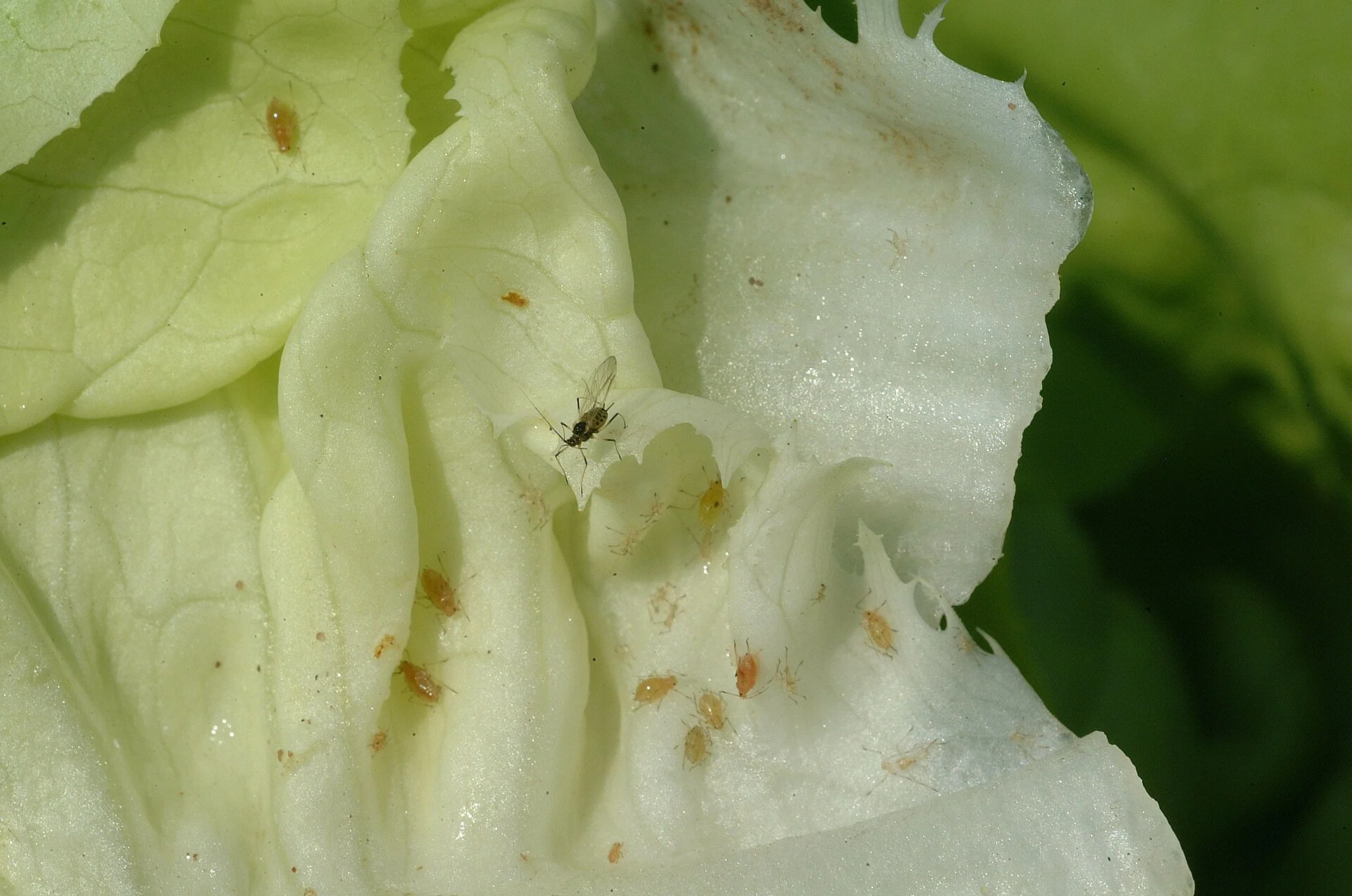
Downy mildew (Bremia) drives the iceberg variety catalogue. Aphids, currant-lettuce aphid Nasonovia ribisnigri in particular, are the second pressure; the Nr-resistance gene that controlled them for a decade has been broken by some populations, particularly in protected baby-leaf, and the trade has moved to stacked-resistance varieties with harder reliance on biologicals. Sclerotinia punishes short rotations on lettuce and brassicas. Soil-borne diseases (rhizoctonia, pythium, fusarium) sit underneath the rotation question and don’t go away.
The arable end is two seasons of learning for me, so I lean on the AHDB material more than my own scars. BYDV (barley yellow dwarf virus, transmitted principally by bird cherry-oat aphid) has been the headline cereals pressure since the neonicotinoid seed treatments came off in 2018; routine pyrethroid foliar sprays went up after the withdrawal, and the resistance pressure on those sprays has gone up alongside. AHDB’s BYDV management tool, web-based and rolled out for the 2026 autumn planting, is a real step in moving the spray decision from calendar-based to risk-based.[17]
CSFB on OSR remains the constraint that’s hollowed out the crop area, with cultural control (delayed drilling, companion crops, varietal vigour) and biological options under research now the working route forward.[7][16] Virus yellows on sugar beet is the next pressure under the post-2024 neonic-free regime; vector control, varietal tolerance and crop hygiene are the working tools.[6] Fusarium head blight on wheat is the mycotoxin pressure that bites in wet harvest years; legal limits for DON and ZEA in grain for human consumption are set in retained EU law, with average GB concentrations usually well below limits but exceedances clustering in wet years.[18]
The supermarket residue audit: what Class 1 actually demands
The supermarket residue specs are the second pinch on top of the regulator. Every major UK retailer runs a residue testing programme that looks at samples drawn from the supply chain and compares the result against MRL. The default measurement-uncertainty allowance is 50%, applied as a downward correction before legal exceedance is called.[10] Most retailers track residues in the 50–100% of MRL band as a separate category and use that band in supplier scoring.
A handful of buyers run near-zero policies on specific actives, in particular on legacy chemistry the retailer’s own consumer team is anxious about. A few publish their results in detail (Co-op, M&S, Morrisons, Waitrose); the rest run the same testing privately.[10]
The practical reality is that a spray decision in mid-July is a decision about whether the lorry passes intake QC three weeks later. Spray timing, variety choice, tank mix, wash-line kinetics, even the day’s weather all feed into the residue arithmetic. A field that grows a perfectly good crop can still fail the residue line on a single ill-timed application of an active the buyer has chosen to be sensitive about. That’s why the spray diary is the document that defends the load, not a paperwork burden.
A residue fail on a lorry doesn’t usually end with the load. It triggers a follow-up audit, sometimes a hold on supply for a period, and a meeting with the buyer where the contract value is on the table. The cost of one lost lorry is small. The cost of a damaged contract is the largest line in the year’s P&L.
A note on bluetongue 3 and Schmallenberg
This guide is written from the salad and veg side. The livestock side I write from the observer perspective. I’ve watched the neighbours through the bluetongue 3 (BTV-3) outbreak that took hold across England in 2025. The whole of England has been a bluetongue restricted zone since 1 July 2025; total BTV-3 cases in GB through the 2025–26 vector season ran into the low hundreds, and BTV-3 vaccines have been in good supply through the year.[19] For an arable-only operator the question is mostly indirect (movement restrictions on contractors, kit and casual labour); for the working livestock farm it’s the year’s central biosecurity question. For the detail on biosecurity, animal-health regulation and farm-yard safety, see /uk-farm-safety-guide/.
Where this is heading: NAP 2025 and the next five years
The UK Pesticides National Action Plan 2025, published in March 2025, is the working policy document for now.[20] It’s the first NAP in a decade, a four-government plan covering Defra, Scotland, Wales and Northern Ireland, and the headline target is to reduce the potential harm of pesticides to the environment by at least 10% by 2030. The Voluntary Initiative is positioned as a principal delivery mechanism, with the IPM Plan now expected from any farm using professional pesticides.[12]
The five-year horizon has three trajectories. The active-substance cupboard keeps thinning, with the EU’s wider list of recent withdrawals likely to push GB in the same direction over time, even where the regulators arrive there in different orders. Supermarket residue specs keep tightening, especially on the actives the consumer-facing teams have decided are unwelcome. And the IPM build keeps moving from optional to mandatory, with the assurance schemes (Red Tractor, LEAF Marque, the supermarket codes) writing it harder into audit.
Crop protection sits across the seam between the HSE (regulator), Defra (policy), the Food Standards Agency (residues in food) and the supermarket buyers (de facto setter of the working spec). No single minister owns the file. That isn’t going to change quickly. If I’m honest, the divergence question is political and slow-burning; the active-substance and residue-spec questions both have short fuses and big near-term effects.
Tim’s view: what’s working, what’s broken, what working growers should know
What’s working: the IPM build, where it’s been done properly. Bagged-salad operations running biologicals and resistant varieties as the backbone, with chemistry as a targeted tool rather than the default, are clearing residue specs more comfortably than they were five years ago. The agronomy is technical, the breeding catalogue is improving, and the assurance scheme paperwork is now structured around something that resembles the work.
What’s broken: the active-substance cupboard is thinner than the practical alternatives can fully cover. CSFB on OSR, virus yellows on sugar beet, BYDV on cereals and sclerotinia on long-rotation salad are pressures the old chemistry programmes used to absorb. The replacement tools (cultural, biological, varietal) work in good seasons. In a bad one they don’t fully cover the gap, and the yield hit lands on the grower not the regulator.
What working growers should know: the spray diary is the document that defends the contract; the agronomist is the most important hire on the farm; the IPM build is the working spec, not the marketing badge. Read the HSE register at least once a season. Walk the rotation list with the agronomist before next year’s planting plan. Budget for the labour, because a real IPM programme is more labour-intensive than the chemistry-led programme it’s replacing.
A first-week checklist for a working holding
If you take nothing else from this guide, do six things this fortnight.
Pull last year’s residue test results from the buyer. Find any active that’s been on the borderline of buyer spec twice and replace it in this year’s programme.
Read the resistance code on every variety in the planting plan. If anything you’re drilling carries a downy mildew rating older than two seasons, ring the seed house and ask for an upgrade.
Take the rotation plan to the agronomist. Mark any block that’s coming up short on rotation length and decide whether a break crop or a different variety belongs there.
Build the IPM Plan to the Voluntary Initiative template if you haven’t already. Most assurance schemes ask for it; the supermarket buyers are starting to.
Cost the biologicals into the protected and field-veg budget at this year’s quoted prices. If you’re under-spending versus the chemistry it replaced, you’re under-treating.
Read the HSE Pesticides Register entry for every active in your top-ten by spend. Note the approval expiry dates. Plan the active-substance rotation in the spray programme so you’re not exposed if an expiry isn’t extended.
Sources
[1] Health and Safety Executive, Regulating pesticides in the UK after Brexit, hse.gov.uk: HSE — Brexit; Regulation (EC) No 1107/2009, retained in UK law: gov.uk — EUR 2009 1107; assimilated Regulation (EC) No 396/2005 on Maximum Residue Levels.
[2] Health and Safety Executive, Active substances approved for use in pesticides — GB Pesticide Register, hse.gov.uk: HSE — Register
[3] Health and Safety Executive, Active substance renewal: glyphosate, hse.gov.uk: HSE — Glyphosate renewal; Farmers Weekly, Glyphosate licence extended in GB until December 2026, fwi.co.uk.
[4] Health and Safety Executive, Maximum residue levels (MRLs) and import tolerances, hse.gov.uk: HSE — MRLS; GB MRL Statutory Register: gov.uk — MRLS
[5] gov.uk, Further restrictions on neonicotinoids agreed: gov.uk — Further restrictions on neonicotinoids agreed; House of Commons Library, The use of bee-killing pesticides in agriculture, briefing CDP-2023-0025: UK Parliament — Cdp 2023 0025
[6] Defra, Pesticide emergency authorisation denied for 2025 to protect bees, gov.uk: gov.uk — Pesticide emergency authorisation denied for 2025 to protect bees; Defra, Statement of reasons for the decision on the application for emergency authorisation of the use of Cruiser SB on sugar beet crops in England in 2025, gov.uk.
[7] AHDB, A review of AHDB impact assessments following the neonicotinoid seed treatment restrictions in winter oilseed rape, ahdb.org.uk; AHDB, Cabbage stem flea beetle (CSFB) and its management in oilseed rape, ahdb.org.uk: AHDB — Cabbage stem flea beetle csfb and its management in oilseed rape
[8] Commission Implementing Regulation (EU) 2019/677 of 29 April 2019 concerning the non-renewal of the approval of the active substance chlorothalonil, retained EU law: gov.uk — EUR 2019 677; Farmers Weekly, EU chlorothalonil ban ‘another hammer blow’ for growers, fwi.co.uk.
[9] Health and Safety Executive, Active substance renewal: glyphosate — GB renewal assessment and approval period extended, hse.gov.uk: HSE — Glyphosate renewal; HSE Pesticides eBulletin, Glyphosate: GB renewal assessment and approval period extension.
[10] Pesticide Action Network UK, Supermarket Ranking — residues in food, pan-uk.org: pan-uk.org — Residues in food; Waitrose, Pesticide Residue Testing Report 2020 to 2023; Red Tractor, Fresh Produce Guidance: Pesticide Residue Testing, redtractor.org.uk; HSE / FSA, UK competent authorities for pesticide residues in food: annual report for 2023, gov.uk: gov.uk — UK competent authorities for pesticide residues in food annual report for 2023
[11] gov.uk, Integrated Pest Management (IPM) in farming: gov.uk — Integrated pest management IPM in farming
[12] Voluntary Initiative, Integrated Pest Management, voluntaryinitiative.org.uk: NFU & VI IPM Plan — FAQ.
[13] University of Hertfordshire AERU, Encarsia formosa: sitem.herts.ac.uk — Reports 2228
[14] Frontiers in Ecology and Evolution, How Safe Is It to Rely on Macrolophus pygmaeus (Hemiptera: Miridae) as a Biocontrol Agent in Tomato Crops?, 2018: frontiersin.org — Full
[15] International Bremia Evaluation Board (IBEB-EU), Race nomenclature update 2024; Syngenta Vegetable Seeds, Resistance to new Bremia races: syngentavegetables.com — Syngenta extends downy mildew resistance cover all three new official races
[16] Rothamsted Research, Companion plants and straw mulch reduce cabbage stem flea beetle (Psylliodes chrysocephala) damage on oilseed rape: Rothamsted Research — Eprint 32615; Pest Management Science, Integrated pest management strategies for cabbage stem flea beetle in oilseed rape, 2022: ncbi.nlm.nih.gov — Pmc9303719
[17] AHDB, Barley yellow dwarf virus (BYDV) management tool for cereals, ahdb.org.uk: AHDB — Bydv
[18] AHDB, Fusarium mycotoxins and limits in UK grain, ahdb.org.uk: AHDB — Fusarium mycotoxins and limits in UK grain; FSA, UK Code of Good Agricultural Practice to Reduce Fusarium; assimilated Commission Regulation (EC) No 1881/2006 on maximum levels of contaminants in foodstuffs.
[19] Defra, Bluetongue: latest situation, gov.uk: gov.uk — Bluetongue latest situation; Defra, Bluetongue virus restricted zone to be extended to all of England on 1 July 2025, gov.uk: gov.uk — Bluetongue virus restricted zone to be extended to all of england on 1 july 2025
[20] Defra, UK Pesticides National Action Plan 2025: Working for a more sustainable future, gov.uk: gov.uk — UK pesticides national action plan 2025 working for a more sustainable future
About the author
Tim Harfield runs a salad and vegetable holding in Suffolk and has done for 21 years. The bulk of the work is leafy salad and field veg into the supermarket programme, with the residue lab raising the occasional eyebrow that comes with that territory. The last two seasons we’ve added a slice of arable into the rotation. The crop-protection programme on the salad end is where we’ve felt every active-ingredient withdrawal first, every supermarket spec change soonest, and every IPM rebuild hardest.
The headline: working salad and veg is the sharpest end of UK crop protection. The chemistry cupboard has thinned, the residue spec is tighter, and the IPM build is now the working spec the contract relies on. If you grow anything sold on a fresh-produce spec, treat the spray diary as the document that defends the load. BritFarmers is independent, takes no commission, and is written by working growers for working growers.
You’ve reached the end of this story.