A way through this story
Dexter cattle at a glance
- Origin: Ireland, descended from the hardy mountain cattle of the south west
- Breed society: the Dexter Cattle Society, which traces back to the Kerry and Dexter Cattle Society formed in 1892
- Size: the smallest British breed, with cows averaging around 300 to 350 kg and standing 92 to 107 cm at the shoulder
- Types: two recognised types, short-legged and non-short, of equal merit in the show ring
- Colours: black, red or dun
- Horns: horned or naturally polled
- Use: dual purpose, for beef and milk, and a common choice for suckling and conservation grazing
- Genetics: the short-legged type is linked to chondrodysplasia, the bulldog gene, and the society requires bulls to be tested before registration
Where the Dexter comes from
The Dexter originated in Ireland. According to the Dexter Cattle Society, it shares its roots with the Kerry and descends from the mostly black cattle of the early Celts. The breed is described by name in a report on Irish cattle written by David Low in 1845, which credits a Mr Dexter, agent to Lord Hawarden in County Tipperary, with creating it by selecting the best of the hardy local mountain cattle.
Dexters came to England in 1882, when Martin J. Sutton of Kidmore Grange in Oxfordshire bought ten head from a herd near Malahide, Dublin. They were first shown at the Royal Show at Norwich in 1886. By 1892 the breed was established well enough in Britain for breeders meeting at the Smithfield Club to form the Kerry and Dexter Cattle Society. The first herd book was the Royal Dublin Society’s volume of 1890, and the English society published its own first volume in 1900.
The breed has since spread well beyond Ireland and Britain, and the society says members across Europe now register over 4,000 cattle a year.
Size, types and appearance
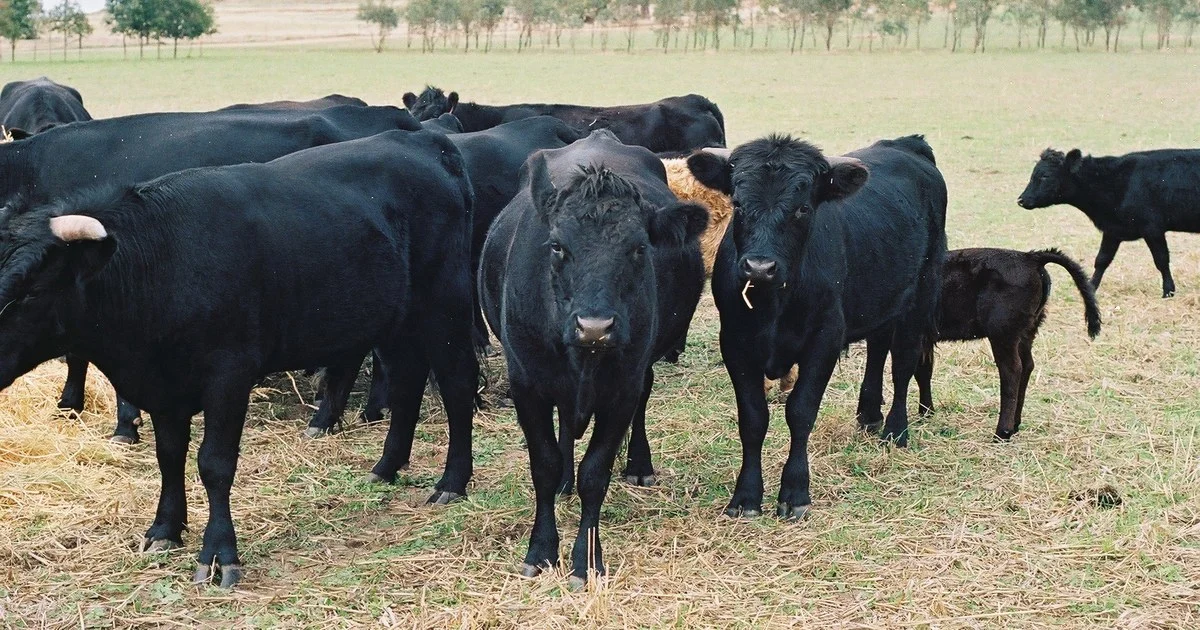
Dexters are the smallest British cattle breed. The society puts the average cow at some 300 to 350 kg, standing 92 to 107 cm at the shoulder. The breed standard measures at the rump and sets bulls at 106 to 121 cm and cows at 96 to 111 cm.
There are two recognised types. Short-legged Dexters are noticeably lower to the ground, while the non-short type has longer legs in proportion to the body. The breed standard treats them as equal but discourages extremes of either.
Colour is wholly black, wholly red or wholly dun. A little white is allowed on the udder, underline, tail tassel and reproductive organs, but none forward of the navel. Horns should be moderately thick with an inward, upward curve, and naturally polled animals are accepted. The coat grows longer and thicker in winter.
Temperament and handling
The breed standard asks for a head with a kind and placid expression, and Dexters have a reputation as a quiet breed that suits first-time keepers. Treat that as a starting point rather than a promise. A Dexter bull is still a bull, and cows with young calves can be protective.
Small size makes handling easier, but standard kit can be too big. Check that your crush, head yoke and race adjust for small cattle, and plan for horns if you buy horned stock.
Why smallholders choose Dexters
Dexters are often the first cattle a smallholder buys. They are light on the land and on fences, eat less per head than larger breeds, and the society describes them as compact, thrifty and hardy.
On the breeding side, the society says calving problems are rare, calves are up on their feet quickly, heifers mature young and can go to the bull at 15 to 18 months, and cows should breed regularly for 14 years or more. Gestation is in the normal range for cattle, so our cattle gestation calculator will give you a due date from the service date.
Mature Dexter cows can also be crossed with most native beef bulls. The society advises care with continental sires: pick a bull with an easy calving record and make sure the cow is fit, not fat, at calving.
Dexter beef and milk
As a dual-purpose breed, the Dexter is judged on both beef and dairy qualities. On the beef side, the society says steers can finish on grass at 20 to 24 months without supplementary feeding, with average carcase weights of 145 to 220 kg and a killing-out percentage of over 56%. Small, well marbled joints suit farm shops, farmers’ markets and home freezer sales, and the society holds a registered certification mark for Pedigree Dexter beef.
Milk yield depends on how the cow is kept. The society’s figures put a house cow at 8 to 10 litres a day, or about 2,450 to 3,050 litres over a 305-day lactation, and a cow managed as a dairy animal at 10 to 12 litres a day, with some individuals giving 14 litres or more. Butterfat averages well over 4% and protein around 3.5%. A Dexter suckler cow can also rear her own calf plus a larger commercial calf.
Conservation grazing
The society describes the Dexter as an ideal suckler cow for conservation grazing. Light weight and hardiness make the breed a regular sight on small reserves, orchards and wet meadows where heavier cattle would poach the ground.
On the Rare Breeds Survival Trust’s 2026-27 Watchlist, the Dexter is listed as a UK native breed in the native category, rather than the Priority or At Risk categories.
Chondrodysplasia: the bulldog gene
Some Dexters carry a gene for chondrodysplasia, a form of dwarfism that gives shorter legs. Short-legged Dexters carry one copy of the gene. A calf that inherits two copies, one from each parent, is a bulldog: a non-viable foetus with a bulging head, compressed nose, swollen tongue and very short limbs, which is usually aborted or stillborn. Mating two carriers gives a 25% chance of this outcome at each pregnancy.
Since 2001 the Dexter Cattle Society has offered a DNA hair test for the gene, through VHL Laboratories in the Netherlands, with results in about five to six weeks. Results come back as BD1-N (not a carrier), BD1-C (carrier) or BD1-A (affected). Any bull being registered must now be DNA profiled, parent verified and chondrodysplasia tested before the society issues a pedigree certificate.
The practical rule is simple: know the status of your bull and your cows, and do not put a carrier bull on carrier cows. Using a tested non-carrier bull means no bulldog calves, whatever type the cows are. Dexters can also be affected by pulmonary hypoplasia with anasarca (PHA), a separate inherited condition, so ask about it when buying and talk to your vet about any losses.
Before you buy Dexter cattle
- Ask for the chondrodysplasia status of any animal you buy, and insist on a tested bull or AI sire if you plan to breed.
- Check registration papers. Females are fully registered on a green certificate; animals that are only birth notified get a yellow one and cannot have registered offspring.
- Calves must be birth notified to the society within 45 days, and registered with BCMS within 27 days, so ask the breeder whether both have been done.
- Join the society and register a herd prefix if you want to breed and sell pedigree stock.
- Sort out a CPH number, ear tags, passports and TB testing before the cattle move. Our guide to what a cow costs in the UK covers the buying side, and our cattle diseases guide covers health checks to agree with your vet.
Frequently Asked Questions
How big do Dexter cattle get?
The Dexter Cattle Society puts the average cow at around 300 to 350 kg and 92 to 107 cm at the shoulder. The breed standard sets bulls at 106 to 121 cm at the rump and cows at 96 to 111 cm.
What is the bulldog gene in Dexter cattle?
It is the gene for chondrodysplasia, a form of dwarfism. Short-legged Dexters carry one copy. A calf with two copies is a non-viable bulldog calf, so carrier bulls should not be mated to carrier cows. The society offers a DNA test.
At what age can a Dexter heifer be bred?
The society says Dexter heifers mature young and can be put to the bull at 15 to 18 months of age, provided they are well grown.
How much milk does a Dexter cow give?
According to the society, a house cow gives about 8 to 10 litres a day and a cow kept as a dairy animal about 10 to 12 litres a day, with high butterfat and protein.
Are Dexter cattle a rare breed?
No longer. The Dexter is listed as a UK native breed on the Rare Breeds Survival Trust’s 2026-27 Watchlist, not in its Priority or At Risk categories.
BritFarmers Weekly
One email a week: what’s moved on schemes, prices, disease control and policy, with links to primary sources. Free. No sponsors. Unsubscribe anytime. Subscribe.
Source: Dexter Cattle Society
You’ve reached the end of this story.