Cover photo: Malcolm Neal (CC BY-SA 2.0, cropped) · Source
UK Farm Renewable Energy — Last updated: May 2026. This guide covers the four big farm-scale renewables (solar PV, wind, anaerobic digestion and biomass), the heat pump add-on, the grid-connection bottleneck that decides what you can actually build, the planning rules, and the SFI 2026 / Capital Grants 2026 funding picture as it stands this spring. It is general information from a working salad and arable holding in Suffolk, not engineering, planning or tax advice. Cost figures are honest 2026 ranges and should be checked against live dealer quotes before any kit is ordered.
We had a conversation around the kitchen table in late February that I suspect a lot of farms have had this winter. The electricity standing charge on the packhouse bill had ticked up again. The day-rate had not come down to anything you could call cheap. The supermarket buyer had sent us a Scope 3 questionnaire wanting our carbon numbers per kilo of iceberg by the end of the contract year. And the south slope of the implement shed roof was sitting there in the rain catching nothing.
So I rang the land agent and told him I wanted to take another proper look at the renewables question. Solar PV first, because we are in Suffolk and the irradiance figures are as good as anywhere in the country. Then everything else. I have been around the block on this once before and walked away. Five years on the numbers are different, the grants are different, the supermarket buyer is asking different questions, and the grid connection queue is the elephant in every meeting room. This guide is what I have learned this winter, written down.
A way through this story
Why this is on the agenda again in 2026 — UK Farm Renewable Energy
Three things have changed at once. The first is that wholesale electricity prices, while off the 2022 spike, have settled at a level meaningfully above the pre-2021 average. Day-ahead baseload through 2025 traded mostly between £70 and £110 per MWh on the N2EX, which translates into a working-farm import price in the 22-32p/kWh range once standing charges, network costs and supplier margin are loaded on.[1] A salad packhouse with vacuum coolers, a wash line and a cold store is not a small consumer of that.
The second is the supermarket Scope 3 angle. The big four are now requiring grower-level emissions data and pushing for verified reductions on a year-on-year basis. Tesco’s net-zero target for Scope 3 is 2050 with a 2032 milestone of a 39% absolute reduction; Sainsbury’s, Asda, Morrisons and the discounters are running similar programmes through Sedex and SBTi.[2] Generating your own electricity, displacing red diesel for heat, and getting a credible carbon line on a packhouse audit is no longer just nice to have. It is starting to show up in tender scoring. The measurement side of that is in our UK carbon farming and net zero guide.
The third is diversification income. With BPS gone, SFI 2024 paused mid-stream, and SFI 2026 reopened on a tighter footing, the on-farm income mix matters more than it did. Renewables are one of the few diversification streams where the long-term contract structure is reasonably visible, the supermarket gatekeeping doesn’t apply, and the planning regime, in 2026 at least, is moving in the right direction rather than the wrong one. Whether the maths actually clears for a given farm is the question this guide is trying to answer honestly.
Solar PV: the one most farms should look at first
Solar is the least-bad starting point for almost any holding, and on a south-facing roof with a meaningful daytime electrical load it usually pays. The two big decisions are rooftop versus ground-mount, and self-consumption versus export.
Rooftop installations on existing agricultural and packhouse buildings up to 1MW peak fall within Class A of Part 14 of the General Permitted Development Order, subject to the usual exclusions on listed buildings, conservation areas and the like. Above 1MW, full planning is required. For commercial-scale rooftop in 2026, installed costs are running in a working band of around £700 to £950 per kWp for systems above 100kW, and somewhat higher for smaller installs where the fixed costs of design, scaffolding and DNO paperwork weigh more heavily.[3] (Cost band flagged for verification — see end note.) That is for the panels, inverters, mounting, AC and DC cabling, switchgear and commissioning. It does not include battery storage, which is a separate decision.
Ground-mount on agricultural land sits in different territory. A field-scale array of 1-5MW typically lands at £600-800/kWp installed, with the lower end achieved on simple ground, no piling, no high-voltage step-up. Above 5MW you are in solar farm developer territory and the deal structure moves to long-term lease payments rather than self-build. Field rents for commercial solar leases in 2026 are commonly quoted at £800-1,200 per acre per year, index-linked, on 25-40 year terms.[4] (Lease rates flagged for verification.) That is meaningfully more than arable rent and it is contracted income, but you give up the field for the duration and the BPR position needs careful thought (see the inheritance tax interaction below).
The export question is where most growers waste energy. The Smart Export Guarantee, which replaced the Feed-in Tariff for new installations from January 2020, requires every electricity supplier with more than 150,000 customers to offer at least one tariff for exported renewable electricity. The tariff floor is set at “above zero”, which is not a useful floor. The actual SEG tariffs in spring 2026 sit in a wide band from around 3p/kWh on the worst supplier offerings to 15p/kWh and occasionally higher on time-of-use products from Octopus, Good Energy and one or two others.[5] Above 5MW, or where the export economics matter more, a Power Purchase Agreement (PPA) with a third party offers a fixed or floor-and-share price for a 5-15 year term. The trap is signing a PPA at a 2023 forward curve when 2026 wholesale is sitting higher.
The arithmetic that matters is self-consumption. Every kilowatt-hour you generate and use yourself displaces a 25-30p import unit. Every kilowatt-hour you export earns 5-10p on a typical SEG tariff. The gap is the entire economic case for solar on a working farm with a daytime load. A packhouse running coolers, fans and conveyors through a summer day from seven in the morning to seven at night will self-consume 60-80% of a properly-sized rooftop array. A grain store with a few weeks of dryer load and not much else will self-consume 15-25%. Size the array to the load, not the roof.
Battery storage changes the maths once self-consumption above 80% is on the table. Lithium-iron-phosphate batteries for commercial use are running at around £400-550/kWh installed in 2026 for systems in the 100-500kWh range.[6] (Battery cost flagged for verification.) Payback on storage on its own is hard to make. Stacking storage with a solar array, peak-shaving the day-rate import on no-sun days and (where the DNO will allow) trading on a flexibility market starts to get the simple payback into single digits in a working year. Most farms aren’t there yet. By 2027 or 2028 they probably are.
If I’m honest, the elephant in the rooftop discussion is the grid connection. We will come to it.
Wind: where it still works, and that is not many places
Wind on farms had a moment between roughly 2008 and 2015 when the Feed-in Tariff carried a working economic case for sub-50kW machines, and a separate moment for medium-scale up to 500kW under the Renewables Obligation. Both subsidy regimes are closed to new entrants. The Contract for Difference allocation rounds favour developments at scale that no working farm bids into.
Small-scale wind under 50kW and medium-scale up to 500kW now stand on Smart Export Guarantee revenue and self-consumption only, the same as solar. Installed cost is much higher per kW: around £3,500-5,000 per kW for sub-50kW machines and £2,500-3,500/kW for the 250-500kW range, which on the maths needs a high-quality wind site to clear.[7] (Wind CapEx flagged for verification.) The capacity factor of a good upland Scottish or west-coast site can be 30-35%, which makes the figures work. The capacity factor of a typical East Anglian arable site is 20-25%, which mostly does not.
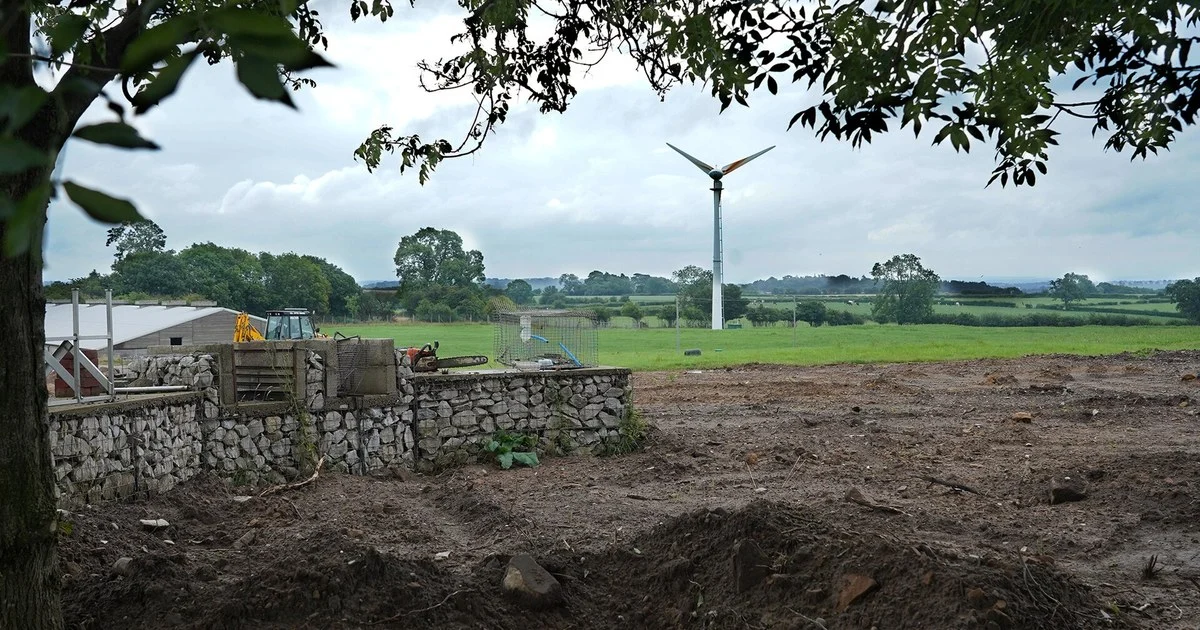
Planning is the bigger problem. The 2015 changes to footnote 49 of the National Planning Policy Framework, which required onshore wind sites to be in areas identified as suitable in the local plan and to have demonstrable community support, killed the small-scale on-farm market in England. The December 2024 NPPF revision softened the language but did not return the sector to where it was before 2015.[8] In Scotland and Wales the picture is more permissive and the resource is better, which is why most of the working medium-scale farm wind in the UK now sits in those two countries.
Wake effects on neighbouring crops are a side issue most farms underweight. A 50m turbine creates a wake zone running 8-12 rotor diameters downwind in which wind speed and turbulence vary. For arable crops the agronomic impact is real but small. For polytunnel and glasshouse sites, the structural loading from gusts and the shading need a proper assessment, not a back-of-envelope.
What I’d actually do on wind in 2026, on a Suffolk salad and arable holding, is nothing. The site is wrong, the planning regime is hard, and the capital required pays back faster on solar with batteries. If you sit on top of a hill in Caithness, the answer is different.
Anaerobic digestion: real economics at scale, not at every farm
Anaerobic digestion sits in a different category from solar and wind. It is not principally an electricity story. It is a gas story, a digestate-as-fertiliser story, and a feedstock-management story, and it works at scale or it does not work at all.
A farm-scale AD plant in 2026 typically lands in the 250kWe to 1MWe band for combined heat and power generation, or in the 250-500 m³/hr biomethane production band for grid injection. Installed CapEx is in the £4,000-7,500/kWe range for CHP plants and £6,000-10,000/kWe-equivalent for biomethane-to-grid plants once the upgrading and injection kit is included.[9] (AD CapEx flagged for verification.) On top of that, feedstock storage, digestate handling, gas cleaning and grid injection or grid connection costs typically add 20-40% to the headline build figure.
The income side has changed. The Renewable Heat Incentive, which was the backbone of biomethane economics through 2014-2021, closed to new entrants on 31 March 2021.[10] Its replacement, the Green Gas Support Scheme, supports biomethane injection into the grid through a 15-year tariff structured in three tiers based on annual output. The GGSS tariff was extended to March 2028 in the Autumn Statement 2024, with budget revisions through 2025. As of spring 2026 the tier 1 tariff stood at around 5.5-6.0 p/kWh of biomethane injected, with tier 2 and tier 3 at progressively lower rates.[11] (GGSS tariff flagged for verification.) That tariff, in combination with the wholesale gas price, is what makes a biomethane plant work. A CHP plant relies on the SEG export plus self-consumed heat, which is a much harder case to clear at farm scale.
The feedstock decision is the one that actually makes or breaks an AD project. Maize silage at scale, grown on contract within 25 miles of the plant, was the standard build through the 2010s. The 2018 reforms capped energy crop subsidy at 50% of feedstock by mass, and the public discomfort with food crops being burned for power has pushed most newer plants towards food waste, slurry and crop residues.[12] Slurry-only AD on a livestock farm is technically straightforward and financially marginal: the gas yield per tonne of slurry is low. Food-waste AD is technically harder (depackaging, contamination, pasteurisation requirements) and financially better, with gate fees from local authorities and food processors paying you to take the feedstock. Most working farm-scale AD now operates on a mix.
The digestate is genuinely valuable. PAS 110-compliant whole digestate, separated into liquor and fibre, gives you a nitrogen-rich liquid fertiliser and a soil-conditioner solid that displaces a meaningful chunk of bagged fertiliser.[13] On our holding the application has been to neighbouring arable contractors rather than our own field veg blocks (food safety protocols on leafy salad rule it out for those rotations), but for the right farm the displaced fertiliser cost adds £80-150/ha to the case.
If I’m honest, AD at sub-250kWe is mostly broken economics. AD at 500kWe to 1MWe with a credible feedstock contract and a reasonable grid injection deal is a real business with real returns, but it is a £3-8 million project and a 15-20 year commitment. Any farm thinking about an AD plant should walk through the numbers with the Anaerobic Digestion and Bioresources Association and a specialist consultant before any meaningful spend on design.
Biomass: where heat is the answer, not electricity
Biomass on farms in 2026 is essentially a heat story, and it survives because some heat loads on farms are big, year-round and currently met by oil or LPG at four to six pence per kWh equivalent.
The Renewable Heat Incentive, which made the working economic case for farm biomass boilers through the 2010s, closed to new non-domestic applications in March 2021.[10] There is no direct replacement scheme for biomass heat. What remains is the underlying displacement: a 100-200kW biomass boiler running on wood chip displaces oil at around 6-8p/kWh equivalent and replaces it with chip at around 3-4p/kWh equivalent (assuming you are buying chip, not making your own).[14] (Chip and oil prices flagged for verification.) On a heat load that runs through the year, the simple payback on installed CapEx of £80,000-150,000 for a working 150kW biomass system can land in the 6-10 year range without any subsidy.
The Biomass Suppliers List is the regulatory backbone. Any commercial biomass user buying chip or pellet wants the supplier to be BSL-listed, both for the carbon and sustainability credentials and (historically) for RHI compliance.[15] Self-supply from on-farm woodland is allowed under separate self-supply registration rules.
Chip versus pellet is the perennial decision. Chip is cheaper per delivered kWh, takes more storage volume, requires bigger fuel-handling kit (augers, walking floors), and lives or dies on moisture content (M30 chip burning hot, M50 chip choking the boiler). Pellet is more expensive, more compact, more forgiving in handling, and works for smaller loads and tighter sites. A working farm with a barn worth of chip storage and a 100kW+ heat load almost always goes chip. A horticultural office or domestic-scale heat load goes pellet.
Where biomass actually pays, and where I’d point a working farmer first, is heated glass and polytunnel sites with year-round propagation, big cold-store sites with a meaningful heat demand for offices and pack areas, and any farm with an existing oil-fired heat load over 100kW. The numbers do not work for replacing a small farmhouse boiler with biomass; for that load an air-source heat pump is now the better call.
Looking back, I’d say biomass on farms is a more boring proposition than it was in the RHI years and a more honest one. The economics now stand on the displaced fuel cost, which is real, rather than a tariff that may or may not still be there in eight years.
Heat pumps: the smaller-scale option most farms are now asking about
Air-source heat pumps for farm office, dwelling and small-scale process loads have moved from niche to mainstream over the last three years. Ground-source remains an option where the geology and the available land work, but the CapEx differential is large and the payback on the extra cost rarely justifies it on a farm site.
A working air-source heat pump for a farmhouse and office of around 30-50kW thermal capacity lands at £25,000-40,000 installed in 2026, including the unit, hot-water cylinder, controls, electrical work, and any required wet-system upgrades.[16] (Heat pump CapEx flagged for verification.) The Boiler Upgrade Scheme grant of £7,500 for air-source heat pumps replacing fossil-fuel systems remains available in England and Wales through 2028 for domestic properties.[17] The headline coefficient of performance for a well-installed modern unit on a properly insulated property is 3.0-3.5; the seasonal performance factor on a rural off-grid property with mediocre insulation is more often 2.2-2.8, which still beats oil at most market prices but does not produce the cost saving the marketing suggests.
The COP reality is the bit that catches farmers off guard. A heat pump that runs at SCOP 2.5 with electricity at 28p/kWh delivers heat at 11.2p/kWh equivalent, which is competitive with oil at 60p/litre and uncompetitive with mains gas at 7p/kWh. On a Suffolk farm off the gas grid, replacing oil, the maths usually clears. On a farm on the gas grid, it usually does not.
The grid connection problem: the elephant in every room
Anybody designing a new renewables project on a UK farm in 2026 needs to start with the Distribution Network Operator queue. Connection waits in much of the country are now multi-year. Ofgem’s December 2024 Connection Action Plan reset took effect through 2025, but the underlying pipeline was over 700GW of contracted capacity at the start of 2024 against a network that does not have the headroom.[18] In some regions, particularly East Anglia, Yorkshire and the Scottish Borders, new export connection offers above 1MW have been quoted dates in 2030, 2032 and beyond.
What this means in practice for a farm. A rooftop solar array under 11kW per phase usually connects on G98 notification with no DNO process worth the name; a system above 11kW per phase up to 50kW typically goes through G99 fast-track; above 50kW the queue starts to bite, and above 1MW it bites hard. A small-to-medium rooftop install (50-200kW) on most farms in 2026 will get a connection offer within months. A field-scale ground-mount above 1MW will not.
Two practical workarounds matter. The first is “export-limited” or “zero-export” installs, which contractually cap your export at a defined level (often zero) and avoid the queue for export capacity. For a self-consumption-led project this is fine; for an export-led project it kills the case. The second is the queue-management reform Ofgem and the ESO are running through 2025-2026 to evict speculative or non-progressing connections from the pipeline. That reform has freed up some capacity but the headline waits are still long.
The honest advice is: get the DNO budget estimate before you spend money on design. Forty days and £300 buys you a non-binding figure that tells you whether the project is two years out, five years out, or ten years out. Anybody designing a large array without that conversation is designing to a queue that may not have them.
Planning: the rules that decide what you can put up
Most farm renewables sit within permitted development rights or low-friction prior approval routes, but it depends on scale.
Solar on existing agricultural buildings up to 1MW peak is permitted development in England under Class A of Part 14 of the GPDO 2015, subject to the standard exclusions for listed buildings, conservation areas, AONBs (now National Landscapes), and Article 4 directions.[19] Above 1MW or on ground-mount, full planning is required. Wind turbines on agricultural buildings up to 11.1m total height are permitted development under the same Part 14, subject to noise and proximity restrictions; standalone turbines need full planning. AD plants, biomass installations of meaningful scale, and any associated grid infrastructure all need full planning.
Most farm building works that go alongside renewables (extensions to grain stores to fit a battery room, new switch rooms, internal modifications) sit within the Class A and Class B Part 6 agricultural rights covered in our Class Q & R permitted development guide. The key change in the 21 May 2024 amendments was the lift of the Class A ground-area limit from 1,000m² to 1,500m², which makes a serious renewables-supporting building project achievable without full planning.
A live consultation, expected to conclude through 2026, would lift the 1MW solar permitted development cap on agricultural buildings and broaden the rights for small-scale wind. Don’t bet a project on it; the consultation outcome is not the Statutory Instrument.
Funding: SFI 2026, Capital Grants 2026, SEG and GGSS
The funding picture for farm renewables in 2026 is messier than it was in the RHI era and slightly cleaner than it was during the 2024 SFI pause. There are four streams worth knowing about.
The Sustainable Farming Incentive 2026 reopened in spring 2026 on a tighter footing than the 2024 scheme, with a smaller per-action menu and a reset payment structure.[20] No SFI 2026 action pays directly for installing renewable generation, but several actions interact with renewables decisions: hedgerow and biodiversity actions are compatible with ground-mount solar where the developer agrees a biodiversity plan, and nutrient management actions interact with AD digestate use. The action menu and rates are covered in our SFI 2026 actions and payment rates guide.
Capital Grants 2026 (the successor to the 2024 round under the Farming Investment Fund) has a published menu of items including some renewable-adjacent kit: water management, slurry storage upgrades that interact with AD feedstock economics, and a small set of energy-efficiency items. The 2026 round budget and item list were published by Defra in early 2026; the fuller scope is in our UK Farming Grants Guide.
The Smart Export Guarantee remains the headline export revenue mechanism for solar, wind and AD plants below 5MW. It is not a grant; it is a regulated obligation on suppliers to offer a tariff for exported renewable electricity. The tariff is the supplier’s commercial offering; shop it.[5]
The Green Gas Support Scheme is the live tariff for biomethane injection. The 2028 closing date and the budget cap mean that any farm seriously looking at GGSS-supported biomethane needs to have applied or be in the queue by 2027 at the latest.[11]
How energy revenue interacts with diversification and inheritance tax
This is the bit a working farm should think hardest about, and the bit most rural surveyors miss in the renewables sales pitch.
A standalone solar array generating electricity for export and self-consumption sits at the trading end of the spectrum on most readings. A long-term solar lease to a developer, by contrast, looks much more like an investment activity and risks being treated as such for Business Property Relief purposes. The leading authorities on the trading-versus-investment distinction (Pawson, Vigne) have not been tested on solar leases at appellate level, but the Treasury’s December 2025 reforms to APR/BPR, capping combined relief at £2.5 million per individual at the 100% rate above April 2026, raise the stakes on the question.[21] Our Farm Inheritance Tax 2026 Guide walks through the interaction in detail.
The diversification framing matters too. A renewables income stream sits inside the wider diversification mix on most working farms, alongside Class R commercial conversions, Class Q residential conversions, on-farm retail and rural enterprise. The interaction of those streams with the farming business as a whole is the subject of our Farm Diversification 2026 working farmer guide — which is currently being drafted in parallel with this piece, so the cross-link will go live when both are published.
Where I land on this: a working farm running a self-consumption-led rooftop solar array with a packhouse load and a small SEG export does not have a BPR problem. A working farm signing a 35-year ground lease for a 50MW solar farm has a BPR question and needs to take advice before the contracts are signed.
Honest comparison: payback and £/MWh by technology
The rough numbers, for a working farm in eastern England in spring 2026, look like this on the back of an envelope. (All figures flagged for verification against current dealer quotes.)
Rooftop solar 100-500kW, self-consumption-led: simple payback of 7-10 years, lifetime levelised cost of around £55-80/MWh generated, IRR in the 8-12% range on a typical packhouse load.
Ground-mount solar at 1-5MW: simple payback of 8-12 years self-built, lifetime LCoE of £45-65/MWh, IRR 6-10% pre-storage. Lease-to-developer: contracted income of £800-1,200/acre/year, no upfront capital, but the BPR question is live.
Small wind under 50kW on a typical lowland English site: simple payback of 12-18 years on current SEG tariffs, marginal at best. Don’t bother unless your site has a measured wind speed above 6 m/s.
Medium wind 250-500kW on a high-quality upland site: simple payback of 8-12 years, viable but planning-constrained.
Farm-scale AD 500kW-1MW with a credible feedstock and GGSS tariff: simple payback of 8-12 years on a £4-8m build, IRR 8-14% on the right feedstock contract, very dependent on the gate-fee economics.
Biomass heat 150-300kW replacing oil on a year-round heat load: simple payback of 6-10 years, no subsidy needed.
Air-source heat pump on a farmhouse off the gas grid: simple payback of 8-15 years against oil, BUS grant pulls that in by 2-3 years.
What working farms typically get wrong
The first mistake is over-sizing. A solar array sized to the roof rather than the load exports most of its production at SEG rates that don’t pay it back. Size to the load, leave roof space for a future expansion, and add the second array when the load grows.
The second is ignoring the grid wait. Designing a 2MW ground-mount in a region with a 2032 connection date means the financial model is ten years out before the engineer arrives.
The third is signing 25-year PPAs at the wrong price. PPA prices struck in 2022-2023 against inflated forward curves are running below current market in 2026 and growers are stuck. A short PPA (5-7 years) with a re-pricing clause beats a long one at a low strike.
The fourth is forgetting the insurance and maintenance line. Solar and wind kit need O&M budgets of around 1-2% of CapEx per year. AD plants need 3-5%. Biomass boilers need annual cleaning and ash handling that is a real labour line, not zero.
The fifth, and the most common, is buying off a salesman rather than off a feasibility study. The salesman is selling a system. The feasibility study is figuring out whether you should buy one.
Tim’s view: what makes sense for a salad and arable holding in Suffolk
Suffolk is a high-irradiance area for the UK. Long-term mean annual horizontal irradiance figures from the Met Office and BEIS sit around 1,050-1,150 kWh/m² on the East Anglian coast, which is among the better numbers anywhere in Britain.[22] On a working salad and packhouse holding with a daytime load running from cooler season through summer harvest, rooftop solar is almost a no-brainer. The numbers on our south-facing implement shed roof, on the figures we have walked through this winter, give a simple payback inside nine years before any battery uplift, and that is at conservative assumptions.
AD I would not touch at our scale. The feedstock economics on a 250kWe plant don’t work, and we don’t have the tonnage of suitable feedstock to justify a 500kWe or larger plant on our own holding. The right structure for a farm our size, if AD is the answer, is a contributing-feedstock supplier into a neighbour’s larger plant, not a standalone build.
Wind is off the table. Lowland Suffolk capacity factors of 20-22% don’t carry the case, and the planning regime for medium-scale onshore wind in eastern England is, for now, a brick wall.
Biomass is a maybe, and only because we still run an oil-fired propagation glass on one block and the chip economics, on a five-year fuel curve, look interesting. The capital cost on the boiler and the chip handling needs running through properly before any kit is ordered.
Heat pumps will go into the farmhouse and the office at the next boiler-end-of-life, with the BUS grant. That is a domestic decision, not a farm-business decision, but it is the right decision.
Where I’d point most working salad and small arable holdings first, in 2026, is rooftop solar on every south-facing roof you can run a feasibility study on, sized to the load, with a battery upgrade penciled in for year three or four. Do that before you do anything else. Then read the SFI 2026 menu and the Capital Grants 2026 list with the renewables decision in mind, because the soil and water actions are easier to layer on once the energy strategy is in place. Then, and only then, ask the wind, AD and biomass questions.
The kitchen-table version is shorter. The grid-connection people are the bottleneck, the salesman is not the consultant, the supermarket buyer is going to keep asking, and the south slope of the implement shed roof is sitting there in the rain catching nothing. That last bit, at least, is fixable.
Sources
[1] Ofgem, Wholesale market indicators, ofgem.gov.uk; Department for Energy Security and Net Zero, Quarterly Energy Prices December 2025, gov.uk: https://www.gov.uk/government/statistics/quarterly-energy-prices-december-2025
[2] Tesco PLC, Climate Transition Plan 2024, tescoplc.com; Sainsbury’s, Plan for Better, about.sainsburys.co.uk; Science Based Targets initiative, Companies taking action, sciencebasedtargets.org.
[3] Solar Energy UK, UK Solar Stock and Deployment Update 2025, solarenergyuk.org; MCS, Installation costs and standards 2025, mcscertified.com.
[4] Strutt & Parker, Rural Land Market Review 2025; Savills, Spotlight: UK Solar Land, savills.co.uk.
[5] Ofgem, Smart Export Guarantee, ofgem.gov.uk: https://www.ofgem.gov.uk/environmental-and-social-schemes/smart-export-guarantee-seg
[6] BloombergNEF, Battery Price Survey 2025; Solar Media, UK BESS Market Report 2025.
[7] RenewableUK, Small and Medium Wind Strategy 2025, renewableuk.com; NFU Energy, On-farm wind 2024 review, nfuenergy.co.uk.
[8] Ministry of Housing, Communities and Local Government, National Planning Policy Framework, December 2024, gov.uk.
[9] Anaerobic Digestion and Bioresources Association, AD Industry Market Report 2025, adbioresources.org; Ricardo Energy & Environment, Biomethane Production Cost Review 2024, ricardo.com.
[10] Ofgem, Renewable Heat Incentive: closure, ofgem.gov.uk.
[11] Department for Energy Security and Net Zero, Green Gas Support Scheme: tariff guidance and budget update, gov.uk: https://www.gov.uk/government/publications/green-gas-support-scheme-tariffs
[12] Defra, Anaerobic digestion and crops grown for energy, gov.uk; ADBA, Feedstock policy briefing 2024.
[13] WRAP, PAS 110 specification for whole digestate, separated liquor and separated fibre, wrap.ngo.
[14] Forestry Commission, Wood fuel price index 2025, gov.uk; HETAS, Biomass installation register, hetas.co.uk.
[15] Department for Energy Security and Net Zero, Biomass Suppliers List, biomass-suppliers-list.service.gov.uk.
[16] Microgeneration Certification Scheme, Heat pump installation cost survey 2025, mcscertified.com; Energy Saving Trust, Air source heat pumps, energysavingtrust.org.uk.
[17] Department for Energy Security and Net Zero, Boiler Upgrade Scheme, gov.uk: https://www.gov.uk/apply-boiler-upgrade-scheme
[18] Ofgem, Connections Action Plan, December 2024, ofgem.gov.uk; National Energy System Operator, Connections reform technical decision, neso.energy.
[19] Town and Country Planning (General Permitted Development) (England) Order 2015, Schedule 2, Part 14, legislation.gov.uk.
[20] Defra, Sustainable Farming Incentive 2026: scheme handbook, gov.uk; Rural Payments Agency, SFI 2026 actions and payment rates, gov.uk.
[21] HM Treasury, Autumn Budget 2024; HMRC, Reforms to agricultural property relief and business property relief, gov.uk; HMRC v Pawson [2013] UKUT 050 (TCC); HMRC v PRs of Vigne [2018] UKUT 357 (TCC).
[22] Met Office, UK climate averages, metoffice.gov.uk; Department for Energy Security and Net Zero, Solar resource maps for the UK, gov.uk.
About the author
Tim Harfield runs a salad and vegetable holding in Suffolk and has done for 21 years, with two recent seasons of arable layered into the rotation. The packhouse is on site and the electricity bill is the line item that has stared back hardest from the Q4 management accounts each of the last three winters. The renewables question is one we have walked around twice before and are walking around again, and this guide is what came out of doing the work properly this time.
The headline: rooftop solar pays on most working farms with a daytime load and a south-facing roof, and the place to start. AD only stacks at scale and only with a credible feedstock contract. Wind is off the table for most of lowland England in 2026. Biomass earns its keep on year-round heat loads. And the grid-connection conversation comes before the engineer’s drawings, not after. BritFarmers is independent, takes no commission, and is written by working farmers for working farmers.
You’ve reached the end of this story.