

Last updated: May 2026. This is the water side of a working salad and veg holding written from inside the trade. It covers the Environment Agency abstraction licensing regime under the Water Resources Act 1991, the post-2003 reform of charges and trickle, the on-farm reservoir as a capital asset, irrigation method choice, ET-based scheduling, rainwater capture off glasshouse and polytunnel roofs, the Severn-Trent and Anglian abstraction-reform pressure, the climate-driven drought-permits reality, the hosepipe-ban risk for irrigated horticulture, the Capital Grants 2026 items for water infrastructure and the underrated drainage problem on heavy land. It is general information, not site-specific design or legal advice. See the action checklist at the end for what to do this season.
The first conversation I had after taking on the salad ground in Suffolk was about water. Not soil, not variety, not labour. Water. The man who’d farmed it before me sat at the kitchen table with a folder of abstraction licences and a hand-drawn map of where the boreholes were, where the surface intake on the river sat, and how the winter-fill reservoir on the bottom block had been built in the late nineties off a generous-for-the-time licence. He pushed the folder across and said: “That’s the farm. The rest is just kit and labour.” Twenty-one summers in salad and veg later, plus the two recent seasons with some arable in the rotation, and I haven’t found a better summary.
You can grow wheat in this country on rainfall in most years. You cannot grow leafy salad on rainfall in any year. Every working holding either has an abstraction licence with real headroom, a winter-fill reservoir, a borehole that won’t dry out, or it isn’t growing the crops it thinks it is. And every year of the last decade has tightened the room a grower has to operate in.
The licensing regime: what the Water Resources Act 1991 actually does
The headline statute is the Water Resources Act 1991, sections 24 to 27 and Schedule 6, which sets up the Environment Agency as the licensing authority for water abstraction and impoundment in England.[1] The basic position is that anyone abstracting more than 20 cubic metres a day from any source of supply (surface or groundwater) needs a licence. Under that figure, the abstraction is de minimis and uncontrolled, though it still has to fit the wider environmental legal framework.
There are two main classes of licence. A full abstraction licence sets a maximum quantity per hour, per day, per year, and is tied to a specific point of abstraction, a specific purpose and (since 2018) a time-limited end date. Most full licences are now issued or renewed with an end date in the 2027 to 2032 window so that the EA can match them up with the next round of Catchment Abstraction Management Strategies. A transfer licence sits over moving water from one place to another within the same catchment, typically into a reservoir.
The 20m³/day threshold catches small horticulture without much trouble. Twenty cubic metres of water is enough to drip-irrigate about a quarter of a hectare of mature iceberg on a hot summer day, or about half a hectare on the milder end of the season. Anyone running an irrigated polytunnel block of more than a few hundred square metres, or any field-veg holding above garden scale, is above the de minimis. That’s most of us in the trade.
The pre-2003 quirk that mattered for salad and veg was that trickle and drip irrigation sat in an exemption from the licensing regime altogether. You could pump unlimited volume through trickle line off a borehole without an abstraction licence. The Water Act 2003 removed that exemption with effect from 1 April 2010, requiring trickle abstractors to apply for licences for any system over the de minimis level.[2] The regime today treats trickle the same as any other irrigation method.
The practical reality of holding a licence in 2026 is that you read it the way you read a contract. Maximum daily volume. Maximum annual volume in megalitres. Hands-of-flow conditions on river licences (the EA can require you to stop pumping when river flow drops below a trigger level). Borehole licences usually carry an aquifer-level condition. New licences and renewals attach an end date.
The licence is a quantity ceiling, conditional on the wider catchment having water to spare, reviewed against the local CAMS document every six years. An existing licence with a long historic record of use is one of the most valuable pieces of paper on a salad and veg holding.
Charges, and what changed after the 2003 reforms
Abstraction charges in England are set annually by the EA under section 123 of the 1991 Act. The 2025-26 scheme charges most agricultural abstractors on a two-part tariff: a standard unit charge in pence per cubic metre of licensed annual quantity, plus an Environmental Improvement Unit Charge for some catchments. The unit charge for high-loss agricultural use (which covers most irrigation) runs in the region of 2.7 pence per cubic metre for the South and Anglian regions, lower in the wetter regions of the North.[3] On a 100 megalitre annual licence, that’s a charge of around £2,700 a year, plus the EIUC top-up where it applies.
That’s small money compared to the kit you spend it on. The Water Act 2003 and the regulations that followed standardised the high-loss/low-loss tariff structure, introduced the EIUC, set up the EA’s CAMS process and required all new licences to be time-limited. The single most important change for working horticulture was the move from a “use it or lose it” indefinite licence to a time-limited licence with a periodic review. Old indefinite licences were grandfathered, but every renewal pulls a licence into the new framework.
The value of an existing licence is now front-loaded into the years before its first end-date review. A licence with twelve years to run is a different asset from a licence with two years to run. Anyone buying land for irrigated horticulture in 2026 should ask the land agent to put licence end-dates on the front page of the particulars.
The on-farm reservoir: cost, planning, payback
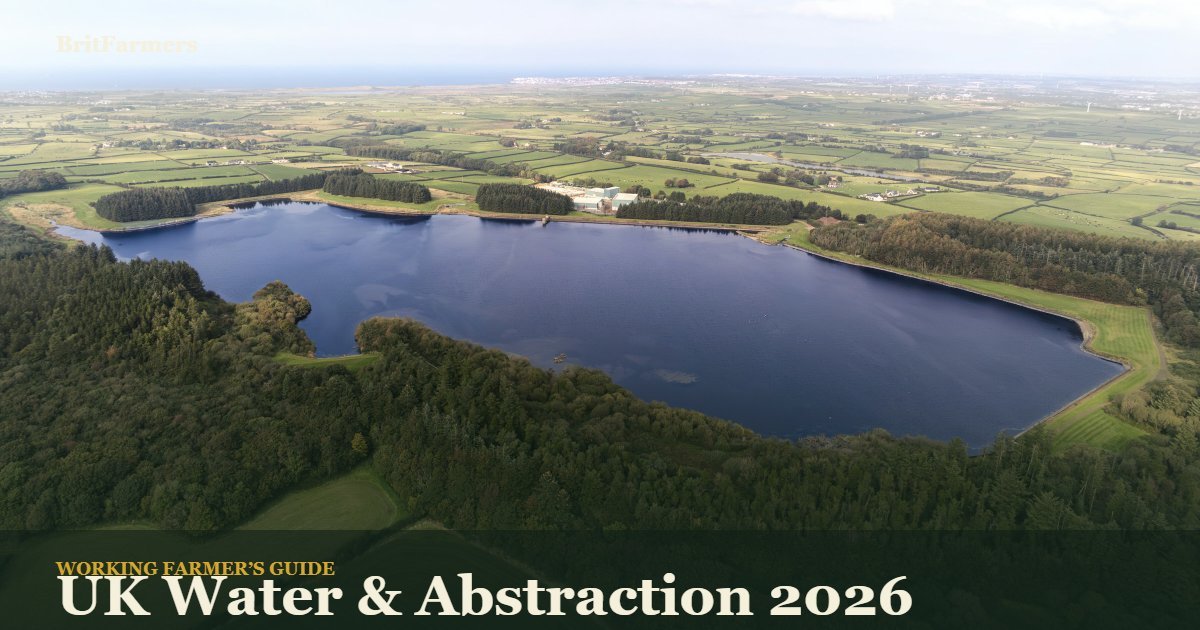
The single most important piece of capital kit on a working salad holding is the winter-fill reservoir.
The principle is simple. The EA is much more willing to issue a winter-fill licence (typically 1 November to 31 March) than a summer abstraction licence, because winter river flows have headroom that summer flows don’t. You pump out of the river, the borehole or the land drain in the winter, fill the reservoir, and irrigate off the stored water through the cropping season. The summer abstraction pressure on the catchment comes off, and the grower has a buffer against hot-week peak demand that no live abstraction can match.
The capital cost is meaningful. A clay-lined, in-ground winter-fill reservoir of 50,000 to 150,000 cubic metres runs in the range of £8 to £20 per cubic metre of capacity all-in: earthworks, liner where required, abstraction pump, transfer pipework, inlet works and design fees.[4] Call it £400,000 to £3 million on a working salad holding. A floating cover, where the buyer-side water quality spec demands one, adds another £40 to £80 per square metre of surface area.
The planning side bites earlier than people expect. A reservoir with a stored volume above 25,000 cubic metres is a “large raised reservoir” under the Reservoirs Act 1975 as amended by the Flood and Water Management Act 2010 and requires registration with the EA, a panel-engineer-designed scheme, an inspection regime and an emergency drawdown plan.[5] Construction almost always requires planning permission, an EIA screening, an EA flood risk assessment if you sit in a flood zone, and detailed pre-application conversations with the local planning authority. The lead-time from first sketch to first water is two to four years if the wind is in your sails, longer if you hit objections.
Looking back, I’d say the single best capital decision the previous generation on this farm made was building the first winter-fill in 1998. The single best decision I have made was building the second one in 2018. The cost of NOT having that storage in the dry summers of 2022 and 2024 would have been a multiple of the build bill. The reservoir wins the dry year. The dry years are getting more frequent.
Drip versus sprinkler versus trickle: the method choice that decides everything else
For a combinable-crops grower coming into veg, the method choice is bewildering. There are four main methods working in UK horticulture: overhead sprinkler from a mobile irrigator or boom, hose-reel travelling rain-gun, surface drip line, and subsurface trickle. Each has a place.
Travelling rain-guns and hose reels are the workhorse of the field-scale sector. Cheap to run on a per-hectare basis, but the efficiency is low. On a windy day a rain-gun can lose 30 to 40% of the applied water to drift and evaporation before it hits the leaf, and application uniformity (the Christiansen coefficient of uniformity) often sits in the 60-75% range against a target of 80%-plus.[6] On iceberg, an uneven application gives you uneven head fill and a hammered Class 1 percentage.
Sprinkler systems built into the field (solid-set or mobile boom) deliver uniformity in the 80-90% range with lower drift loss than a gun. They are the standard on the larger field-veg blocks where the contract spec demands consistent head weights.
Drip irrigation runs the highest application efficiency in the toolbox, typically 85 to 95%, because the water goes into the soil at the root zone with negligible evaporation loss.[7] The capital cost is meaningful (£700 to £1,500 per hectare for surface drip), and the agronomy is different: you fertigate down the line, monitor emitter blockage, lift the line before primary cultivation. The yield response on iceberg, baby-leaf and salad onions against a rain-gun programme is significant enough that on the higher-value blocks the kit pays back inside three seasons.
The choice on any one block is a function of crop, soil, water quality and licence position. On heavy ground with marginal abstraction, drip is the obvious move. On lighter ground with plentiful water, a hose reel is still in the toolbox. On protected production, drip is the universal default and the only sensible answer to the licensing pressure on trickle since 2010.
What I’d actually do on a new block in 2026: start with what application efficiency the licence headroom requires, then work back to the kit choice. If you don’t have plenty of water, drip is the only method that gives you enough head per cubic metre to grow the crop.
ET-based scheduling: the discipline that turns kit into yield
The other side of the efficiency equation is when you irrigate, not just how. The right tool is evapotranspiration-based scheduling, which has been the working standard in the trade since the Defra-funded MORECS and MOSES models put a number on it.
The principle: a reference crop ET (ETo) is calculated from local weather data (Penman-Monteith is the canonical equation) and a crop coefficient (Kc) is applied to estimate actual crop water use. You then top up to keep soil moisture in the optimum range. FAO Irrigation and Drainage Paper No. 56 is the standard reference, and AHDB Horticulture used to fund UK-specific updates before the levy was scrapped in 2022.[8]
Practical implementation is a network of tensiometers or capacitance probes in the field, a weather station logging ETo, and a scheduling software package (AquaCheck, Sentek and Aquaspy are the common UK systems) telling you what to apply to the millimetre. The kit costs £300 to £500 per tensiometer station, £3,000 to £5,000 per weather station and an annual software subscription. The saving on water against a fixed-schedule programme is 20 to 40%, and the saving on yield variability is bigger.[9]
The bit nobody talks about until it bites: ET-based scheduling also defends the licence. After a dry summer the EA asks how you used your licensed volume. A scheduling record is the answer that gets them out of the yard. A fixed-schedule programme that pumps the same volume every Tuesday is the answer that gets your licence cut at the next CAMS review.
Rainwater capture: the under-used asset on every glasshouse and polytunnel
The roof on a glasshouse or polytunnel is a rainwater capture surface, and on most working horticultural holdings it is the most under-used water asset on the farm. A 1 hectare glasshouse with 600mm of annual rainfall captures, in theory, 6,000 cubic metres a year. With practical losses (gutter blockage, first-flush diversion, evaporation off the holding tank) you’d plan to capture 70 to 85% of that, which is still 4 to 5 megalitres of water that doesn’t come off an abstraction licence.
The water quality is also better. Captured roof water is low in sodium, low in chlorides and free of the calcium-magnesium hardness that gums up drip emitters on a borehole source. For protected crops with a fertigation system, captured roof water is the working benchmark.
The kit list is straightforward: gutters and downpipes, a first-flush diverter at each downpipe, a holding tank or pond sized to a 3 to 6 week dry-period buffer, a UV sterilisation step if the water is going onto edible foliage, and a transfer pump to the fertigation system. Capital cost on a 1 hectare glasshouse retrofit is in the £20,000 to £60,000 range, and a polytunnel block is cheaper still. Payback against an abstraction-charge-plus-electricity baseline is four to seven years; against a no-licence scenario, the payback is shorter than any other infrastructure spend on the holding.
The Severn-Trent and Anglian reform pressure
The two catchments where the reform pressure has bitten hardest for working horticulture are the Anglian region (covering much of the salad and veg base in Lincolnshire, Cambridgeshire and Norfolk) and the Severn-Trent region (covering the West Midlands and the salad base around the Vale of Evesham).
The Anglian Water Resources Management Plan 2024 and the EA’s Anglian regional water resources strategy set out a working assumption that abstraction headroom in the region will tighten through the 2025-2050 horizon, with particular pressure in the East Suffolk and Norfolk catchments and the Chalk groundwater bodies under the Cambridgeshire fens.[10] The reform programme includes a pipeline of licence changes to remove “unsustainable abstractions” and an assumption that summer abstraction caps will tighten on renewal.
The Severn-Trent equivalent is the Water Resources West regional plan, which identifies the Vale of Evesham, the Avon and Severn middle reaches and the Shropshire Tern as catchments where summer abstraction has to come down to meet environmental flow targets.[11]
The Defra Plan for Water (April 2023) and the EA National Framework for Water Resources (the 2020 framework refreshed in 2025) set the national policy direction.[12] The 2025 refresh is unambiguous: more storage, less summer abstraction, more reuse, more catchment-scale management. The working assumption for any field-veg holding planning to be in business in 2035 is that the licence position you hold in 2026 is, at best, a ceiling.
Drought permits and the working-horticulture exception
Under the Drought Act 1976 and the Water Resources Act 1991 (sections 73 to 81), water companies and the EA have powers to impose Temporary Use Bans (the “hosepipe ban”) and to seek Drought Orders and Drought Permits that can restrict abstraction licences in a declared drought.[14] Working horticulture has historically sat in an exempt position on the hosepipe ban side. The Water Use (Temporary Bans) Order 2010 lists exempt uses, which include irrigation of plants in a commercial setting, food production and the maintenance of livestock.[15] A Temporary Use Ban does not stop a salad grower irrigating a crop.
The 2022 summer pushed twelve water companies to apply Temporary Use Bans on domestic supply and the EA issued Drought Permits in five catchments. The 2025 summer was tighter again in the south and east. Factor a 1-in-5 chance of a drought-permit summer into your irrigation plan, and have the storage and scheduling to ride through one without losing the crop.
Capital Grants 2026: where the water money is
The Capital Grants 2026 round, which opened in March 2026 as the successor to the previous Countryside Stewardship Capital Grants programme, includes a meaningful list of water-infrastructure items relevant to working horticulture. The water-resources bundle includes winter-fill reservoir construction (subject to scheme caps and a contribution rate typically in the 40-50% range of eligible costs), borehole and pump installations under specific catchment-priority criteria, rainwater harvesting from glasshouse and polytunnel roofs, and on-farm reservoir lining works.[17]
What I’d actually do on grants in 2026: get a grant specialist to score your blocks against the priority matrix before the autumn window opens. The applications that get funded are the ones submitted complete in the first week with all the engineering and quotes in place, not the ones rushed in on the closing day.
The unfashionable subject: drainage on heavy land
The water guide that talks only about abstraction misses half of the working reality. On heavy land, and much of the salad and veg base in East Anglia sits on Beccles, Burlingham or similar slowly-permeable clay-rich soils, drainage is the other half of the story. A block that doesn’t drain doesn’t grow iceberg, never mind the abstraction licence.
The historic field drainage schemes installed under the Land Drainage Acts and the 20th-century drainage grant programmes are the substrate that most heavy-land horticulture sits on. Those schemes are now 40 to 70 years old. Clay tiles silt up. The plastic perforated pipe of the 1970s collapses at the joins. The collector drains overflow in a wet October. The water sits on the field, the soil structure suffers, the next planting goes in late.
The working answer is a maintenance programme: jetting the drains every five to seven years, replacing collapsed runs, lifting and re-laying short sections where the gradient has gone, and re-establishing perimeter ditches to working depth. Cost is in the range of £200 to £600 per hectare for a maintenance pass, more for full replacement. The 2026 Capital Grants menu does not include a meaningful contribution to field drainage maintenance, which is the single biggest hole in the grant regime for working horticulture and a point the NFU has flagged repeatedly.[18] The drainage spend is the one that gets deferred year after year because there isn’t a grant for it, and it shouldn’t be.
Where this is heading
The regulatory direction is set. More on-farm storage, tighter summer abstraction caps, more catchment-scale management, more rainwater capture and reuse, more grant money chasing the bigger and better engineered schemes.[19]
The climate trajectory is also set. The Met Office decadal projections for England show a pattern of wetter winters and drier, hotter summers that any working irrigator can already feel in the harvest schedule. The 2022 and 2024 summers were not anomalies. They are the working assumption.
The blocks that will be growing salad and field veg in 2035 are the blocks with the licence headroom, the on-farm storage, the drip kit, the ET-based scheduling and the drainage in working order. The good news is that almost all of the work has a payback inside the planning horizon a working family farm operates on. The bad news is that lead times are long, grants are competitive, and the planning system doesn’t move at the speed the climate is now moving. Start the work now, not next year.
Sources
[1] Water Resources Act 1991, ss.24-27 and Sch.6, legislation.gov.uk: https://www.legislation.gov.uk/ukpga/1991/57/contents
[2] Water Act 2003, s.1, legislation.gov.uk: https://www.legislation.gov.uk/ukpga/2003/37/contents
[12] Defra, Plan for Water, April 2023; Environment Agency, National Framework for Water Resources 2025, gov.uk.
[17] Rural Payments Agency / Defra, Capital Grants 2026: guidance and items list, gov.uk.
About the author
Tim Harfield runs a salad and vegetable holding in Suffolk and has done for 21 years. Almost everything about this trade comes back to water: the licences, the reservoir, the kit, the scheduling, the rainwater off the polytunnel roofs, the drainage in the bottom block. The last two seasons we’ve added a slice of arable into the rotation, and the contrast between a wheat field (rainfed, forgiving, broad in its planning windows) and an iceberg field (irrigated, unforgiving, tight on the calendar) is the clearest demonstration I know of how central the water side is to working horticulture. The reservoir we built in 2018 has paid for itself twice over already.
The headline: the licence is the asset, the reservoir is the engine, the scheduling is the discipline, and the drainage is the bit nobody talks about until it bites. BritFarmers is independent, takes no commission, and is written by working growers for working growers.