

Pasture Management UK 2026 — Grass management is the longest-running and most under-optimised piece of UK livestock farming. The species selection in this guide — perennial ryegrass, Italian, hybrid, plus the alternatives like Timothy, cocksfoot, and red fescue — covers the working palette, but the more important question is which combinations actually fit the system you’re already running.
For working dairy and beef farms, the section worth reading first is the species-by-purpose mapping. Italian ryegrass for short-term leys is genuinely useful, but only if the rotation can absorb the reseed cost. Hybrid ryegrass is the practical compromise for most mixed operations, and the variety choices within hybrid have moved meaningfully over the last five years.
The drought-tolerance discussion in the cocksfoot and fescue sections is the part working farms in the south and east of England should read carefully. The 2022 drought is now reference data, not a one-off. Mixes that didn’t include any drought-tolerant component before 2022 should now include some, regardless of historical performance. Read the section that matches your dominant system. The grass guide that gets used at field level is one that’s read with the system in mind, not the species in mind.
What should a UK pasture management plan include in 2026?
A practical UK pasture management plan in 2026 should start with soil testing, sward assessment and grazing demand, then set out reseeding, rotational grazing, silage timing, weed control and nutrient use field by field. The highest-return decisions are usually keeping pH and P/K indices right, matching ryegrass, clover, cocksfoot or fescue to the system, avoiding overgrazing, and measuring grass covers before stock numbers or silage area are fixed.
- First check: soil pH, phosphate, potash, magnesium and compaction before buying seed or fertiliser.
- Grazing system: split fields into paddocks, rest grass between grazings and use a plate meter or sward stick.
- Reseeding: target poor-performing leys first; choose ryegrass, clover, timothy, cocksfoot or herbal mixes for the field, not the catalogue.
- Silage: cut by growth stage and feed need, not only by calendar date.
Overview — Pasture Management UK 2026
Grass Species
Perennial ryegrass remains the workhorse of UK swards because the breeding investment over the last forty years has been concentrated there. The Recommended Grass and Clover List, run by AHDB, refreshes annually — varieties move on and off the list, and the practical takeaway is that the mix being sold today as “PRG” is not the mix that was on the same farm ten years ago. Italian ryegrass earns its place in short-term leys where the rotation can carry the reseed cost — typically two to three years on dairy platforms where pit demand is heavy. Hybrid sits between, and most mixed beef-and-sheep operators end up with a hybrid-led mix for medium-term leys.
Timothy, cocksfoot and red fescue belong in the conversation for specific conditions rather than as headline species. Timothy adds palatability in hay and silage but is slow to establish. Cocksfoot is the species most often cited for drought tolerance on drier ground in southern and eastern counties. Red fescue tolerates poorer soil but does not produce the dry-matter yields that justify a primary place in the mix.
On cost, the honest answer is that the figure shifts each season. AHDB’s reseeding guidance sets the working seed rate (18–35 kg/ha) and the Recommended Grass and Clover List sets variety choice; the merchant price for the mix matters more than the named species. Where the analysis bites is on lifetime return: Barenbrug’s working figure of around £1,190/ha additional annual revenue from a successful reseed — based on a 7.5 t DM/ha yield uplift at a £140/t valuation — is the number to test against the establishment cost, not the seed bill in isolation.
Sowing Methods
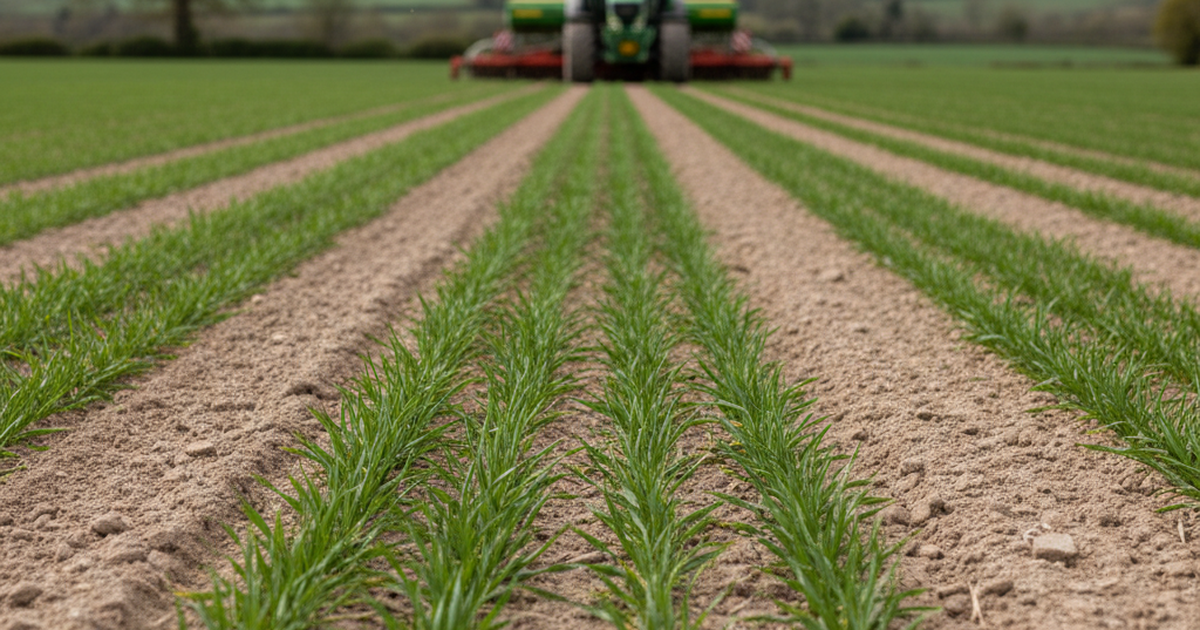
The three working methods on UK grassland are conventional drilling into a prepared seedbed, direct drilling, and overseeding into an existing sward. Broadcasting still happens — usually with a rear-mounted spinner — but as a primary establishment method it has been losing ground to drilling for the last decade. The reason is yield: a poorly distributed seed costs the same as a well-placed one and produces a thinner, weedier sward.
The choice between conventional and direct depends on whether the previous sward is failing because of soil structure or because of species composition. If structure is the problem — compaction, pan, drainage — conventional cultivation is doing two jobs at once. If composition is the problem and the soil structure is reasonable, direct drilling holds onto soil carbon and gets the new ley in faster. Overseeding into a thinning sward is a maintenance operation rather than a reseed, and works best where the existing PRG content has dropped below 60% but the structure is sound.
Contracting rates vary by area and by current diesel prices, and the working-farm number is the contractor quote rather than a national average. The reference points worth bookmarking are AHDB’s reseeding guidance for seed rate and depth, the AHDB Recommended Grass and Clover List for variety choice, and the Andersons annual Outlook for benchmark machinery and contracting rates.
Rotational Grazing
Paddock grazing — small fields, short residency, frequent moves — is the standard route to lifting dry-matter utilisation on grass-based systems. AHDB’s beef grazing project reports improver farms moving from 4.7 t DM/ha in 2016 to 8.4 t DM/ha the following year — a 79% gain on the same acreage, mostly from grazing management rather than from reseeding. The performance targets on the same project are 12–15 t DM/ha grown, 1.5–2.0 LSU/ha stocking, and a gross margin in the £600–£1,000/ha range.
Setup cost is the question that decides whether a system gets built. The published figures sit in a wide band because what’s being measured varies. A Welsh sheep operator with 2,500 m of electric fencing and 1,200 m of water pipe came in around £342/ha. A 285 ha system that built out gradually came in at around £50/ha. Three-line electric fence runs 40–60p/m as a working contracting rate. The honest framing for a farmer planning the spend is to set a target stocking density first, count the paddocks needed to deliver a 21–28 day rest interval, then cost the fence and water from there.
The first season is where most paddock systems either bed in or fall over. The discipline that matters is the residency rule — move stock when residual cover hits 1,500–1,600 kg DM/ha for cattle, lower for sheep — and the plate-meter measurement that supports it. AHDB’s Forage for Knowledge publishes weekly grass-growth figures that most paddock farms use as a national reference point.
Silage Production
Grass silage is the largest single forage budget on most UK livestock farms, and the unit cost has moved sharply over the last four years. DAERA Northern Ireland’s 2022 reference figure for a three-cut grass silage system was around £160/t DM, with a four-cut system landing closer to £195/t DM — the extra cut bought higher D-value but cost more to take. Those figures predate the worst of the fertiliser-price spike, and own-farm numbers are better triangulated through AHDB’s Farmbench, which is now the standard place to benchmark silage cost against peer farms.
Silage clamp management is where a lot of value either lands or leaks — sheet quality, oxygen barrier weights, edge sealing and a tight feed-out face determine whether the analysis you took at clamping holds through to feed-out.
The methods question — three-cut versus four-cut, multi-cut versus zero-grazing, big-bale versus pit — sits downstream of the herd or flock’s protein and energy requirement. A high-yielding spring-block dairy needs different silage from a suckler beef operation, and the same farm may need both. The decision worth making early is the cut number and the fertiliser regime that supports it; the kit and contracting choices follow.
Storage and feed-out costs are usually under-counted in own-farm calculations. AHDB’s work on silage losses is the reference for the dry-matter percentage that typically disappears between clamp and trough — between 10% and 25% depending on clamp management. That loss multiplied by the £/t DM cost is the number to put against tighter sealing, faster feed-out, or smaller-face management.
Soil Health
Soil health on grassland comes down to four working measurements: pH, organic matter, available phosphorus and potassium, and structural assessment. The Defra/AHDB Nutrient Management Guide (RB209) sits behind almost every formal fertiliser recommendation in England, and AHDB’s consistent recommendation since the 2022 fertiliser-price spike has been to test more often and apply more precisely rather than spread by historical habit.
The pH range that works for most UK grassland is 6.0–6.5. Below that, available phosphorus drops sharply regardless of how much is in the soil reservoir; lime correction is generally the highest-return input on neglected grassland because it makes everything else work better. Soil texture and drainage set the upper ceiling — a heavy clay that ponds in winter will not grow ryegrass yields no matter how much P and K get applied.
Costing soil improvement is harder than costing a reseed because the work spans several seasons. Lime, drainage, and structural improvement (subsoiling, sward lifter) each carry their own payback profile. The honest framing is to test first — a standard soil analysis is the cheapest input on the farm — identify the binding constraint, and spend on that rather than on a generic improvement programme. Defra’s Farming Rules for Water set the regulatory floor on nutrient applications and shape the timing of organic-manure spreading in particular.
Livestock Integration
The phrase “livestock integration” covers two different conversations. The first is the mixed-farm conversation — running cattle or sheep on land that’s primarily arable, usually to manage cover crops, take a hay or silage cut from a fallow, or graze stubbles. The second is the regenerative-system conversation, where livestock are the management tool that drives soil and pasture improvement.
For arable farms looking to bring livestock into the rotation, the practical questions are infrastructure (existing or bought-in fencing and water), animal-welfare experience, and whether to own stock or accept grass-keep arrangements. Grass-keep — letting the grazing rather than running the stock — is the lower-friction entry point and the one most arable operators end up taking.
For livestock farmers integrating arable into a grassland system, the decision is more often about ley rotation length and break-crop choice. Defra’s Sustainable Farming Incentive (SFI) has shifted the economics on mixed and herbal leys over the last two years, and the per-hectare payments are now meaningful enough to factor into rotation planning — check the current SFI handbook on gov.uk for the live action codes and payment rates.
The cost question is system-specific. Setup numbers in the low five figures circulate online as a generic benchmark, but they aren’t a national figure — the honest number is the quote from a local fencing and water contractor against the specific layout, plus the cost of stock purchase or the agreed grass-keep rate.
Improvement Programme
A grassland improvement programme works when it’s narrow, time-bounded, and tied to a measurable target. The framework AHDB uses on its benchmark and Farm Excellence farms is to pick two or three constraints — typically soil pH, sward composition, and grazing utilisation — set 12–24 month targets against each, and measure quarterly.
The common failure mode is the comprehensive plan that does six things half-well rather than two things thoroughly. The other failure mode is the rolling improvement programme that never gets measured — without a starting baseline (a soil test, a sward composition walk, a grass-growth measurement), the second year of work has nothing to compare itself against.
On cost, the binding constraint is almost always operator time rather than capital. The kit-and-inputs figures that appear in generic costing tables are the easy part; the labour and management attention to do the work properly are larger and harder to value. AHDB’s Farmbench remains the most accessible peer-benchmarking tool for putting own-farm performance against a comparable group.
Seasonal Management
The UK grazing year breaks into four working blocks: turnout (March–April), peak growth (May–June), summer management (July–August), and autumn closing-up (September–October). Each block sets different priorities, and the budget — fertiliser, fertiliser timing, residency lengths, supplementary feeding — should be planned a season ahead, not week-to-week.
The 2022 drought has become reference data rather than an exception. Working farms in the south and east of England should now plan for a summer forage deficit period as a working assumption, with buffer feed or earlier silage closure built in. AHDB’s Forage for Knowledge grass-growth tracking is the practical reference for week-by-week management.
Cash flow follows the seasonal pattern. Fertiliser spend is concentrated in spring, contracting in May–July, silage clamping and stored-feed costs from October. Spreading the spend against a working forage plan is the budgeting discipline most paddock-grazing systems find delivers more value than any single equipment or seed-mix change.
Related guides
- UK Livestock Farming — Complete Guide
- UK Arable Farming — Complete Guide for British Farmers
- UK Farming Grants 2026 — Funding and Support Schemes
- UK Soil Health 2026 — A Working Farmer’s Guide
Continue reading
- UK Crop Protection 2026 — A Working Grower’s IPM Guide
- UK Beef Farming 2026 — Suckler and Finishing Systems
- UK Sheep Farming 2026 — Lowland and Upland Flocks
Frequently Asked Questions
When should I reseed my pasture in the UK?
In most UK regions, the best time to reseed is in early autumn (September–October) or early spring (March–April) when soil moisture and temperature favour seed germination. Autumn sowing allows the new grass to establish before winter, while spring sowing can avoid weed pressure.
How often should I soil test my grassland?
Soil testing every 2–3 years is recommended, but if you are applying fertilisers or manures regularly, annual testing helps adjust nutrient inputs. Focus on pH, phosphorus, potassium, and magnesium levels to maintain optimum grass growth.
What are the most effective ways to control docks and thistles in pasture?
Integrated control combining spot spraying with a translocated herbicide (e.g., 2,4‑D or fluroxypyr) in early growth, followed by good grazing management to outcompete weeds, gives the best results. Mechanical topping and ensuring good sward density also suppress weed seedlings.
How do I implement a rotational grazing system on my farm?
Paddock grazing UK farmers have adopted from the New Zealand model — small fields, short residency, regular shifts — produces consistently better dry-matter utilisation than set-stocking on the same area, particularly in May and June when grass growth peaks.
Start by dividing fields into paddocks of equal size based on livestock numbers and desired rest periods (typically 3–5 weeks). Move animals frequently to allow grass to recover, adjust stocking density to match growth rates, and monitor forage availability with a plate meter to avoid over‑grazing.
BritFarmers Weekly — launching soon
One honest email a week when we launch — what’s moved on schemes, prices, disease control and policy, with links to primary sources. Join the early list.