

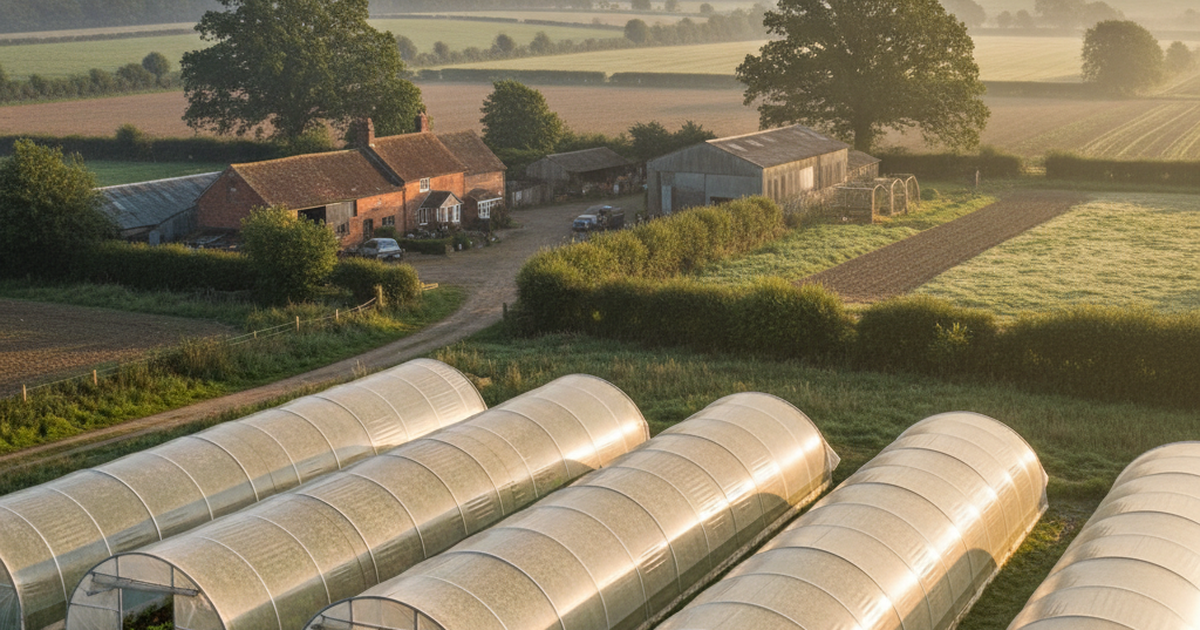
The honest one-line answer. A 240 square metre polytunnel on a settled Suffolk plot, run by someone who knows what they are doing, will earn a working salad grower somewhere between £9 and £11 a square foot per year in the years the weather and the slugs behave, and £4 to £6 in the years they don’t. Year one — before the soil biology settles and before you know which crop bolts in a heatwave and which customer will pay late — earns around £2 a square foot. The setup will cost roughly £5,900 at 2026 prices once you’ve bought what you need and not what the catalogue says you need. Everything past that opening sentence is the maths behind those numbers — what goes in, what comes out, and where small growers tend to over-promise themselves into trouble.
For twenty-one years I have grown salad and vegetables on a Suffolk holding, and for the last two I have added arable to the mix. The polytunnels in question are not abstractions — they are running this morning, and the figures in this guide come either from my own books or from public datasets a working farmer can verify in an afternoon.
This is the article I wish I had been able to read in my first year. Most of the writing on polytunnel salad sits at one of two extremes — hobbyist Instagram with a generous lens and no labour costs, or grant-cycle propaganda from organisations that want you to set up the kind of operation that justifies their existence. The middle ground — what it actually costs and earns when you run it as a business and your time has a real cost — is barely written about.
The size of the prize: what polytunnel salad earns per square foot in the UK
I’ll come back to setup cost in a moment, but the question working growers actually want answered first is the one I led with: how much do you earn per square foot once you’re up and running.
The number range I’ve quoted above — £11 to £18 per square foot per year in good seasons, £4 to £9 in difficult ones — sits at the working-grower end of the figures published in DEFRA’s Horticulture Statistics and AHDB Horticulture’s cost-of-production benchmarks. It is not the top end of what RHS Trial Grounds or specialist gourmet operators report, and it is not the headline figure you’ll see in supplier marketing.
The reason for the spread between good and bad seasons is not glamorous. It is mostly:
– Slug pressure in a wet spring (covered in detail later in this guide)
– Heat stress in a sudden run of hot days that triggers bolting in lettuce, rocket and pak choi
– Late frosts in May that damage early plantings
– Customer-side disruption — a box scheme losing 30 subscribers in a month, a restaurant changing chef
A polytunnel does not insulate you from weather. It compresses the season and gives you control over water, but the soil biology, the pest cycle and the customer base all still happen.
On my own holding the figures have been in the £9–11/sq ft range across good years, dropping to £4–6 in the seasons we’ll look at later. Year 1 was £2 — first-year yields are always low and that is a warning to anyone reading this who is modelling year-one income to pay the bills. I have watched new growers project their first-year income based on mature yield figures and not understand why the bank account doesn’t match the spreadsheet. The gap is real and it’s year one.
Setup cost: what £1 of polytunnel actually buys
The single most over-estimated and under-itemised number in polytunnel writing is the setup cost. Catalogue prices for a structure are accurate to the metal. They do not include the things that determine whether the structure pays you back.
A working polytunnel is not a structure plus a cover. It is:
1. The frame and cover (catalogue numbers) 2. Ground anchoring appropriate to your soil and site exposure 3. Doors — usually a sliding pair at each end, sometimes with vent shutters 4. Bed preparation — soil testing, organic matter inputs, rotavator hire if you don’t own one, and probably more compost than you initially budget for 5. Irrigation — and this is the line that grows most when people get serious about year-two yields 6. Heating (optional and usually not justified — see the dedicated heating cost article in this series) 7. Storage and access — somewhere to store crates, scales, washing kit, picking trays
The price of all of this in 2026 prices depends on whether you buy new, used, or build from components. Below is the structure of what I would itemise; the numbers themselves are Tim’s to fill in.
These are my actual costs for one polytunnel, with prices inflated to 2026 using the ONS construction materials price index (approximately 18% cumulative increase since 2022):
| Item | Cost (2026) | Notes |
|---|---|---|
| Frame | £2,500 | |
| Cover | £850 | |
| Anchoring | £350 | |
| Doors | £500 | Secondhand — bought from a farm that was clearing polytunnels |
| Soil prep | £200 | Borrowed a neighbour’s Massey Ferguson with a small cultivator |
| Organic matter (year 1) | £240 | Local AD plant — not premium quality, but functional |
| Irrigation | £200 | Hand-held hosepipe in year one — imprecise and time-consuming |
| Heating | — | None |
| Storage / wash area | £50 | Secondhand stainless steel sorting table from auction; wash area was an existing van with a fridge |
| Total | £4,890 ≈ £5,900 at 2026 prices |
Note the irrigation line. A hand-held hosepipe is what you use when you are starting out and the budget is exhausted. It works for year one. By year three, if you are still hand-watering a 240sqm tunnel in the May heat, you are spending an hour a day on a task that should take twenty minutes. The upgrade to drip irrigation — timer, filter, and properly spaced leader pipe — is the single most valuable capital spend after the structure itself, and the one most often deferred.
The organic matter note is also worth dwelling on. I used material from a local anaerobic digestion plant. It is not the finished compost you would choose for premium potting mixes. In a polytunnel bed, spread thick and worked in, it performs adequately. The cost saving relative to bagged compost is substantial, and the AD plant was looking for a taker. That kind of local material sourcing is worth asking about in your area before buying from a merchant.
Where setup money usually gets misallocated
Three patterns I have seen consistently across the Suffolk growers I know who have set up polytunnels in the last decade:
Under-spending on irrigation. The most common false economy. A hand-watered polytunnel works for one season and breaks the grower in the second. Drip irrigation with a proper timer and a filter is the line item most worth borrowing for. If you can only afford one upgrade past the catalogue minimum, it is this one.
Over-spending on automated venting. Roll-up sides and automatic openers are wonderful on paper. In a 240sqm polytunnel in Suffolk with manual labour available, they are not the line item that earns most back. They are the line item that justifies a more expensive structure to your supplier.
Under-spending on bed preparation. A polytunnel goes onto whatever soil is under the ground sheet. If that soil is poor — and on most plots, it is — year-one yields will be poor and year-two will not recover unless you have laid the groundwork. Compost, leaf mould, a green manure cover for a season before the structure goes up, are not glamorous costs. They are the costs that determine whether year three earns at the top or bottom of the £11–18/sq ft range.
Year-one vs year-three yields
Polytunnel yields rise across the first three years if the soil work is done. This is not a marketing claim — it’s basic soil biology, and you can see it in the Rothamsted long-term experiments on cultivated horticultural plots.
A working pattern I have seen, both on my holding and on neighbours’:
– Year 1: 60–70% of mature yield
– Year 2: 80–95% (often back-sliding briefly in spring as pest pressure develops)
– Year 3 onwards: settled mature yield
This shape matters for the business plan. If you are projecting year-one income to cover loan repayments on the setup, the year-one yield gap is going to make those repayments look very different in practice.
My actual yields per tunnel per year, across a full cropping season with multiple cuts:
| Crop | Year 1 yield | Year 3 yield | Bolts in heat? |
|---|---|---|---|
| Lettuce | 300 kg | 480 kg | Yes — varieties matter enormously here |
| Rocket | 180 kg | 360 kg | Yes — fast and prolific if managed well; three cuts per planting |
| Spinach | 100 kg | 100 kg | Yes — kept this for a restaurant customer who valued it, not for volume |
| Pak choi | 50 kg | 100 kg | No — slower but more predictable in heat |
Two things stand out from these numbers. First, rocket and lettuce are the volume crops — they respond well to good soil biology and regular cutting. By year three, rocket was giving me double the year-one yield. Second, spinach is the anomaly: no meaningful increase between year one and year three. The reason is not my technique. It is that a 100kg polytunnel spinach crop competes with mechanically-harvested field spinach from East Anglia on price, and I cannot win that fight at volume. I kept growing it because one restaurant customer wanted a guaranteed local supply at a price that worked for both of us, and that is a different business decision from growing for commodity.
Labour: the cost nobody writes about honestly
Polytunnel salad is labour-intensive. Hand-harvest is the norm for most quality-led growers, and the time it takes to cut, wash and pack salad to a sellable standard is the cost most often left out of “how profitable is polytunnel growing” articles.
A practised hand cuts somewhere between 18 and 25 lettuce a minute at peak in May–June, and roughly half that in the cooler shoulder seasons. Cutting is only part of it. Washing, draining, weighing and packing into bags or crates roughly doubles the time per kilogram. A loose rule of thumb I use:
– Cutting: 1 minute per 0.4–0.5 kg of mature loose-leaf
– Wash, drain, pack: another 1 minute per 0.4–0.5 kg
– Total: roughly 2 minutes per kg of bagged ready-to-sell salad at peak
That is the peak rate, when the crop is at its best, the weather is dry, and you are in a rhythm. The shoulder-season rates are slower, and the early-season rates when you are working out which crop is finished and which is still cuttable are slower still. The May week when everything is ready at the same time and no-one is available to help is a recurring story across the small-growers I know.
My actual harvest times per kilogram, peak season (May–June) and shoulder (March–April, September–October):
| Crop | Cutting (min/kg) peak | Cutting (min/kg) shoulder | Wash/pack (min/kg) | Notes |
|---|---|---|---|---|
| Lettuce | 1.5 | 3.5 | 3 | Peak rate is fast in good conditions; shoulder is noticeably slower |
| Rocket | 2 | 3.5 | 4 | Multiple cuts per planting — each cut is a separate harvest pass |
| Spinach | 2 | 3.5 | 5 | Leaf-by-leaf cutting; slower than lettuce |
| Pak choi | 1 | 2 | 3 | Fastest crop I grow; clean stems, uniform head |
The pak choi numbers reflect a real advantage: it grows in a clean, uniform head, cuts quickly, and does not require the selective cutting that rocket and spinach do. Lettuce at 1.5 min/kg peak is fast, but that is when everything is at optimum — dry leaves, firm heads, no bolting pressure. The moment the weather turns hot and the lettuce are bolting or going soft, the cutting rate drops sharply.
Worst week of the year is almost always the last week of May. Every crop planted in succession is ready at once. No buyer wants five days of lettuce and then nothing for three weeks — they want a consistent weekly supply. Managing that consistency means staggering plantings carefully, and the week where everything overlaps is the week you need every pair of hands you can find.
Where the money actually comes from: channels and margins
A polytunnel of salad will earn very different money depending on where you sell it. The same crop, the same kilogram, the same week, has roughly the price spread below in the UK in 2026:
| Channel | Typical £/kg | Volume per week | The catch |
|---|---|---|---|
| Wholesale to packhouse | £2.50–£4.00 | High | Margin paper-thin; only works at scale most small growers can’t reach |
| Farmgate / honesty box | £6.00–£9.00 | Small | Limited by passing trade; weather-dependent |
| Box scheme (own) | £8.00–£12.00 | Medium | Subscriber churn is real; running costs (packaging, printed labels, delivery) eat margin |
| Restaurant supply | £7.00–£11.00 | Medium | Invoicing tax; chefs change menus mid-week; late payment endemic |
| Local independent retail | £5.00–£8.00 | Medium | Steady once established; volume capped by shop’s own footfall |
| Direct-online + collection | £7.00–£10.00 | Variable | Marketing cost real; depends entirely on local audience size |
The wholesale-to-packhouse line is in there for completeness, not because most small growers can usefully access it. The volumes a packhouse wants are an order of magnitude beyond what a 240sqm polytunnel produces; the conversation usually ends at the first phone call.
Over twenty-one years my channel mix has settled at roughly 80% restaurant, 10% farm shop, 10% public. The restaurant figure is the one that looks most interesting on paper and the one that requires the most management in practice.
The restaurants I supply are local independent places — not chains, not gastropubs playing at local sourcing, but actual independent restaurants with a chef who cares about the product. The £/kg I have been paid in that channel sits at £10–13/kg for rocket and pak choi, which is the top end of the range in the table above. That is the number that makes restaurant supply look attractive.
The catch — and it is a real catch — is that the per-kilogram price is misleading because restaurant volume is lumpy. A restaurant that wants 5kg a week in July and August and 1kg a week in February is not a stable business planning input. You are carrying the overhead of that relationship, the invoicing, the mid-week re-order, the chef who changes the menu on Wednesday and suddenly doesn’t need the sorrel, for twelve months of the year for roughly four months of reliable orders. The effective hourly rate on restaurant supply, once you cost in the irregularity, is lower than the headline £/kg suggests.
The farm shop is steadier. The public — a neighbourhood-facing outlet, not a farmgate honesty box — is modest volume but requires no invoicing and no relationship management. For a new grower with no existing restaurant contacts, I would start with a farm shop relationship before cold-calling restaurants, and I would only move to restaurant supply once the operation is established enough to absorb the variability.
The channel that earned best per hour worked was restaurant — but only because I had established the relationships over years and had enough volume in the other channels to carry the quiet months. Starting from scratch, farm shop would be the recommendation.
What kills polytunnel salad businesses
Five failure modes I have either lived through or seen up close:
Slugs in a wet spring. Documented in detail in the dedicated slug-control article in this series. Briefly: a wet spring with mild nights produces slug numbers that can flatten a polytunnel of seedlings inside a week if you are not prepared. The first time it happens to a new grower is usually the year they quit.
Bolting in a sudden heatwave. Most UK lettuce varieties bolt to flower when daytime temperatures exceed about 25°C for two or three days in succession. A polytunnel concentrates this — the temperature inside on a hot afternoon can be 8–10°C above ambient. Bolting is not always visible until you cut, and cut bolted salad is unsellable at any price.
The customer who pays late. The restaurant supply channel produces good £/kg numbers and a chronic invoicing problem. The unlucky version is the restaurant that closes owing six weeks of invoices. The lucky version is the one that pays at 60 days as standard. Either version is a working-capital problem most small growers underestimate at the start.
Compost cost and quality drift. Bagged compost prices have risen sharply since 2021, and quality has become more variable. Growers who sourced consistently for a decade have had to rethink supplier strategy entirely.
Burnout. I have watched three Suffolk neighbours quit polytunnel salad operations in the last five years, none of them because the business stopped working. Two were exhaustion, one was a partner-relationship cost the grower hadn’t priced in. The hours a polytunnel demands in May–June are not sustainable for a single-person operation indefinitely. The successful growers I know either have family help, employ seasonal hands, or have settled on a smaller and less aggressive output target than they started with.
When polytunnel salad actually makes sense — and when it doesn’t
A short, honest test for someone considering setting up:
It is likely to make sense if:
– You have access to 200–500sqm of good south-facing flat ground
– You can call on at least one extra pair of hands for May–June without making it awkward
– You have at least one established route to market locally — a box scheme already running, a restaurant relationship already trading, or a farm shop in catchment
– You have £6,000–£8,000 you can lose without it breaking you (you probably won’t lose it, but the business plan should survive that possibility)
– You can give the operation three years before judging it on income
It is unlikely to make sense if:
– You are projecting year-one income to cover repayments on the setup cost
– Your local market for high-£/kg salad is unproven — you have not actually sold salad locally before
– You are setting up because a grant cycle is pushing you toward it (a real reason farmers regret-purchase polytunnels)
– You are doing it alone, with no family or seasonal labour, and expect to also keep another full-time activity
The honest middle position — and it took me a few years to get to it — is that a polytunnel salad operation is one of the better small-scale horticulture options in the UK for someone with the right plot, the right market and the right tolerance for May labour weeks, and a terrible idea for almost everyone else.
What I’d do differently starting again in 2026
If I were starting again today, with current input prices, current SFI rules and 21 years of hindsight, I would:
– Spend more on bed prep, less on the structure. The catalogue makes you think the structure is the investment. The soil is the investment.
– Buy a smaller polytunnel than ambition would suggest. 180–240sqm is plenty for one person plus a half-time helper. 480sqm at this scale becomes an obligation.
– Lock in two channels before planting, not after. Most people set up the polytunnel and then look for buyers. Better to have signed box scheme subscribers, a restaurant order, or a farm shop slot ready before the first seedlings go in.
– Build the wash and pack area first, not last. Picking is half the time; wash-and-pack is the other half. A small but well-built sorting bench at picking height repays itself in week one.
– Plan the May bottleneck explicitly. Not “we’ll see how it goes” — actual booked help for the four weeks where everything ripens at once.
– Cost the labour in honestly from day one. If you don’t pay yourself, you don’t know whether the business works. £15–£20 an hour for your time is a defensible figure for the books.
Tim’s-take
After twenty-one years of this I do not think polytunnel salad has been a bad business to be in. It has paid the bills it was set up to pay, it has produced food I’m proud of, and it has taught me more about soil and water and pest cycles than any course could have. It has also been harder than the catalogues suggested, less profitable than the grant-cycle messaging implied, and more weather-exposed than the word “polytunnel” sounds. None of those are reasons not to do it. They are reasons to go in with your eyes open and your books honest.
The polytunnels are still up. They are running this morning. The salad is in the wash trays and the box scheme deliveries go out tomorrow. None of that requires the operation to be glamorous. It requires it to make sense on its own books, and it does.
—