

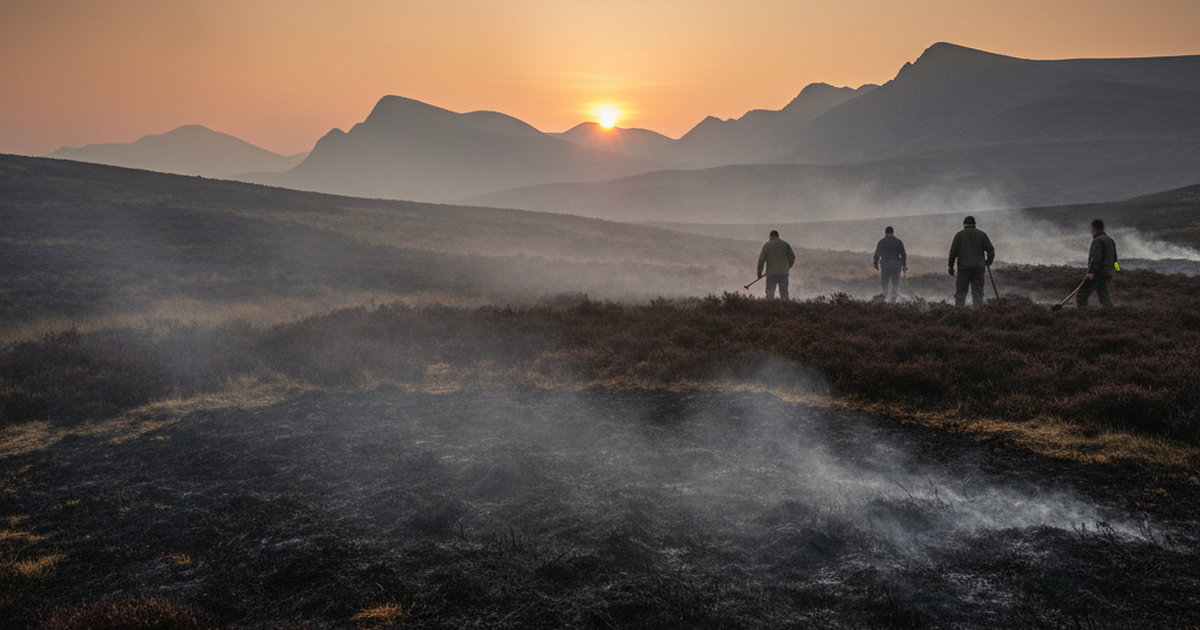
Cairngorms Fire Ban — Seasonal fire bans are blunt tools, and the Cairngorms National Park’s barbecue and campfire ban from 1 April through September is exactly that: a blunt tool deployed because the alternatives haven’t worked. The Carrbridge and Dava Moor wildfire that scorched 12,000 hectares of heather moorland and commercial forestry last year was the trigger event.
The detail to register is the 36-rural-business mobilisation needed to contain that single fire. Thirty individual estates worked alongside Fire and Rescue, which is a reminder that wildfires beyond a few hectares immediately exceed what the formal emergency services can handle alone. Land managers are first responders by default, even when they didn’t volunteer for the role.
For working farms in or adjacent to upland areas — anywhere with heather, gorse, dry grassland, or commercial conifer plantation — the Cairngorms ban is a useful precedent. Other National Parks and AONBs are watching. If your patch has any of the same fuel-load conditions, a seasonal byelaw of some kind is increasingly likely. Use the next few months to harden firebreaks, vehicle access, and water-source identification on your own holding. The official ban only addresses one ignition source. Most upland fires don’t start with a barbecue.
New fire restrictions come into force as wildfire threat intensifies — Cairngorms Fire Ban
A seasonal fire ban has descended across the Cairngorms National Park this week, with landowners describing the move as a “vital step” to combat a growing wildfire threat sweeping Scotland. The byelaw, introduced by the Cairngorms National Park Authority, kicks in from 1 April and runs through to September each year, outlawing barbecues and campfires across the park’s vast upland terrain. The timing isn’t coincidental, these months capture the spring and summer period when dry conditions typically peak and visitor numbers surge.
The ban arrives after last year’s catastrophic Carrbridge and Dava Moor wildfire scorched nearly 12,000 hectares of heather moorland and commercial forestry. That single incident required a mammoth response from at least 36 rural businesses, including 30 individual estates, working alongside fire crews to bring the blaze under control. The scale of that operation exposed just how exposed Scotland’s rural sector has become to extreme fire events, something land managers say they’re seeing more frequently as climate patterns shift.
Scottish Land & Estates (SLE) has thrown its weight behind the restrictions, with director Ross Ewing calling them “a sensible and necessary step at a time when Scotland is facing a clear and growing risk from wildfires.” He’s quick to emphasise prevention over cure: “Once a fire takes hold, the impacts can be devastating, for people, for wildlife and for rural businesses. Reducing the likelihood of ignition in the first place is absolutely critical.”
The Park Authority is backing the ban with real teeth. Additional countryside rangers are being deployed, new enforcement powers have been granted, and joint patrols with Police Scotland are targeting known hotspot areas where irresponsible behaviour has historically caused problems.
What This Means for Farmers
Here’s what matters to working farmers: land managers are repeatedly cast as the first responders when wildfires break out, often before emergency services even arrive. The Carrbridge response proved this, the 30 estates involved weren’t just bystanders. They deployed their own machinery, staff and local knowledge to contain flames threatening livestock, fences and young plantations. This voluntary effort isn’t trivial. It represents thousands of pounds in direct costs and puts farm workers in genuine danger.
The fire ban acknowledges this reality by shifting focus upstream, reducing ignition sources rather than just throwing resources at blazes once they’re out of control. For farmers in the Cairngorms and surrounding areas, this should mean fewer panicked phone calls at midnight, fewer fields lost, and less disruption to spring lambing and grouse shooting seasons.
One point worth clarifying: muirburn, the controlled burning of heather carried out by trained operators, remains permitted under the byelaws. This matters for moorland estates and grouse moors that depend on rotational burning to maintain habitat quality and reduce fuel loads. The distinction is important. Managed burning, when done properly, actually lowers wildfire intensity. The ban targets careless public behaviour, not professional land management.
The collaboration aspect is equally significant. SLE’s emphasis on partnership between the Park Authority, rangers, Police Scotland and land managers reflects how wildfire response actually works on the ground. Farmers shouldn’t expect to fight these fires alone, but they do need to maintain those relationships with neighbours, estate staff and emergency coordinators before disaster strikes.
What to Do Next
If you farm or manage land within or near the Cairngorms boundary, now’s the time to review your fire response protocols. Check that emergency contacts are current, particularly for the local fire and rescue service, Park Authority offices and neighbouring estates who might need your help or offer assistance. Many smaller farms assume the big estates will handle everything, but during major incidents like Carrbridge, every available body and machine counts.
Consider what equipment you can offer. Compact tractors with water bowsers, All-Terrain Vehicles with towing capacity, even just fuel for pumps, these resources proved invaluable during the 2025 wildfire response. Contact your local NFU Scotland branch or SLE member representative to register what you can contribute to community fire response schemes.
Finally, if you host any visitors or manage land accessible to the public, reinforce signage warning of the fire risk and the new restrictions. The Park Authority’s “protect our national park: no flame, no spark” campaign gives you ready-made materials for this. Rangers can’t be everywhere, the eyes and ears of local land managers remain the most effective early warning system we’ve got.
The message from landowners is clear: they support this ban, they supported the emergency response when fires did break out, and they want that partnership approach to continue. Whether Scotland’s politicians will match that commitment with adequate rural fire services funding remains to be seen, but that’s a fight worth having.
Frequently Asked Questions
When does the Cairngorms fire ban start?
The seasonal byelaw comes into force on 1 April 2026 and runs through September each year, covering the entire Cairngorms National Park.
What activities are prohibited under the fire ban?
Barbecues and campfires are banned across the park during the restricted period. However, muirburn carried out by trained land managers remains permitted.
How big was the Carrbridge wildfire?
The Carrbridge and Dava Moor wildfire burned nearly 12,000 hectares and required support from 36 rural businesses, including 30 estates, to bring it under control.
Does the fire ban affect farmers’ right to carry out controlled muirburn?
No. Muirburn is specifically excluded from the byelaws as it is a controlled, regulated practice carried out by trained operators to manage fuel loads and habitat.
BritFarmers Weekly — launching soon
One honest email a week when we launch, what’s moved on schemes, prices, disease control and policy, with links to primary sources. Join the early list.