
Wildfire Reduction Plan — Ten-year strategy documents from devolved governments tend to outrun their delivery, and the question with NI’s Wildfire Action Plan to 2030 is whether the 35 named measures actually get funded and delivered or end up as a glossy PDF on a Stormont webpage.
The detail worth reading carefully is the institutional structure: the Northern Ireland Strategic Wildfire Group and the Wildfire Stakeholder Forum. Plans deliver when they have governance with named owners and reporting cadence. Without that, they don’t, regardless of how good the underlying analysis is. Andrew Muir’s department needs to publish quarterly progress against named measures; otherwise the strategy ages out.
For working farms in NI’s upland areas, the practical move is to engage with the Stakeholder Forum if your producer body has access to it. The 35 measures will be designed and prioritised based on input. Land managers who are silent at design stage end up with implementation arrangements that don’t fit their operations. The 2024 NI fire season is fresh enough that the political will exists now to fund prevention at meaningful scale. That window won’t stay open. Read the plan, identify the two or three measures that would actually help your patch, and put the case to your producer body before the autumn budget cycle hardens.
New 10-year action plan targets rising wildfire threat to NI farmland with 35 prevention measures and expert consortium support.
Stormont launches 10-year wildfire strategy for Northern Ireland — Wildfire Reduction Plan
Farming communities across Northern Ireland are facing a new era of wildfire management after the Stormont government published its first thorough action plan to tackle the growing threat of countryside fires.
The Wildfires Action Plan to 2030, unveiled by Agriculture Minister Andrew Muir, commits to sweeping changes across prevention, preparedness, response, recovery and enforcement. The strategy identifies 35 key areas for development and will be delivered through the Northern Ireland Strategic Wildfire Group and Wildfire Stakeholder Forum, bringing together agencies with expertise spanning firefighting, land management and environmental conservation.
“We have all witnessed the devastating consequences of wildfires in recent years, endangering homes, businesses, and communities whilst also damaging vital upland habitats across Northern Ireland,” Minister Muir said. “The Wildfire Action Plan lays out how we will work together to reduce wildfire risk by implementing specific actions over the years ahead.”
Rising threat forces government action
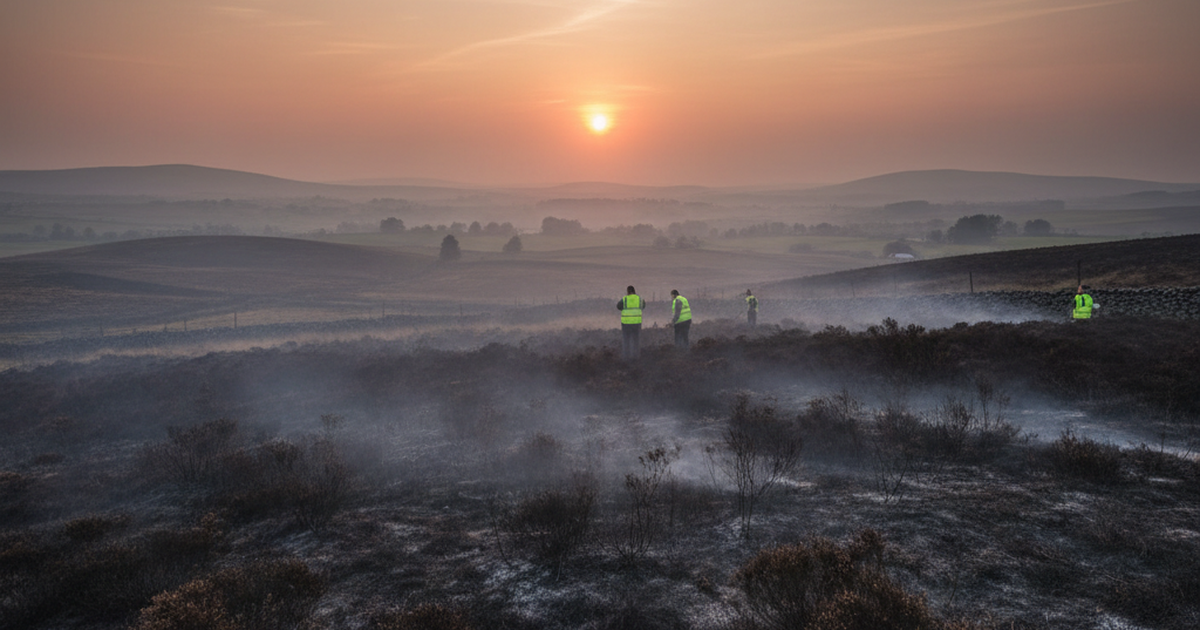
The plan arrives at a critical moment. Climate projections indicate wildfire risk in Northern Ireland will intensify substantially over the coming decade, with longer dry spells and earlier springs creating extended periods of high danger. Upland farmers, whose land sits most exposed to these risks, have borne the brunt in recent years, losing grazing ground, grouse moors and forested areas to fires that can sweep across hundreds of acres within hours.
Ryan Thompson, Northern Ireland Fire and Rescue Service area commander and strategic wildfire lead, said the plan marked a fundamental shift in approach. “We are working closely with our partner agencies to address the impact of wildfires in our community. This Wildfire Action Plan sets out a new approach to reduce their frequency and severity to help protect lives, the environment and make Northern Ireland safer.”
Thompson warned that with spring beginning, the public must follow safety advice when visiting the countryside. Northern Ireland’s rural sector remains tinder-dry in many areas after an unusually sparse winter rainfall, leaving grass and heather primed for ignition from a discarded cigarette or unsupervised barbecue.
Expert consortium to deliver on-ground improvements
In a concrete move to improve wildfire resilience, DAERA has appointed a consortium of international wildfire experts led by the Pau Costa Foundation to deliver mitigation and management work across Northern Ireland. The project is being funded by the 25p carrier bag levy that applies to all new carrier bags priced at £5 or less, money already ring-fenced for environmental purposes.
The consortium will focus initial efforts on the Eastern Mournes, an area that has suffered repeated fire incidents in recent years. Experts will work with land managers, farmers and rural communities to develop practical firebreaks, maintain buffer zones and implement controlled burning programmes that reduce fuel loads without causing ecological damage.
The Pau Costa Foundation, a global non-profit organisation with experience across Europe and beyond, brings techniques developed in fire-prone regions including Spain, Portugal and Australia. These approaches have shown significant results in reducing both the frequency and scale of wildfires where they’ve been implemented.
What This Means for Farmers
For working farmers in Northern Ireland’s upland areas, this plan represents both reassurance and obligation. The strategy explicitly acknowledges that agricultural land sits at the front line of wildfire risk, and its success or failure will directly affect farm businesses, livestock and livelihoods.
The good news is funding is available. The carrier bag levy connection means resources are already identified for the initial work programme. Farmers in designated high-risk areas should contact DAERA or the Wildfire Stakeholder Forum to understand what support they can access for creating firebreaks, upgrading access tracks for emergency vehicles, and joining local wildfire preparedness groups.
The enforcement angle deserves attention too. The plan’s fifth objective covers regulatory action, and this could eventually include requirements for land management practices that reduce fire risk. Farmers who engage early with the programme will be far better positioned than those who wait to see what rules emerge. There’s also the practical reality that a wildfire on one farm rarely stays there. Flames spread to neighbouring holdings, and coordinated prevention efforts protect everyone in a sector.
Specifically, climate change adaptation sits alongside biodiversity and peatland restoration as stated priorities. For farmers managing commons or shared grazing, this means the plan could eventually link with agri-environment schemes, creating opportunities for income through fire-risk management work. Peatland restoration, in particular, requires careful burning regimes that reduce wildfire likelihood while maintaining ecological value.
What to Do Next
Farmers should act now rather than wait for the plan to unfold. First, assess your own land for wildfire risk: identify areas of dead grass, heather or bracken that could fuel a fire, note access routes for emergency vehicles, and check water sources that could be used for firefighting. Second, contact the Northern Ireland Strategic Wildfire Group or your local NIFRS station to register your interest in joining a community wildfire group. These bodies are being asked to deliver the plan at ground level, and their effectiveness depends on farmer participation.
Third, review your own fire prevention practices. Ensure cigarettes are never smoked near dry vegetation, keep barbecues well away from grass and scrub, and store farm machinery away from fire-risk areas when conditions are dry. Finally, watch for announcements from DAERA about grant schemes linked to the carrier bag levy funding. The 35 key development areas will translate into specific programmes, and early applicants typically secure better support.
The next decade will test Northern Ireland’s ability to live with fire risk. This plan provides the framework, but its success ultimately depends on farmers, landowners and rural communities taking ownership of prevention. The alternative—watching another summer of devastating wildfires destroy grazing land and threaten lives—isn’t acceptable.
Frequently Asked Questions
What is the Wildfires Action Plan to 2030?
It’s a 10-year government strategy published by DAERA minister Andrew Muir to reduce wildfire risk in Northern Ireland. The plan focuses on five objectives: prevention, preparedness, response, recovery, enforcement, supported by 35 key development areas delivered through multi-agency partnerships.
How will the wildfire action plan be funded?
Initial work is funded through Northern Ireland’s 25p carrier bag levy, which is ring-fenced for environmental purposes. DAERA has appointed an international consortium led by Pau Costa Foundation to deliver on-ground mitigation work starting in the Eastern Mournes.
What can farmers do to reduce wildfire risk on their land?
Farmers should assess their land for fire fuel loads, create and maintain firebreaks, ensure emergency vehicle access, join local wildfire groups, and follow safety guidance during high-risk periods. Grant support may be available through DAERA schemes linked to the action plan.
Who is leading the expert consortium?
The Pau Costa Foundation, a global non-profit organisation with wildfire expertise from Europe and Australia, leads the consortium appointed by DAERA to deliver wildfire mitigation work across Northern Ireland.
BritFarmers Weekly — launching soon
One honest email a week when we launch — what’s moved on schemes, prices, disease control and policy, with links to primary sources. Join the early list.
Official Sources
- DAERA Northern Ireland — agriculture and environment policy
- Natural England — conservation and environmental stewardship