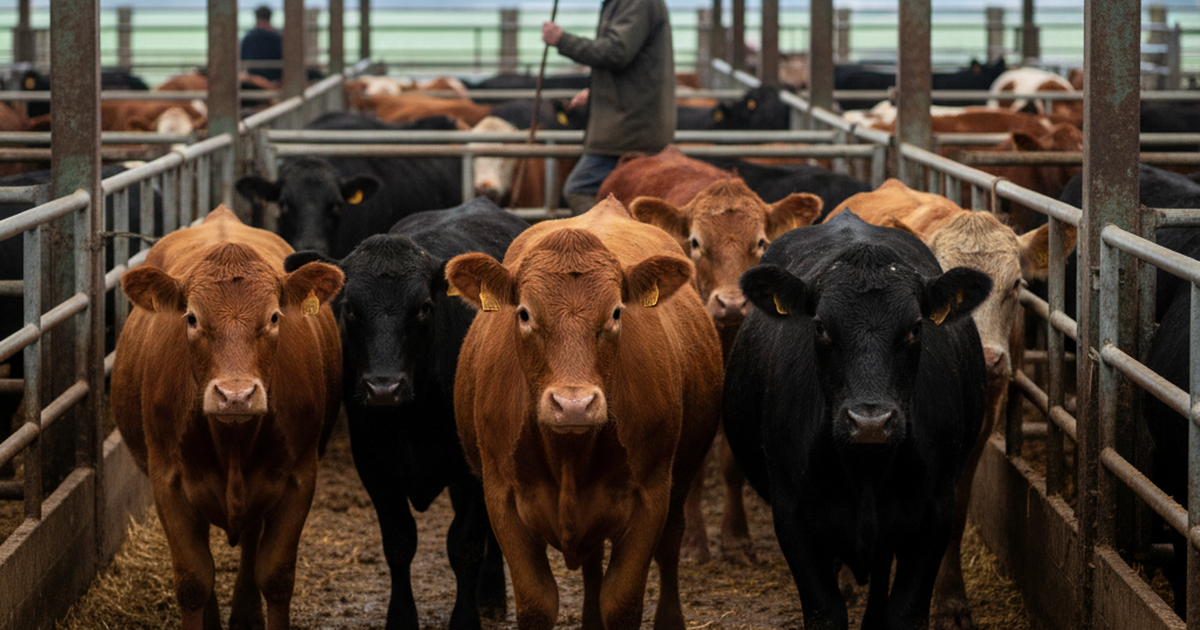



Last updated: May 2026. This guide looks at UK precision agriculture from a working sub-500-acre holding, with the bulk of the income coming off salad and veg and a small slice of arable layered into the rotation in the last two seasons. It covers what’s earning its keep on a real farm, what the trade press oversells, and where SFI 2026, Capital Grants 2026 and the Farming Equipment and Technology Fund touch precision kit. It is general information, not bespoke kit advice. See the action checklist at the end.
The phone went on a wet Tuesday in April. A lad I know two parishes over, decent vegetable grower, had been to a precision-ag open day at a kit dealer’s the week before and had come back with a quote for a full RTK auto-steer, ISOBUS sprayer section control and a yield-mapping retrofit on his combine. He wanted to know whether I’d bought any of it on our holding and what I’d actually do with it. I told him what we’d done and what we hadn’t, and the call ran longer than either of us had time for.
For 21 years I’ve grown salad and veg on this Suffolk holding. The last two seasons we’ve added a slice of arable to the rotation, partly for soil health on the older blocks and partly because the maths on a winter-wheat break crop finally added up.[1] In practice that’s meant time on both ends of the precision-ag conversation: the high-margin-per-hectare horticultural end where every percent of irrigation efficiency or weed-control accuracy lands in the gross margin, and the lower-margin arable end where a £25,000 kit decision needs to clear a cost-benefit hurdle the salesman never quite shows you.
This guide is the conversation that should have happened before that quote got written.
UK precision agriculture in plain English
Precision agriculture is a marketing umbrella for technologies that share one feature: they replace a uniform farm decision (a flat seed rate, a flat fertiliser dose, a flat spray pass) with a spatially varied one. The pitch is that the variation matches the variation in the field, which lifts margin, cuts inputs, or both. The reality is more mixed.
The trade press oversells the technology and undersells the cost-benefit reality on a working sub-500-acre holding. AHDB’s Review of the past, present and future of precision agriculture in the UK is a useful corrective: the genuinely valuable technologies are a shorter list than the catalogue suggests, and the adoption curve on smaller holdings is much flatter than the press cycle implies.[2] Defra’s Farm Practices Survey work confirms what anyone walking around a Lincolnshire arable show already knows. GPS guidance is widespread on big arable; section control on the sprayer is widespread; variable-rate application of nutrients is patchy; full-autonomy anything is a rounding error.[3]
Two figures are worth holding in your head. The Agricultural Engineers Association reckons UK agricultural machinery sales were around £2.5 billion in 2024, down 11% on the 2023 record.[4] UK tractor registrations in 2025 were the lowest since records began in 1964, fewer than 9,000 machines, on the back of policy uncertainty and weak commodity prices.[4] The kit gets more sophisticated and more expensive every year, and the willingness to buy it on a working farm is not getting easier.
Where the real precision lives on a salad and veg holding
The honest answer to “where does precision actually pay on a salad and veg holding?” is that the high-margin-per-hectare nature of horticulture means precision pays harder here than it does on most arable. £25,000 a hectare gross is not unusual on a contracted iceberg block. A 5% input efficiency, a 3% yield lift, a 1% rejection improvement at intake: each lands somewhere meaningful on the bottom line.
The first place precision earns its keep is in-row mechanical weeding. Camera-guided inter-row hoes, the Garford Robocrop range chief among them, sit in the gap left by the active-substance cupboard collapsing.[5] Twenty years ago a residual herbicide programme did most of the weeding in field veg. Today a working iceberg or brassica block runs a thin residual, a stale seedbed, and a Robocrop pass at three to five leaves, with the camera box picking up plant rows and side-shifting the hoe at 12kph to within 10-15mm of the row. On a baby-leaf block the same kit can hoe between rows at 60mm spacing.[5] On organic horticulture there is no chemistry. The hoe is the programme.
The second is irrigation precision. We run drip on most of the leafy salad and most of the brassicas, and the question of when to switch on isn’t done on a finger in the soil any more. Soil-moisture sensor inputs combined with reference evapotranspiration data give a defendable schedule that holds the root zone at field capacity through establishment and lets it dry to a managed depletion in mid-crop.[6] The peer-reviewed work on ET-based scheduling for lettuce is consistent: a properly built schedule saves water (often 25-30% versus calendar-based scheduling), holds yield, and reduces the disease window.[7] If you abstract under licence, every cubic metre saved in July is a cubic metre on the licence in August.
The third is variable-rate top-dressing fertiliser. Brassicas in particular respond strongly to nitrogen and the variation across a 10-hectare block can be considerable. A satellite or drone biomass map at the right growth stage feeds a VRA prescription on the spreader. The result is a more uniform crop at harvest, which lifts the box-fill standard and shaves rejection. AHDB’s variable-rate-nitrogen work is the cleanest UK source on the principle, even if the headline studies are arable.[8]
The fourth is packhouse data tied back to the field. Every box off our line carries a field code, a grading code and a rejection reason. Wash that against a yield map at row level and you start to see which beds underperform, which varieties failed which spec, which days of the week the QC was tight. That’s not precision agriculture as the dealers sell it. It’s precision agriculture as a working grower defines it.
What we’ve layered into the small-arable rotation
The arable end is newer ground. Two seasons in, here’s what’s earned its keep and what hasn’t.
GPS guidance with section control on the sprayer is the one piece of arable precision kit that pays straight back. The sprayer doesn’t double-dose headlands, doesn’t spray over the tramlines, doesn’t waste chem on the field-margin pollinator strip. On a 50-hectare programme the chem saving alone is meaningful. A decent-spec lightbar and display can be had for under £1,500 on a small tractor; a full RTK auto-steer with ISOBUS section control on a sprayer runs from £8,000 entry-level to upwards of £25,000 fully fitted on a self-propelled sprayer.[9]
Variable-rate seed and fertiliser is the next step, and it’s been a more cautious decision. The maps need to be right. Soil-electrical-conductivity scanning, satellite biomass imagery and a sensible-grid soil sampling regime (a sample every 4 to 5 hectares, not the hyper-grid the vendor pitches) are the inputs. On 50 hectares of wheat the spreadsheet says it pays. On 15 hectares it almost certainly doesn’t.
Drone and satellite imagery we contract out. Both are diagnostic tools, not decision tools. They tell you where to walk; they don’t tell you what to spray. Yield mapping at harvest is hardest because we don’t own the combine. The neighbour who brings his over has a yield monitor, but not one tied to our system, and the data export is a job nobody fancies at midnight. On a 50-hectare programme the yield map is a nice-to-have. On a 500-hectare programme it would be a must-have. We’re firmly in the first camp.
What’s overhyped
Vertical farming at macro scale is the headline embarrassment. Jones Food Company entered administration on 3 April 2025, with operations halted on 7 April and 61 redundancies, taking down the Scunthorpe and Lydney facilities held up as the European benchmark.[10] The wider European picture is a long list of administrations and shutdowns: Infarm wound back, Agricool gone, Plenty Unlimited filing Chapter 11 in March 2025 despite raising close to a billion dollars in earlier rounds.[10] Industry analysis points to electricity at around 60% of operating costs and only about 27% of operations reaching profitability.[10] The idea that vertical farming was about to displace field-grown salad in this country was always a stretch.
Full-autonomy tractors are the second. Press releases move faster than the hardware. Working autonomy on a flat, square, single-variety block is one thing. Autonomy on an irregular Suffolk field with a hedge that hasn’t been laid since 2008, a track that gets wet in the corners and a footpath running across it is another.
AI-driven decision-making that requires data farms don’t have is the third. A working farm generates a yield monitor file once a year, a soil sample set every three to five years, a packhouse rejection log, and a spray diary. That is not the data density the AI vendors imagine.
Blockchain-anything in farming, after a decade of pilots, has produced essentially no production-grade tooling a working grower would pay for. Move on.
What’s underhyped
Controlled-environment fertilisation in glasshouses (not vertical farms) is the underhyped story. Dutch glasshouse tomato, cucumber and protected-lettuce production runs fertigation regimes that adjust nutrient solution composition by the hour against light levels and crop stage. The yield-per-square-metre figures are the real output. Don’t confuse the failed vertical-farm sector with the working CEA sector. They aren’t the same trade.
Drip-irrigation scheduling tied to evapotranspiration data is similarly underhyped because it isn’t sexy. The kit cost is small. The returns in water saved, yield held and disease reduced are real and repeatable.[7] If you grow leafy salad on drip and you’re scheduling on the calendar, you are giving away free margin.
And in-row mechanical weed control as a working answer to active-substance losses, already covered above, will only become more important. A holding without an answer to weeds-without-residuals is going to find the next five years harder than the last five.
The data nobody actually has
A friend two villages over let a vendor sell him a sensor-network proposal that ran to a hundred-plus monitoring points across a 200-hectare farm, with a subscription that quietly added up to four figures a month. The data the system generated, after a year, was a beautiful dashboard that confirmed what his agronomist had already told him on a walk-round in March.
The gap between the data farms actually generate and the data the precision-ag pitch deck assumes is the single most important thing to understand before you sign a quote. A working salad and veg holding generates packhouse throughput by field, rejection percentages by spec, a spray diary, a fertiliser log, an irrigation log, a labour roster and a contract-volume run. A working small-arable holding generates a drilling log, an N-max plan, a spray diary, a yield monitor file at harvest, a soil sample report on a 3-5 year cycle. Both useful. Neither the hyperscale data lake the brochure imagines.
The honest test for any data product: what decision will you make differently because of this data? “I’ll know my farm better” is not a decision. “I’ll cut the August second nitrogen by 15kg/ha on the lighter blocks because the biomass is already there” is a decision and worth paying for. Most dashboards fail that test.
The economics: kit cost, payback, contractor vs buy
Headline kit costs are easy to find and hard to verify, because every dealer quotes differently and every farm is a different fit. As a 2026 working benchmark, lightbar GPS guidance starts under £1,500; a full RTK auto-steer retrofit on a working tractor sits in the £8,000-£25,000 zone; ISOBUS sprayer section control retrofits run from a few thousand to north of £20,000 fitted; a Garford-style camera-guided inter-row hoe runs comfortably into five figures on a working multi-bed config; and a vacuum-cooler or bag-line on the post-harvest end is six or seven figures of capital.[9] Those are 2026-shopping-trip numbers. Eyeball them with your dealer.
Payback windows are the bit the brochure won’t show clearly. Auto-steer with section control pays back inside two to three seasons on a 100-hectare-plus arable programme through chem savings and overlap reduction. Variable-rate fertiliser pays back over three to five seasons, less obviously, and the case can collapse on a wet year when the prescription map didn’t account for the wet end of a field. Contracted satellite imagery pays back inside one season on a 50-hectare-plus block if it triggers a single avoided spray pass. A camera-guided hoe on a horticultural holding can pay back in a single season if it replaces a contract weeding gang on a tight August block.
The contractor-versus-buy call catches small holdings. The default for a sub-500-acre operation should usually be: contract the satellite imagery, contract the drone work, contract the soil sampling, contract the heavy-iron precision drilling, and own only the kit you’ll use 50-plus days a year. Owning kit you use ten days a year is a road to a depreciation line that breaks the case for the kit in the first place. Obsolescence is the other ugly variable: a 2018 ISOBUS terminal can be a year of pain to integrate with a 2026 implement. Buy the brand the dealer in your county supports, not the one with the best brochure.
Skills and the sticker-on-the-cab problem
Precision kit is only as competent as the operator. There is a real gap between farms where the auto-steer is calibrated, the section-control overlap is set right and the prescription maps are read into the right ISOBUS implement, and farms where there is a sticker on the cab and a £30,000 invoice in the office and not much else. The dealer’s commissioning visit is the most important hour the kit gets. Demand a proper handover, with the operators present, the prescription map loaded and the test pass run.
Hiring matters more than kit. A competent operator with a £5,000 retrofit guidance system will outperform an indifferent operator with a £40,000 RTK auto-steer most weeks of the year.
Where SFI 2026, Capital Grants and FETF intersect with precision
Three Defra schemes touch precision in 2026. SFI 2026 carries advanced nutrient-management actions that reward variable-rate-application planning and recordkeeping on the revenue side; see /sfi-2026-actions-payment-rates-explained/ for the full list.[11] Capital Grants 2026 (£225m, opening July 2026) covers some precision-relevant capital items in the boundaries, water and air quality categories.[12] The Farming Equipment and Technology Fund 2026, which opened on 17 March 2026 and runs to 12 May 2026, is the scheme that directly funds precision kit, with 290 productivity items eligible including camera-guided inter-row hoes, real-time NIR nutrient analysers, precision water meters and yield-monitor bundles.[13]
The FETF is the pot to apply against if you’re contemplating a precision-kit purchase, and most working growers I know underuse it. Read the productivity items list before you talk to the dealer. /uk-farming-grants-guide/ pulls together the application timing for all three.
Where precision and regen meet, where they fight
Precision and regenerative agriculture are sold as natural allies. They’re more often awkward neighbours.
They meet on variable-rate inputs (the right input at the right place), camera-guided hoeing (lower residual load), and ET-driven irrigation (working with soil water-holding capacity). They fight on auto-steer (which is regen-aligned for controlled traffic but equally good at full-tillage with surgical precision); on yield maps (which optimise for current-year output and can pull against rotations that pay back over five years); and on the data-collection pitch (which assumes a standardisation a regen-rotation farm deliberately doesn’t have). The two philosophies overlap in places, diverge in others. A working holding makes its own peace with it.
Tim’s view: what’s worth the money on a sub-500-acre holding
On the salad and veg side: a camera-guided inter-row hoe, a soil-moisture sensor network paired with an ET-based irrigation schedule, packhouse data tied back to row-level performance, and the agronomist’s time to read it. On the small-arable side: GPS guidance with section control on the sprayer, contracted satellite imagery, soil sampling on a sensible grid, and a yield monitor on the combine if you own one. Skip the hyper-grid soil sample. Skip the hundred-sensor monitoring network. Skip the AI agronomy box.
What I’d actually say to the lad two parishes over from the April call. Buy the section control. Skip the rest of the quote. Spend the difference on a soil-moisture sensor network for the salad blocks and a contractor relationship for satellite imagery on the wheat. Read the FETF productivity items list before you write the cheque. On a holding our size, precision isn’t the answer to whether the year clears its costs. The contract is the answer. The packhouse is the answer. The labour bill is the answer. Precision kit, used well, makes those answers a couple of percent better at the margin. That’s worth real money. It’s not a transformation.
A first-fortnight checklist
Six things to do this fortnight if precision kit is on the agenda for 2026.
Walk the farm with your agronomist and a list of decisions you make differently from year to year. Match each precision purchase to a specific decision it would change. If no decision changes, the kit isn’t earning its place.
Pull the FETF 2026 productivity items list and circle anything you’d buy at part-grant pricing before the 12 May 2026 deadline.[13]
Ring two dealers, not one, on every quote. Ask each for a working calibration and commissioning visit, and a written training plan for the operators.
Cost the contractor option for satellite imagery, drones and soil sampling against the buy option. On a sub-500-acre holding, contracting wins more often than the dealer wants you to think.
Audit the data you already generate. Packhouse log, spray diary, yield monitor file, soil samples. If you aren’t using that data to make decisions, no new data product is going to help.
Talk to the next generation, if there is one, about the kit they want to run. The ten-year decisions on machinery integration sit with whoever’s going to be sitting in the cab.
Where this is heading
Two trajectories matter. The active-substance cupboard for both arable and horticulture is going to keep thinning, and the precision technologies that substitute for chemistry (in-row mechanical weeding, biological IPM, ET-driven irrigation) will keep getting more important as a result. /uk-crop-protection-2026/ pulls the regulatory picture together (this guide is being drafted in parallel; if it’s not yet live, the AHDB and HSE pages are the canonical sources). And the kit market itself is in a difficult period. AEA’s 2025 tractor-registration low signals a sector that’s not buying, and dealers are responding with sharper offers and longer demonstration periods.[4] If you’re in the market for precision retrofits in 2026 and 2027, you have negotiating room you didn’t have in 2022.
Back to the call from the lad two parishes over. Precision agriculture is real, the working bits of it pay, and the trade press makes it sound bigger than it is. On a working sub-500-acre holding, the right answer is rarely the catalogue. It’s the two or three pieces of kit that change a decision you actually make, fitted to a holding you actually run, paid for at part-grant pricing where the scheme allows. The rest is sales.
For the wider context of where horticulture and arable sit on the smaller-holding scale in 2026, see /uk-salad-vegetable-production-guide-2026/ and /uk-arable-farming-guide/. For the funding mechanics, /sfi-2026-actions-payment-rates-explained/ and /uk-farming-grants-guide/. For everything else BritFarmers covers, /knowledge-hub/.
Sources
[1] Defra, Agriculture in the United Kingdom 2024, gov.uk: gov.uk — Agriculture in the UK 2024
[2] AHDB, A review of the past, present and future of precision agriculture in the UK, ahdb.org.uk: AHDB — A review of the past
[3] Defra, Farm Practices Survey, gov.uk: gov.uk — Farm practices survey; Defra, Farm Practices Survey February 2025, gov.uk: gov.uk — Farm practices survey february 2025
[4] Agricultural Engineers Association, Industry Facts and Tractor Statistics, aea.uk.com: aea.uk.com — Industry facts; Agricultural Engineers Association, UK agricultural tractor registrations by power and region in 2025, aea.uk.com: aea.uk.com — UK agricultural tractor registrations by
[5] Garford Farm Machinery, Robocrop Guided Hoes and Robocrop InRow Weeder, garford.com: garford.com — Robocrop guided hoes; Future Farming, Garford triple-bed Robocrop guided weeder, futurefarming.com: futurefarming.com — Garford triple bed robocrop guided
[6] Comparative Analysis of Soil Moisture- and Weather-Based Irrigation Scheduling for Drip-Irrigated Lettuce Using Low-Cost Internet of Things Capacitive Sensors, Sensors 2025, PMC: pmc.ncbi.nlm.nih.gov — Pmc11902337
[7] Field-grown lettuce production optimised through precision irrigation water management using soil moisture-based capacitance sensors and biodegradable soil mulching, Irrigation Science 2024: link.springer.com — S00271 024 00969 9; Evapotranspiration-based Irrigation Scheduling of Head Lettuce, HortScience: journals.ashs.org — Article p935
[8] AHDB, Variable-rate nitrogen application to reduce emissions, ahdb.org.uk: AHDB — Variable rate nitrogen application to
[9] Farmers Weekly, Seven budget GPS guidance systems on test, fwi.co.uk: Farmers Weekly — Seven budget gps guidance systems; AllyNav, Tractor GPS System Price 2026: Cost, ROI & Payback Guide, allynav.com: allynav.com — Tractor gps system price
[10] FreshPlaza, Jones Food Company enters administration, halts operations at UK vertical farms, hortidaily.com: hortidaily.com — Jones food company enters administration; AgTechNavigator, Vertical farmer Jones Food Company enters administration, agtechnavigator.com: agtechnavigator.com — Vertical farmer jones food company
[11] Defra, SFI26: details, definitions and what to expect, The Farming Blog, 24 February 2026: gov.uk — Sfi26 details definitions and what
[12] Defra, The 2026 Capital Grants offer, The Farming Blog, 19 March 2026: gov.uk — The 2026 capital grants offer
[13] Defra, Farming Equipment and Technology Fund (FETF) 2026, gov.uk: gov.uk — Farming equipment and technology fund; Defra, Farming Equipment and Technology Fund 2026: guidance now available, The Farming Blog, 24 February 2026: gov.uk — Farming equipment and technology fund; Defra, Productivity items and specifications, FETF 2026, gov.uk: gov.uk — Productivity items and specifications farming
About the author
Tim Harfield runs a salad and vegetable holding in Suffolk and has done for 21 years. The bulk of the work has been leafy salad, brassicas and field veg into the supermarket programme, with a packhouse on site and the cold-chain headaches that come with it. The last two seasons we’ve added a slice of arable into the rotation, partly for soil structure on the older blocks and partly because the maths on a long break crop finally added up. Precision agriculture sits inside both ends of the operation, and what’s earned its keep on a 25-hectare iceberg block is not always what’s earned its keep on a 50-hectare wheat field.
The headline: precision agriculture pays on a sub-500-acre holding when it changes a decision you actually make. The catalogue is longer than the working list. On the salad and veg side, the camera-guided hoe, the ET-based drip schedule and the packhouse data tied to row performance are the three things I’d buy or upgrade first. On the small-arable side, GPS guidance with section control is the one piece of kit that pays straight back, and the rest is contractor-or-skip. Read the FETF productivity items list before you talk to the dealer. BritFarmers is independent, takes no commission, and is written by working farmers for working farmers.